Flowering this week: Lapageria alba

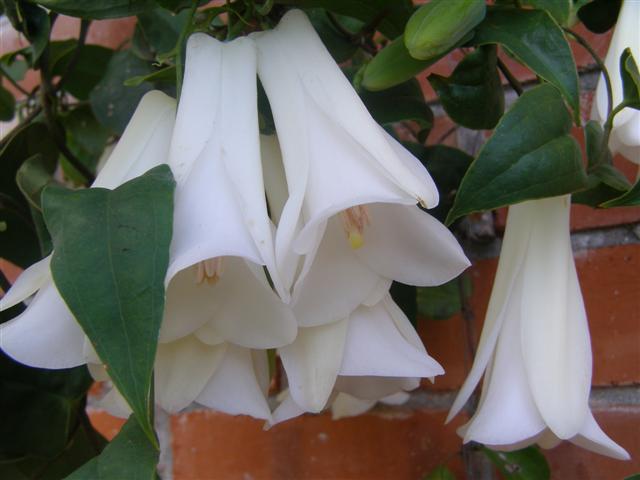
The perfect white waxy bells of Lapageria alba

The perfect white waxy bells of Lapageria alba

The lapageria is commonly known as the Chilean bellflower and is the national flower for that country where it is called copihue. In the wild, reddish pink is the dominant colour though there are pure white forms, pretty pale pink forms and apparently even picotees in cultivation. The white form, Lapageria alba, is particularly prized in this country, but rare because it does not set seed to itself. You need two different clones to get viable seed. In fact all lapagerias are fairly hard to source these days because they are not an easy nursery crop. Young plants can sulk and do nothing at all for several years. They will then send out a strong fresh tendril and some wayward snail will choose that very time to pass by and eat off the long awaited fresh growth. If you see plants offered for sale, don’t set your heart on a particular colour – just take what is available.

They are evergreen climbers which, like most climbers, appreciate a cool position for their roots and their heads into the light. Being forest dwellers, they will take colder temperatures but not frost. Once established, they are enormously satisfying because they are almost never without flowers. And the flowers are beautifully simple waxy bells, reasonably long lived and apparently good for floral art. We have some huge granddaddy vines in red, white and soft pink which have been growing in the cold, narrow back border of our house for several decades where they gently flower on and on and on.
In the garden: March 19, 2010

  • Don’t be tempted to sow lawns until we have quite a bit more rain and the moisture has penetrated deeper down. If you scratch around the soil, you are mostly likely to find that it is as dry as a bone a few centimetres down. However, the more work you do getting the ground levelled and taking off successive waves of germinating weeds, the better your lawn will be when the grass seed germinates. We favour a mix of fescue and rye for lawns here though in reality there are now many other micro greens in our grass. We try and keep out flat weeds, onehunga weed, kikuya and paspalum but beyond that, as long as it is green when mown, we are resigned to our mixed colony. We prefer that to the constant application of chemicals necessary to maintain a pristine lawn.
  • Root vegetable crops take longer to grow and mature so you have pretty much missed the boat on winter root veg but you can still plant the leafy harvests such as winter spinach, silver beet and winter lettuce along with the brassica family. It is the leafy crops which require most fertiliser so be generous with the compost or liquid feed. Vegetable gardening is like any form of cropping – you can’t keep taking harvests and expect the soils to remain fertile unless you keep feeding and replacing the goodness that is being stripped out. Using composts, green crops and manures is more sustainable than continually relying on proprietary fertilisers and also helps to build good soil structure and texture.
  • Compost chicken manure before use because when fresh, it can burn plants. If you don’t want to compost it, at least leave it until it is mature. Seaweed can be spread directly onto the soil and does not need to be washed first. Horse, cattle, pig and sheep manure can be spread directly on the soil. You may prefer to compost all fresh manure or leaving it to dry for several months before spreading around edible crops.
  • If you are not planting all your area in winter vegetables then plant a green crop as you take out the autumn harvests. At this time of the year, we recommend lupins, oats, ryegrass or mustard. We are trying vetch for the first time. You should avoid using lupins where you have been growing beans or peas because they come from the same legume family and it is wise to rotate crops.
  • As cooler temperatures set in, mice will start to migrate indoors so make sure you have any seed you are storing in rodent-proof conditions.. A disused fridge in the shed is good or plastic containers for smaller quantities. However, while rodent proofing is necessary, some seed, including fleshy types, do not want to be sealed off from all air so you may need to devise some compromise if the plastic containers have a tight seal.
  • If your strawberry plants have put out strong runners, these can be planted now to give vigorous cropping plants next spring. Strawberry plants are best replaced entirely every two years and some gardeners replant every year, using runners and divisions. If you plan to leave existing plants for another year, cut any runners off.
  • If you enjoy the mass display of annuals, you can sow seed now for an early spring show. Pansies, cineraria, alyssum, lobelia and snapdragons are all easy and reliable. Hollyhocks get badly mildewed in our climate, alas. Some perennials such as aquilegia, wallflowers, carnations and gypsophila can also be done easily from seed. Use seed trays for much better results. Don’t delay on taking cuttings of perennials and fuchsias. Hydrangea cuttings are best left until winter now and treated as deciduous cuttings.

Lifting & limbing – the before and after of careful pruning

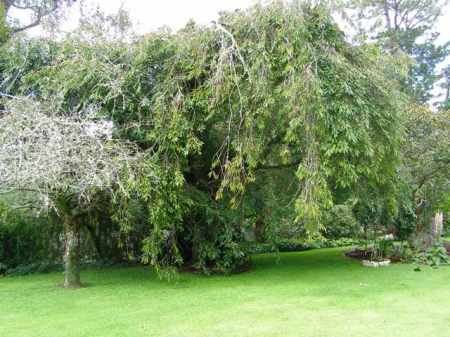
1) This garden aspect is generally all right but you would not look twice at it. The large tree is a weeping cherry, Prunus subhirtella pendula. The fact that the left hand tree, a malus or flowering crabapple, has no leaves on it in high summer is a bit of a giveaway. It is dead.

2) The malus is showing fresh growth at its base but as we knew it was a grafted plant, this is just the root stock growing away.

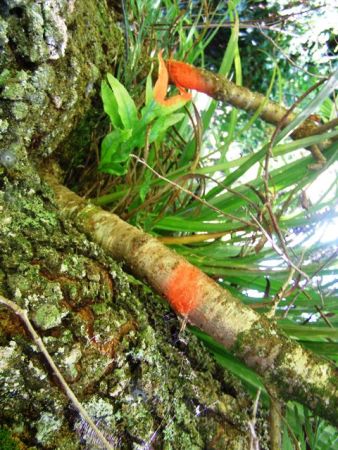
3) Spend some time working out which branches need to be removed. You can’t glue branches back on and it is surprisingly easy to make a mistake. We are taking off the lower branches and a few higher ones which extend too far over the adjacent gardens. We used a squirt of paint to mark the branches destined for the chop.

4) Make an initial cut underneath the branch. This prevents the branch from ripping off and damaging the bark when you cut from above.

5) Cut close to the trunk or main stems. Don’t leave ugly stumps which resemble protruding coat hooks. There are different schools of thought about whether wounds need to be painted with an antibacterial paint. In this case we have coated the wounds but we don’t usually bother.

6) The dead malus has been removed entirely, even the main stump. If you can get most of the root ball out, it reduces the chance of honey fungus or armillaria getting established on the rotting roots and potentially spreading to surrounding trees. The cherry tree now has a more pleasing shape and it is possible to see beyond the tree and to notice other garden features in the same view. Successful pruning is often discreet – quite a bit of material is removed without it being obvious where it has come from.

Tikorangi Notes: March 12, 2010

Latest posts:

March 12, 2010 The ephemeral delight of Rhodophiala bifida in late summer.

March 12, 2010 Early autumn garden tasks for this week.

March 12, 2010 Who should pay when a garden is uneconomic to run? Transferring the costs of running Pukeiti Rhododendron Trust to the wider public.

The case of the nonconformist sunflower.

The non conformist sunflower

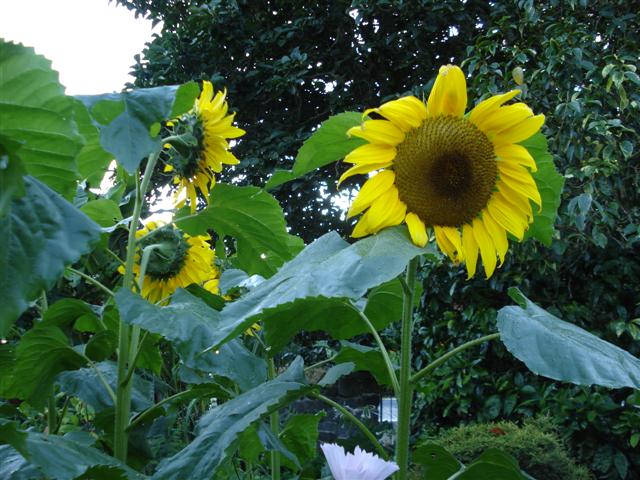
As anybody who has ever grown sunflowers knows, the flowers face the morning sun. All but this one. In a row of sunflowers standing around two metres high, all are obediently lined up to curtsey to the east, bar one which is defiantly facing west. Theories abound. It has a contrary nature. It is a northern hemisphere sunflower, confused by the southern orientation. It was planted back to front. Mark is of the opinion that the other flowers voted it to be the watch flower to ensure there are no ambushes from behind. I just think it wants to be different.

Flowering this week – Rhodophiala bifida

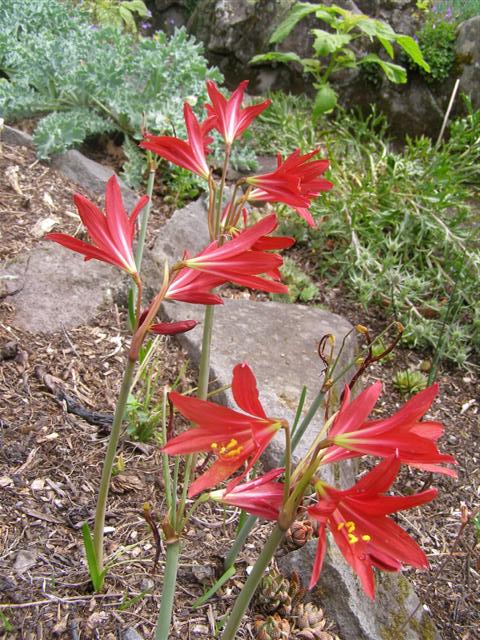
An ephemeral late summer delight - Rhodophiala bifida

An ephemeral late summer delight - Rhodophiala bifida

Markers, perhaps, of late summer or harbingers of autumn, rhodophiala are not well known in this country. They are bulbs again, but this time from South America (Uruguay and Chile, in fact) and closely related to hippeastrums. We used to know them as Hippeastrum bifida and they do resemble a smaller flowered hippeastrum. However, they are certainly not as touchy and particular as some of their exotic cousins and they are hardy. The stems shoot up and pop up heads of up to six trumpet flowers each before there is any hint of foliage. The colour is in shades of rich deep pink to maroon red with contrasting yellow anthers. When the leaves follow, they are modest and strappy.

Rhodophiala have to be increased by seed because the bulbs rarely if ever set offshoots (though there is apparently a Texan variant which sets multiple offshoots). They also have the characteristic of finding their own depth in the soil, pulling themselves down deeper to a level where they are happiest. Gloriosas do the same thing. In all honesty, I have to admit to admit they are a fleeting seasonal pleasure with each bulb only putting up a single flower spike which passes over reasonably quickly. But they don’t take up much room at all and they are a transient delight.