Flowering this week: Michelia alba

Michelia alba - grown for fragrance and foliage rather than any spectacular floral display

Probably the most fragrant tree we know, Michelia alba is in flower now and will be for most of summer. The flowers are definitely not spectacular to look at, being small and rather sparse for the size of the tree, spidery in form and cream. But for a knock you down fragrance which permeates the air all round, alba is amazing. In fact it is apparently the fragrance of Joy perfume. The tree gives us a few worries because it is growing considerably larger and faster than we anticipated and we wonder if we have it planted in the right place. Glyn Church tells us he had to cut one of his out because it outgrew its position. At least it is upright, rather than spreading and its foliage is lush tropical green all year – possibly because it comes from tropical and sub tropical areas of Asia.

Michelias have now been reclassified as magnolias – a somewhat arbitrary decision with which we do not agree so we will continue to use the former names. Alba was given to us by an elderly Chinese gentleman who told us that it was sacred and we could sell one to every Chinese family in NZ. We tried, believe me we tried but it does not set seed and it very rarely strikes from cutting so it has to be grafted and it is not easy to reproduce that way either. We have seen it used as a street tree throughout Asia and we think they aerial layer it.

For the botanically interested, current information is that alba is probably a natural hybrid from the orange flowered Michelia champaca and all alba plants throughout the world are therefore the one clone. Champaca sets seed freely but we have yet to hear of anybody who has proven experience with alba showing fertility. The plant appears to be a genetic dead end.

For a photograph of the tree in our garden, check out Magnolia Diary 14.

In the garden, February 19, 2010

Simulating winter chill before planting out the anemones

Simulating winter chill before planting out the anemones

  • The distinct cooling of temperatures this week and intermittent rain has me fearing that summer may beat an all too early retreat after a late arrival. Mark delights in pointing out that technically we have under two weeks of summer remaining because March officially signals the onset of autumn. But generally we can look forward to settled, summery weather until April.
  • If you have been tempted into buying anemones and ranunculus, remember to plant the former pointy side down and the latter with the claws down. The advice from Aorangi Bulbs is to place the bulbs in a paper bag (not plastic) and refrigerate for a few weeks – six weeks for anemones and four weeks for ranunculus. Then soak them overnight in tepid water before planting. The refrigeration is to simulate the winter chill so that they spring into growth with the warm water. If you have bulk-bought bulbs (and some are ridiculously cheap in quantity), staggering the planting over several weeks is likely to extend the flowering season this year. The chilling process is called stratification.
  • Unless you are willing to refrigerate your hyacinth bulbs every year, you need to treat them as annuals in our climate. Bulbs purchased this year have already set their flowers so you will get one season of lovely blooms. But they need a winter chill to trigger them each year and few gardeners in our area will have sufficiently cold conditions to have them continuing to flower year after year. By no means all bulbs need that winter chill, but hyacinths and many tulips do.
  • The rains this week will trigger winter and autumn flowering bulbs to break dormancy so you are running out of time for lifting and dividing congested clumps.
  • The rains and mild temperatures will also see an explosion of fungal disease in vulnerable plants. Dig main crop potatoes as soon as it appears they are ready, to avoid losing them to blight. You may have to get a spray applied for mildew on crops such as grapes, tomatoes and cucurbits. If you don’t want to use proprietary sprays or copper, you could try baking soda – a level teaspoon to a litre of water.
  • If you have been seduced by the current fashion for growing vegetables in raised beds (ideal for over 70s, those with bad backs or otherly abled but otherwise over-rated in our area with wonderful friable soils and drainage) don’t fill the beds to the top. If you do, you can’t dig the soil without much of it spilling over the edge which makes a mess of the surrounding paths. Nor can you keep adding compost and humus to enrich the soils unless you dig the level lower each time and barrow away the excess.

T-budding an apple tree: step-by-step with Abbie and Mark Jury

A step by step guide by Abbie and Mark Jury first published in the Taranaki Daily News and reproduced here with permission as a PDF.

New Outdoor Classrooms are uploaded fortnightly.

The green breathing space

A restful green on a summer's day - a garden border in dry shade

It is a reflection of our benign climate that I can write a mid-summer column about the soothing role of green in the garden. Overseas visitors are often amazed when they are told that we never irrigate our garden here. Three weeks without rain is nearing a drought in our area of North Taranaki but I hasten to add that we also enjoy high sunshine hours. Much of the world is brown in summer and areas with winter drought or very low temperatures can be brown (or white) in winter, too. We are green fifty two weeks of the year.

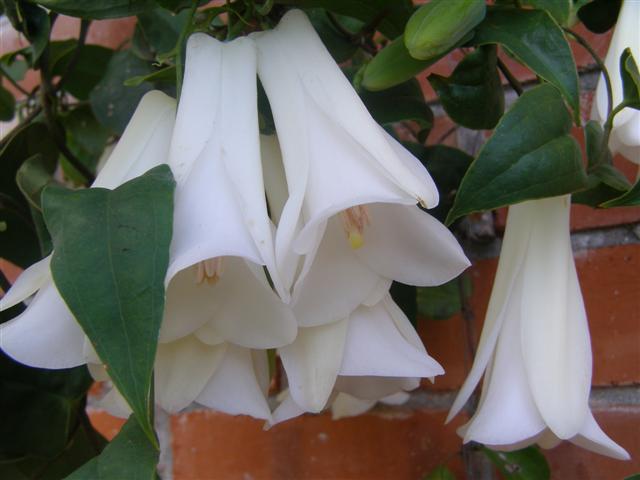
As I brought in the washing yesterday, I contemplated the view from the line which includes the modest back border of the house. I say modest because it is the typical New Zealand house border which runs between the path and the house and so it measures about 50cm wide and several meters long. It is not always easy to know what to grow in a narrow border which is cool dry shade in summer and downright cold dry shade in winter but I did think it was looking rather lush, green and attractive yesterday. There are no flowers out at the moment so it was toned green on green and all about leaf texture and shape. The lapagerias clamber up to to reach the guttering and give height. These are commonly known as Chilean bell flowers and we have a towering pale pink one, a teetering huge white one and a red one all in a row with a daphne bush marking one end. There is good textural variation in the fine foliage of a maiden hair fern, the strappy leaves of a cymbidium orchid, a rather understated green hosta and the large, lush leaves of scadoxus, all underplanted with the mouse plant (arisarum). This last plant can be somewhat invasive but it has nowhere to invade in such a confined border and children are enchanted by the curious flowers. At other times of the year, the lapagerias flower and we have seasonal bulbs that come through but for the heat of summer, it made rather a nice restful picture of green.

Restful, simple green gives a breathing space in a busy garden. Most of us achieve this with lawns where the expanse of green is a little like letting out a sigh of relief. Paved patios and decking just do not give this sense of spacious rest even if they don’t need mowing. Mind you, I was raised by a keen gardener who decided that lawns had no merit. She would rather weed and maintain additional garden than mow a lawn. Widowed early, she never got to grips with mowing. I can remember when I was about nine we moved in to a house where the lawns were rather too extensive to manage with the old push mower. She bought a motor mower. After three days and a couple of site visits from the salesman, the shop took the mower back and refunded her money. They were probably deeply relieved to be shot of her. My mother’s aura did not mix with a motor mower. It would not start for her and she decided it was jinxed. She never tried to make the acquaintance of a mower again. She simply dispensed with grass. Now I think she was wrong and it did not suit her to see the role played in garden design by the restful green space.

The green circle carried off with style and panache at Sissinghurst

The green circle carried off with style and panache at Sissinghurst

No doubt many readers have been to Sissinghurst in England. Vita Sackville West and Harold Nicholson employed a radical device in that garden to create a space – a simple circle of grass surrounded by a high clipped green hedge (probably yew). In the wrong hands, this could look overly contrived, or even naff in a suburban New Zealand quarter acre garden. But in all the busy-ness that characterises the arts and crafts garden rooms of Sissinghurst, filled with colour and texture, this simple green circle gave a place to pause. There was nothing to assault the senses. The circular lawn, viewed from above, as one can because of the splendid tower (not to be confused with a viewing platform – the tower is a relic of the former castle) is neatly and obediently striped. They may not wish to unleash a creative or careless lawn mowing person on that lawn – a spiral, bulls-eye or even an untidy mishmash would not look as perfect as the wide and precise stripes.

At Hidcote Manor, Major Lawrence Johnston from a similar era and also with a busy arts and crafts garden full of small garden rooms, achieved a similar purpose with his Long Walk and his circular area – simply referred to as The Circle. The Long Walk is appropriately long, running on an axis spanning over half the garden and it is simply a generously wide mown strip of grass (no manicured lawn here – this was indubitably grass) bounded on both sides by tall hornbeam hedges. The Circle was tidy lawn bounded by clipped hedges and some rather large and splendid topiary birds.

Think of it all as the gardening equivalent of the sorbet to cleanse the palate between courses at an elaborate dinner party. A sorbet would be OTT at an informal barbecue but it is entirely appropriate at a banquet.

A good garden designer (the operative word is good) will understand the juxtaposition of uncluttered space and detail – that is one of their techniques. The reality is that most home gardeners in this country either can’t afford a good garden designer or they prefer not to. The DIY green space is the lawn. While technically green is a colour, in gardening practice it is perceived as colour neutral like the off white walls of the interiors of many houses. Defining the boundaries of that green space, maybe with clipped hedging, gives it more oomph as long as it is immaculately maintained. However, the imposed formality of the perfect circle needs to be managed carefully – you really need your proportions and context right. There is a fine line between circles with panache and being contrived, or worse – pretentious. The sweep of lawn is safer.

It was a revelation to us to see how effective the deliberate green breathing space was in both Sissinghurst and Hidcote. But most gardens will benefit from the framing that a green lawn provides and in the heat of summer, it makes even more sense.

Flowering this week: Scadoxus multiflorus ssp. katherinae

Scadoxus ssp. katherinae is very happy in dry shade

Scadoxus ssp. katherinae is very happy in dry shade

This particular patch of scadoxus is looking very fine this week and stands around 140cm tall which is fairly remarkable given that it is growing in quite hard condtions. But then, scadoxus like dry shade and that is one thing we have in abundance in our garden.

These are very large bulbs, hailing yet again from the bulb wonderland of Zimbabwe and South Africa. Mark has always described the flowers as being like the chimney brush of the bulb world because they resemble the round brushes used by old fashioned chimney sweeps. Katherinae flowers red in mid summer. Her cousin from Natal, Scadoxus puniceus, flowers orange in spring with a similar flower form. The foliage of both is large and lush. If you know of anybody with either variety, the seed will germinate readily. It is very slow to increase from the bulb (no doubt you could twin scale it) so it is normally done from seed. You are more likely to find bulbs of katherinae for sale rather than the rarer puniceus.