Monarch caterpillars and butterflies – a mid-life obsession that is safer than a Harley Davidson

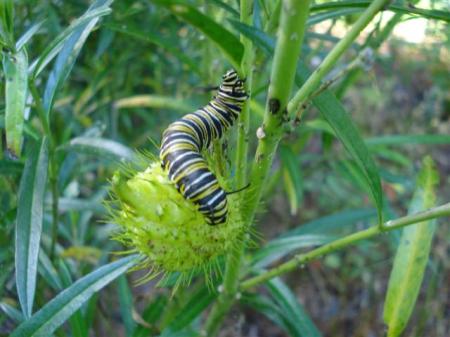
The green swan seed pods and the fat monarch caterpillar in high summer

Mark has always loved butterflies. Alas it was his misfortune to be born in a country with remarkably few butterflies so he has had to focus all his efforts on the only obliging candidate, the monarch. When we travel overseas, he likes to be armed with guides to both local birds and butterflies but at home the yellow admiral and the coppers are largely unknown in our area and the cabbage white does not qualify. The red admiral, which is here, is not as much fun because its main host is stinging nettle. New Zealand has an abundance of different moths, many of which are extremely beautifully marked, but you have to be of a nocturnal disposition for these. This brings us back to the monarch which is large, spectacular and can claim indigenous status because it was self introduced (like the wax-eye), arriving here under its own steam, apparently around 1840.

I admit that I fear his dedication to supporting an exponential increase in numbers of monarch butterflies wintering over may be nearing obsessive levels. Even I was a little surprised at the extent of his swan plant plantations. As magnolia crops have been harvested from our open ground area, he has gone in to the cultivated ground with his little seed sower and trundled up and down the rows dispensing swan plant seed. Strung end to end, we are talking several kilometres of swan plants – probably closer to five kilometres than two. What is more, he is successional sowing in the same way he does with the sweet corn and beans. All this is aimed at ensuring that we have plenty of food to take the monarch caterpillars through to late autumn. That way, they are far more likely to winter over here and there are few close up sights of natural beauty as magical as looking up into a tree on a fine winter’s morning and seeing the monarchs waking and stretching in the sunshine.

The drive to have successional crops may strike a chord with many readers who will be struggling now with a surfeit of caterpillars and a dearth of food. There is something both brave and poignant about watching an exodus of monarch caterpillars heading down from a completely stripped swan plant and wriggling off into the wide unknown in search of another. I suspect Mark suffered some emotional traumas in years past, coping with food shortages. One autumn he raised many caterpillars on slices of pumpkin and he finds it hard to cull babies to preserve dwindling food supplies for the more advanced specimens who are likely to reach maturity and chrysalis in time to metamorphose.

Merely sowing swan plant seed is not enough, however. Definitely not. Crops require management. For starters, you want to try and get at least one plant through to its second season so you can gather your own seed. It germinates readily if sown fresh. We have always known the swan plant as an asclepias, Asclepias fruticosa in fact but it has apparently been renamed Gomphocarpus fruticosus which is altogether too difficult for us to remember even with our experience in horticulture. Sometimes it is referred to as milkweed (it exudes a milky sap) but the term swan plant is commonly understood. The seed pod is like a green bubble swan and when it bursts, the fine seeds come out attached to silky white filaments – maybe they resemble white swan feathers? The filaments help the seed to be dispersed by the wind.

The problem with juvenile swan plants is that the monarchs don’t understand about food conservation so you have to protect your swan plants or they will be stripped long before they become established. If you only have a few plants, you can cover them and restrict access to the egg laying butterflies. These days we have so many plants that the supply finally outstripped demand but in the awkward mid stages, Mark did have to resort to a little infanticide to protect the plants for autumn. And we have to be honest and say that our swan plants are not organic. Without intervention in the form of insecticide, the yellow aphids would have destroyed the entire crop before the monarchs even got going. When he first decided that spraying was necessary a couple of years ago, he went through and carefully picked off all the larger grade caterpillars and relocated them to a clean area. These days we just have too many plants so he tries to get his timing right because insecticide is indiscriminate and will kill eggs and caterpillars as well as the nasty aphids. He tries to do it as early in the season as he can before the explosion of monarch caterpillars.

If you only have a few plants or a single plant under siege from caterpillars, it helps to put in a twiggy branch alongside. Too often the caterpillars will chrysalis on the swan plant where they can be very vulnerable to subsequent generations eating off the stem to which they are attached, so it is better that they be encouraged to neutral territory. Our observations are that cocoons must hang in order to allow the butterfly to emerge undamaged. If you have a stray cocoon, you can try tying a piece of fine cotton to its top so you can suspend it. We have resorted to a bit of sticky tape just across the stem at the top of the cocoon which seems to hold them long enough as long as it doesn’t get too wet.

The final piece of the jigsaw for us is having enough food throughout the year to sustain the butterflies. So it is swan plants as host for the eggs and caterpillars and nectar rich flowers for the butterflies. They will just fly away if you live in a green desert with no food for them. I have written before about butterflies feeding in winter on our Prunus Awanui and Edgeworthia papyrifera. There are many flowers with good nectar but I am slightly amused to see zinnias and marigolds making a reappearance here. We haven’t grown these since back in the competitive school garden days of our children but I notice Mark will row them out in the vegetable garden for the prime purpose of feeding the butterflies. In fact the monarchs have caused him to revisit his approach to the vegetable and kitchen gardens and to give space to many flowering plants in order to feed his butterflies. There is nothing as twee as a potager. We are talking more meadow garden style but it is very pretty. The monarchs are a good argument in support of a gardening style which favours flowers twelve months of the year.

Mark is by no means alone in his monarch butterfly fetish. There is a strong organisation in New Zealand to foster the monarch and readers who wish to know more can visit their website on www.monarch.org.nz . This site will also give further suggestions for nectar rich flowers. One of our friendly neighbours has derived much delight from our monarch butterflies visiting his garden in winter, despite Mark threatening to bar code them and charge accordingly. Send our butterflies home, I heard him say. As far is Mark is concerned, his monarch butterflies give him a great deal more pleasure than a mid-life Harley Davidson and are a lot safer and cheaper.

Flowering this week: Justicia carnea

Summer flowering Justicia carnea in our woodland

Plants which thrive and flower prolifically in reasonably dense shade are rare indeed but Justicia carnea is a stand out this week with a particularly lovely combination of foliage and flower colour visible from quite some distance. The tufted flowers of justicias always remind me of the old candlewick bedspreads despised by my mother but now having a second coming as a collectable on Trade Me (our NZ equivalent of Ebay). This form of carnea has a salmon pink flower complimented by very dark green leaves which are velvety maroon on the back but it does come in other colours, including a pure white form. And the yellow candlewick form which we used to know as Jacobinia chrysostephana is also referred to as Justicia aurea (which means yellow).

These central American shrubs are members of the acanthus family. It had never occurred to us that they are frost tender but in large parts of the world they are regarded as glasshouse plants or they are lifted each winter so they must be more tender than we thought. We have never seen them suffer from frost or cold in our garden but we do tend to favour them as a woodland plant. We just ignore them most of the time. When they start to get a bit rangy and leggy after several years, I cut the tallest stems back to the base of the plant. The old wood is surprisingly hard which is why I use loppers in preference to secateurs. It takes many years for them to get to the size of this one and you could keep them more compact by pruning and pinching out from the start but we don’t mind the tufted pink flowers and slender growth occupying an area about 2.5m x 2.5m. It combines well here with a tropical cordyline behind and ferns, Solomon Seal and mid green hosta at its feet.

In the garden – 26 February, 2010

The challenge of the ongoing cucumber harvest

  • We have a surplus of cucumbers here. Our formerly well travelled staffer tells us that in Turkey, street stalls sell cucumbers which they peel on the spot, slice in half and sprinkle with salt. The smaller, younger ones are pleasant eaten as a fruit though the Heart Foundation would no doubt prefer the salt omitted. I failed to convert Mark to cucumber juice last year but adding them to unsweetened yoghurt is tasty and ups the quantity consumed.
  • Regrettably we are cooling off somewhat and the days are noticeably shorter. The upside of this is that if you are dying to get into the ornamental garden, you can plant or dig and divide clumping perennials. These are more forgiving than woody trees and shrubs and as long as you water them in well and follow up in a few days time, they should be fine. Most perennials will keep growing until winter arrives so there is plenty of time for them to recover. If you have clumps which have fallen apart and are looking really scraggy, it is likely that they are congested and need to be split up. Make sure you replant in well cultivated soil and preferably add compost.
  • As summer crops are harvested from the vegetable garden, it is time to be sowing and planting winter crops. Pretty well every novice gardener ends up with far too many cabbages, broccoli and cauliflower all maturing at exactly the same time. It is better to sow a few seed every fortnight or so because you want them to mature in stages. If you buy small plants, look out for the punnets of mixed brassicas which are widely available – these usually have two of each vegetable.
  • You can also be planting winter lettuce (which is leafy not hearting), mesclun (which bolts to seed too fast in the heat of summer), Florence fennel (the most versatile of vegetables), spinach, beetroot, parsnip, peas, and carrots. Do leeks from plants now in preference to seed. Mark has just put in his last crop of beans though he is a little worried it may be too late. Don’t delay past this weekend on these in coastal areas. It is too late inland.
  • If you are harvesting rhubarb, make sure you feed and mulch the plant to encourage it to grow again. Rhubarb is deemed a gross feeder, which means it is a hungry plant. Adults may like to try adding grated fresh ginger when stewing their rhubarb. To make it palatable for children, cook it up with a bit of sago (tapioca takes too long to cook) which reduces the sharpness and therefore the amount of sugar you need to add.
  • Further to today’s column, if you have run out of swan plants for your monarch caterpillars, you can finish the larger ones on sliced pumpkin but apparently it is an insufficient food for young ‘uns and leads to deformities. You do have to imprison them in a box with the pumpkin or they will migrate in search of another swan plant, even if there are no more around. You can find more information on www.monarch.org.nz .

Tikorangi notes 24/2/2010

Latest updates

February 24, 2010 A guide to T budding, shown on an apple tree. Outdoor Classroom.

February 23, 2010 The bulbs section of Plants for Sale has been updated with many offerings which are very hard to source in New Zealand.

February 20, 2010 Magnolia Diary 14 – a summer update on the fragrant Michelia alba and magnolias.

February 20, 2010 Flowering this week – Michelia alba again, as published in the Taranaki Daily News.

February 20, 2010 In the Taranaki garden this week. Our weekly diary of garden tasks – from stratifying bulbs to the pros and cons of growing vegetables in raised beds

Summer flowering Crinum moorei in our rimu avenue, February 24, 2010

Magnolia Diary 14, February 19, 2010

Click to see all Magnolia diary entries

Click on the Magnolia diary logo above to see all diary entries

Magnolia alba - hardly spectacular flowers but an intoxicating fragance

In our southern hemisphere summer, Michelia alba is in flower. One could never describe alba as being in full flower – it just gently flowers over a long period without ever putting on a mass display. We planted it near our swimming pool so it could perfume the air in the summer months but as it grows ever larger, we are wondering if we have made a mistake. After about eight years, it is already around eight metres tall and showing no sign of slowing down. It has splendid foliage for those in warm enough climates to grow it and the flowers make up for their rather understated (almost insignificant) appearance with their heady fragrance. We have never seen any evidence that alba is fertile, either as seed parent or pollen donor and lean to the belief that it is likely that there is only one clone in existence and that is sterile. We have champaca (believed to be the seed parent of alba on the premise that alba is most likely a natural hybrid) which has attractive colour in the flowers but the forms we have seen are scruffy as garden plants.

Michelia alba, in the centre rear of the photo, has lush foliage but is growing at an alarming rate in our garden

Michelia alba, in the centre rear of the photo, has lush foliage but is growing at an alarming rate in our garden

Mark’s Fairy Magnolia Blush (the first of his michelias to be released) is also summer flowering but these are random blooms which lack the colour of the main spring season. We have decided that the move to lump all magnolia relations, including michelia and mangletia, into the magnolia group is not helpful so we are going to remain with the former nomenclature at this stage. Mark is of the view that michelias are a distinct group which warrants being kept separate. As far as he knows, nobody has yet proven that they can successfully cross michelias with magnolias, or indeed mangletias although some have claimed hybrids. We will wait for proof because we doubt that it is possible to achieve crosses between distinctly different groups without scientific intervention.

Many of the deciduous magnolias are summer flowering at this time but we never get particularly excited about these. They are bonus flowers, tucked in amongst the foliage, and they lack the impact of the spring flowering on bare wood though it should be said that Black Tulip has put up some fine dark flowers this year. Iolanthe, Apollo and Serene all have summer flowers – in fact most soulangeana hybrids will do so. With our very strong sunlight (blame the depletion of the ozone layer along with our clear atmosphere) summer flowers tend to burn.

Summer flowers on Iolanthe

Magnolia Serene has stand out dark foliage. Generally speaking, the foliage on deciduous magnolias does not excite much interest and in summer, most of them are just green trees with relatively large leaves. But when we cast our eyes around a number of trees in our garden landscape, Serene stood out as having deeper colour and appearing glossier than the others nearby. We think it has considerable merit as a specimen tree for its summer foliage as well as its form and spring flowering. Some magnolias stand the test of time and this is one of Felix’s where we are surprised that it has not been picked up more widely in the marketplace. With its later flowering (ref Magnolia Diaries 11 and 12 to see the flowers) it should perform well in cooler climates.