
• Try planting up simple pots as Christmas gifts but get them done now to have them looking at their best in a few weeks time. Punnets of annuals are ridiculously cheap to buy. Planted now, three small plants (plugs, they are called) will fill a pot which measures around 20 to 25cm across. I still remember my splendid summer combination years ago of blue ageratum and cerise petunias. Or you can find cheap herb plants if you want to give an instant herb garden. Ceramic and terracotta pots are inexpensive these days, especially the classic terracotta type despite the fact they still seem to be imported from Italy. This is a good activity to carry out with children and will go down well with grandparents as it shows thought and effort. The cheapest potting mix is fine for annuals but keep the pots well watered and protected from slugs and snails while they settle in.
• With summer coming, set the level on the lawnmower a notch higher. Cutting the lawn very short does not mean you reduce mowing. Instead it tends to stress the grass so the weeds move in.
• If you have onehunga weed in your lawn, you have left it late to spray it but it is the one really bad weed which we think justifies a chemical assault. It is the weed that puts tiny prickles into any bare feet that dare tread upon it. There is a targeted spray called, we understand, Prickleweed Killer which doesn’t kill off the desirable grasses. If there are any children in your life, get onto dealing to it this weekend as your first task. Do not let this weed go to seed.
• Apples will have set their fruit for the year which means that if you had a codling moth issue in the past which you have not done anything about, odds on the larvae are scaling the trunk now to reach the fruit, if they have not yet made the journey. This means it is too late for pheromone traps which are designed to catch the moth before it lays eggs. You will either have to put up with moth eaten fruit or resort to some insecticide spray. Apparently lavender bushes or nasturtiums planted below will discourage infestations in the future but we have yet to see proof of this. It may be worth a try but I would keep to lavender because it is likely that rampant nasturtiums will engulf your entire apple tree. Tipping new growths by hand will largely deal to the leaf curling midge which attacks the very ends. Unroll the leaves and you may find a small pink creature inside. You either nip them off or spray them.
• The end of this month means you are running out of time to plant kumara, yams and any other type of sweet potato. Give these priority along with tomatoes. Potatoes planted now will be a late crop so you don’t want to delay on these either.
• It is four weeks until Christmas so get quick maturing salad vegetables in this week for harvesting at that time. It is much nicer to head out and pick your own mesclun, rocket, microgreens and radishes.
• If you are a fan of monarch butterflies, you will need to get swan plant seed in urgently to get the autumn crop through to feed the late caterpillars. Real enthusiasts will also be sowing seed trays of zinnias, marigolds and other autumn crops of annuals to feed the butterflies.
Flowering this week – Kalmia latifolia “Ostbo Red”

Kalmia Ostbo Red with its look of piped icing rose buds
Kalmias are evergreen members of the heath family, growing here in similar conditions to rhododendrons (they like an acid soil) and coming into flower just as the rhododendrons are largely over. They are native to the eastern seaboard of North America from Canada to Mexico so are tolerant of a wide range of temperatures but generally we would describe them as very hardy. Americans often refer to them as the Calico Plant or Mountain Laurel. Over time, they will grow to about 1.5 metres high but they are pretty slow growing.
Kalmias are not rare but they are not often available in garden centres simply because they are notoriously difficult from cutting. Sometimes plants will come in a rush through tissue culture (micro propagation) in which case you should buy on sight because you don’t know when they will be offered again. If you know of somebody with a plant you can grow them by layering (we did an Outdoor Classroom on the topic about six weeks ago) or if you find any seed on a plant, they are straightforward and reasonably consistent from seed although you will get some variation from the parent. Alas some of the common named varieties don’t set much, if any, seed at all.
November 20, 2009 In the Garden

And the prize for likely the best flowering anywhere in the world of the beautiful but difficult vireya rhododendron orbiculatum in the week ending November 20, 2009 goes to friends of ours at Oakura, near New Plymouth
• If you have grape vines that you pruned in winter, they will be in rampant growth now and you will be needing to shorten the laterals and thin some of the growth. Our Albany Surprise are already starting to flower and we will keep them to one or two per lateral (side shoot) and trim at two leaves past the outer bunch. If you let the growths get too long and heavy, they snap off without warning.
• When you get a good steady rain after a dry spell, such as last Tuesday evening, the snails come out to feed in their hordes. You can get a really good kill rate if you head out with torch and umbrella to their favourite haunts. A foot stamp is environmentally kinder than poison.
• You can keep digging and dividing clumping perennials while they are in full growth. You should be safe continuing to do this up until Christmas or so. Always dig over the ground well and loosen up clods before replanting, preferably adding compost. New roots are tender and fine and will have trouble getting into heavy, compacted soils.
• Deadheading roses can be a big task but it makes a difference to keeping pests and disease at bay. It is best to do it with a bucket at your side and take off diseased foliage as you go, removing all from the site. Roses give maximum flower for your efforts but if you don’t spray them, they do take a little extra care to keep them looking healthy and bountiful.
• Get onto planting kumara runners if you have yet to do them. Keep sowing seeds of corn, salad veg, beans (dwarf, butter and runner) to ensure a succession of crops later. If your courgettes, cucumbers, pumpkins and similar running plants are up and growing well, keep pinching them out after about six strong leaves have formed, to encourage side growths (laterals) rather than just a few long runners.
• Time is running out for picking asparagus. Commercial growers will pick through to Christmas but this a mistake in the home garden. You need to leave sufficient shoots to form a mass of ferny growth in order to nourish the crowns below ground. When you stop picking, give a feed if you have not yet done so and get a layer of mulch on to suppress summer weeds getting a foothold.
• It is still relatively cool so there is time to get tomatoes, cucumbers, aubergines, melons and pumpkins planted but don’t delay and you are better to buy plants if you have not got your own seed sown in pots and well underway. Keep a copper spray on tomatoes and potatoes if they are already established in the garden. Wet weather followed by warmer weather will almost certainly lead to blight.
• Cover strawberries without delay to beat the birds.
• Anybody who has grown vireya rhododendron species will know that it is difficult to keep many of these alive. So when local friends sent us photographs of their R. orbiculatum with probably over 60 flower trusses this week, we figured that they probably take the award for the very best flowering of this very tricky vireya species anywhere in the world for the week ending November 20. We have never seen such a spectacular orbiculatum before.
Colourful Gardens by Dennis Greville
We are so over green gardens, we are past claiming that gardening is primarily about foliage not flowers and equally we have moved on from good taste mono colour palates and static, unchanging gardens. I am with the author on his determination to celebrate seasonal colour and flowers.
Readers of the NZ Gardener magazine will know Dennis Greville as a regular contributor. He is very experienced and competent, both in writing and photography, and I am guessing that he really enjoyed doing this book because at times he treads a fine line between enthusiasm and a hint of purple prose. But an exuberant topic such as colour deserves a somewhat passionate text. The first forty pages give a useful theoretical background, the remaining chapters feature the colour palette and impact in the garden. There are many coloured photographs, on every page in fact and all captioned.
It is not a beginner’s book. Too much plant interest and too many photos of fairly sophisticated planting combinations for that. Hallelujah for an author and a publisher who are not scared to use proper plant names as well as giving the common reference. On an experience scale of 1 to 10 (1 being absolute beginners), this book sits appropriately in the mid level as being suitable for gardeners in that 3 to 6 level of ability and experience.
(Published by New Holland. ISBN 978 1 86966 269 1)
Flowering this week – Arisaema dahaiense
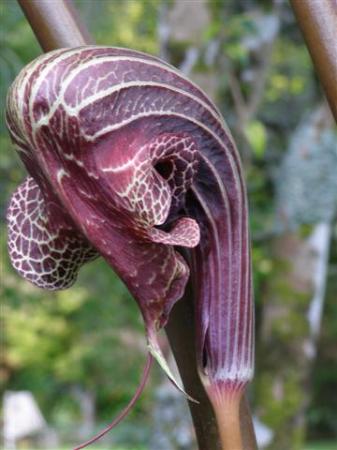
Not quite a mouse eating plant, but truly remarkable - A. dahaiense
In a quiet moment in the middle of our garden festival last week, Mark must have been suffering from boredom to be so mischievous as to tell a garden visitor that this flower had just eaten a mouse. She actually believed him too, until he twiddled the long tendril which comes out from the flower and resembles a mouse tail. She wasn’t sufficiently gullible to believe that the mouse was still alive. But this extraordinary flower is decidedly reptilian in appearance.
You certainly won’t find this plant on the shelves at your local garden centre. Mark spent many years hoping to be given one of the rare bulbs and it finally came to pass last year so this is its first flowering for us. At this stage, it is strictly who you know when it comes to acquiring this plant. Dahaiense comes from the Yunnan area of China although this strain was collected somewhere round the Burmese border area. In the wild, it has been photographed at close to two metres in height but our plant has yet to reach anywhere near that stature.
There are a whole range of different arisaemas and some are much more spectacular than others. They are a most curious genus being true hermaphrodites. When the plant is strong and robust, it becomes female and able to set seed but when it is immature or feeling a little weak and poorly it becomes male and is only capable of pollen donation. We will say no more on that topic.
Mark has spent some years gathering all the different species available here and hybridising to get some unique forms to use in the garden. He has a large number of spring flowering plants which hold their cobra-like heads above the foliage (most species hide their flowers below the leaves) and his summer flowering forms extend the colour from the more usual brown or greenish flowers into pinks and burgundies. They are not pretty but they are certainly interesting and nobody else has bedding plants quite like our arisaemas. Dahaiense has opened a whole new range of possibilities as a pollen donor this year.
 Tikorangi The Jury Garden