Taming the Wilderness – workshop notes

Create space around individual plants to avoid an overgrown, unkempt look

Create space around individual plants to avoid an overgrown, unkempt look

TAMING THE WILDERNESS

Handout notes from the workshop taken here in our garden November 7, 2009 as part of the Taranaki Rhododendron and Garden Festival.

  1. If you are new to the garden, don’t charge straight in immediately and start dropping trees and shrubs. Ideally, give it about nine months to go through the seasons so you can see what is there before you do major felling and removal. In the meantime you can be clearing the lower grade plants – most plants that sucker, clump or seed down can be safely attacked.
  2. Track the path of the sun so you can see where your winter sun and summer shade positions are.
  3. Unless you know what you are doing, seek advice as to which trees are quality, long term trees worth preserving. Somebody at the botanic garden or public park, or an enthusiastic member of a group such as the International Dendrology Society will likely know more than a tree surgeon (whose skills often lie more in safely felling a tree and using chainsaws than in deciding which trees are of value).
  4. Overgrown gardens lose the detail and small treasures, but can give you a framework and maturity to work with. Don’t reduce it all to a blank canvas by clearing everything.
  5. Stand at each window in the house and plan views if possible. Also spend plenty of time looking from every angle in the garden to work out potential view shafts, sun and shade through the seasons.
  6. Make the most of maturity of plants. LIFT AND LIMB. Allow light through underneath and build up layers of garden. Many, if not most, young gardens are badly overplanted to get a quick effect. It is likely that you will need to thin out a number of these plants.
  7. Mature gardens are usually about shade conditions. LEARN TO GARDEN WITH SHADE. Don’t try and turn it all back to sun and a juvenile garden.
  8. CREATE SPACE AROUND PLANTS. The fresh appeal of young gardens is often because each plant stands alone in its own space. As gardens grow, that space gets swallowed up and the plants become entangled. Creating a sense of space again is good for the plant (less competition, more light and more air flow) and creates a more cared for look in the garden. Most gardens need to restrict the size of trees and shrubs.
  9. LEARN ABOUT PRUNING – especially the right times of the year to prune plants and the general rules of pruning. A good pruning saw is worth the expense, as are good loppers. Supervise chainsaw operators carefully – you can not glue branches on later.
  10. Widen paths. Remove anything spiky or prickly beside the path. Creating a sharp edge between a path and garden immediately makes a place look better cared for.
  11. As a general rule, woody trees and shrubs are best left well alone in the root area. Just a feed (preferably in spring) if the plant is looking hungry and pile on the mulch. Herbaceous or clumping plants prefer friable or fluffed soil and in a neglected garden may need to be lifted, divided and rejuvenated.
  12. If you are gardening on a slope or even on a hill, trim the branches and prunings and lay them around the contours of the slope and use them to start building up layers of humus. It is all part of the natural cycle. Bare earth is not a good look.
  13. Be a vigilant weeder from the start. It saves a great deal of time and effort later. Once an area is weeded, lay mulch to suppress fresh young seedlings. You will have many dormant weed seeds in your soil which will spring into life with a bit of light and cultivation.
  14. In our opinions, gardens need some logic to them and this usually means that detailed and tightly maintained areas of the garden are closest to the house, to living areas and entranceways. As you radiate out further, the theme becomes looser and more casual. Most people use outdoor living areas which are close to the house, rather than at the bottom of the garden.
  15. Vegetable gardens need full sun.
  16. As a general rule, water features are best in full sun.

The growing popularity of garden workshops

Lifting and limbing allows us to garden below our avenue of huge rimu trees

Lifting and limbing allows us to garden below our avenue of huge rimu trees, now 130 years old (which is very old for New Zealand gardens where there is a widespread apprehension of anything older than about 20 years)

In one of those rash moments when our annual garden festival was a long way out, I volunteered to take a workshop here in our garden. These are fast becoming a feature of our event. The popularity of workshops suggests a growing demand for quality information. Predictably, muck and mystery (as English garden writer Alan Titchmarsh used to call compost) attracted the largest number – presumably those driven by a desire to demystify the secrets of making the good stuff. I say predictably because compost is closely tied in to the Great Vegetable Garden Boom still in full swing. But all workshops attracted good attendances and all but one were based in festival gardens.

Several of our attendees commented later that one of the unexpected bonuses of coming to our garden festival here was the presence of knowledgeable gardeners who are available and willing to share ideas, name plants and give good advice. It is one of the characteristics that set us apart from other such events around the country. Back in the early days of our festival when most gardens were free and there were many more open gardens, there was little expectation placed on garden owners. They weren’t even required to be there. In fact, some just left the gate open when they went to work. I always wondered why there weren’t more burglaries because I felt sure that any burglar worth their salt would have cased out the joints. But maybe forward planning is not a mandatory qualification for your average burglar and thief. That aside, there is something slightly disturbing about not being formally invited onto private property to look around the garden and quite often garden visitors would comment that they felt very uncomfortable looking around where there was nobody home and they left quickly. It is all a bit like snooping into your host’s private cupboards or drawers.

It was precisely because of this, the requirement that every garden be hosted was brought in some years ago. Nowadays we expect a great deal of our garden openers and most in fact deliver even more than is expected of them. Not only do they have to get their gardens up to opening standards (and pretty well without exception, our garden openers are their own toughest critics and have lifted standards higher every year), but then we expect them to front up to the public and meet and greet and chat to them for ten days on end. There are other festivals where this does not happen, where the garden owners are not visible or available. The Trinity Garden Festival in Auckland (which doesn’t seem to be running any longer) was the most often cited event – students employed to do the gate and a completely impersonal experience with nary a gardener and garden owner in sight. But it is not just that our gardeners are available, it is also that they are voluntarily up-skilling themselves so that they are more knowledgeable hosts. It is one of the defining characteristics of our festival and a reason why it has run without interruption for 22 years and is apparently going into another growth period.

I started by saying it was a rash impulse which saw me offering to take a workshop here. It always looks a long way out when you agree to do something but it is a bit like an exam – some of us don’t start worrying until it is almost upon us. It actually takes quite a bit of thought and discussion to marshall one’s ideas and key points and it may even be harder to make a casual workshop coherent than it is to present a formal lecture. Whatever, we chose the title of Taming the Wilderness and then started worrying about what direction to take it. I am not going to try and summarise all we covered but it was interesting that for us, personally, there were three critical points.

  1. If you have a property with large trees and shrubs and you are not sure what is what, seek out some good advice as to which plants are special so worth saving and which are the long term trees. You can’t buy maturity and too often, ignorance sees some pretty special plants lost forever. At the risk of making enemies, tree surgeons and arborists tend to be the people you seek out when you have decided which trees you want saved and which ones felled. They should do the work safely and efficiently for you but by no means are all these people knowledgeable about tree varieties. You need a plantsperson or dendrologist for this and the really able enthusiasts are often found in the voluntary or amateur sectors.
  2. Lift and limb. Gardening is about working with nature. Just by cutting off the lower branches of trees, you can open up an area to light and air movement. You don’t have to return a tree back to juvenile size if it is too large. You can celebrate the stature of large plants by managing the lower metres of trunks and canopies so you can garden below, rather than growing dense forest. At our workshop, Mark did a memorable demonstration of lifting and limbing – showing what a difference dropping merely a couple of large limbs can make, creating vistas and views and opening up around the plants.
  3. Reclaim space around individual plants. Much of the appeal of juvenile, freshly planted gardens is that each plant stands alone in its own space. As gardens grow, plants become intertwined and thugs can dominate. Over time, plantings can become forests or hedges. To reclaim a sense of managed garden, create space around individual plants by judicious pruning and thinning. It is also better for plant health.

In a place with some very large trees and a well established garden, we are constantly working to hold the forest and potential overgrown wilderness at bay and to keep a sense of garden and open space within that mature framework. It is simply what we do here.

Flowering this week: Eupatorium sordidum

Like a giant fluffy blue ageratum on steroids

Like a giant fluffy blue ageratum on steroids

It is a member of the wider daisy family but it looks like the annual fluffy blue ageratum on a massive overdose of steroids. In fact it is a perennial woody shrub from Mexico which reaches about 3 metres high and nearly as wide with big leaves (slightly felted) and big fluffy, fragrant flowers in lilac blue. Normally it is in full flower for our spring garden festival but it is a little late this year. It is not very hardy and presumably it didn’t like the cold winter.

We grow it outdoors here but we saw it in the covered house at Kew Gardens in London under a different name and then we saw it in a garden in Italy under yet another variation but it appears that all are more or less correct: Eupatorium sordidum, Eupatorium megalophyllum, Bartlettina sordida or Bartlettina megalophylla. It does not appear to have a common name so it is referred to here upon occasion as that giant overgrown blue ageratum-like plant. You are not likely to find it for sale but it does grow easily from cuttings if you find somebody with a plant.

November 13, 2009 In the Garden

  • We are starting to dry out already. Keep a close eye on container plants. If they are showing signs of stress, it is likely they are either badly root bound (should have been potted on when we told you in winter), hungry or dried out. To get water back into dehydrated plants, a squirt of dishwashing detergent or surfactant will help absorption. However, ignore any advice given elsewhere to add water holding crystals (also called Crystal Rain) to potting mix for anything other than annuals. In our climate with high rainfall, woody plants and perennials will rot out in winter if you add these crystals, however tempting it may be in summer to use them. Partially burying pots and containers into the garden (called plunging) can reduce excessive drying out. It also stops pots with taller plants from blowing over in the wind.
  • It is late in the season for planting out woody trees and shrubs, especially if they are large or root bound. Our advice is to heel them into the vegetable garden until autumn. If you are determined to plant into other garden positions, make sure that the root ball is soaked right through. A watering can just will not do. It can take hours (or leave overnight) to get the water into the middle if it is very dry. Once planted, mulch to conserve moisture and keep an eye on the plant until Christmas at least to ensure that it has not dried out again.
  • If you spray for thrips on rhododendrons (the leaf sucking critters which cause silver leaves), get the first application on when you see the insects on the under side of the new growth. We are not keen on this practice and will only spray one or two special plants ourselves. We would be much happier to hear of gardeners opening up around the plant to encourage air movement, feeding and mulching to encourage more health and vigour and taking out plants which are particularly susceptible to replace with healthier selections. We have drawn a line under many of the cold loving German and American hybrids here and said that we just can not grow them well in our mild, coastal conditions.
  • It is the optimum time for planting kumara runners. This is one plant which really loves warm, light soils.
  • As soon as we get more rain, fungi are likely to attack potatoes and tomatoes. A copper spray applied as soon as the foliage has dried out after rain is usually necessary if you wish to guarantee a harvest later.
  • Brassicas will be under siege shortly, if not already, from much of the insect population and in particular the dreaded cabbage white. This is the single biggest reason for not growing brassicas for summer harvest in our climate. If you don’t wish to spray with an insecticide, you have to start getting creative with old net curtains and the likes. However, this only stops the cabbage white laying more eggs and does nothing to deal to existing caterpillars in residence. We will be eating our remaining brassicas soon and not replanting until autumn, with the exception of brussel sprouts which are best sown in the summer for harvest next winter.
  • Leeks can be sown now.

Flowering this week – Olin and Caroline (rhododendrons of course)

DSC01930 (Small)

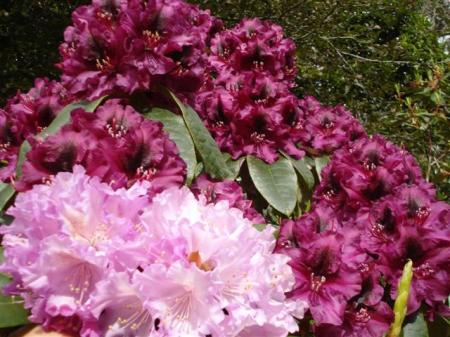
Olin O. Dobbs - a vision in blackberry and Caroline Allbrook - enchanting in lilac

It is only appropriate to keep with rhododendrons as our Rhododendron Festival steams on so it is two half-siblings this week. Olin O. Dobbs is the mysterious and unusual one (they share Purple Splendour as a father) – spectacular conical trusses in the deepest blackberry colour, rivalling Blackberry Nip rose but Olin does not fade out. Unfortunately, despite being much sought after when in flower because of the striking hue, Olin is difficult to propagate (basically needs to be grafted) so is virtually unavailable on the market these days. He also prefers a colder climate and gets infested by thrips here so does not look crash hot as a plant for the other 50 weeks when not in flower. We don’t mind because we will trade all that for two or three weeks of blackberry splendour.

The half sister, Caroline Allbrook, is a pretty, pale lavender which is a reliable performer every year here. Caro also distinguishes herself by holding well when picked which is by no means true of all rhododendrons. Great flower truss, easy to grow and should be reasonably readily available in the marketplace. She does look rather fine planted beside Olin in our carpark area but if you could use the burgundy foliage of loropetalum to contrast, in the absence of Olin.

For devotees, the seed parent of Olin is Mars and for Caro it is the species yakushimanum.

DSC01940 (Small)

We were very taken by the juxtaposition with the purple car parked alongside by a garden visitor