- There is precisely no gardening going on here this week as we meet and greet visitors – just the daily garden equivalent of housekeeping with the mower, the blower vac, hose, leaf rake and push hoe. It is a good exercise in keeping a garden looking sharp by maintaining freshly mown lawns and defined edges.
- Start deadheading rhododendrons as they finish flowering. Oiling your fingers (olive oil is fine), means you don’t get the sticky residue hanging on. If you only have a few plants, deadheading all of them certainly tidies them up but if you have many, then take the time to work our which ones set seed and give these priority. Try and avoid breaking off the new shoots which are coming through just underneath the spent flower.
- Be vigilant now on weeds. Early season control saves a great deal of work later on. It is warm enough now to push hoe and on a fine day, the sun will dry them to a frazzle. You can only do this if you catch them before they reach seeding stage. If you let them get too large, you really need to cut off and remove the seed heads or you are just spreading the next generation.
- Do not delay on laying garden mulch before summer. It needs to be down before the ground dries out. Laying mulch suppresses many germinating weeds, conserves moisture, improves the look of a garden and if you are using a nutritious mulch (compost) it adds nutrition and structure to the soil. It is a myth that laying pea straw adds nitrogen to the soil because the peas store all the nitrogen in their roots not their tops. If you are worried about your carbon footprint look for local alternatives – we don’t grow peas commercially in Taranaki and your cheap garden mulch is shipped from points quite some distance away.
- Top priority in the vegetable garden is getting the crops in which have the longest growing season – melons, aubergines, tomatoes, cucumbers, gherkins, kumara, Florence fennel and corn. You can continue sowing peas but it might be a little late for getting the Christmas Day harvest through in time unless they are already growing. Keep sowing the salad veg for continued harvest (lettuce, mesclun, radishes, micro greens). You can get sowings of basil and coriander in now from seed. Making pesto at home is so easy that that you will wonder why ever bought it.
- Plant main crop potatoes if you have not yet done so.
- Last year’s notes tell me that we had a triumph eating our first bowl of home grown strawberries at this time. We certainly won’t be achieving that milestone this year. I don’t think there is even a hint of red visible yet. This can be attributed to the use of a cloche last year.
Growing vireya rhododendrons from cuttings: step-by-step with Abbie and Mark Jury
A step by step guide by Abbie and Mark Jury first published in the Taranaki Daily News and reproduced here with permission as a PDF.
New Outdoor Classrooms are uploaded fortnightly.
30 October, 2009 In the Garden – including the recipe for preserved lemons as promised in the Taranaki Daily News
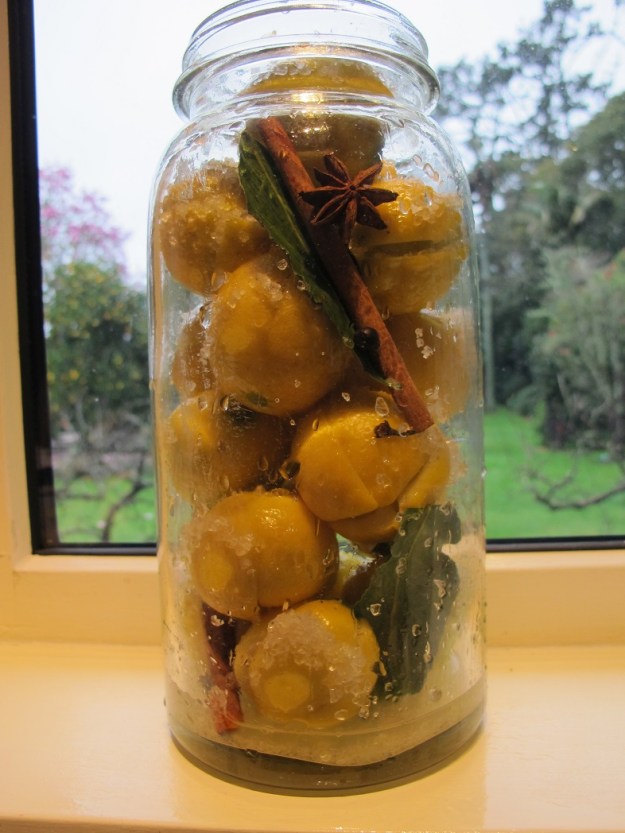
1) If you are into making home grown Christmas presents, I can vouch for the preserved lemons I made last year (except I used limes because they were a better size for the jar). I didn’t think I would use them because we have citrus available here all year, but the preserving intensified the flavour so well that I am finding all manner of uses for them. They would make a decorative festive gift in an attractive jar for very little expense and not a lot of effort.
I used a recipe from Robyn Martin’s delightful book on preserves called Relish :
Preserved Lemons
10 lemons
1 cup coarse sea salt
2 cinnamon sticks
4 bay leaves
10 coriander seeds
10 black peppercorns
1 cup lemon juice
Boiling water
Method: Cut the lemons in quarters to within 2cm of the base. Sprinkle 1 tablespoon of salt over the base of a large jar. Fill each lemon with salt and pack into the jar. When 4 lemons are packed in, place half the herbs and spices in the jar. Top with the remaining salt filled lemons and add the other herbs and spices. Pour the lemon juice over and cover with boiling water.
Seal and store in a cool dark place, shaking the jar daily to distribute the salt and spice flavours. Leave at least three weeks before using and store in the refrigerator after opening. To use, rinse the lemon well in fresh water, discard the pulp and use the skins.
Being paranoid about food safety (my toxicologist father raised us with a healthy fear of botulism), even with all that salt and lemon juice, I kept my jar in the fridge and after close to a year, the flavour is intense and delicious.
I can recommend Robyn Martin’s book for a modern take on all sorts of interesting preserves. It is a New Zealand publication by Chanel and Stylus and the ISBN is 978 0 9582729 5 7
2) This is the busiest week of the year for open gardens in Taranaki. We would encourage everyone to get out and do a spot of visiting. It is really affirming for the garden opener to receive good numbers of visitors and there is also much information sharing that goes on. All garden openers should, by definition, be a welcoming and friendly lot but the camaraderie with other garden visitors may surprise. So, no excuses. If you do not have your own garden open, then make the effort to go and get some ideas and to enjoy looking at other people’s gardens.
3) If you are tempted into buying trees and shrubs now, do not delay on getting them planted. It is not so critical with bulbs and leafy plants (perennials) but woody plants sometimes don’t recover if they get too dry and stressed. Before planting, if you can, plunge the whole plant, pot and all, into a bucket of water and hold it down until the bubbles stop rising. You can leave it overnight in the bucket. This ensures that the rootball does not have dry patches in it. If you are on coastal, sandy soil you are better to heel the plant into well cultivated soil such as the vegetable garden and relocate it to its permanent position next autumn.
4) Mulch. Mulch. Mulch. It has to go on to the garden beds before they dry out over summer if there is to be any benefit. As a general rule, if you are going to add fertiliser to your garden, apply it now and then lay the mulch on top. You don’t have to fertilise everything every year. It is best to do it when a plant starts to look a little hungry or when an area of the garden starts to look little hard done by. If you are managing your garden well, adding fertiliser should be an occasional rather than a regular occurrence.
5) In the vegetable garden, it is a continuation of the great Labour Weekend plant out. Get the kumaras and potatoes in. Start pumpkins –these are so easy to grow from seed that it is almost a crime to buy plants. Make a mound about a metre across and 60cm high comprised of layers of soil and grass. The grass will generate heat as it rots and hurry the pumpkin along. Plant tomatoes, melons, courgettes, cucumbers, gherkins – all the summer veg go in now. Unless you have a massive whanau, you will only need two or three plants of each of them, except maybe the tomatoes where a varied range of different ones is more fun all round. When you have done all that, you can be planting corn, green beans and ensuring a continuation of salad greens.
Rhododendron Yvonne Scott
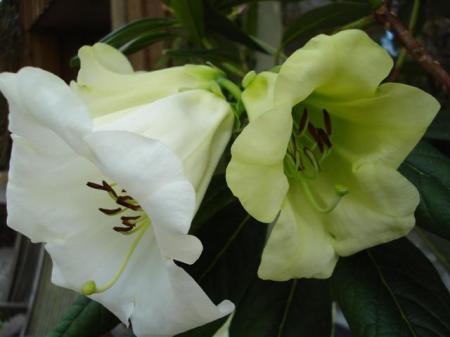
Rhododendron Yvonne Scott - bringing startling lime green into the nuttalliis
The late Mrs Yvonne Scott from Inglewood was a fine looking woman and this may in part explain why Sir Victor Davies gave her this seedling rhododendron before it even flowered for the first time. VC, as he was commonly referred to, had a gallant regard for those of the fairer sex. Mrs Scott was shopping at the Westown outlet of Duncan and Davies at the time and, as she was a good customer, VC presumably felt a generous gesture was appropriate. He may not have realised quite what he was giving away because this is a pretty interesting nuttallii.
Rhododendron Yvonne Scott is part nuttallii (the other part has lindleyi and dalhousiae genes) so it has very long trumpets with frilly lobes. What makes it stand out from other nuttalliis is that it opens pure lime green, all over. Within a few days, the lime green bleaches to white but with a lime green throat inside. Not even the most enthusiastic fan could describe the plant as compact, but at least it has lovely peeling bark, rarely gets attacked by thrips and the flowers even have scent. It is remarkably robust as far as the spectacular but often touchy nuttalliis go.
Maintaining social status if not economic value – the rhododendron in Taranaki

The generic pink rhododendron photo - in fact an unnamed seedling from our park
2009 may not go down in history as having the best ever display of rhododendrons in Taranaki because spring came somewhat early this year and festival dates are somewhat late. But it is rather a happy collision of different occurrences that sees us wearing a rhododendron crown in the first place. It is not that we grow them hugely better than everywhere else. We just happen to have Pukeiti here and that organisation and identity has given an enduring regional focus to the plant genus, along with our longstanding annual garden festival. In fact going back in history, that garden festival was first floated by Pukeiti and owned and run in the early years by the Taranaki Rhododendron Group.
Why rhododendrons? Just as tulips commanded prestige and price well beyond their actual worth in Holland in centuries past, rhododendrons were the high status and high prestige plant for the post World War 11 gardeners and we had a cluster of serious gardeners in Taranaki at the time.
Douglas Cook, the father of Pukeiti, bought land here primarily for rhododendrons because it was clear to him that these aristocrats from lower mountain slopes in Asia would never be an option for his first choice location near Gisborne, where he set up Eastwood Hill with its heavy focus on drought tolerant deciduous trees.
Around the same time, a number of Taranaki gardeners and plantspeople were creating their gardening masterpieces. These included Bernard and Rose Hollard near Kaponga, Russell and Mary Matthews on Mangorei Road (Tupare), Les Jury at Sunnybank on Tukapa Street, Harold Marchant and Les Taylor near Stratford, Jack Goodwin at Pukekura Park and Pukeiti – and Felix and Mimosa Jury in the garden here at Tikorangi. The rhododendron family featured large in their plans and individual collections were highly prized.
Historically, back in those mists of time around the late forties and fifties, Duncan and Davies were becoming the major force in commercial production and that happened in Taranaki partly because all plants were field grown in those days (in other words in the ground in real soil, rather than in containers and planter bags in modern nurseries). With its friable, volcanic soils, high sunshine and regular rainfall for 12 months, Taranaki just happened to have the best conditions in the country for field production. It needs also to be said that the charisma and dynamism of V.C. Davies was a major influence.
Times keep changing. These days the market value of a rhododendron plant has plummeted so far that you can go to any plant shop and buy one for around the same price as a perennial, a clipped bay tree, even a semi-clipped buxus or a large succulent. I can tell you, dear Reader, that there is a vast amount more skill and time required to get that rhododendron onto the shop floor than the other plants and that they are dreadfully underpriced, almost without exception. I am frankly astonished that rhododendrons have to some extent kept their elevated status in theory, even though reality has them relegated well down the plant equivalent of the social scale. It is a conundrum.
But then we still lay claim to the rhododendron in Taranaki even though the local nursery industry continues to dwindle away (we certainly can’t claim to be the Southern hemisphere power house of plant production these days!) and even though most home gardeners would rather plant a fruit tree than a rhodo. The rhododendron gives a focus, an icon, to our garden festival which sets it a little apart from others all round the country – except for Dunedin who shamelessly (though quite justifiably) continue to challenge our claim to having the Rhododendron Festival.
As our festival starts today, never underestimate the importance of this annual event on our regional garden calendar. It is the single event which keeps Taranaki right up at the top nationally in the garden scene. The 10 days of festival deliver more visitors into most of our open gardens than will be seen on the other 355 days of the year. It is the single event which makes it worthwhile to maintain gardens to the high standards we currently reach. Without festival, there would be no incentive to keep lifting gardening standards and setting the benchmarks.
 Tikorangi The Jury Garden