July 17, 2009 In the Garden

* There we were thinking that a Taranaki winter is not so bad after all, when wham bang. Winter struck with a vengeance on Tuesday. A nasty little frost was not even followed by a sunny day, as is usual. Instead cloud kept the temperatures low and then the rain started. Nobody in their right mind would have been outside gardening in the prevailing weather as I started to write this but then Wednesday dawned calm and sunny. We are only two weeks off August which means a short space of time until magnolia season starts and temperatures rise. Our winters may be patchy, but they are also enviably brief.

* It is seed catalogue season. Italian Seeds Pronto have their new catalogue of heirloom vegetables and herbs of Italian origin. On a bleak winter’s day, it is wonderfully evocative of an Italian summer. Find them on line at http://www.italianseedspronto.co.nz or at Vetro or Fresha Food in New Plymouth. Lots of Italian style and big packets of seed which mean plenty to share with friends.

* The latest catalogue from Kings Seeds has also arrived in the mail. This is a large format affair which covers flowers, herbs, organic seed, microgreens, seeds for sprouting and all manner of vegetables from utility to gourmet. There is quite a lot of information packed into it. You can go on line at http://www.kingsseeds.co.nz or send $7.50 (a cheque or even in 50c stamps) to PO Box 283, Katikati 3166 if you want to get a copy. Inspirational stuff.

* We have been asked about pruning feijoas. The rule of thumb is that the wonderfully forgiving feijoa does not require routine pruning. The only reasons to prune are to keep the bush to a smaller size or if the fruit was disappointingly small this year. If you rejuvenate the bush you will get larger fruit, fewer in number but larger. Thin the plant by taking out firstly any dead wood, then weak branches, then the oldest branches. Removing a third of the canopy is safe and you will get the best fruit on vigorous young growth. Use secateurs and loppers, not hedgeclippers because you are taking entire branches out, not just shortening the leafy growth. Do not shear the plant like a hedge if you want a crop next season as you will cut off the flower buds which are concentrated at the tips.

* The same pruning principles apply to olives and guavas. Prune soon after harvest.

* If you are buying feijoas, buy named cultivars (not cheap seedlings). If you are only planting one, check that you have a variety which is self fertile. Not all of them are and without a pollinator, you may not get fruit. This is one South American fruit that we have virtually made our own in New Zealand.

* Keep digging and dividing clumping plants – time will run out for this soon.

* Continue the winter pruning round on roses, wisterias, hydrangeas and all the rest.

* Last call for getting your spring bulbs planted out if you still have some poor anemones, ranunculus, daffies or similar sitting around. You have just about missed the boat on them.

* In the vegetable garden it is onion time. Seed can be sown directly into the ground but onions are gross feeders and like well cultivated soil so take the time to dig over the bed well. The rule of thumb is to sow onions where you had a heavily fertilised crop such as corn or tomatoes growing last summer.

Pruning a grapevine

A step by step guide by Abbie and Mark Jury first published in the Taranaki Daily News and reproduced here with permission as a PDF.

New Outdoor Classrooms are uploaded fortnightly.

English summer gardens – part 2

The delphinium trials at Wisley - yes these are creamy yellow

The delphinium trials at Wisley - yes these are creamy yellow

When I packed for our English trip, I packed for an early English summer. That is to say that I anticipated a temperature range in the vicinity of 12⁰ to 22⁰. Not 32⁰ which is what we ended up in – soaring even higher as we crawled the M25 in a car which was not air conditioned.

England is generally regarded as a moderate maritime climate, lacking extremes experienced by inland continental areas. But as we looked at extensive snow damage to large conifers at Hidcote Garden in Gloucestershire, bone dry conditions in East Anglia and Surrey where the annual rainfall is a mere third of what we get here and thin, poor soils on top of chalk in many areas, it made our conditions look easy. And bunny rabbits may be native to England, but it does not make them any easier to cope with. We have been complaining about a minor population explosion at home but believe me, it is nothing to what we saw over there. Super bunny is fearless and everywhere, grazing at will. Pretty well all plantings outside urban areas need rabbit protection. Even hedgerow plants all went inside individual plastic sleeves. Add in voracious grey squirrels, invisible but destructive moles, badgers who insist on excavating their own version of the Clyde dam, marauding foxes and various birds of prey. At times, nature seemed rather more savage in that well tamed country than we expected.

Over a period of a couple of weeks, we visited about 30 gardens. By the end of that, we felt we had a reasonable grip on a range of gardening practices particularly with regard to herbaceous plantings but you will have to wait for my next column for any analysis. While I blithely deny jet lag, the brain is still a little woolly. So this week is edited highlights, Hidcote, Beth Chatto Gardens and Wisley.

“Go to Hidcote,” urged our Oakura friend and colleague, Glyn Church, “it is my all time favourite garden.” Having been ever so slightly disappointed in most of the Cornish private gardens we had seen, we headed up to Gloucestershire and hoped Glyn was right. He was. Hidcote was quite simply everything to which we aspire.

I have gone on record before saying that there are measurable and definable standards for gardens. That whether you or I like a garden is a matter of personal taste but whether it is a very good garden is not just opinion. Hidcote excelled across the board. It was very well planted, it was managed with sensitivity, it showed excellent design and structure, the maintenance was top quality. But more than that, for us Hidcote was on a scale we can relate to (it is a defined 10 acre garden) and quite simply, it set the standard for the genre that we like. It was the complete, all round domestic garden. To visit it was gardening nirvana.

Apparently Hidcote has not always attained this standard in recent years and it is nearing the end of a £3 million makeover (yes, that is three million UK pounds) so it should be looking good. And with about 10 qualified gardeners on the staff, the skilled labour component is well beyond what we can ever hope to reach. It is owned by the National Trust and it must be a flagship for quality management of what was a private garden created on a domestic scale (narrow paths and entranceways) now coping with very large visitor numbers. But the garden has not lost the intimacy or detail that defines a private vision. It was one of the early Arts and Crafts gardens, using rooms or defined spaces to mark changes of atmosphere and plant types. Photos are all very well, but to actually visit was to experience the gifted use of vistas, borrowed views, green rest areas between busy plantings, different types of plantings and all the other layers that go together to make a brilliant garden. The red mixed border was terrific. We walked out after several hours like stunned mullets.

The famed Beth Chatto gardens in Essex on the same site where she has gardened for many decades. We were privileged to have close to half an hour with her personally taking us around part of the garden and although she is now elderly, she has lost none of her mental sharpness and still appears to be very active managing what is now a pretty massive machine in terms of large, intensive garden, nursery, tea rooms and a constant flow of visitors. Beth Chatto is synonymous with perennials, both as a writer and a gardener. Her reputation is such that even my late mother (who died several years ago at an advanced age herself) always regarded Mrs Chatto as The Expert. And her gardens were so good that we had to go around twice, once going one way and then in reverse. Decades of intensive skilled gardening show in plant composition, plant health and management. Putting together combinations which are eyecatching and effective even without any flowers is not easy with perennials. Avoiding the scruffiness which can come with herbaceous material past its peak, keeping very tight weed management and restricting the movement of invasive wanderers, stopping it all looking the same – there was so much to learn from these gardens. It is not as if there was much hard landscaping and I can’t recall garden ornaments or sculptures – this was a brilliant garden that was all about plants and plant combinations.

Wisley was our third garden that provided a completely satisfying experience. It is the flagship for the Royal Horticulture Society – over two hundred acres of property encompassing pretty well every aspect of gardening that you are ever likely to encounter. Its scale is astounding and so is its quality. It must surely rank up amongst the very top public gardens in the world.

We were in the extraordinary position of having access to Wisley out of hours, after the thousands of visitors had gone home. Wisley is not just about plant collections and public gardens. It has a strong educative and comparative research function and to this end they have display frames of all fruit trees that they can grow, including different cultivars. We were worried that nobody appeared to be sufficiently rigorous with the assessment trials of the ripe cherries in particular, as well as the berry fruits. Left alone in the gardens, we spent some time working out how to gain entry to various netted cages but decided it would be all too embarrassing to be caught stealing fruit so we had to settle for the pieces we could wheedle out through the protective layers which reduced the efficacy of our assessments.

What Wisley showed us (besides the fact that stolen fruit does not always taste the best – Mark encountered the sour Morello cherries) was a whole range of different approaches to herbaceous gardening with examples by a number of different designers over a period of years, including very modern plantings around the new glasshouse. It gave us a series of reference points for what we now think is a continuum stretching from wild flower meadows through a range of styles and eras to an end point of herbaceous plantings best characterised by the massed utility grasses on motorway embankments. And for our thoughts on that, you will need to wait another fortnight.

Mark takes responsibility for the after hours cherry trials

Mark takes responsibility for the after hours cherry trials

Vireya rhododendron macgregoriae

R.macgregoiae - the original plant

R.macgregoiae – the original plant

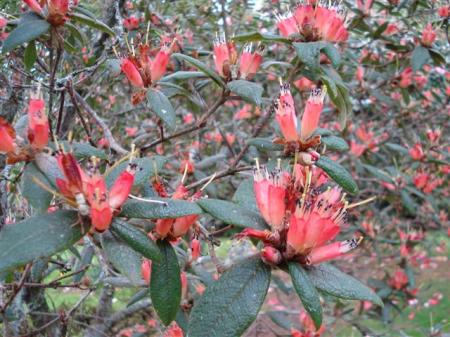
R. macgregoriae is flowering on cue again, as it has for about six decades now. This particular plant is quite historic for us, it being the original vireya rhododendron that Mark’s father, Felix, gathered in the highlands of New Guinea in 1957. In a courageous move, Felix headed over alone, plant hunting in an area where he was apparently the first pale skinned person the indigenous people had seen and a source of great curiosity. We should have asked him more about that trip while he was around to tell us. His thinking was that with altitude in the highlands, the plants may be more tolerant of our temperate conditions. He didn’t bring back a lot that stood the test of time – two beautiful scheffleras, a very odd fig tree (Ficus antiarus) and this resilient vireya rhododendron. This particular plant was used to start his vireya breeding programme and is a parent of ‘Golden Charm’, ‘Orangemaid’ and ‘Buttermaid’. Most gardeners will vouch that vireya rhododendrons tend not to be long lived so this one has achieved a truly venerable age.

July 10, 2009 In the Garden

• We returned from our UK sojourn to view the results of what Mark described as the largest frost he has not seen. Judging by the damage, it was a once in a decade frost (the renga renga lilies were burnt, for goodness sake) so Mark was relieved he had constructed a winter shroud for his precious bananas. Areas such as ours where severe frosts are rare, suffer considerably more damage from one-off events than colder places where plants are better hardened. We won’t be rushing to cut off the frost damaged foliage because this will give some measure of protection should we get another bad one.
• In the vegetable garden, you can continue planting brassicas (that is if you need more. If you have been faithfully planting them every week, you may want to take a week off lest you drown under the harvest of cabbage and cauli). For a change, you can start sowing carrots and onions. Cover carrot seed with a board or a strip of nova roof or similar to stop the fine seed from being flooded out before it germinates. We are assuming that by now all vampire repelling garlic aficionados will have planted their crops but it is not too late if you have yet to do it.
• Sow broad beans and if you have a good sheltered spot, really keen gardeners will be racing to get in the first crop of early potatoes. Make sure they are well sprouted. Peas are hardy and can be sown now. We saw crops of green peas to die for in English allotments which make our modest offerings look pathetic but picking fresh peas from the garden remains a taste treat for all, even if the peas never make it as far as the pot.
• Prune grapevines. If you are not sure how to do this, we will be featuring this in the Outdoor Classroom next week.
• Get a copper spray onto citrus trees if you have not yet done so. At the same time, you can put a protective copper clean up spray over all fruit trees if you are thorough.
• Prune, prune and prune. Roses, wisterias, hydrangeas and anything deciduous that needs a shape-up or trim back (except for cherry trees).
• If you haven’t yet done so, take off last year’s fruiting canes on raspberries and thin out the new canes so you don’t over crop. A bit of work now tying down the canes pays dividends when it comes to harvest time when rasps can put up quite a battle.