Vireya rhododendron macgregoriae

R.macgregoiae - the original plant

R.macgregoiae – the original plant

R. macgregoriae is flowering on cue again, as it has for about six decades now. This particular plant is quite historic for us, it being the original vireya rhododendron that Mark’s father, Felix, gathered in the highlands of New Guinea in 1957. In a courageous move, Felix headed over alone, plant hunting in an area where he was apparently the first pale skinned person the indigenous people had seen and a source of great curiosity. We should have asked him more about that trip while he was around to tell us. His thinking was that with altitude in the highlands, the plants may be more tolerant of our temperate conditions. He didn’t bring back a lot that stood the test of time – two beautiful scheffleras, a very odd fig tree (Ficus antiarus) and this resilient vireya rhododendron. This particular plant was used to start his vireya breeding programme and is a parent of ‘Golden Charm’, ‘Orangemaid’ and ‘Buttermaid’. Most gardeners will vouch that vireya rhododendrons tend not to be long lived so this one has achieved a truly venerable age.

July 10, 2009 In the Garden

• We returned from our UK sojourn to view the results of what Mark described as the largest frost he has not seen. Judging by the damage, it was a once in a decade frost (the renga renga lilies were burnt, for goodness sake) so Mark was relieved he had constructed a winter shroud for his precious bananas. Areas such as ours where severe frosts are rare, suffer considerably more damage from one-off events than colder places where plants are better hardened. We won’t be rushing to cut off the frost damaged foliage because this will give some measure of protection should we get another bad one.
• In the vegetable garden, you can continue planting brassicas (that is if you need more. If you have been faithfully planting them every week, you may want to take a week off lest you drown under the harvest of cabbage and cauli). For a change, you can start sowing carrots and onions. Cover carrot seed with a board or a strip of nova roof or similar to stop the fine seed from being flooded out before it germinates. We are assuming that by now all vampire repelling garlic aficionados will have planted their crops but it is not too late if you have yet to do it.
• Sow broad beans and if you have a good sheltered spot, really keen gardeners will be racing to get in the first crop of early potatoes. Make sure they are well sprouted. Peas are hardy and can be sown now. We saw crops of green peas to die for in English allotments which make our modest offerings look pathetic but picking fresh peas from the garden remains a taste treat for all, even if the peas never make it as far as the pot.
• Prune grapevines. If you are not sure how to do this, we will be featuring this in the Outdoor Classroom next week.
• Get a copper spray onto citrus trees if you have not yet done so. At the same time, you can put a protective copper clean up spray over all fruit trees if you are thorough.
• Prune, prune and prune. Roses, wisterias, hydrangeas and anything deciduous that needs a shape-up or trim back (except for cherry trees).
• If you haven’t yet done so, take off last year’s fruiting canes on raspberries and thin out the new canes so you don’t over crop. A bit of work now tying down the canes pays dividends when it comes to harvest time when rasps can put up quite a battle.

In the Garden July 3, 2009

• As you read this, we should be high in the air flying back from a few weeks looking at early summer gardens in southern England. Alas July is the most miserable month at home but at least we have a short winter in Taranaki compared to large parts of the world. It is already countdown to spring and within a few weeks the day lengths will be noticeably longer and temperatures significantly milder.
• We will be home to prune pretty much everything but those who heed our advice will be well ahead of us on the winter prune. Because we live in a mild coastal area, we prune hydrangeas at the same time as everything else. Those in cold, inland areas may wish to hold off on the hydrangeas until August. As with wisterias, do not cut off your hydrangeas at ground level and then wonder why they fail to flower. They flower on last year’s growth so you are taking out all spindly growths, anything too woody and ugly and then reducing the very long growths to the fat flower buds. If you look, you will see small buds and fat buds. The small ones produce leaves, the fat ones flowers. So cut back to the lowest fat buds you can find.
• As you work your way around the garden, get a good layer of mulch onto garden beds. This does wonders for your soils, encourages worm activity (as long as you use organic matter as opposed to inorganic weed mat, black plastic, gravel, stones or, horrors, tumbled glass), suppresses weeds and makes your garden look a great deal more loved and cared for. If you are in a summer drought area, you need to follow this up with another layer of mulch in spring to keep moisture levels up. Our preferred mulch is compost. Leaf litter is good. Pine needles work, especially around acid loving plants such as rhododendrons. Bark chip looks good and can be locally sourced. Calf shed shavings are good if you have a local source. Pea straw is a classic quality mulch but because we don’t grow peas commercially in our area, it is expensive and represents quite a hefty carbon footprint moving it here for you to buy when you can find local alternatives.
• Get your locally sourced New Zealand garlic planted soon, if you have yet to do it. It is a bit cold to be planting much else in the vegetable garden though sowing broad beans is fine.
• If you are getting cabin fever and you lack a glasshouse, cloches are worth investigating. Mark bought a Rolls Royce cloche last year. It takes a bit of putting up and down but greatly extends the planting opportunities. A cloche is relocatable and somewhat like a mini mobile poly house – support hoops that you move around and cover with clear plastic. As temperatures rise and the crop grows, the cloche is dismantled. A cloche will lift the internal temperature by several degrees, protect from frost and stop the worst excesses of rain from flattening tender young plants. The classic glass bell jar is Ye Olde English version of the protective covering for individual plants and you can buy modern repro bell jars. Cut off pet bottles are not as large and certainly lack any style, but will work to cover individual plants.
• If you are trying to make a hot compost mix, make sure you remember to turn your compost (it is what the garden fork is for, though to be honest we do it with the front bucket on the tractor here). You need to keep it aerated and ideally keep the cold rain off it. We cover ours with a heavy sheet of plastic.

How to dig and divide (hostas).

A step by step guide by Abbie and Mark Jury first published in the Taranaki Daily News and reproduced here with permission as a PDF.

New Outdoor Classrooms are uploaded fortnightly.

Flowering this week: the early snowdrops

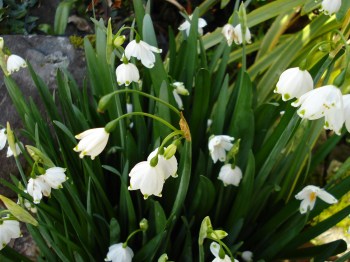
The “snowdrop” in NZ – leucojum vernum (left) The proper snowdrop – galanthus S. Arnott (right)

New Zealanders are vague on identifying snowdrops and often confuse the snowflakes that have naturalised in paddocks alongside daffodils with snowdrops. But people of English stock have no doubt at all as to what proper snowdrops are because they grow wild en masse through parts of the countryside, even bravely putting their heads through the snow. Proper snowdrops are galanthus and have three inner petals forming a dainty cup with an outer skirt of three long petals. The pure white flowers often have some green markings on them and they are simply the prettiest and daintiest things imaginable. Lacking snow, our snowdrops flower a little randomly and intermittently all winter but the main display won’t come for another month or so. We have several different forms of galanthus but in an area where we are marginal (they do prefer a much colder winter), galanthus S. Arnott is the most reliable form.

Snowflakes, by the way, are a different bulb altogether, being leucojums. They grow larger, have just the dainty cup flower without the 3 long petals, a remarkably long flowering season in spring, are easy and unfussy and are completely under-rated as a garden plant.