The Piazzas of Florence

Author: Lisa McGarry
Publisher: Allen and Unwin (RRP NZ $39.99)
ISBN 978 1 7419 6089 1 hbk

This exquisitely presented little book is a slightly obscure and self indulgent little gem. It contains detailed descriptions of 12 piazzas in Florence, including fold out maps, originally executed in water colour by the artist author and all backed by beautifully marbled paper. The text gives a multitude of detail – historic, architectural and modern day minutiae. The author is a well travelled American who currently lives in Florence with her daughter and is besotted with the romance of the city.

This is more than a guidebook, though if you plan on spending a few days in that fair city, carrying it with you would certainly enhance the experience. It is a gently understated and beautifully presented book which would grace the shelves of anybody who either loves Italy or who likes to own quirky and appealing books.

In Praise Of Plants

We have been watching Around the World in Eighty Gardens on the Living Channel. Sadly we wised up too late to the fact it was screening to catch the New Plymouth garden, Te Kainga Marire, which was featured in one of the early episodes but we have seen Monty Don (the host with an unlikely name) gallivanting around South America, the United Kingdom and Europe visiting gardens of his choice across the whole spectrum from very grand to very modest.

There is a bit of an open verdict here about our Monty as a garden host, though it did strike us in the last episode that he does not show much interest in plants. He is presenting gardens as form and vision through history across the globe and certainly has a fine grasp of the big picture and an avid interest in the social milieu which prompts the establishment of different types of garden. Big picture gardening makes good television and is undeniably impressive but can also be quite impersonal. To be fair, Monty does intersperse with some little gardens but he does not focus on the plants. Maybe our ambivalence is because we like to see the little pictures within the big frame and gardening to us is all about a passion for individual and interesting plants as much as good form and design.

We caught another programme which showed a London garden which was all green with not a flower in sight. They claimed no flowers at all but I am sure I saw a rhododendron so either the owner disbuds it or there was a slight exaggeration. It was a garden which was all about form and nothing at all to do with colour or seasonal change. Certainly it had a restful quality but it could perhaps be a little gloomy at times.

Would I ever want to garden without flowers and seasonal change? Never. If we didn’t have the flowers, we wouldn’t have the tuis. At the moment the campanulata cherries are in full bloom. The tuis don’t sit still long enough for us to take a census but there must be over a hundred of them bickering and squabbling over the bounty. Photographer friend, Fiona Clark, has been videoing our tuis for the last two seasons and I will advise the website address when the sequence goes on-line but she became a little frustrated last week when one large and aggressive tui decided an entire tree she was filming at the time was to be his and his alone, fighting off all pretenders. Tuis are territorial birds not given to living in happy harmony, but it is a delight to see trees which are alive with swarming birds and to see entire flocks flying in to the most desirable trees in the morning.

Campanulatas are the Taiwanese cherries (as opposed to the later flowering, more delicately coloured and often fluffy Japanese cherries). They can set seed a little too freely and indeed have been declared a noxious weed in Northland so if you are planting them, look for ones advertised as sterile, or that set minimal seed. While they can provide splendid food for tuis, we don’t need a jungle of wildlings in our native bush. If you already have one that seeds, stay on top of the seedlings because they are deep rooted and not that easy to eradicate if you let them get away on you. Our resident pigeons have reduced our crop of wildlings in recent years.

If we gardened without flowers, we would not have had the ephemeral delight of the English snowdrops (galanthus) or this week’s dwarf daffodils which are in full flight. Similarly, if we gardened with only the big picture in mind, we wouldn’t be enjoying these tiny treasures either.

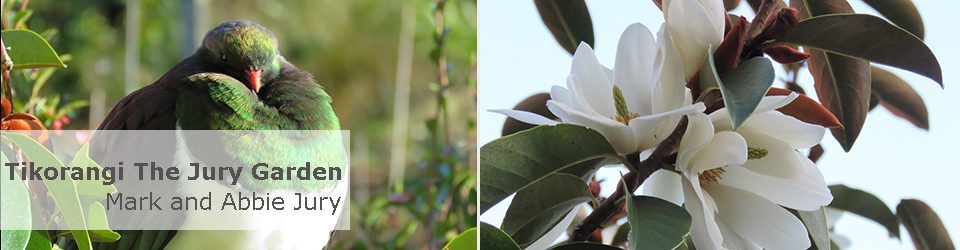
Magnolia Burgundy Star in full glory

Magnolia Burgundy Star in full glory

Burgundy Star is just opening her flowers. Photo Abbie Jury

The flower-free zone would also mean missing out on the magnolias which are opening now. I had a very pleasant interlude at the weekend with a visit from an Auckland architect who was seeking magnolias for her new garden. Not for her the uniformity of evergreen magnolias or restricting her range to one variety only. No, she was after big, blowsy, spectacular and seasonal. I warmed to her instantly, recognising a fellow traveller. She knew and I knew that she was overplanting her small section, but she wanted to fit in as many OTT trees to cover as long a flowering season as possible. That exuberance is refreshing in an era when good taste in gardening and design is often equated to restraint bordering on the anally retentive. And it is unusual in somebody who works professionally in the design sector without a great background in plants.

A flower free, or all green, or totally evergreen garden is usually designed to be as static as possible. Ditto the low maintenance garden. The creative process happens once at the very beginning. From then on it is straight maintenance, outdoors housework. There may be a bit of a makeover or renovation every five years or so but basically it is repetitive work to maintain the status quo. As one who finds housework a dull but necessary chore, the prospect of reducing gardening to the same level of repetitive activity does not appeal at all.

What I like about gardening is the constant creative thinking and action. To achieve that, you need to be willing to change the scene by altering planting combinations, adding extra bits of interest, replacing underperforming plants, getting excited about discovering a plant you didn’t know about before, coming upon something new in flower or growth each week and responding to the changing environment. Those are the interesting parts, not doing edges and clipping and weeding.

It is the vibrancy of plants and seasonal change that give life to a garden and for us that includes flowers and vast range of different plants all of which have their time to shine. Good design gives a framework to hold it all together visually just as good architectural design can create a splendid house but does not make it a home. Good maintenance presents it well. But it is the plant selection that makes it come alive. We will stay with the flowers and the birds here and watch the tuis while rejoicing in the OTT display of tree magnolias in full flower over the next month or two.

August 15, 2008 Weekly Garden Guide

There we were hailing the arrival of spring last week, only to be assailed by not one but two frosts at the weekend and more cold weather and rain during the week. But the plants are telling us that spring is on the way and the prettiest time of the year for flowers is just starting.

  • Over sow bare patches in lawns. If you feel you must use hormone lawn sprays to get rid of broad leafed weeds, it is best to get onto it as soon as we get a reasonably dry spell. Even with very careful application, some spray drift can occur and badly distort new growth on surrounding plants, particularly deciduous plants so you don’t want to be using hormone sprays when leaf break starts. You can however dig them out by hand at any time and feel virtuous at your decision to avoid the use of chemicals.
  • You can still be digging and dividing clumping perennials but the highest priority in the ornamental garden is to get the winter pruning of deciduous plants done.
  • Sasanqua camellias can be pruned and shaped now. They are the autumn flowering camellias.
  • If you have green crops in the vegetable garden, start digging them in to give them time to break down before you put in the spring and summer crops.
  • It is still a little early to get carried away planting in the vegetable garden unless you know what you are doing. Better to use your time preparing the beds and starting the plants in containers and trays to plant out when we have well and truly turned the corner into spring.
  • One organic reference book counsels pruning apple trees now but leaving stone fruit trees until just at the point where they are going into growth in early spring. This apparently reduces the chances of disease getting into the cuts. One of the tenets of organic gardening is that healthy plants withstand diseases and pests best so if you are leaning in the organic direction, give a high priority to plant health and care.
  • Keep on top of weeds.

Potatoes are of course originally from South America and were introduced to Europe by the Spanish in the middle of the sixteenth century. It would be fair to say that they were not an instant hit. Indeed some even believed that the potato caused leprosy (on account of its lumpy, pockmarked appearance) and the Protestants rejected them because of the South American association with Catholicism. The Germans used to feed them primarily to animals and prisoners while in the same vein, the English gave the potato to the Irish (parsnips were preferred as a staple food in the mother country). How the reputation of the potato has changed over time.

August 8, 2008 Weekly Garden Guide

Certainly in the north we are warming up noticeably and the grass is starting to grow again. While we will no doubt get a few more wintery blasts, when the sun comes out it is feeling positively spring-like. In the gardening world, this means that the pressure is about to increase exponentially to finish the winter pruning and clean up round.

  • Climbing roses get pruned differently to shrub roses. Tie in the long whippy growths for the first three years after planting and resist the temptation to prune them back. If you can undulate the whips along supports or train them more or less horizontally, it encourages all the side shoots to sprout and hugely increases the flower production. After three years, take out the oldest, woodiest stems and replace them with fresh green whips on a rotational basis. Prune back the side growths from the tied-in whips, to a few buds just as you do with wisteria. Climbing roses are not the easiest of subjects to prune and tend to be very vigorous but you may live to regret it if you fail to prune them hard.
  • Beware an explosion in weeds which is just about to happen. If you can stop this first seeding of the season, you will substantially reduce your workload later.
  • It is an ideal time for planting woody trees and shrubs. Put in now, they have time to establish themselves before the dryness and heat of summer. People on sandy soils which dry out faster, should take particular note.
  • It is time to be vigilant on slugs and snails again. These unwelcome critters will be multiplying up nicely and nipping off all your young shoots. Some intensive control now will reduce numbers later but you do not need to use slug bait like fertiliser. One bait can kill several. Digital control, beer and other environmentally sensitive approaches are also kinder to hedgehogs, birds and the odd suicidal family dog.
  • Container plants should be repotted every two years or so, especially if they are somewhat rootbound. It is a good time to attend to them now so they can settle in again before making spring growth. If you are intending to prune the roots to make them fit back into the same pot, then it is even more important that you do it without delay. Hose off all the old potting mix and make sure you prune the top of the plant to reduce stress. Slow release fertilisers were developed for container plants. We don’t recommend their use in the garden generally (there are cheaper, more environmentally friendly options) but we do use them in pot plants. If your plant is destined to stay undercover, halve the recommended rate of fertiliser to avoid burning the plant.
  • Early sowings will be starting in the vegetable garden – potatoes in warm areas, peas (pick an early cropping variety), turnips, carrots, parsnips, summer spinach and beet. A reminder that if you are buying asparagus divisions, you are likely to have more success with them if you get them established and growing well in pots before you plant them at the required 10cm plus depth in the garden. Asparagus is a bit of a long haul crop at the best of times (you will be waiting three years for the first harvest) and it is a permanent fixture so it is worth this extra effort and delay.

According to The Curious Gardener’s Almanac, over three quarters of all garden chemicals sold in Britain are for the improvement of lawns. It is likely to be similar here and that is a disgraceful situation when you think about it. Time to rethink attitudes to lawns.

Thinking Small in the Big Country

We had cause to travel to Australia a couple of weeks ago for a family celebration. Fortunately, given our timing, we were in Wollongong (south Sydney) and Canberra and our paths only crossed with the 125 000 Catholic pilgrims when it came to flying out of Sydney airport. We avoided the chaos of Sydney, which also meant we missed the Pope. But as I noted the austerity of St Peter’s Square and the near total absence of any vegetation in the Vatican City when I was there a month ago, I doubt that we would have been able to discuss gardening with him.

We have never been to Wollongong before and despite it being a somewhat industrial area, we were rather taken by it. Its location ensures a higher rainfall than many other parts of Australia and the climate was almost balmy. The soulangeana magnolias were at their peak (little sign of them showing colour here) and the presence of sub tropical plants, including an abundance of frangipani, indicates that the area never gets particularly cold. The beautiful blue sky and expanses of pristine beaches had us thinking that maybe Australia is indeed the lucky land. Certainly we did not hear the doom and gloom talk of home. Mind you, that may be a superficial judgement because the TV only showed wall to wall happy, smiling pilgrims.

After a tiki tour of the area which involved much bonding with her father identifying and discussing the multitude of exotic Australian birds, Elder Daughter drove us to her second home in Canberra. I have been to that city before but it was a first for Mark and he was a little shocked at the harshness of the climate. In winter it is very dry and very cold while in summer it is very dry and very hot. He whispered to me that he much preferred Wollongong. Gardening as we know it just is not possible in Canberra.

Daughter commented that none of the Aussie TV gardening gurus she has seen appears to have come to grips with practical design suggestions for front yards. The private courtyard out the back has been done to death, but there is a dearth of ideas when it comes to dealing with the waste of space out the front. Irrigation is on a semi permanent ban so the front lawn and garden does not survive. The only alternatives appear to be green nylon lawn (!) or dyed bark chip mulch (referred to as tan bark). Daughter was suggesting that if she had a front yard, she would be looking at buying a truckload of massive rocks and establishing a rock garden (more rock than garden). Or maybe try a meadow of anigozanthus (kangaroo paws) which, being native, might fare better.

Nylon lawn at up to $120 a square metre

Nylon lawn at up to $120 a square metre. Photo Abbie Jury

Post celebrations (no, neither a wedding nor a grandchild), Daughter and her partner indulged us by taking us to the somewhat remarkable Cockington Green Gardens which had possibly more than a nodding affilation to the genre of Fred and Myrtle’s paua house in Invercargill. No paua, but scaling hitherto unconquered heights of being twee to the point where it takes on a life of its own. It was started by a passionate Anglophile model maker and has recently been expanded with an international section (mostly sponsored by foreign embassies). Leaving aside the plethora of miniature scale buildings, cricket match, soccer match and all the rest of it (and there was a lot of the rest of it including fairy garden and miniature trains), the gardening was dominated primarily by dwarf conifers and clipped and topiaried buxus. Alas we can not get that excited about masses of dwarf conifers, but it was certainly clear that in a much colder climate the conifers colour up a great deal better. The silver blues and burgundies made our few at home look very subdued.

The Treaty House at Cockington Green

The Treaty House at Cockington Green. Photo Abbie Jury

New Zealand was represented by a model of the Treaty House at Waitangi. If I remember correctly, it was the only one not sponsored by the Embassy but I think by an individual instead, which may possibly be an indication that our ambassador to Australia has better taste. After our initial amusement, we were underwhelmed by the gardening at Cockington Green but envious of the evidence of large tourist numbers. Given that Canberra is hardly a tourist hotspot, it makes you realise how few we actually get in Taranaki.

Conifers and buxus and a toy train at Cockington Green

Conifers and buxus and a toy train at Cockington Green. Photo Abbie Jury

As an antidote to the OTT naff nature of Cockington Green, we headed off to the botanic gardens which are devoted entirely to native Australian plants with a purity of purpose which is not necessarily a populist position with locals, who may well prefer some bedding plants and colour. And the dry, open areas were a little arid with no underplanting at all. The hardy natural flora of Australia is nowhere near as exotic as their fauna and around Canberra is heavily dominated by hardy eucalypts. It wasn’t until we reached the bushland plantings that we went: oh yes. As New Zealanders, we take for granted our lush growth, both in the natural environment and in the contrived garden. It is a concept largely foreign to those who live in much harsher environments.

Mark was grateful for the relative absence of plant eating fauna at home. We would be less than impressed to have kangaroos peering out from the understory of the garden and effortlessly hurdling our fences. Possums here are a pest but at least we can shoot them – they are a protected species in Australia. The rosellas, vast flocks of sulphur crested cockatoos, crows and an abundance of other birdlife can wreak havoc in an environment where their main of source of food includes your garden plants. And at least we never got foxes courtesy of the British settlers. We saw tree ferns (yes, Australia has a range of tree ferns of their own) where the new growth had been stripped bare by rosellas in search of the spore.

There really is no place like home and the verdant green environment that we take for granted here is really quite rare. We would rather be here than there. They may be the lucky country economically, but we are the lucky gardening land.