Who knew that magnolia petals are edible and, when pickled, make a pretty fair substitute for that pink pickled ginger (gari) often served with sushi? I didn’t, until it came down my social media a few days ago but plenty of other people did. I found this out when I googled ‘pickled magnolia petals’. Even Jamie Oliver has a recipe for them on line.
The recipes seem to be fairly uniform and not at all complicated.
Four cups of petals ready to be blanched
Bringing the pot back to boil for 30 seconds
Pick four cups, loosely packed, of fresh magnolia petals (see my notes below on petal selection).
Blanch the petals in boiling water for 30 seconds then drain, cool quickly and dry. I laid them out on paper towels.
Boil 1 cup of apple cider vinegar, ½ cup of sugar, 1tsp salt and a 2cm knob of peeled ginger.
Pack the petals in a clean jar and pour over the boiling liquid. Mine filled a Roses marmalade jar.
Seal and leave for 24 hours. Once opened, store in the refrigerator.
Surprisingly, they do taste and handle remarkably like the pink pickled ginger.
Magnolia petals are edible fresh and can be used in salads – but I can not describe them as delicious. The outside petals can get a slightly bitter after taste. Maybe take a few bites to sample when picking to pickle and you will soon get a feel for which ones will pickle the best.
I picked a mix of colours – red, pink, yellow and white. It is too early for me to advise whether some colours taste better than others. Others declare that different varieties of magnolias have different flavours but I wanted to post this before magnolia season finished so maybe we can crowd source reader opinion on this?
Four cups fresh petals to one jar pickled
Next time, I will keep to younger flowers. It is easier to handle petals that are on the smaller side so the cup-shaped magnolias (often soulangeanas) are perfect candidates and bruise less than the large cup and saucer blooms with huge petals. I wouldn’t cut the petals as one recipe advised because they instantly turn brown which is not a good look.
My pickle is still very fresh but it is certainly tasty with cheese on a cracker. I plan to do a second jar to keep sealed until summer when I make sushi again but I can see it will be handy to use as a fresh pickle in many contexts, not just limited to Asian inspired dishes. It is certainly cheap and fast to make.
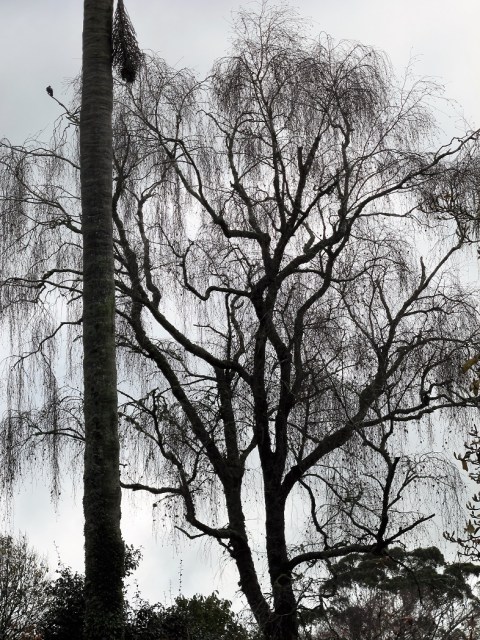
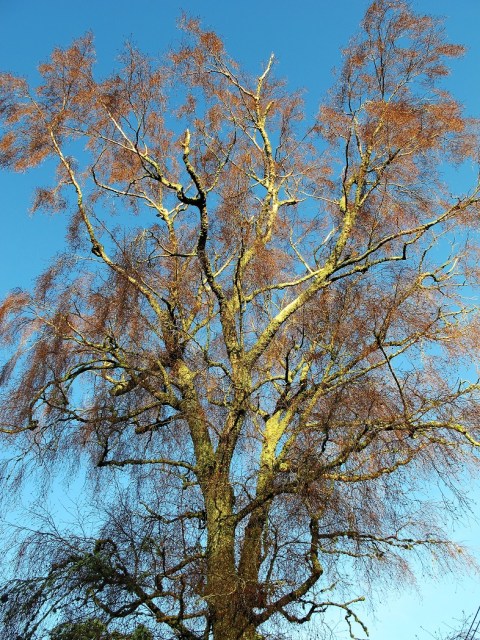
It is just a common old silver birch – Betula pendula. It is not even one of the more highly prized white barked or named forms. There is nothing special about it botanically speaking. It is not well suited to our conditions because it prefers a drier climate and it is hardy to cold winters. It is really messy, dropping fine twiggy lengths all year round which get caught in the lower canopy plants and it defoliates by late summer because rust attacks the leaves. Of late, it has been dropping not just twiggy sprays but also smaller, dead branches.
Nevertheless, I felt a distinct sadness when I looked at it yesterday and thought ‘No, it is time for you to go. The decision can not be delayed much longer. Tree euthanasia’.
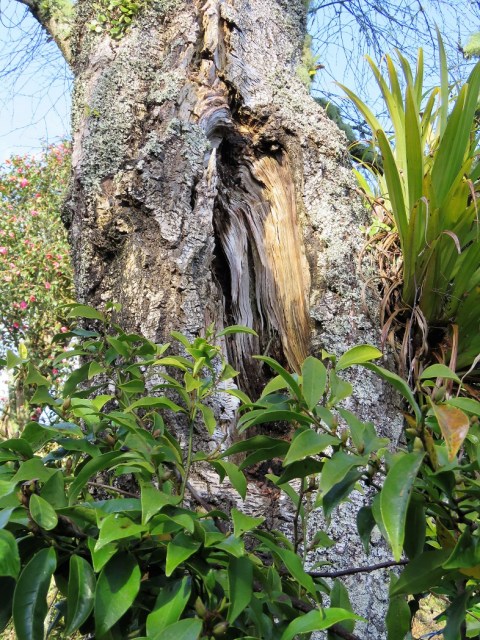
That is a big scar on its side
It is one of the original trees that Felix planted back in the early 1950s when he started the garden. A large branch dropped out in the early 1980s and Felix suggested then to Mark that he could cut the whole thing out. But Mark decided not to and just did a clean-up. Now it appears that the tree is rotting from the scar of that episode but at least we have had an additional 40 years of pleasure from it.
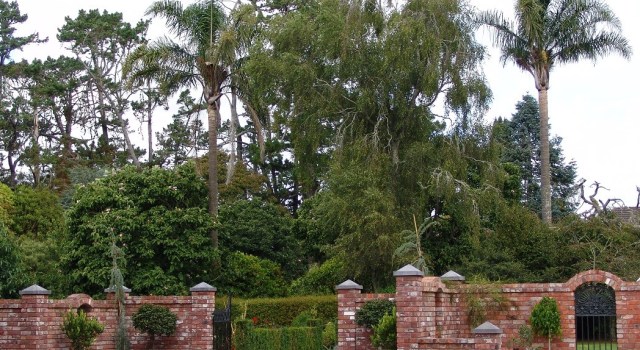
I was a bit surprised by this 2005 photo. It made me realise how much smaller the tree had become in the intervening years. That is it between the two queen palms
Why do I like it? I love the graceful bare form silhouetted against the sky. It has always been part of our view from our favoured seating spot in the front porch where we often sit together for a coffee, tea or wine. I have photographed it countless times, simply because of that silhouette. Given its propensity for early defoliation, we get the silhouette unimpeded by foliage for at least seven months of the year now, maybe eight. When I look at older photos, it certainly used to have a lot more foliage and branches than it has now.
A convention of Mark’s tumbler pigeons
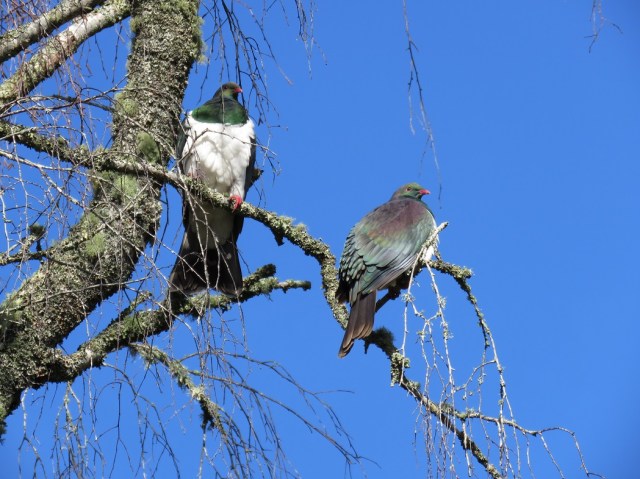
Kereru in the birch
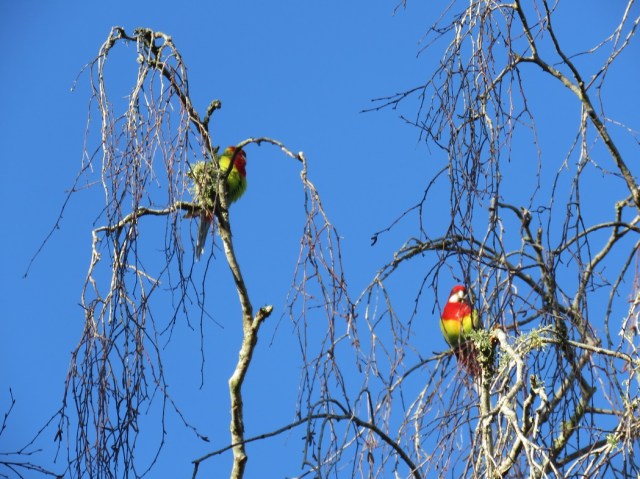
The birds love it. It is a favoured staging post, whether for Mark’s tumbler pigeons, our native woodpigeons – the kereru – rosellas, common old sparrows, tui and the rest. It has birds resting in it, surveying the lie of the land, almost all the time. It is not a feed source, it just gives a good view. There are plenty of other trees around and I am sure the birds will adapt quickly but I will miss the sight of them pausing there on their busy rounds.
Australian rosellas – so gaudy compared to our native birds
It will be a job for our arborist. While access is easy and it is not a difficult tree to remove, it has a lot of rot in it and it stands maybe 15 metres high. But really, the concern is for the low stone wall that separates the driveway. Felix built the wall back in the early 1950s and it is a patchwork of wafer-thin split stone. We don’t fancy having to rebuild a section of it if we dropped a big branch on it. Our arborist is very good and he will manage to avoid such damage. But it can wait until our garden festival is over in November.
The low stone wall is now more important than the tree
I have decided I just can’t get excited about hellebores. The most common hellebore – Helleborus orientalis – in particular, but not exclusively so. Not in our conditions with its mild climate and the explosion of spring flowers we get before winter has even officially ended. I have seen them in colder climates and they are way more rewarding than here.
Orientalis as a garden plant just doesn’t spark joy for me
I have tried and so has Mark. I have mollycoddled them, replaced inferior performers with better selections, weeded out endless seedlings, scrupulously dead-headed them to reduce unwanted seeding and to hold the infestations of aphids at bay, removed unsightly foliage (it takes years for scruffy spent foliage to drop and decay of its own accord), given them compost, bought new selections and still they are underwhelming. Mark has raised many seedlings of controlled crosses to get cleaner colours and flower spikes that stand above the foliage and they can look very promising in nursery pots and very average in the garden.
I don’t know how many H. niger we have raised and planted out. It is the pretty, low-growing white with the upward-facing flowers held just on the foliage. It is a one season wonder for us. I was delighted with ‘Angel Glow’ but after three very pretty seasons, it has all but disappeared this year.
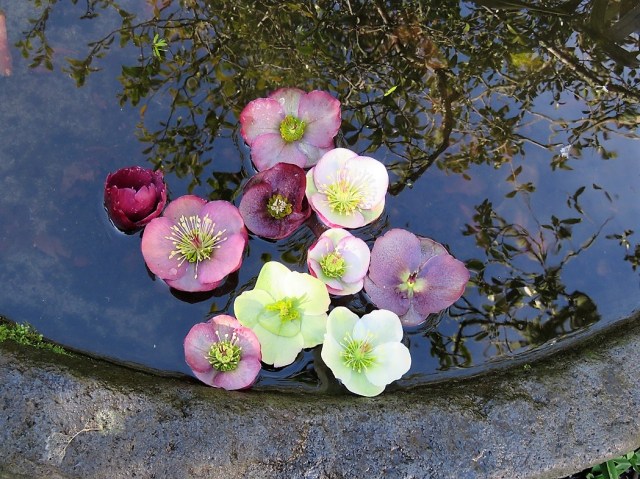
The temptation was too great. I floated flowers from the ‘Marbled Group’ but it is their all round performance as garden plants that impress.
They are not all without merit. I remain sold on the ‘Marbled Group’ from UK breeder, Rodney Davey. ‘Anna’s Red’ and ‘Penny’s Pink’ remain the best of that series in our garden but we also have ‘Molly’s White’, ‘Ruby Daydream’ and ‘Sophie’s Delight’. Just a word of warning: ‘Anna’s Red’ made a big and luscious plant so I thought I would divide it to use it further. It did not appreciate this treatment and has been slow to recover- as in a few years, not months. Mark informs me that hellebores do not generally like being dug and divided in the same way as other perennials. They can sulk somethin’ chronic.
Helleborus x sterniiHelleborus foetidus
Helleborus argutifolius
Helleborus x sternii is a mainstay in the woodland garden and very easy care. All it ever needs is the spent flower spikes removed at the end of the season. So too with H. argutifolius which is one of the parents of x sternii. H. foetidus is fine – more utility than exciting and it can spread a bit but it has interesting foliage. What these three have in common is that they all have green flowers but hold their flower spikes up above the foliage.
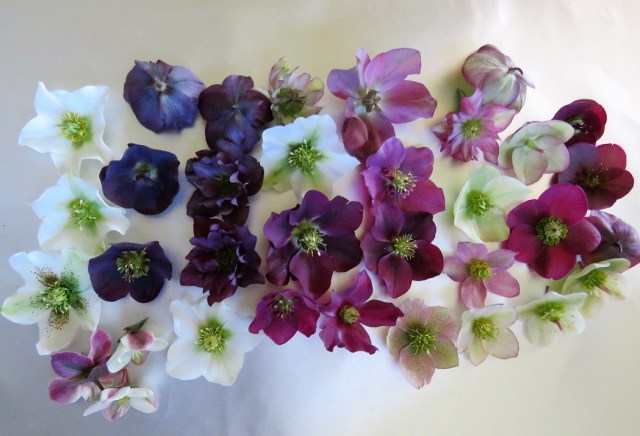
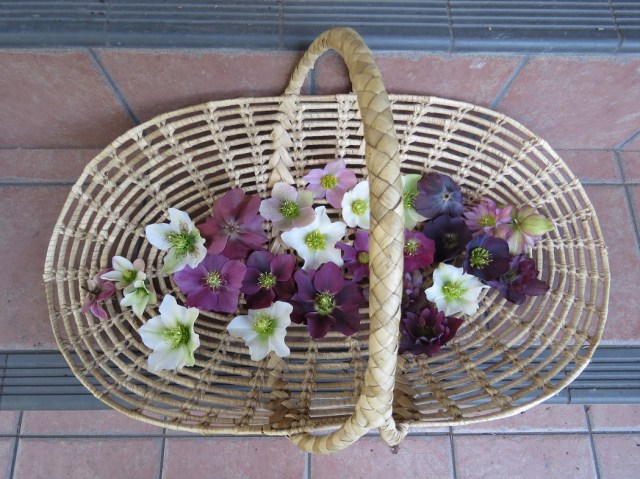
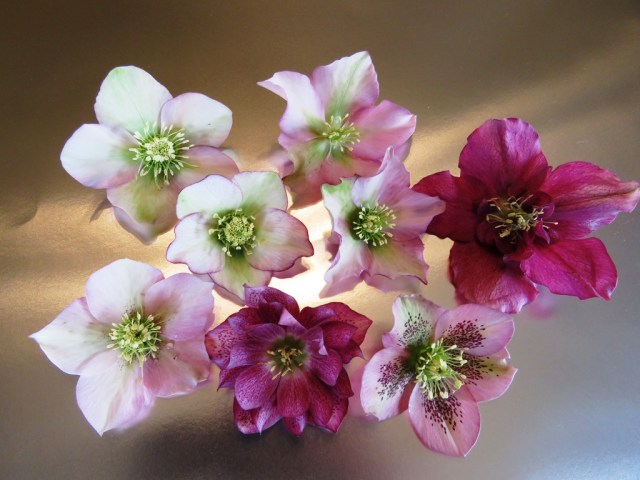
The staged photo of cut blooms shows they are individually pretty but I do not generally rate them as garden plants in our conditions
And therein lies the problem. There are many lovely staged photos of picked blooms arranged to face upwards. I have done a few myself. But that is not what they look like in the garden where H. orientalis is characterised by downward facing blooms. And as soon as one gets into the popular double blooms, the extra weight drags them over even further. Also, the interest in the dark slate colours – the deeper purplish-black the better – is based on picking a flower and looking at it facing upwards. As a garden plant with those dark flowers, they just tend to meld into the backgound. The best I can say is that orientalis opens a wider colour range than the other types we grow.
This sight sparks more delight for me than rather lacklustre H. orientalis – and comes at the same time of the season
While I am in awe at the far-reaching and long-standing enthusiasm that has made H. orientalis such a popular plant, they are best in cold climates which don’t have the same options we have. Colder, drier climates are even better. With calanthe orchids and Hippeastrum aulicum both in full bloom at the same time, I am not convinced that the utility hellebores that grow in similar conditions are worth more effort on my part. If you really want to grow them in softer climates like ours, keep them in a pot. They seem to perform better in controlled conditions. I don’t love them enough to give them that sort of special attention.
Yet another staged photo. I see I have done a few of these over the years.
Here we are again, in lockdown across the whole country. Where we are in Taranaki, we haven’t been in any form of lockdown since May 12 last year, which must seem pretty astounding to most of the world. I think it is 170 days since we last had a Covid case in the community anywhere in the country, though there have been plenty caught and isolated in mandatory quarantine at the border. Despite the evidence to the contrary, some still persist in describing our Covid status as dumb luck. I am not alone with an uncomfortable feeling that there are people who would be delighted to see us fail. Some of them even live in NZ – an example of political allegiance taking precedence over common sense and humanity, perhaps?
What is disconcerting is to see the spiteful glee from some on social media. Mostly men from the UK, Canada and the USA, they are referred to on Twitter as ‘the northern hemisphere reply guys’ because they will pop into conversations to sneer and jeer, delighting in how our country is now grappling with a Covid incursion. It proves them right, you see. Given how many of them don’t even realise that Australia and NZ are actually different countries separated by an ocean (It is a 3 hour flight between), I think it may be time to dig out all those world maps that leave NZ off entirely. I would be quite happy if they just forgot we existed again. ***
Currently happy for our country to fall off world maps
It seems New Zealand is going to be splendid test case for whether it is actually possible to contain and then eliminate the Delta strain when it is loose in the community. If it can be done, we will do it over the next few weeks but at this stage, the outcome is unpredictable.
Like everybody else, my real life world has become much smaller again, focused inwards within the boundary of the bubble I share with Mark and Dudley dog.
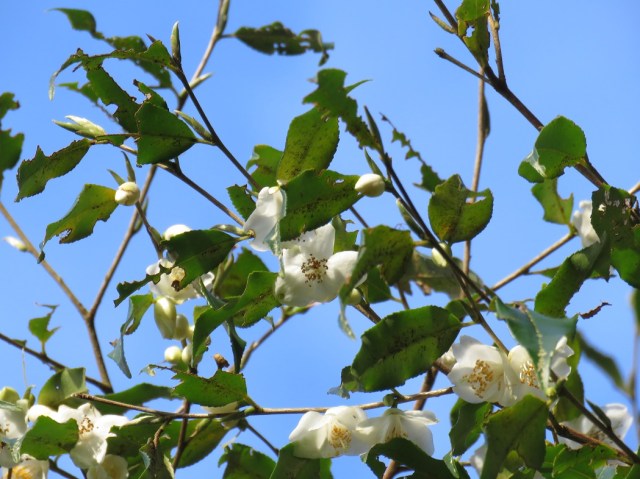
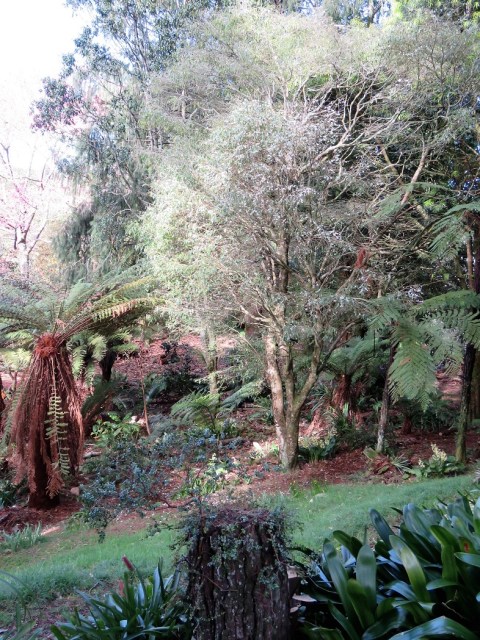
That airy tree in the centre to the right of the tall tree fern is Camellia tsaii
Sometimes I get a reminder of my ignorance. Camellia tsaii is the one of those. It is a species camellia with tiny white flowers and small leaves with a serrated edge. We used to grow it in our nursery days and I see it is still produced commercially in New Zealand and often commended for its fragrance (more ‘light scent’ than fragrant, in my book) and its arching habit of growth with an estimated height of 2.5m.
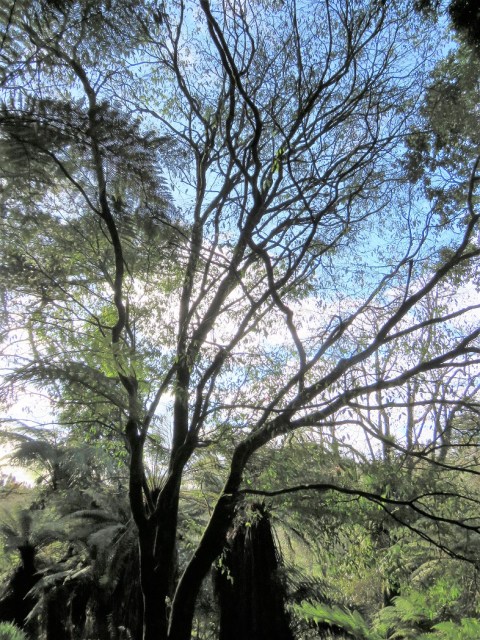
Yes, those little blooms which measure about 2.5cm up are lightly scented but as they are a good 7 metres up, it is a bit irrelevant
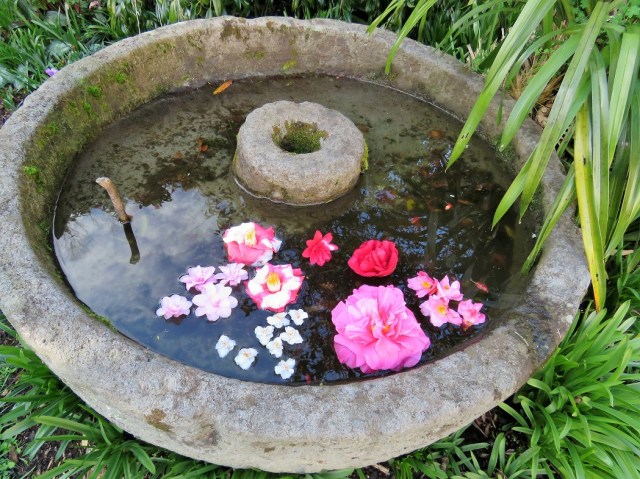
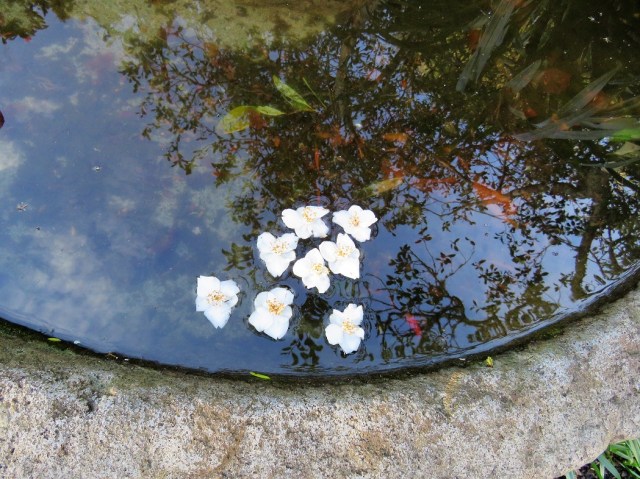
I gathered a few of the fallen flowers to float in the old stone mill wheel which we use as a bird bath
Somehow, it took me a long time to make the connection between those tidy, bushy little plants about 80cm high and this plant in the garden. Behold Camellia tsaii, admittedly many decades old. It still has masses of tiny flowers – lightly scented – and feeds the tui. So too does it have the typical serrated foliage and graceful, arching growth. It is just that it is about seven metres high. I am sure the customers who bought a plant from us back when we used to retail were never advised that it had the potential to become a graceful, small tree.
Camellia tsaii – a tick for arching, graceful growth
It used to be larger but a chunk was brought down with a large branch falling from a tree above. Mark recalled a totally random piece of information. Most camellias make good firewood but tsaii was different. It was a much lighter wood and it sparked horrendously. Mark is a wood connoisseur, you understand, having been a woodturner back in his younger days and with decades of experience bringing the winter firewood into the house. He can always identify which wood we are burning and will balance the daily winter woodbaskets between quick-burning and slower-burning firewood. Tsaii originated in Vietnam, Burma and southern China, and I wonder whether the lighter wood is an indication of it being a lower canopy forest tree.
It is however a handsome little tree, our Camellia tsaii, is it not?
As viewed from the sunny side with a cloud of tiny white flowers
May you stay safe and well wherever you are. My totally non-scientific observations from social media tell me that cinnamon scrolls and cheese puffs are the dominant baking themes this lockdown. Given it was sourdough bread last time, these quicker options might suggest we are hoping to triumph over Covid sooner rather than later. All I can offer is the best cheese puff recipe I have tried. It does need tapioca flour which is more widely available now than it used to be. I haven’t been out but if your local Asian supermarket is still open, it seems to be a staple there if Countdown and New World don’t have it.
Kia kaha.
Abbie
This cheese puff recipe couldn’t be easier and has never failed me
*** Just as an example of how vile the spiteful glee can be, here is somebody called Matthew Lesh who writes for the Telegraph in the UK starting a gloat at NZ’s expense with “Poetic justice is beautiful”. What on earth is wrong with these people?
Goodness, gracious me. Just eleven weeks until we open for the annual Taranaki Garden Festival. Well, ten weeks and five days to be precise. October 29 is D-Day.
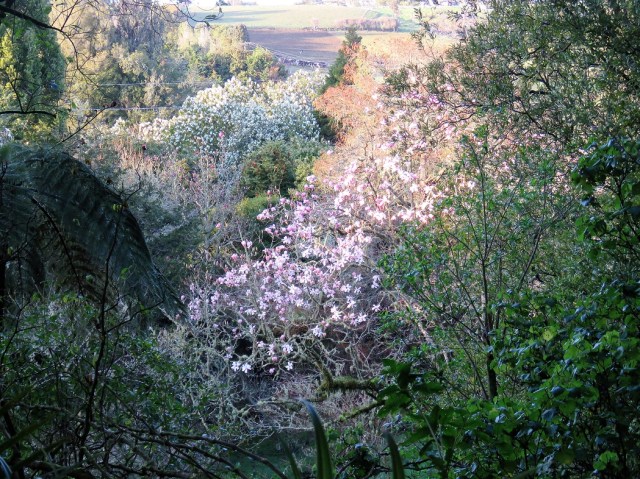
A view down into the park yesterday with Magnolia sargentiana robusta in bloom and the neighbour’s winter grazing across the road in the background.
I am not starting to panic. No sirree. The advent of an extra pair of skilled and motivated hands in the form of our Zach has taken away the pressure I felt last year. Though last year, as I was getting stressed by how much I wanted to get done, we had no idea that Covid and the difficulty of overseas travel would result in the biggest festival ever for us. We had three times the number of people we were expecting. It was fine. Our garden is large enough to absorb a lot of people without it feeling crowded. It is just a challenge as far parking and toilet facilities go. The poocalypse was memorable.
This year is shaping up to be another boomer of a festival, if early bookings and programme requests are anything to go by. It is not that we can’t travel overseas from NZ. We are not like Australia where they have to request permission giving sufficiently important reasons to be allowed to travel offshore. We can leave. It is getting back into the country that is the barrier – trying to book a place in MIQ (as we call our managed quarantine programme for almost everybody entering the country) is so difficult that few people want to risk it. And even more of us don’t want to travel overseas at this time. NZ seems a very safe haven. There is always the risk of Delta getting in but so far so good. I will be really miffed, though, if we get an outbreak just before the festival…. It is already disappointing enough that Covid in the community in Australia will probably keep that travel bubble closed, making it impossible for any Australians to cross the Tasman this spring.
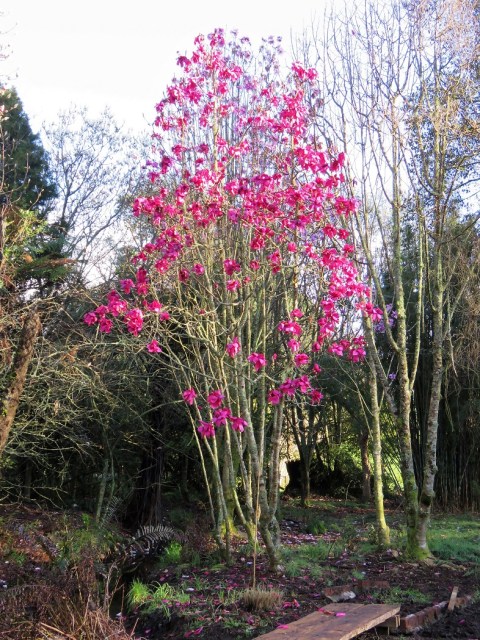
An unnamed seedling magnolia of Mark’s down by Lloyd’s latest bridge. It is actually red but my camera has rendered it bright cerise.
We have never been so well prepared this far in advance. Ten weeks and we have broken the back of the major preparation work. We just need four weeks at the end to do the final round of presentation so all seems well in hand at this time.
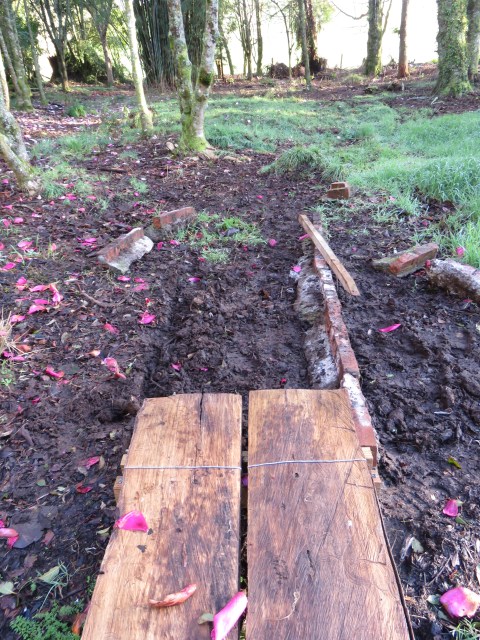
Lloyd’s latest bridge needs some work on the approaches
Lloyd has built the last bridge essential for access around the new Wild North garden. He has had to make this one higher because the ground is boggy beneath so is now constructing some all-weather access to it. Because we live rurally on a reasonably large property, we have room to store materials that we may need one day. Who knew that the brick and concrete edging to a garden bed we dismantled some years ago would be just the ticket for retaining the edges of the access paths? We will have to buy in some pit metal, though, to get a safe surface to that area of path.
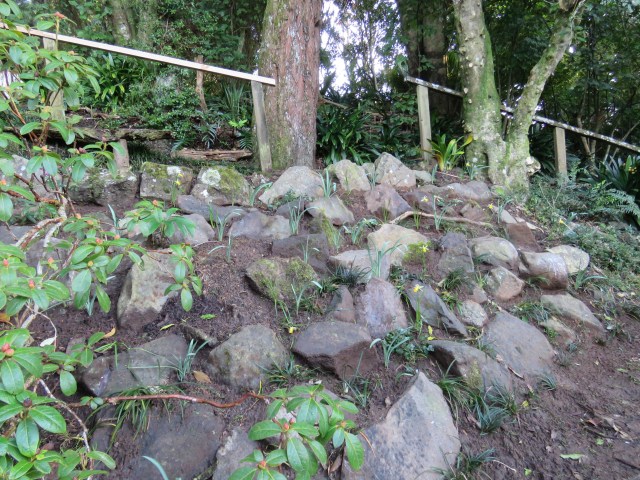
Zach’s accidental rockery project
Zach was pleased to find a stack of big rocks to build his accidental rockery on the steep zig-zag path down to the park. I say an accidental rockery because he really only started by trying to retain the soil on the steep bank so it didn’t scour out and wash down onto the path below in heavy rains. It was part-way through that it became clear that he was actually constructing a semi-shaded rockery. I found him assorted suitable plants to fill it – the Australian native Veronica perfoliata, trilliums, snowdrops, Mark’s arisaema hybrids, little narcissi – to add to the Solomon Seal and green mondo grass that are already doing an excellent job of holding the soil.
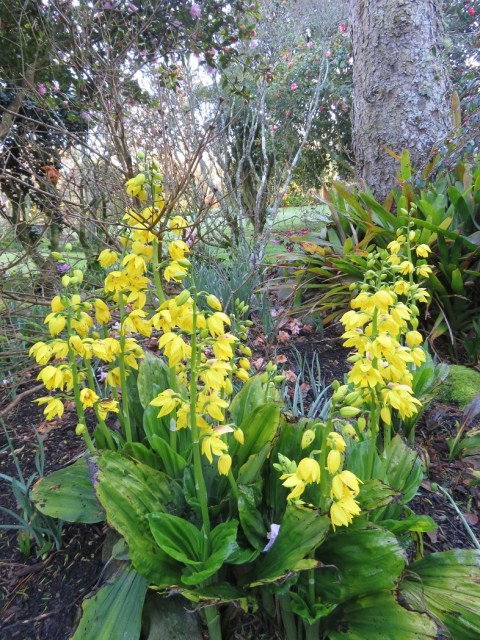
Calanthe orchids one
… and calanthe orchids two. There are many more in the garden but just these two varieties in bloom at this time.
It is a lovely time of year, despite winter’s last gasps and storm fronts. Where I am working on the margins of the Avenue Garden, the calanthe orchids are at their charming peak. In fact, everywhere I look, there are spring flowers out and a whole lot more in bud. We are on the cusp of peak magnolia season. Mark is spending many hours doing his circuits of his magnolia and michelia seedlings to assess performance.
We are busy but on track. And oh my, I couldn’t think of a lovelier place to be busy.
A reminder about our Festival workshops:
Gardening on the wilder side
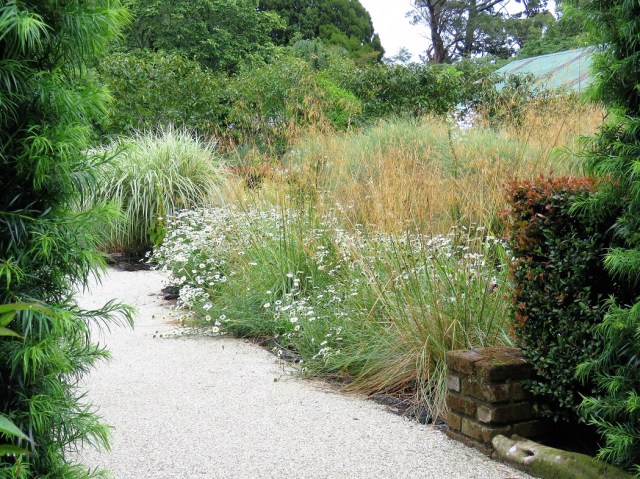
There is a whole lot more to meadows and wild gardens than just letting plants grow. It takes a shift in thinking, a fresh view and different approaches to managing the garden. They are less demanding on maintenance but they still require management. “Tidying nature”, Mark is fond of saying.
We have spent a lot of time considering the less environmentally friendly aspects of domestic gardening – the use of nitrogen fertilisers, sprays to manage weeds, pests and fungi, the costs both financially and environmentally of achieving top quality lawns, meeting human expectations of tidiness and order, let alone the use of internal combustion engines like the lawnmower, hedge trimmer, weed-eater, chainsaw, rotary hoe and more.
We want our garden to be lower maintenance so it is sustainable into the future, more environmentally friendly yet still be beautiful to our eyes. It is why we have moved some areas of the garden to being managed meadows. Added to that, this year we are opening the new four acre Wild North Garden. I say new, but work started on it thirty years ago when Mark began planting up his father’s old cow paddock. Only now do we have it to the point where we are happy for others to see it, a new area of much looser maintenance with a wilder, more romantic feel to it.
My workshop this festival is entitled ‘A Gentler Way to Garden’ but it could be sub-titled ‘Lowering our garden carbon hoofprint’. If you are interested in walking more gently on the land but still creating a beautiful garden that can make your heart sing, you are very welcome to join this workshop on Sunday 31 October. You do, however, need to book. Details are here.
A view through to the summer Court Garden, though it looks good in later spring and right through autumn, too
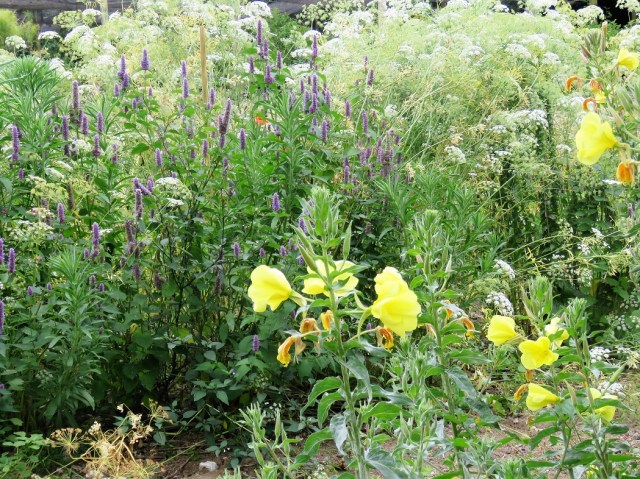
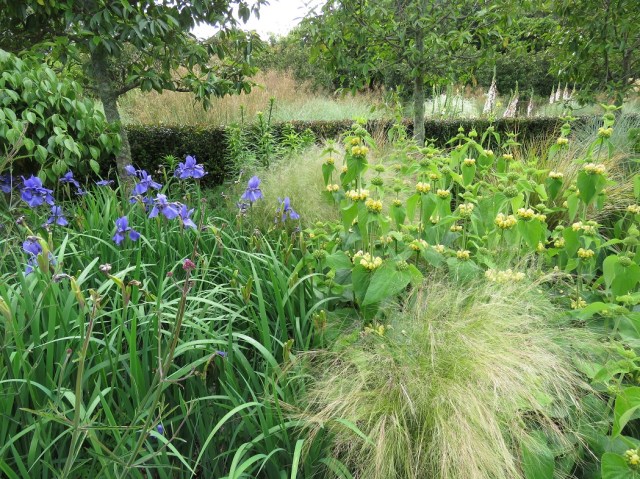
The other workshop we are offering is ‘New Directions with Sunny Perennials’. It all started with our desire for summer colour here, masses of summer colour when our extensive woodlands are largely restful green. We have had a fairly close look at contemporary trends in gardening particularly in the UK but also parts of Europe – alas not quite as close as it would have been had we been able to make our most recent trip in July last year. But over several years, we have distilled our learning, so to speak, and experimented and trialled to come up with summer gardens that work in our situation and the NZ climate.
This is the same workshop that many people missed out on last year (numbers are restricted) but with the benefit of another year of experience in handling these styles of perennial gardening. We are offering it twice, Monday 1 and Saturday 6 November, as part of the Taranaki Garden Festival. More details and booking here.
Borders, more New Perennials in style than classic twin borders














 Tikorangi The Jury Garden