I am worried about 2021. We all crossed our fingers that it would be better than 2020 but there was no radical change on January 1. The wall to wall Covid news coming out of the UK, Ireland, Europe and USA is unrelenting and disturbing. The trans-Tasman travel bubble so many of us are waiting for looks to be on hold with outbreaks in Sydney and Melbourne. And the transition of power in USA looks more dangerously unstable than the usual peaceful and orderly process. My thoughts go out to those readers in more dangerous parts of the world.
All I have to offer is summer.
Looking through to the Court Garden on Christmas Eve.
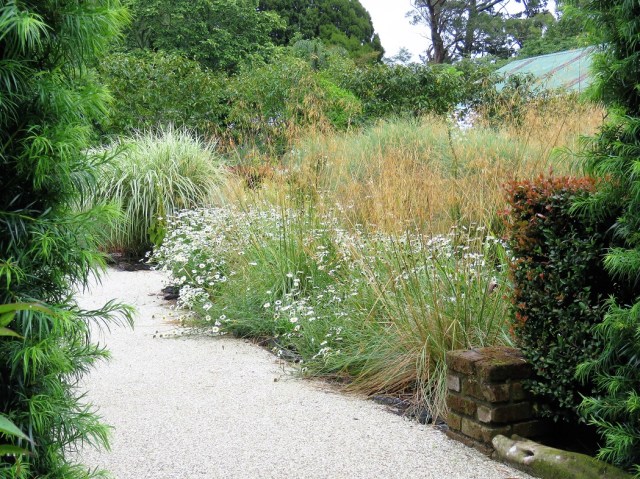
All spring, it was the newest of the summer gardens, the Court Garden where the main plantings are grassy-themed, that brought me the most pleasure. As I walked out to do my morning rounds, it was there that I chose to linger the longest.
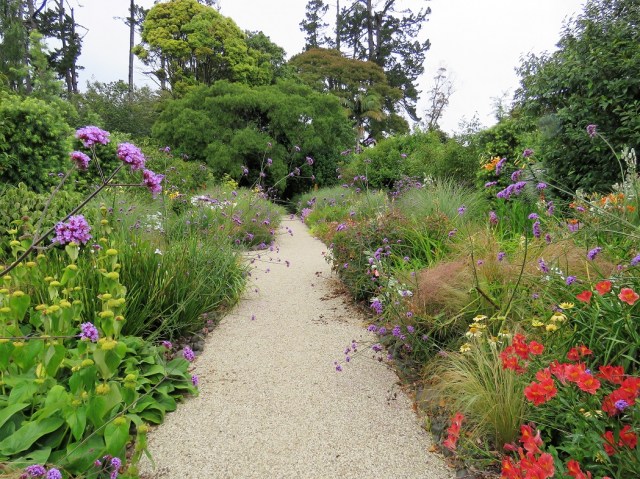
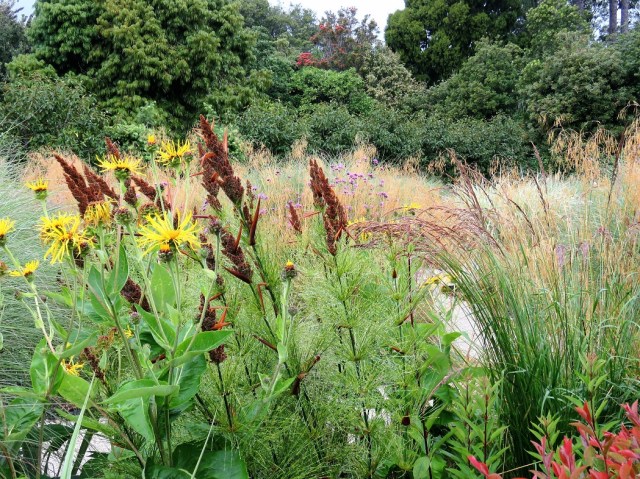
The borders yesterday morning, just before the onset of steady rain
The light levels were fairly low which gave a softer feel than the harsh glare of the mid-summer sun
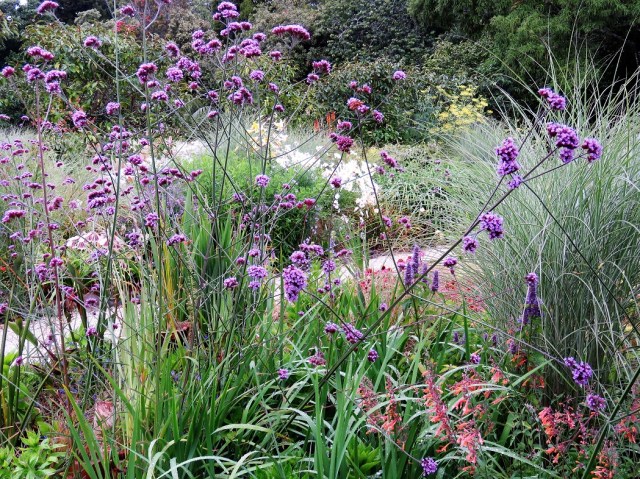
As December progressed and now that we are into January, the borders have taken over pride of place on my morning perambulations. They bring me much delight and while I can see a couple of areas that I will tweak, overall, I am happy with them. The borders have the most complex plantings and that means there is more of a succession of blooms.
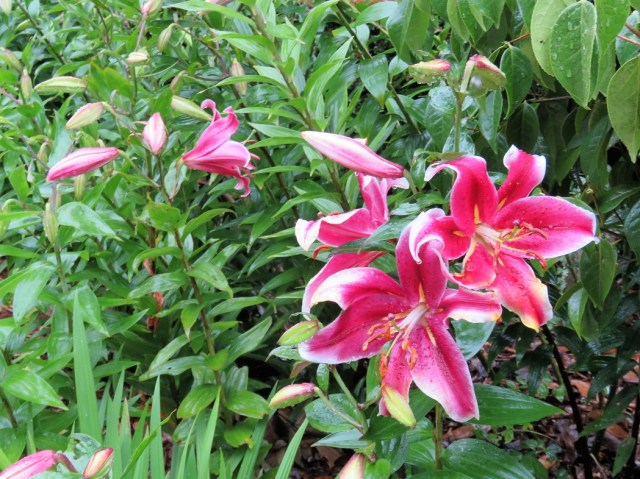
The first auratum lily has come into bloom
The auratum lily border is the only garden we have that is dedicated to a single plant genus. It only stars for one month of the year and that will happen soon. The entire length holds the promise of so much with the mass of buds fattening and starting to show colour.
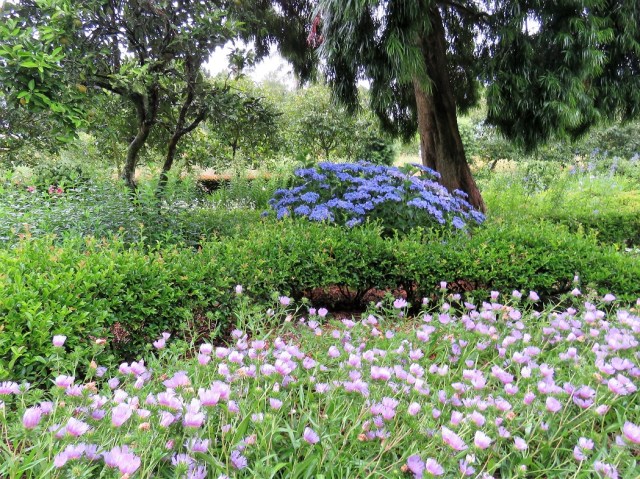
Stokesia and hydrangeas in the wave garden
The Wave Garden has its good sections and the flowering of the blue bearded iris in early November was a delight. But I have been reworking some bays that I was not so happy with so it is a bit patchy overall at this stage.
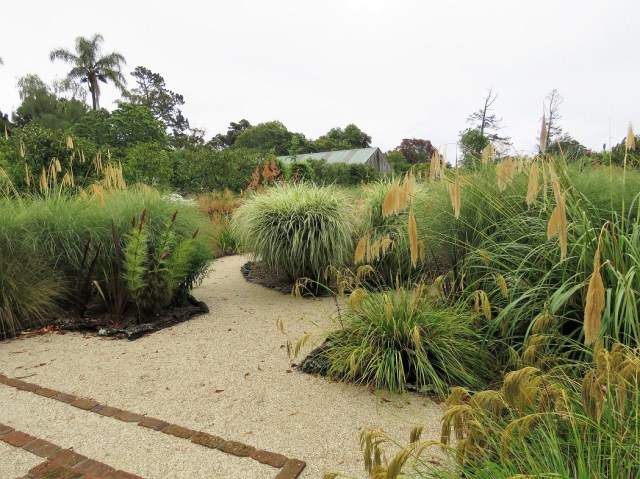
The grass garden on January 2
The growth in the Court Garden is nothing short of phenomenal and I am looking nervously at the abundant Miscanthus ‘Morning Light’ but thrilled at the flowering on Stipa gigantea this season. Being sterile, the flowering lasts a long time. It really is the immersive experience I planned for.
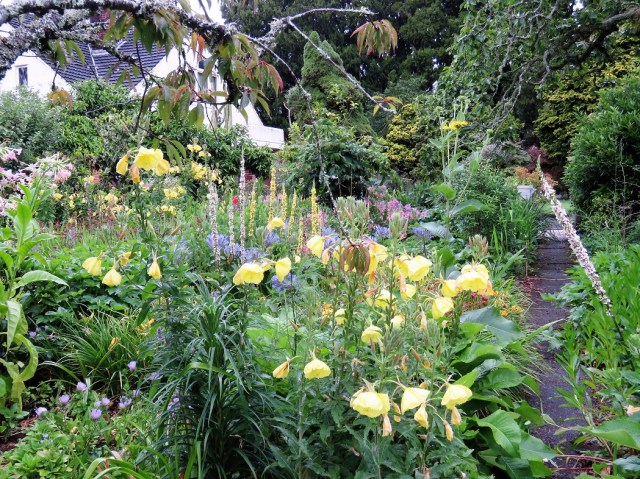
Flowery abandon in the Iolanthe Garden
The Iolanthe garden is very different with its casual wildness and mass of blooms both planted and self-seeded. I am doing a bit of maintenance – well, I say a bit, but really I am wheeling out barrow-loads of seeding forget-me not, parsley and spent foxglove flower spikes. Fortunately, the weed infestation is nowhere near as bad as I feared and it has the appeal of an artfully casual cottage garden, very different to the other summer gardens.
Echinacea with contrasting foliage of fine grass and the foliage of Iris sibirica
It is not new year resolutions that have had me thinking in the last few days. In a world that has spun beyond our control, resolutions seem a little… irrelevant. No. Since my post about the graveyard, I have been thinking about plant combinations.
I have a photo file of images loosely categorised under ‘plant combinations’. There are lessons to be learned from some of them.
Ephemeral delights 1: lilac and a deciduous azalea. A very ephemeral delight, this one.
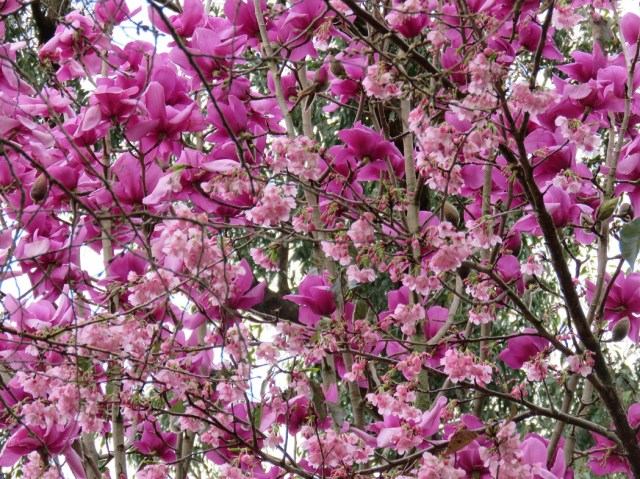
Ephemeral delights 2: A magnolia and Prunus Te Mara
Spot the problem with these two. These are pretty scenes based entirely on flower and colour combinations that we like. But, and it is a very big but, the flowering only lasts for a week to ten days every year. Many trees and shrubs have a very short peak time in bloom if you time them. We have plenty of such pretty scenes around our garden but we have a very big garden. In a smaller garden with limited space, most people want their plants to work harder over a longer period of time.
Hydrangeas are exceptions to the short blooming season rule and there are others but if you are setting out to plan for good combinations that are dependent on flowers, it is wise to check how long it is reasonable to expect the plants to actually bloom.
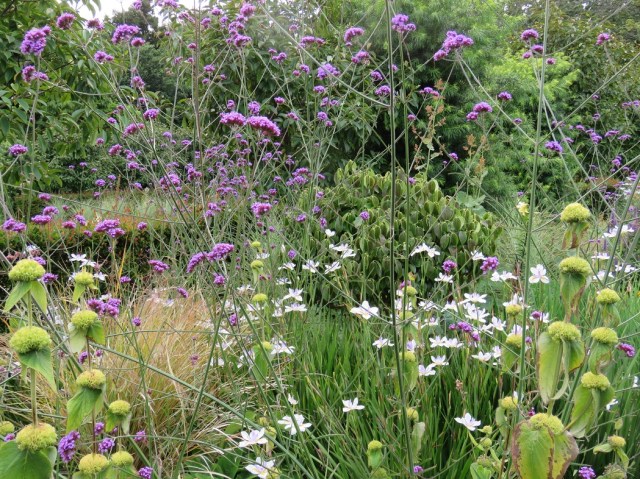
You can get longer in bloom from perennials than trees and shrubs. In practice, perennial gardening is heavily dependent on combinations. This pretty scene of Phlomis russeliana, Dietes grandiflora and Verbena bonariensis will last for a long time. And when the flowering is finished, the foliage combination will carry it through. That is the larger, flattish leaves of the phlomis contrasting with the grassy growth of the dietes, helped by how long the spent, candelabra flower stems of the phlomis hold on with their sculptural form.
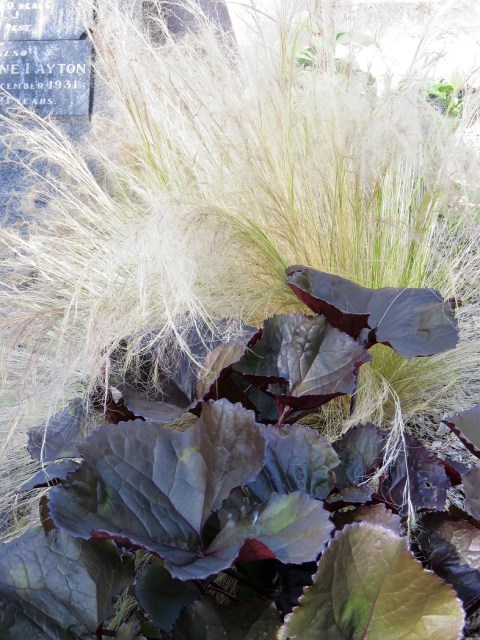
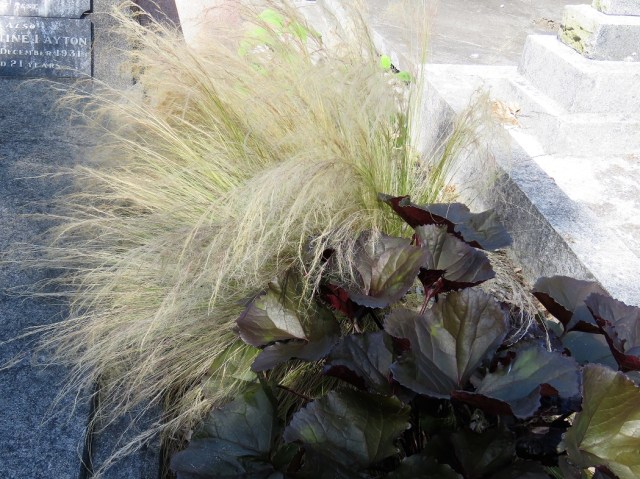
Stipa tenuissima and a burgundy ligularia pack a visual punch amongst the graves
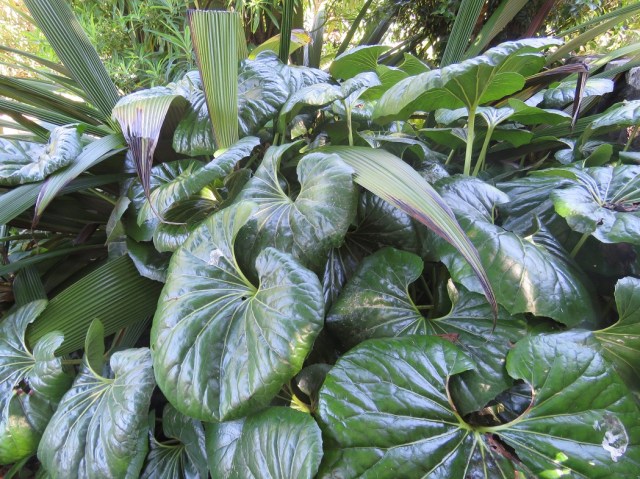
So too do Ligularia reniformis and Curculigo recurvata on our swimming pool garden
Foliage matters. A lot. The graveyard photo of Stipa tenuissima and the burgundy ligularia is entirely dependent on foliage. So too is this scene of Curculigo recurvata and Ligularia reniformis. Foliage contrasts and combinations are what will carry the scene through the year. But, to be honest, foliage alone rarely lifts my spirits and makes me smile in the way flowers do.
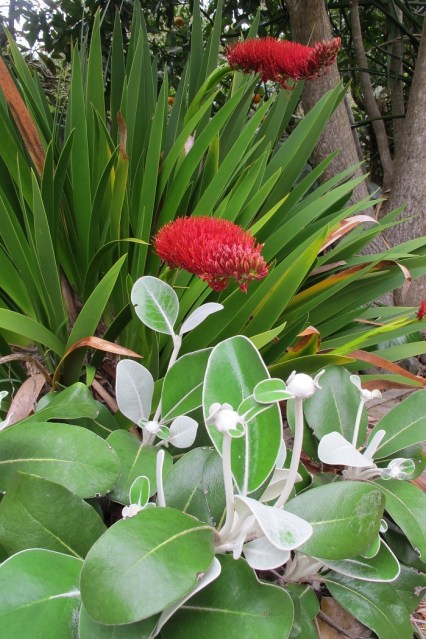
Flowers and foliage work better. This combination of natives – Xeronema callistemon (the Poor Knight’s lily) and Pachystegia insignis (Marlborough rock daisy) looks interesting all year round but is particularly pleasing when the red xeronema or white daisy are in bloom, even though they flower in succession, not at the same time.
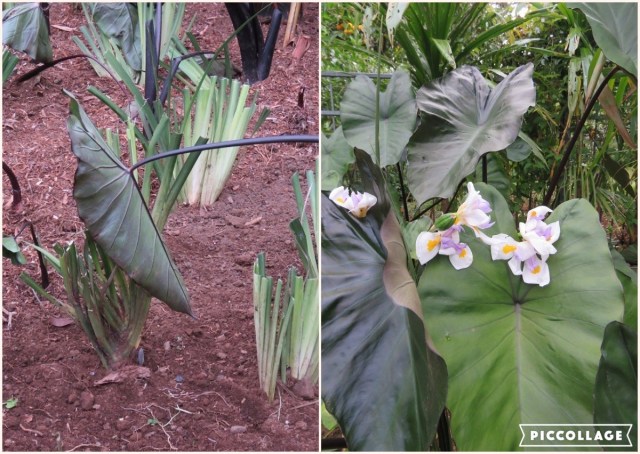
Freshly planted on the left, what it was meant to look like – but with the addition of the dietes grassy foliage – on the right. Alas, the dietes never managed to get above the colocasio so languished, flower-less, beneath the overpowering foliage.
There are plenty of resources that will recommend good plant combinations but I never use them. It is much more fun to put your own together, even if you don’t always get it right first time. I thought my combination of a dark-leafed ornamental taro (black colocasia) and Dietes grandiflora in a low-maintenance planting for summer impact by our swimming pool would be brilliant. It wasn’t. The colocasia was so vigorous, thuggish in fact, that even the dietes didn’t stand a chance. I ended up removing all the colocasia because it was spreading at an alarming rate.
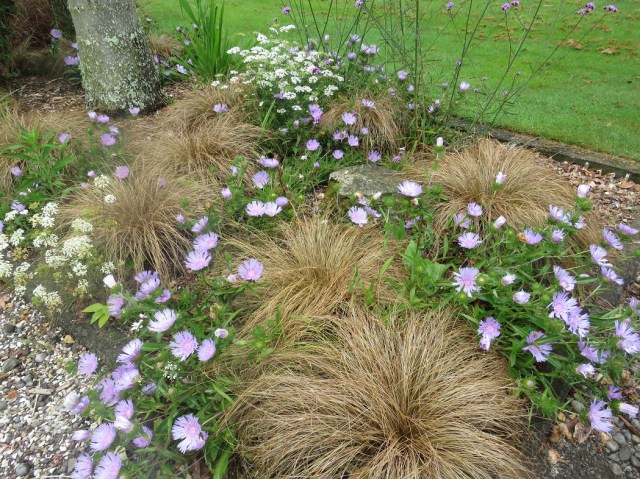
But sometimes it does work. A year ago I replanted this previously unsuccessful bed by our entranceway and I am pretty pleased with it. The dominant groundcovers are the two brown carex – upright Carex buchananii and the spreading Carex comans with a blue stokesia that blooms almost all year round. Autumn interest comes with a plum red nerine of Mark’s raising and towering self-sown Amaranthus caudatus, in late winter snowdrops and dwarf narcissi pop through, rhodohypoxis bloom in spring and I let the Orlaya grandiflora gently seed through. But it is the buff-brown carex and blue stokesia that carries it through all twelve months.
In a colder, semi-shaded area with heavy soil – hostas in blue and yellow hues, Chatham Island forget-me-not (Myosotidium hortensia), Ranunculus cortusifolius and even a blue meconopsis
Putting plants together with both skill and flair comes with experience. Novices may line out plants in the garden centre, often based on flowers alone, and think ‘oh that looks nice. That’ll do.’ Experienced gardeners factor in a whole lot more variants. These variants will include the following:
Plants need compatible growth habits. A vigorous thug will soon out-power a plant that is slower to establish or destined always to be of a more delicate nature. Plants with a spreading habit create shade and those with spreading root systems may swallow up their neighbours.
Plants grow. It helps to consider how quickly and how large they will grow at the time of planning. Also, what their mature form will be.
Plants need to like similar conditions – whether that be full sun or semi shade, sharp drainage or soils that never dry out or any of the other variants that contribute to a favourable growing situation.
If you select plants for floral display, you have to accept that the beautiful combination so carefully crafted may be for a very brief time.
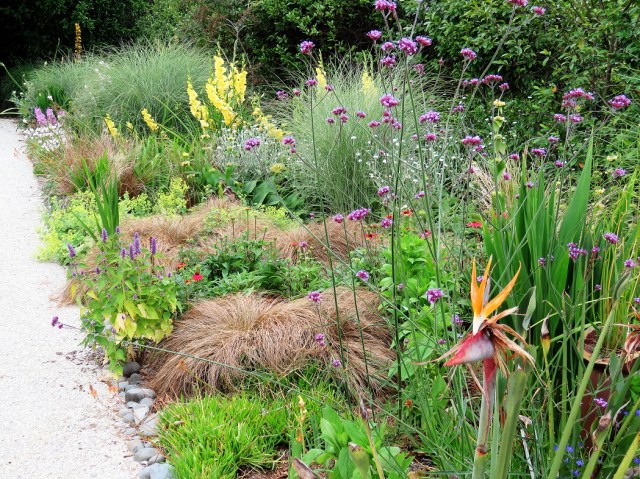
Foliage contrasts give interest most of the year round. The most obvious contrast is spear-shaped foliage beside rounded, lush leaves or bold foliage with something light and fine but it can be more subtle. Variegated foliage is always best teamed with contrasting foliage that is a single colour. One lesson I have learned from our new Court Garden is that contrasts can be more subtle and still effective. All the foundation plants in that garden are selected for their ‘grassy style’ foliage and it is the other, more subtle variations that make the combinations effective – colour, movement, layering, and shape rather than foliar contrast.
A combination of both flowers and foliage will cover more bases in terms of complementary plantings and longer term visual interest.
Plant combinations can be quite simple but effective. It is the combinations that stops a large planting from looking like a Council traffic island or a utility supermarket carpark. Mark’s mantra bears repeating: “The world is full of too many interesting plants to want to mass plant a single variety.
The good news is that with time and experience, deciding on combinations becomes instinctive rather than an intellectual exercise in planning and is, for many of us, one of the best parts of gardening.
It took several attempts to get this stretch of lower growing plants in the summer borders to the point that pleased me visually but I looked at it two weeks ago and thought “Yes! I am happy with that.”
It seems a little over the top to wish the usual merry Christmas and happy new year but in a year when so many of us will be happy to settle for just being Covid-free, may your festive season be tranquil and safe.
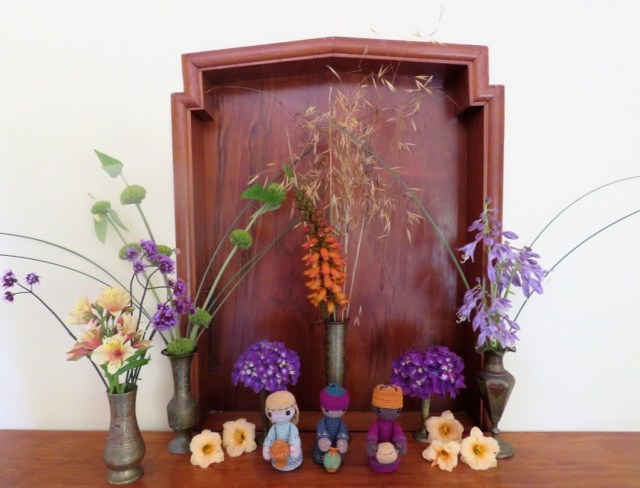
Really, I staged this little scene of colour-toned early summer flowers to showcase the three kings that our Canberra daughter crocheted for me with much skill and love last year, when the world seemed a different place.
I was delighted by the tweet that came down my line from @KenJennings who appears to be from Seattle:
“Every country had a tough 2020 except New Zealand. (they had a tough twinty twinty)”
NZ commenters were equally amused and it is true that our most prominent, international figure, the young(ish) woman who has spearheaded the sustained efforts to keep her people safe this year, Prime Minister Jacinda Ardern says “twinty twinty”.
The only radio station I listen to, Radio New Zealand, favours “twenny twenny”. The best I hope for from that quarter, as we move into the new year, is “twenty twenny-one”.
Let us hope the world becomes a safer place in twenty twenny-one.
Since I set it up my little Christmas tableau, I thought the kings might like the bottle of Bombay festive gin added to the scene. It is at least colour-toned.
Friends invited me to join them amongst the graves last week. The Te Henui Cemtery in New Plymouth must be the country’s prettiest, most vibrant graveyard. I credit this entirely to the energy and cheerful dedication of the small band of volunteers who tend to a multitude of discrete, grave-sized gardens.
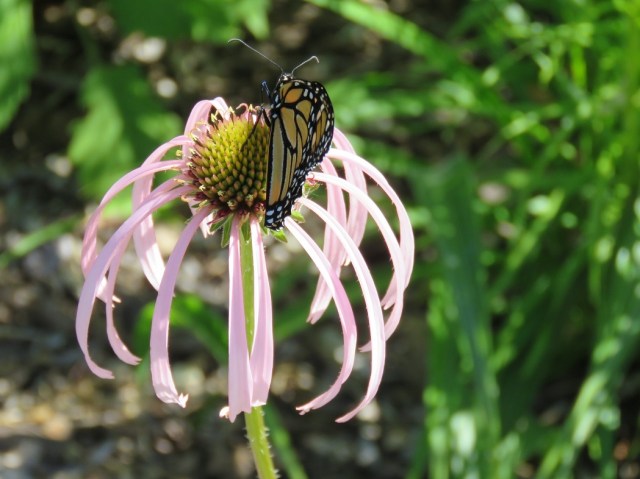
My first sight was a monarch which resolutely refused to oblige by opening its wings, feeding on a shaggy echinacea
It is very seasonal and, on this visit, it was lilies, agapanthus and dahlias that did the heavy lifting in the floral display. The sunlight was so bright and the shadows so deep that I was struggling to get half way decent photos which is why landscape shots are missing. I need to go back on a day when light conditions are more muted. But it is a really interesting place to look at plant detail and planting combinations.
The most startling plant combination of the day, one to make you stop and go ‘wow’, was the dark leafed ligularia with Stipa tenuissima. The stipa is pretty controversial, as I learned a month or two ago, (banned from commercial production but not illegal to have in the garden) but the combination is one that would not look out of place in a super-smart Auckland townhouse.
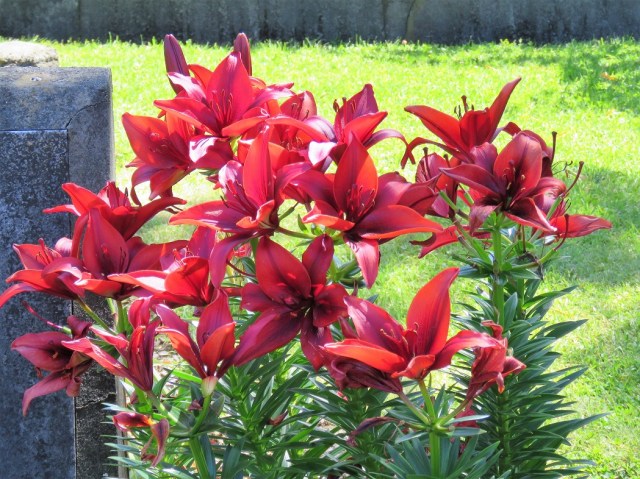
Mark was not with me on this occasion but I have shared a life with him for so long now that I know what his response will be. And he does not like upward-facing lilies. He holds his opinion so firmly on this matter that it could be described as dismissive. It didn’t stop me photographing this handsome red lily that was looking splendid. I am guessing it is an Oriental hybrid, maybe even what I have just discovered is sometimes called an ‘Orienpet’ which is, the ever-handy internet tells me, a hybrid between and Oriental and a Trumpet lily. Why does Mark reject upward-facing lilies? Leaf and litter gatherers, he calls them. And when a bloom gathers debris, it marks badly and its flowering time is limited as a result. In the Garden of Jury, lily blooms are to be outward-facing, not upward-facing.
The cemetery has a good selection of lilies so locals and visitors may like to check them out from now until early February.
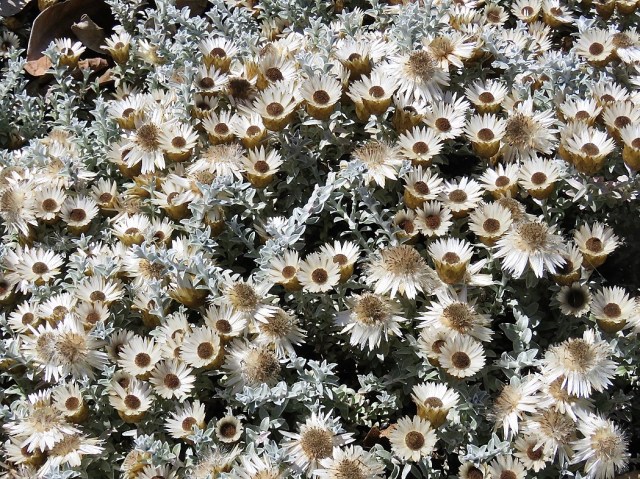
I call it a helichrysum but I think it is actually an anaphaliodes
It is over ten years ago that I wrote up Helichrysum ‘Silver Cushion’ and I have not added anything to my knowledge about what most people know as everlasting strawflowers in the intervening years. All I can say is that this plant is not what we have growing as ‘Silver Cushion’ though it must be related. Those everlasting blooms are larger and clearly hold better over a long period of time. They were dainty and charming, albeit somewhat reminiscent of tarnished tinsel daisy-stars at this time of year.
My best guess is that this and ‘Silver Cushion’ have derived from our native plant Anaphalioides bellidioides (formerly Helichrysum bellidiodes) but I doubt they are species selections and what else is sitting in the genes, I do not know. I would like a piece of this larger form, though.
Any input from readers who know more about anaphalioides is most welcome.
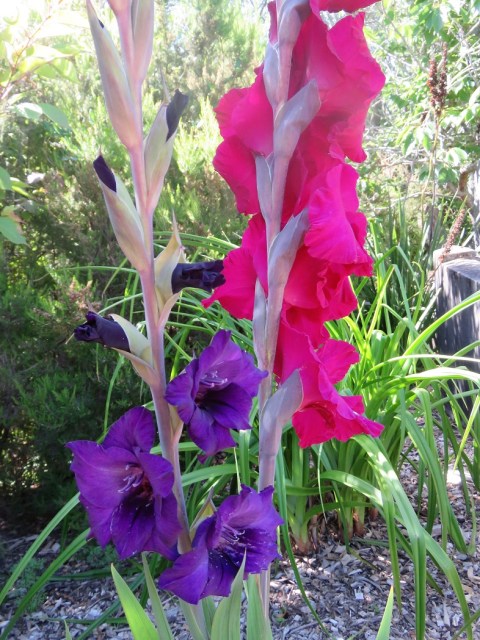
I am not a fan of Dame Edna gladiolus, not at all. I tolerate my vigorous yellow ones that are a legacy from Mark’s mother. But look at the startling colour in these two. Vulgar, yes. Lacking refinement, yes. But vibrant and with a clarity of colour that is not to be derided. Just not in my garden, I think. The foliage gets rusted and unsightly here. That is another good reason to go to the cemetery – to see plants and colours that I do not grow at home.
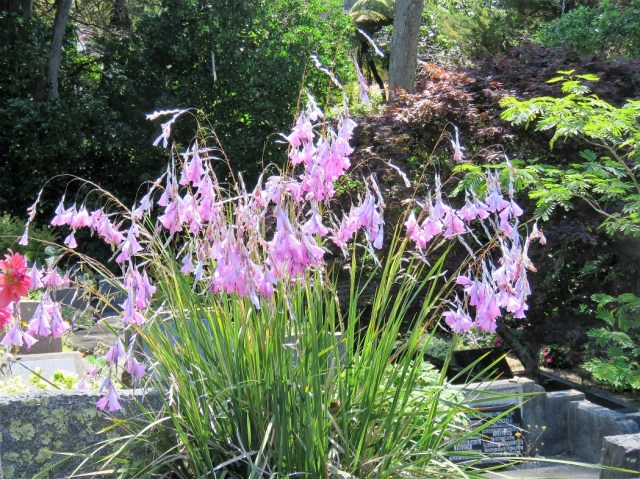
I do not understand why my dierama – angel’s fishing rod, do not perform as well here as amongst the graves. They flower, but nowhere near as freely. I don’t think it is varietal, it is more likely to be conditions. What am I doing wrong?
Our thanks go to the dedicated volunteers who tend to this particularly cheerful and colourful place which combines delighting the living as much as remembering the dead.
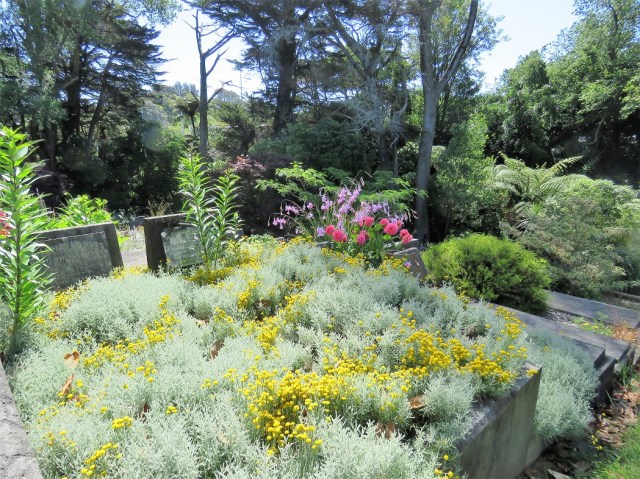
A simple santolina, I think in the only landscape view I managed in the glare of summer sun
I was contemplating writing about poinsettias* as a Christmas topic that is not derived from our own garden. Though I am not sure that I have anything to say about poinsettias that I have not said before. My world has become so much smaller this year. But then I came across two minor incidents that seemed to capture hope.
Christmas this year seems especially poignant. While we, in our archipelago of five million, can lead close to normal lives, nothing, anywhere, is normal. Our degree of disruption is just less than so many other places and we can go about our day to day business without fear. Our hearts go out to those in other countries where life is so very difficult and spirits are low.
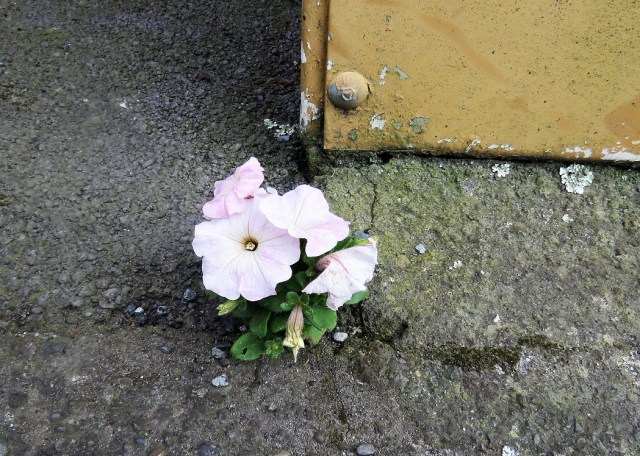
My local town of Waitara is widely regarded as … fairly unprepossessing, shall I say? But two sights yesterday made me smile. Blink and you might miss the first one. It is in the bottom left of the photo.
Not a lonely little petunia in an onion patch but a brave, little, self-seeded petunia flowering in a sea of ashphalt and concrete right beside the gutter. The seed must have fallen from a hanging basket above. A tiny beacon of hope and survival, maybe.
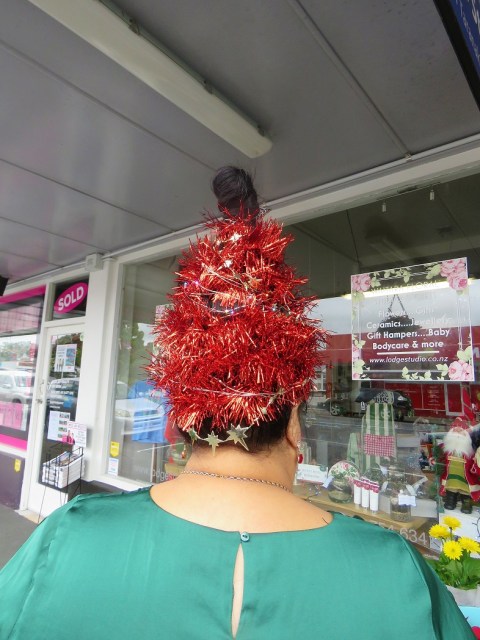
Along came a woman with her hair wreathed in Christmas tinsel. I asked her if I might photograph her from behind, to preserve her anonymity. Though, upon reflection, you don’t go out adorned like that if you wish to remain anonymous. She turned so I could photograph the rear view and then told me I could photograph the front if I wished. Is she not both brave and beautiful?
May you find your own little harbingers of hope if Christmas is a difficult time for you this year.
Back to the topic of poinsettias
*Should you wish to know more about poinsettia, I can refer you to
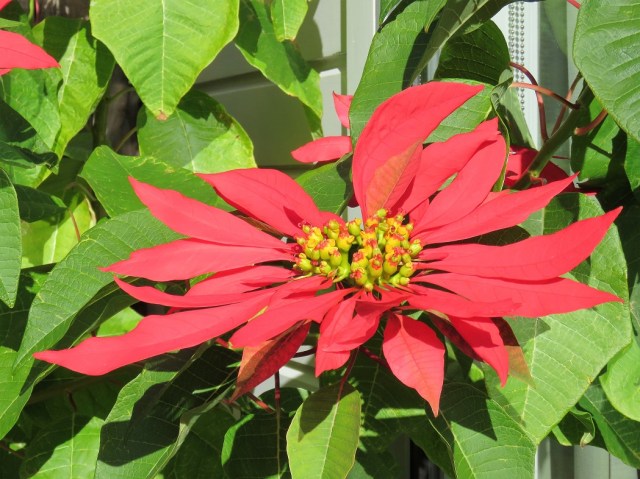
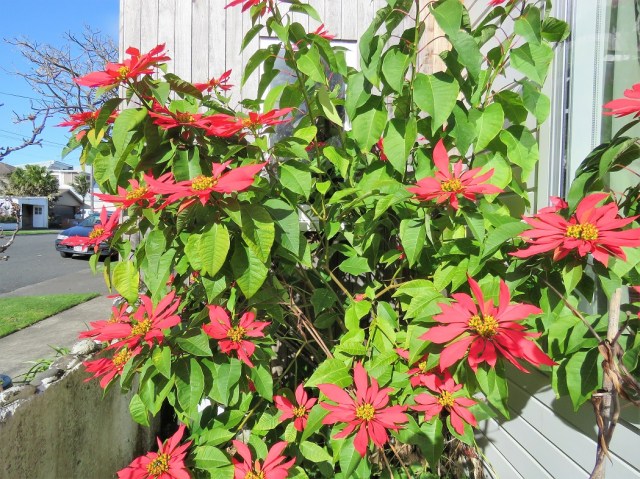
But I do not appear to have shared these photos of a splendid poinsettia flowering in front a friend’s house in New Plymouth in June this year. I think he told me it was just a house plant he had put into the garden where it grew and grew.
We do not have a poinsettia here in any shape or form, though I did once try planting out a Christmas houseplant whereupon it just became insignificant for reasons explained in the second link above. Had I been more patient, it may have ended up looking as exotic and large as our friend’s garden specimen.
It is a sign of different times that our Christmas presents this year are arriving with no festive wrapping. Our children, all living out of reach overseas, have resorted to remote shopping online and remote delivery. A minor sign of a Covid Christmas, even in safe New Zealand.












 Tikorangi The Jury Garden