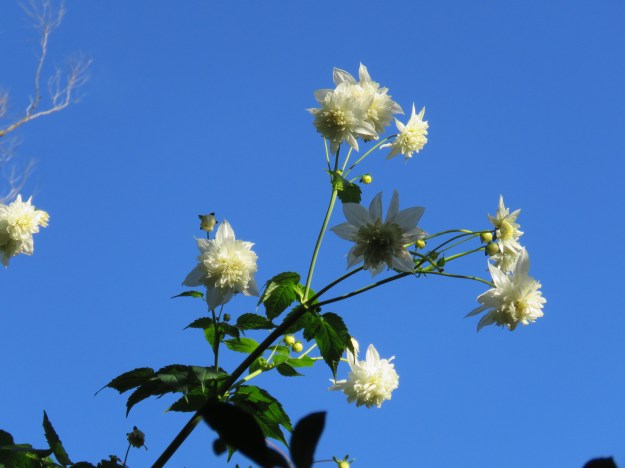
RIP little Albert

Just last month, I introduced you to Albert, our visiting piwakawaka. Albert was the type of companion who liked to announce his presence but, being a very small bird, we didn’t really notice when he wasn’t present. So, we didn’t worry when a few days passed without a visit. No alarm bells rang for us, so to speak.

Sadly, Albert had extended his house visits to the upstairs bedrooms and became trapped in one of them when the door was closed to keep the house warmer on a cool night. I found him, passed away on the bedspread yesterday when I went to open the windows.

Albert alive would, apparently, have weighed no more than 8 grams. Deceased and dehydrated, he weighed little more than a cluster of feathers. It was poignant. I was sad. Mark was sad when I brought the little body downstairs. I buried him in the garden where I was working. Small of stature he may have been, but he deserved dignity in death.

Such an exuberant little life filled with energy and chatter snuffed out.

Week six of lockdown already but gardening continues

Te mounga – Mount Taranaki – with its first major snowfall of the year this week

The first wintry blast struck this week and our mounga has put on his winter coat. In our part of NZ, these early cold blasts are generally brief – two days this week – and we are now back to mild, calm and sunny autumnal days. This settled weather can often continue through until the shortest day, which is only six weeks away now, when we settle into proper winter. By mid August we will warm up again and spring will be here so we mustn’t complain about a full-on winter that only lasts about 7 or 8 weeks.

Flooding in the sunken garden soon after the upper garden beds were removed 

Flooding has not been a problem once the grass was well established

Eighteen months ago, I wrote about the unexpected consequence of flooding the sunken garden when we stripped out the surrounding garden borders that had clearly soaked up the rainfall in the past.  Fortunately, we did not rush into major work to rectify the situation because it turned out to be temporary. When the grass was fully established, the flooding issues disappeared. It is an interesting lesson in the importance of vegetation – even just grass – in preventing water run-off. Presumably all the roots create small channels, enabling the water to be soaked up by the ground where it falls. Bare soil is not good. It is a shame that the Council has never learned this. They still send out contractors to spray the roadsides, under the delusion that bare, denuded road verges channel the water away quickly, solving flooding issues. All it does is concentrate the flooding issues at the lowest point and prevent the ground from absorbing and filtering the water long before it gets to that lowest point.

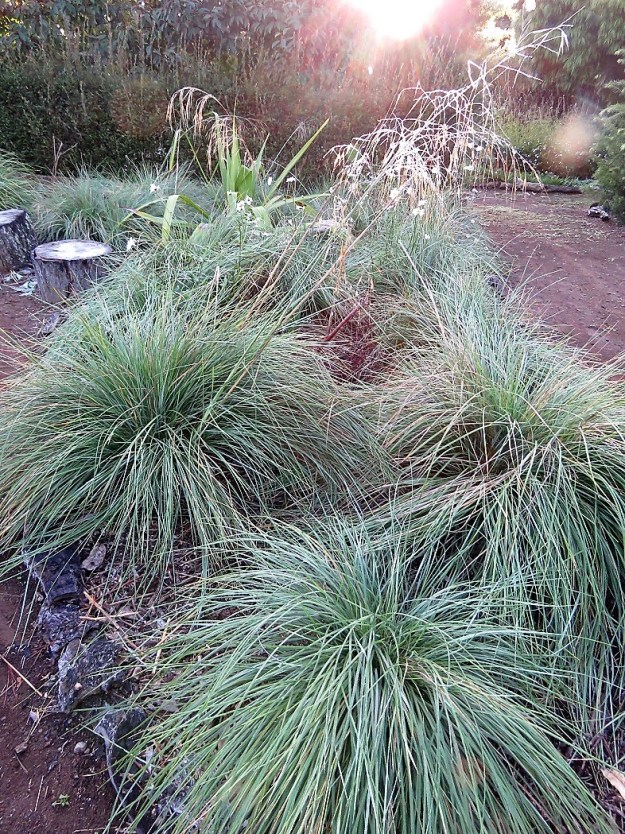
Stipa gigantea – I removed maybe six plants from this section to give the remaining ones room to spread to their natural form

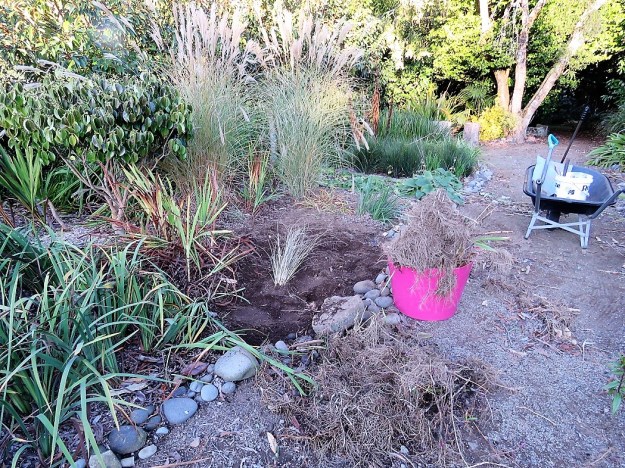
I have also been thinking about the lessons I am learning in the new grass garden. Even with quite a bit of gardening experience, I thought I was planting at final spacings in the new grass garden when in reality, I was planting for immediate effect. I am now going through removing overplanting – just about every second Stipa gigantea at this stage. Many plants, especially grasses, look better to my eyes when they have their own space without competition. It is then possible to enjoy the shape of each plant rather than the massed effect where shapes become enmeshed. Maybe next time, I will have learned enough not to repeat the same mistake of overplanting. It is even more important with trees and shrubs which are not as easy to thin as perennials.

Lloyd is back!

As we dropped down a lockdown level to 3*, Lloyd was able to come back to work. Physical distancing is not a problem here. I was very pleased to see him back. I do not drive the quad bike or the tractor – nor indeed the fancy lawnmower – and cannot manage a trailer so cleaning up after cutting back and clearing areas is much more problematic without him. With both his wife and son-in-law being medical professionals, he is extremely mindful of safe practices and the dangers of getting careless with regard to Covid, so we feel quite safe about him joining our home and workplace bubble.*

(*For overseas readers: we have our own Covid vocabulary in NZ and, thanks to the very clear communication from our prime minister, we all know exactly what bubbles and levels are and we have swapped out ‘social distancing’ for the more accurate ‘physical distancing’. With daily Covid cases down to one or two only, some days none at all, we are on track to eliminate the virus from our shores as long as we maintain border controls and quarantine. What happens longer term is as yet unknown but in the present, we are still alive and well, bar a few unfortunates.)

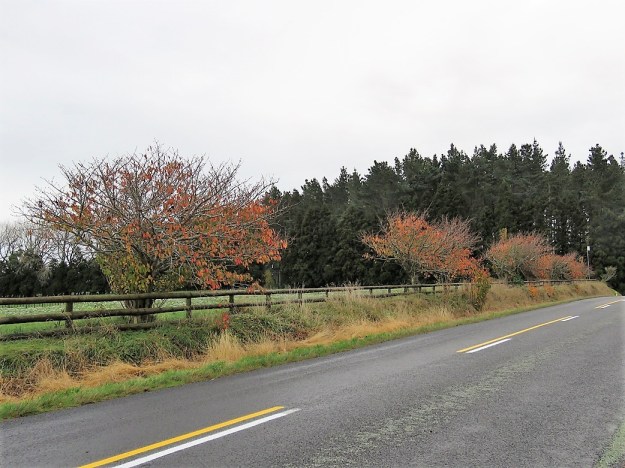
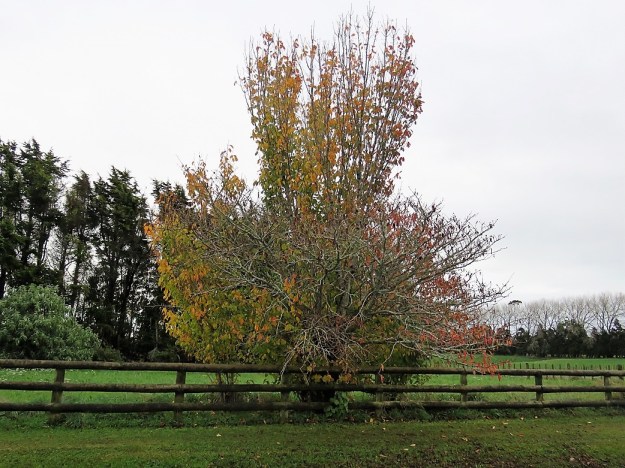
An autumn morn this week

Can I give a shoutout to our travel agent and the company she works for – Hello World? Against all expectations, she negotiated a full refund of both our long-haul airfares on Qatar Air and the travel insurance we took out for our cancelled trip to Greece and the UK. The money appeared back in our bank account yesterday. This was by no means a sure thing and many others have been left with airline credits, heavy penalty fees and financial loss. I am deeply relieved. None of us know when the world may open up again but in the medium term, we have our fingers crossed that the border with Australia may open soonish so that we can see our three children and grandson again.

One year on – the Court Garden

April 25, 2020

I say one year, but that is from when I first started planting the new grass garden. Much of this is only eleven months. I took this photo last Saturday, April 25.

May 16, 2019 

May 16, 2019

These photos, taken from either end, are dated May 16, 2019. We still haven’t filled the steps or laid the path surfaces but the plant growth has been phenomenal. New ground – plants love new ground. I expect the rates of growth to slow.

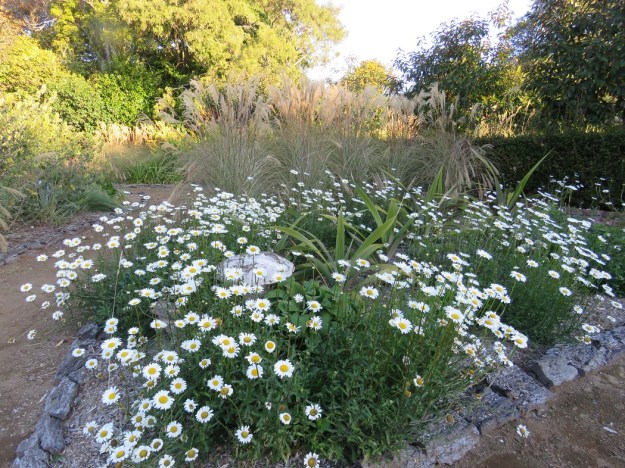
I planted at what I intended to be final spacings and there is only one section that I have put in too closely and will need to reconsider. The rest, I think, will be fine for some time. Mark would like more flowers so I am working in a bit more colour as I find plants that I think will be able to compete. The giant Joe Pye Weed (Eutrochium purpureum) which the bees and monarch butterflies love is the next to move in.

I was worried that I had too much Miscanthus ‘Morning Light’ until I took a closer look this morning. There are only four waves across the whole garden and I don’t think that is too much. It is just that it is very dominant at this time of the year. It is a brilliant tall grass and only throws up a few unwanted seedlings.

Big miscanthus flopping after only 10 months 

All it took was three lengths of jute string to restore order and form

A friend gave me a larger growing form of miscanthus, similarly variegated but with a wider leaf. It was too large for her and fell apart too readily. It is an excellent looker but I worried when even the fresh divisions started to fall apart and flop onto the paths as early as January. I don’t want plants that I have to dig and divide every year. The solution was simple. I tied a string around each clump, just a length of anonymous jute string that is not visible. A five minute job solved the problem.

I would like more large grasses for variety but have failed to source additional options so far. They are obviously not that popular in this country. I looked at Miscanthus ‘Zebrinus’ which is available and rejected it. The variegation looks too much like spray damage to me.

For those of you who are interested in grasses, I offer this update on performance of others I have used:

Chionochloa rubra (our native red tussock) is brilliant. My favourite grass of all. It needs space around each plant so that its attractive fountaining habit can be admired.

Chionochloa flavicans is often described as a miniature toetoe though it is a different family. I had a lot of trouble getting plants large enough to survive sustained attack from rabbits. Mark has shot 34 of those cursed bunnies so far this summer and most of the plants are now large enough to withstand future attacks. If you can control the munchers, it does indeed look like a small toetoe in flower though it is pretty anonymous in leaf and form.

Proper toetoe are now classified as austroderia and I think it is A.fulvida that I sourced through Trade Me – the only three plants I had to buy for this whole new garden. They have grown ten fold since I planted them but that is fine because I gave them space. I am looking forward to their flowering next year.

Stipa gigantea (Golden Oats) – an attractive enough grey-green, fine-leafed grass but the main appeal is their ethereal, large flower heads on tall spikes. The wretched sparrows took out every one of the main flowering but they have persevered and continued to put up new flower spikes. It appears to be sterile.

Miscanthus, as mentioned above, is a key feature and the only fully deciduous grass I have used. We started with just one established plant which was elsewhere in the garden and I have lifted and divided it over three years to get as many as I want. It doesn’t need to be divided that often but I wanted more plants.

Calamagrostis ‘Karl Foerster’ I took out of the twin borders because it is too rampant. I thought it may be fine in the more spacious grass garden but it is too rampant. It is beautiful when it puts its flowers up in late spring but it is altogether too strong, spreading rapidly with its expanding root system. I am thinking I will take every second plant out this autumn and look to replacing it altogether as soon as I find a less vigorous alternative.

If any readers have other suggestions of tall grasses that are available in NZ, I would be pleased to hear.

To dead head or not to dead head, that is the question

Phlomis and Stipa tenuissima in the morning light of autumn

I have never done so much dead heading in my life before. Not that I mind it, you understand, more that I am surprised to find it becoming part of my routine. The need was not anticipated. But neither have we ever had extensive areas of summer perennials before. This week, I achieved what was a milestone for me – the completion of the revamped Iolanthe Garden as a perennial meadow (I use the word ‘meadow’ loosely, here.) That gives us close to an acre (0.4 hectare) of new summer gardens finished.

It has been heavily influenced by the New Perennials movement, led by its uncrowned monarch, Dutch designer, plantsman and gardener, Piet Oudolf. Anything and everything you read about this modern approach to perennial gardening will refer to its lower maintenance requirements and leaving the plants and all the seed heads to stand well into winter, that there is beauty in that black and brown decay of autumn and winter until everything is cut down to the ground – usually in February, so very late northern winter. Besides, all those seed heads feed the birds and save them from starving when food supplies are desperately short. Oudolf has coined the term ‘fifth season’ to describe that period in late autumn when low light levels, frost, dew and sometimes snow light the blackened tips of plants to make them sparkle. There are many beautiful photographs on line capturing this phenomenon.

You can have too much of a good thing – Verbena bonariensis and fennel

It is different in New Zealand. Boy is it different. Only the coldest parts of the country have that winter hiatus. Most of us have flowers and seasonal interest all year round. A large proportion of the plants we use are evergreen so never die down to ground level. There is food for the birds all year round and they are not in danger of starving. Besides, most of those seed and grain eating birds are the introduced ones (sparrows!). Our native birds tend to favour fruit or partaking of nectar. Our light levels don’t drop in winter. A midwinter’s day can be as clear and bright as midsummer.

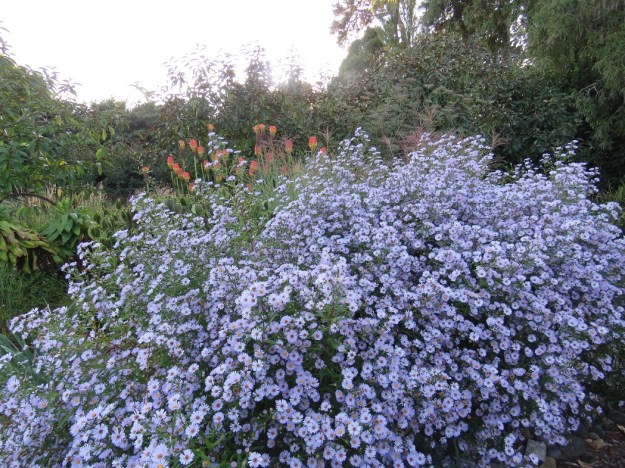
And we have a problem with garden escapes becoming weeds. That is the big issue that has me out there dead heading. Much and all as I love Verbena bonariensis, I don’t want mountains of it everywhere. The same goes for crocosmia be it yellow, orange or red, kniphofia (red hot pokers), some of the asters, tigridia (jockey caps), eryngium, dietes, fennel, nicotiana, verbascums and quite a few other plants we are growing. Even Gloriosa superba sets so much seed it is threatening to become a weed. There is nothing for it but to get out there with my snips and bucket to reduce the seed heads.

Amaranthus caudatus – not unwelcome in this situation but a surprise arrival in the compost

There is a slight problem with disposing of the seed heads. Even though we make hot compost, too many seeds come out the other end of the process and live to germinate and grow another day in another place around the garden. This unexpected display of amaranthus arrived in the compost I spread in this area. I have learned my lesson. Now I stow the seed heads in deep shade on the wilder margins of the property where few will germinate because they don’t see the sun.

A sampling of seeds that need removing. I contemplating setting it up as one of those quizzes for bored readers to identify but I would rather be out gardening. Top left tigridia and fennel, bottom left nicotiana, eryngium and dietes, centre crocosmia, top left aster, bottom right Lilium formasanu,. kniphofia and Verbena bonariensis.

The skills come in knowing which plants need total removal of seed heads (kniphofia and tigridias, for example), which plants need the removal of most seed heads to restrict their self-seeding (such as eryngiums, fennel, crocosmia, verbascums and Verbena bonariensis) and which plants don’t need to be dead headed because they are either welcome to seed down (I am not sure than I will ever have too many echinaceas) or because they don’t seem to cause a seeding problem (phlomis and the grasses). Then there are a few plants that I will dead head because that encourages them to flower again (roses, though I don’t grow many of those these days, and some of the daisies).

There is no substitution for observation and experience. We can not just take gardening practices from other climates and assume it will be the same here. If I have another 20 years, I may be able to come up with plant lists that are specifically designed for our conditions. For anyone thinking that maybe it would be better to concentrate on using our native plants, consider the fact that most of our sunny perennials are alpine. In our lowland conditions, native perennials are shade loving foliage plants with a heavy emphasis on ferns.

I want some eryngiums to self seed but not all of them

Two footnotes: the acclaimed film about Piet Oudolf, called ‘Five Seasons: The Gardens of Piet Oudolf’ is available free to stream this weekend only. We plan on watching it this evening, as long as I can work out again how to get Chromecast working. Where is a teenager or young person when you need one? It is being streamed from https://www.hauserwirth.com/?fbclid=IwAR2YXqr5-VDT2TwThnzWxVF2lzS4HXMVCV-l9166HQsVlTqqktF-QYsMTm4

And we are opening the garden and unveiling the new summer gardens for ten days this spring during the annual Taranaki Garden Festival, October 30 to November 8. As part of that, I am considering offering workshops on new directions with sunny perennials and managing meadows in our climate. Numbers will be strictly limited so look for details when the programme comes out.

May your lockdowns go well, or at least harmoniously. The end is in sight for us in NZ, with the strong possibility that we can eliminate the virus and return to some sort of Covid-free normality – as long as our border stays closed. Just don’t try injecting, drinking or otherwise consuming disinfectant – you may then be Covid-free but actual scientists tell us you will also be dead.

Farewell poor Felix. We knew thee well.

The Prunus campanulata, that is. We farewelled the person – Mark’s Dad – back in 1997. The magnolia named by Mark for him continues to thrive here and we have several specimens planted around the property, including the original plant. The prunus – we have just the one and it may not pull through.

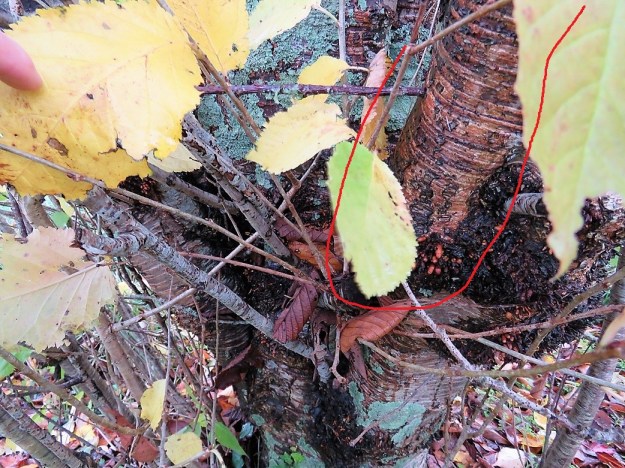
A definite lean. In fact it has fallen over, though the root system is still in the ground.

I noticed two days ago that the tree had a major lean. On closer inspection, it became clear that only the brick wall was holding it up and I was a bit worried about whether it could bring down the wall. Mark set about removing the weight that was pulling it to one side. He will cut the tree back hard and we will look at putting a prop in place but we doubt it will survive.

Prunus ‘Felix Jury’ is the reddest campanulata that we know of

Prunus campanulata ‘Felix Jury’ was named by the nursery Duncan and Davies for Felix, because he was the originator of this selection. It is simply not done to name a plant after oneself. It is still the deepest carmine red bloom on the NZ market and is much beloved by our native tui. Being a smaller growing, upright form, it has been popular as a garden plant. Unfortunately, it is not sterile so it sets seed which makes it problematic in areas where campanulata has become a noxious weed. We do a lot of weeding out of seedling cherries here because the birds spread the seed far and wide.

We will try and keep a plant going as part of the Jury collection. Hopefully this tree will stay alive until late spring so Mark can take some cuttings off it. The optimum time for taking cuttings from deciduous plants in our conditions is December.

Native tui feeding from a campanulata cherry but it looks too pink to be ‘Felix Jury”

I do not think I have ever told the story of the naming of Camellia ‘Julie Felix’. It would have been very poor form for Felix to name it for himself but he really liked it. Enter Julie Felix, the American-born folk singer who made her name in Britain in the late 1960s and early 1970s. She was touring NZ and doing a concert in New Plymouth. Felix thought that naming the camellia Julie Felix was a subtle play on names that would suit his purposes. Besides, though he took no interest in music, he liked her songs.

“You can’t do that without her permission,” protested his wife, Mimosa. She was a great woman for the telephone was Mimosa, so she tracked down that Julie Felix was staying at the Devon Hotel in New Plymouth and tried to call her. Whoever took the call – almost certainly the Devon receptionist – wouldn’t put her through to the singer’s phone so Mimosa explained (no doubt at great length) that she was trying to contact her for permission to name a camellia after her. “I am sure that will be fine,” said the person at the other end, very kindly.

So there we are. Permission was sought for this name and consent was give – by the receptionist at the Devon Hotel. I doubt that the singer ever knew there was a camellia bearing her name although it never was named for her. In a typically convoluted fashion, Felix was naming it for himself.

Ironically, I can’t even find a photograph of it, even though we have a big plant close to the house. I must set that right this winter when it comes into bloom again. It never achieved the status of his better known camellia cultivars like ‘Water Lily’ and ‘Dreamboat’ and ‘Mimosa Jury’. But Felix clearly rated it highly.