Our very own mountain daisy, the celmisia

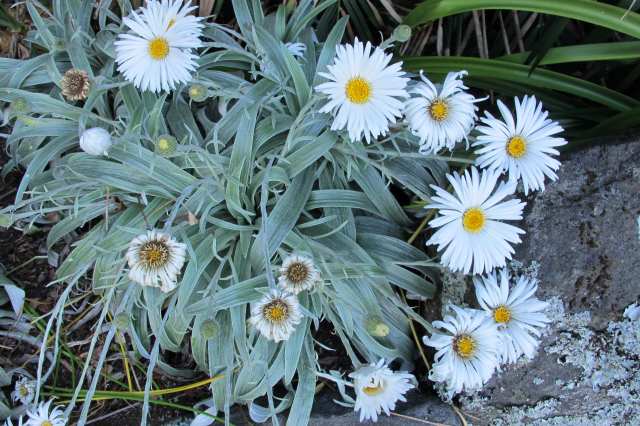
The three species crosses resulted in broader leaves and silver colour all year round

Celmisias are our very own mountain daisies. They have never been a common garden plant because they aren’t easy in nursery production and rarely thrive in the average home garden. It is likely that their greatest fans are trampers and botanists but that should not blind us to their charm. Many people just don’t know of them. And I suppose, when you think about it, quite a lot of our native plants have white daisy flowers.

I was surprised when I looked them up and found a far greater number of species than I ever knew existed. Some dedicated botanists have clearly spent a lot of time unravelling this genus.

When Mark’s father, Felix, was still alive, he became very interested in seeing whether he could hybridise different species to get plants that would thrive in our lowland, humid conditions. Most celmisias are subalpine to alpine plants. I remember Felix and Mark heading up our maunga, Mount Taranaki, in search of the form which grows there naturally – Celmisia major var. brevis – and being thrilled to find some flower variations into pink. This was about 40 years ago, you understand, when people didn’t feel so bad about collecting plant material in a national park. They collected some plants, including a few of the pinks which they only saw growing in one area.
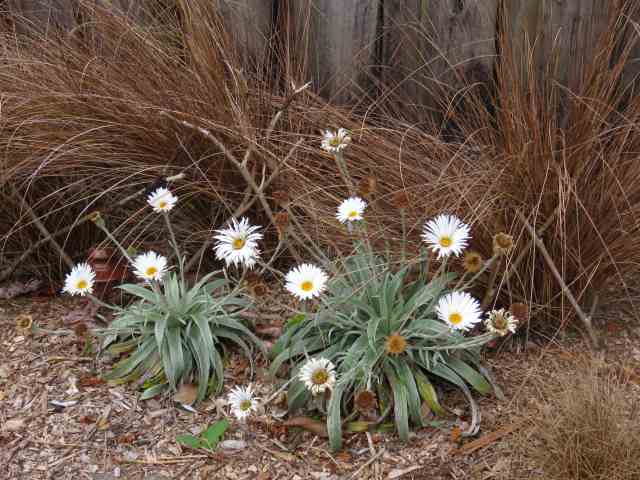
The first season after their relocation. I have moved them again because the grasses were overhanging them and these plants do not appreciate having to compete for space and light.

Felix set about crossing three species – C. coriacea which comes from Fiordland, C. hookeri  from the Otago area and the aforementioned C. major, in various combinations. Forty years on, we still have some of those hybrids growing and flowering in the garden here. It is the three way cross which gave us the broader leaves in distinctive silver all year round. Over the decades, we lost many of them, including all the pink ones, and have, at times, run close to losing the lot but for a bit of quick intervention. They have never seeded down for us; we have to increase them by division. They do set seed which we could gather and sow in seed trays but, in a busy gardening life, we don’t seem to get around to it. These are plants that need to be lifted and divided every few years or they rot out and fade away so we can never claim that they have naturalised here.
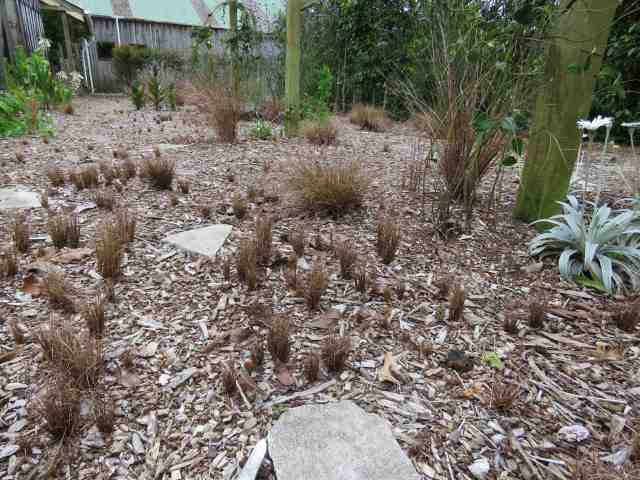
The area we refer to as ‘the grasslands’ when I first planted it in 2022 – one of the few celmisias to the right

When I planted my tawny brown area of two native carex grasses, C buchananii which is specific to our maunga and C. comans, I envisioned a simple breathing area of just those two plants. Mark looked at it and wanted more detail and colour. He suggested moving some of the celmisias which we were in danger of losing, into the newly cultivated area. So I did. There weren’t many left to play with. In the first year, I probably only had half a dozen divisions.  That was in 2022. It was like they breathed a sigh of relief and set about growing with renewed vigour. Last year I divided a few clumps that were large. This year, I divided most of them and I lost count around 58 or 60 plants. Some are small but they are surviving and I have done my best to give them optimal growing conditions. It was enormously satisfying. There aren’t many perennials I am willing to lavish such frequent and individualised care upon but the rewards feel worth it with the celmisias.
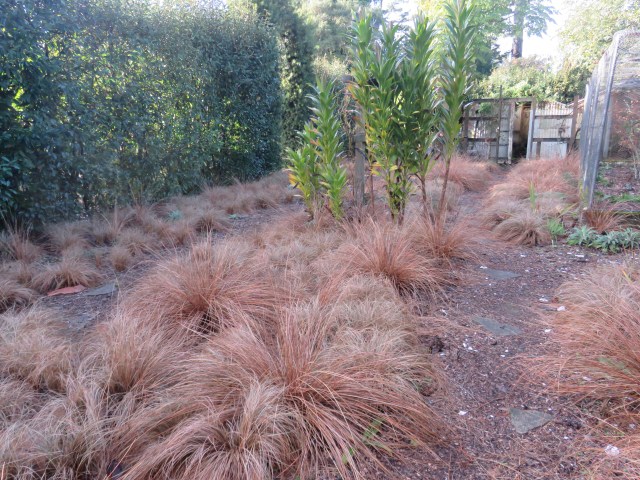
The same area in 2025 but now with the addition of 58, or it may be 60, celmisia plants

It is mighty hard to be original in a garden. Pretty much everything has been done before, some time, some place. I always scoff silently to myself when I hear the occasional gardener declare that somebody ‘stole their ideas’ or copied them. “But who influenced you in the first place?” I want to ask (but never do). However, I doubt that the celmisia and carex combination will be replicated soon, at least not locally. It is a successful subalpine planting in coastal, subtropical conditions and I am moderately chuffed by its unexpected nature in that context.
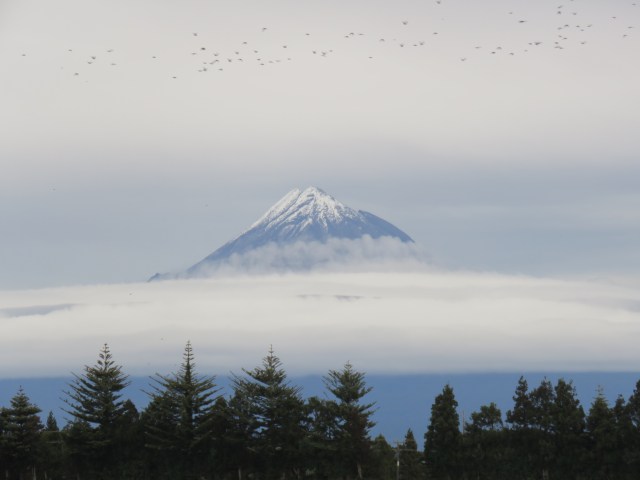
Te maunga, our mountain, Mount Taranaki, as I drove to town on Wednesday. The snow cover is abnormally light for mid-winter. There may be no more skiing days this season.

More ‘invisible gardening’.

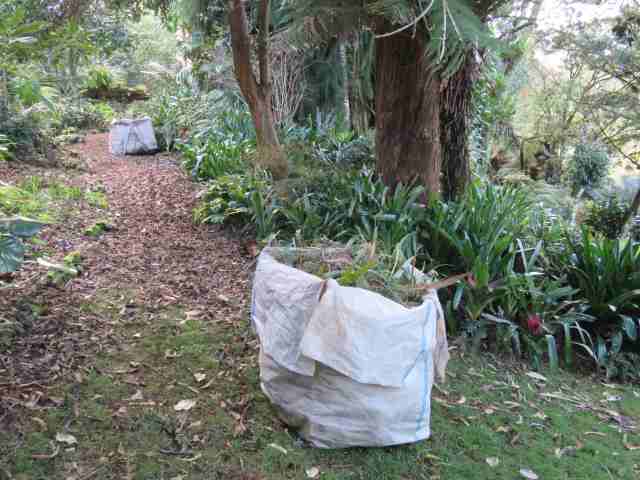
Green waste is removed by the wool bale full – too much for my wheelbarrow .

I coined the description of ‘invisible gardening’ in recent times. It describes when I spend many hours, often days, working through every square metre of a section of garden with meticulous care, removing huge amounts of foliage and debris. All the while, I know that the only people who will notice are the four of us here because, after all that, it just looks tidier. No dramatic changes.

I didn’t think to take a before photo of this stretch but this is the after shot. It doesn’t look as though it has had two wool bales of green waste removed.

I am invisible gardening my way along the lower borders of the Avenue Gardens where it meets the park and the waste is coming out in packed wool bales to be composted elsewhere. So far, I am up to five full bales. I figured it is a reasonably high level gardening skill to pick over an area and remove that volume without making the place look denuded.

By the time I was onto the next path, Ralph and I remember the camera. This is BEFORE ….
… and AFTER another very full two bales of green waste was removed

I was trying to remember when I last gave this area the same level of close attention. It will be three to four years ago. In the interim, it has had the once over lightly treatment once or twice a year- a bit of weeding and removal of fallen debris and spent foliage, but nothing detailed. We don’t apply fertiliser; natural mulch provides nutrition. And we will only spot-spray if there is a problem that has got away on us. We never need to water.

BEFORE…
and AFTER. Spot the difference. It is a bit subtle, but believe me, a lot has been removed in the clean-up.

It started me thinking how long a garden lasts if you ignore it or just give it the occasional once-over-lightly attention. These are woodland gardens under a canopy that is largely evergreen, which slows growth and restricts weed germination. I came to the conclusion that after about three years, the area loses its definition. This is because plants are no longer standing in their own spaces but have melded together, enmeshed, so to speak. After about four years, the detail starts to go. We like highly detailed gardens – many different plants in varying combinations and a good representation of treasures. By four years, the thugs are taking over (I have removed A LOT of clivia seedlings) and the daintier plants have been squeezed out or swamped. From there, it is all downhill.

Halve the time estimates for sunny gardens. In those conditions, plants grow faster and the weed explosion can be exponential.

I am of the opinion that low maintenance and good gardening are mutually exclusive concepts. You can have one but probably not the other. If you want a lower maintenance garden, stick to shrubs and swathes of the same plant. We want detail and complexity and we live with the resulting maintenance demands. Besides, a couple of weeks every three years or so doesn’t seem oppressively high maintenance.

The meadow in late spring

For readers who have followed our experiments in sustainably managing the park as a meadow, Lloyd mowed it all down this last week in June. The areas too steep to mow, he cuts with the weed-eater or strimmer. The timing is important because the bluebells and narcissi are all coming through. We will mow again in late January. With our high fertility and rainfall, we have to cut it right down twice a year. Grass grows every week of the year here, just a bit slower in winter. If we didn’t mow as we do, we would soon lose all the bulbs, the irises and other perennial meadow plants.

An FCC, no less.

It is not every day that we hear the news that a Jury plant has been awarded an FCC – First Class Certificate – from the prestigious Royal Horticultural Society in the UK. In fact, it has never happened before. I remember, back in the days of writing plant descriptions for our catalogue, coming across the occasional FCC and being aware that it was prestigious but I had to seek clarification on the difference between an FCC and AGM (an award of garden merit, not to be confused with an annual general meeting). We have few Jury plants with AGMs, but not many.

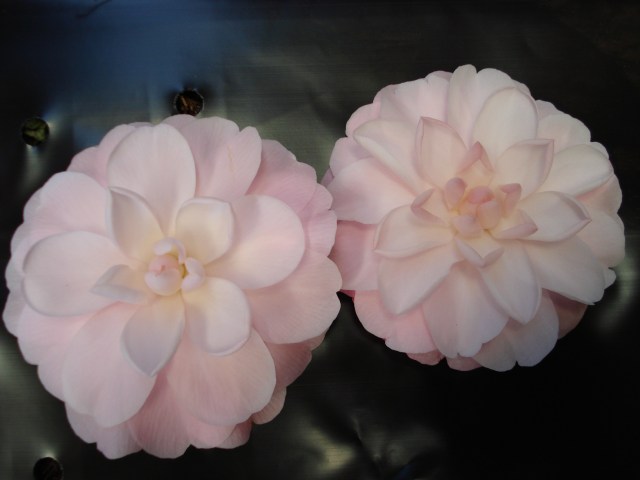
Camellia ‘Mimosa Jury’

First class certificates are like the pinnacle of quality assessment – an award that is attached to that plant forever. Awards of garden merit can be bestowed and then, on occasion, taken away, being a recommendation by the RHS of top quality cultivars that perform well as garden plants in most situations. FCCs are quite a step above that.

It is Felix’s plant, not Mark’s, that has been honoured. Camellia ‘Mimosa Jury’ was named for his wife so we know both Felix and Mimosa rated it very highly. I see we first released it in 1989, some four years after Mimosa died. From our modest little nursery (very modest back then), it was distributed by others throughout the camellia world.

It is an exceptionally beautiful flower in the form that Felix particularly liked – described as ‘formal’ in form – in the prettiest shade of pink. It is not a big bloom like the highly rated ‘Desire’ or even ‘Queen Diana’ back in the day, but that makes it a better garden plant. And the FCC award recognises the merit of the overall plant, not a single show bloom.

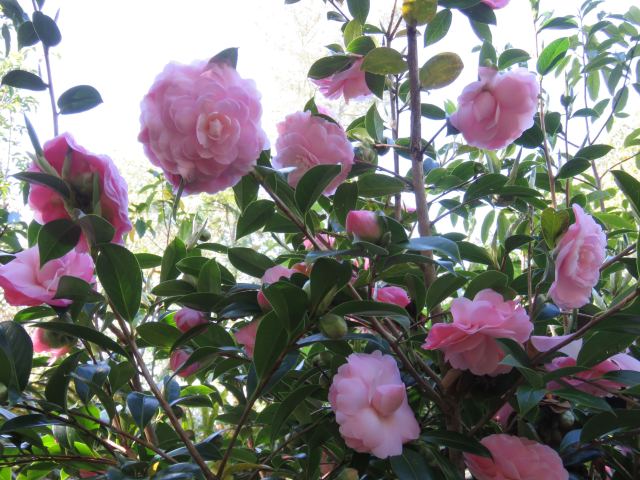
Camellia ‘Mimosa Jury’, now recognised as one of the best but, sadly, no longer in our conditions

Sadly, camellia petal blight has robbed us of the once beautiful display in our conditions. None of the japonica, reticulata or hybrid camellias have escaped the scourge of petal blight which is particularly bad in our mild, humid climate. We haven’t planted a new camellia from those vulnerable groups in many years. Camellia petal blight has spread throughout the world; I am told it has now arrived in Australia which had managed to stay free from it for a long time. But it is not as devastating in other places, especially those with colder winters, lower rainfall and less humidity. Camellias in other places still perform and mass bloom in the manner we have not seen here for decades now.

It seems Camellia ‘Mimosa Jury’ is performing so well in the UK that it stands head and shoulders above most other camellias. Felix died 28 years ago but we will bask in the reflected glory on his behalf.

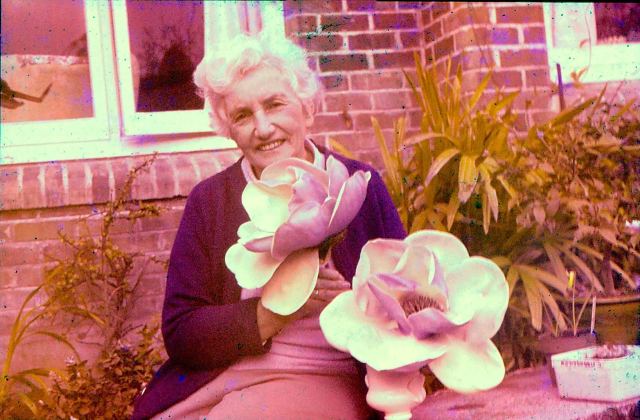
I don’t have many photos of Mark’s mother, Mimosa, from later in life. She died before the advent of digital cameras and existing photos are mostly studio shots from her younger days. Here she is, sitting in front of the house with early blooms of Magnolia ‘Atlas’, in the early 1980s.

Mānawatia a Matariki

Happy Māori New Year

We refer to this seedling as Hazel’s magnolia

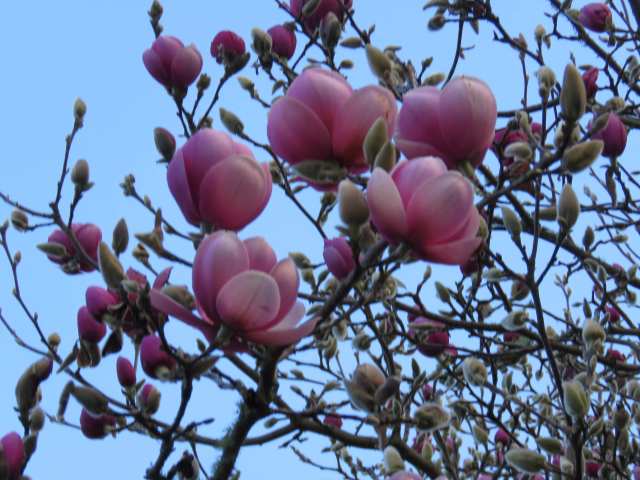
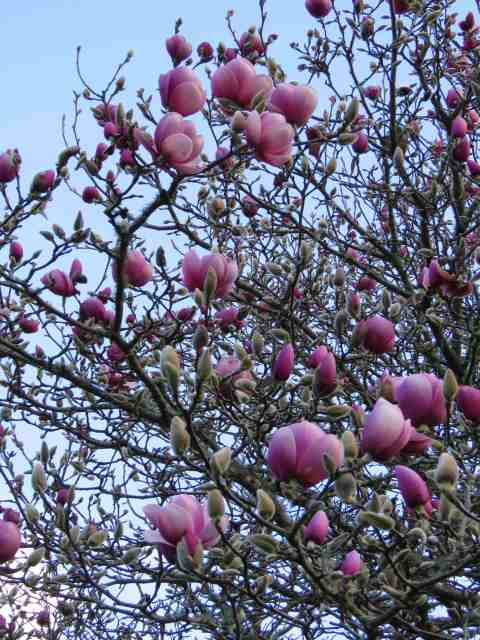
Usually I mark the time of the winter solstice and Matariki – the Māori New Year – with a photograph of the first blooms of the season on our pink Magnolia campbellii, set against our maunga (Mount Taranaki), with or without snow. The snow came in sufficient quantity last week for the low altitude ski field to open for a day or two. This week, that snow has melted away, all but a smidgeon on the peak. Such is the situation with a mountain set right on the coast.

This year, I am marking it with a seedling from Mark’s breeding programme that we refer to as ‘Hazel’s magnolia’. Several years ago, when Mark was asked to do the casket flowers for an old friend’s mother, he constructed his arrangement with the flowers of this magnolia. Her name was Hazel. In a world hurtling at breakneck speed towards one disaster after another, marked by cruelty and inhumanity, the memory of Hazel seems especially poignant. Hazel was a gem in life – one of the kindest people you could ever meet, gentle, welcoming and with natural grace.

Remembering Hazel

It gives us considerable pleasure to remember Hazel each year with this magnolia. It is a one-off plant; we won’t officially name it or release it. It flowers too early in the season for commercial release and is not sufficiently distinctive to make the cut of the very few we name but that in no way diminishes our pleasure in the blooming each year around Matariki and the winter solstice.

It seems a vain hope that the start of a new year in Aotearoa will bring optimism, hope and a return to kinder, more compassionate times. Hazel’s magnolia is a reminder for us that these qualities are possible at an individual, personal level. May you have your own personal markers of hope for the year to come and the future beyond.

A postscript – or maybe an update –  to my last two posts on digging ‘n dividing and bluebells.

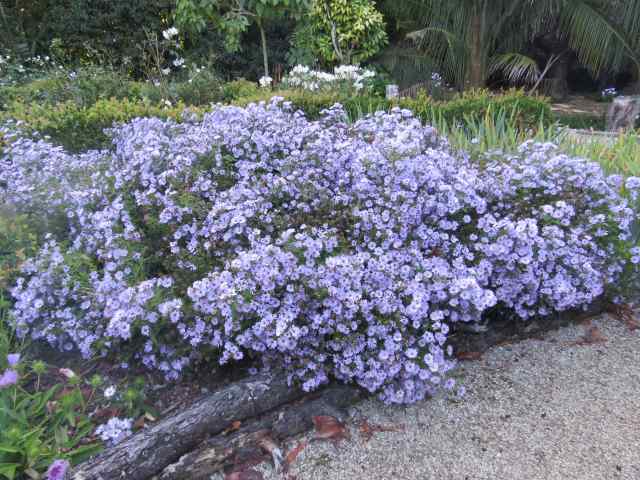
I photographed this patch of asters trimmed to the ground because I thought it was a good example of when not to let sleeping asters lie. Digital photography is very handy for dating things and I see it is only three years since these were last dug and divided. It had become a seamless carpet of aster in the time since. Both Zach and I noted that it did not look as good as it should have last summer. They weren’t helped by getting hit by mildew which has not happened before, but there was no mass flowering.

It should have looked like this last summer, but it didn’t. This is from summer 2024.

Time for a dig and divide, which Zach did this week. A perennial that has to be lifted and split every two to three years is on the high maintenance side and we don’t have many in that category. My friend, Sue, who leads the team of volunteers at the pretty Te Henui cemetery, told me she is culling plants that are too high in maintenance for their labour resources and this aster might fit that category. I must ask her for her latest list of culls. Fortunately I have Zach to carry out such tasks or I might be casting around for a less demanding plant option.

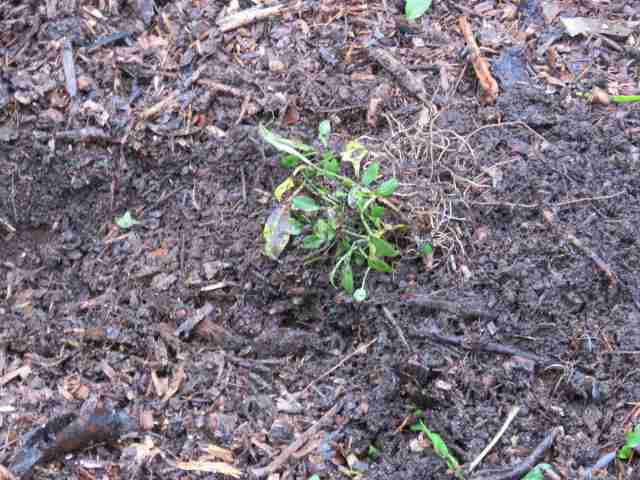
Enter the rabbits. After a quiet few months on the rabbit front, they are back and there is nothing they like more than an area of soft, freshly dug garden and mulch to dig. I sent Zach a text yesterday telling him that the rabbits were undoing his work. He was equally unimpressed but at least the photo shows you the size of division he split off from the previous carpet to replant.

I have just replanted the casualties, filled in the holes and spread blood and bone. The rabbits don’t like blood and bone and will stay away from that area but it does need to be replenished after rain and we have had plenty of that this week.

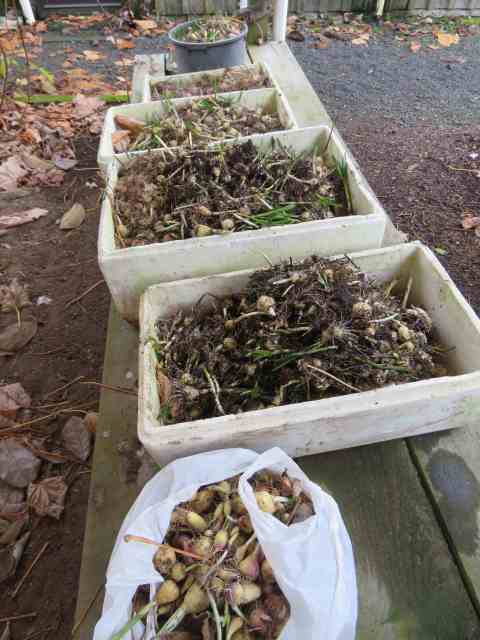
A whole lot of bluebell bulbs, just from the Iolanthe garden. There were more. I have already disposed of some.

The war on bluebells continues and I am at an advanced stage of boredom. I took this photograph as proof that I am not exaggerating. This is by no means all of the bulbs I have dug out of just the Iolanthe garden. Most were never planted there but I will have spread a few when I planted that area in 2019. Some have already been disposed of and still there are more to be dug.

They did not dehydrate in the summer sun. They grew instead.

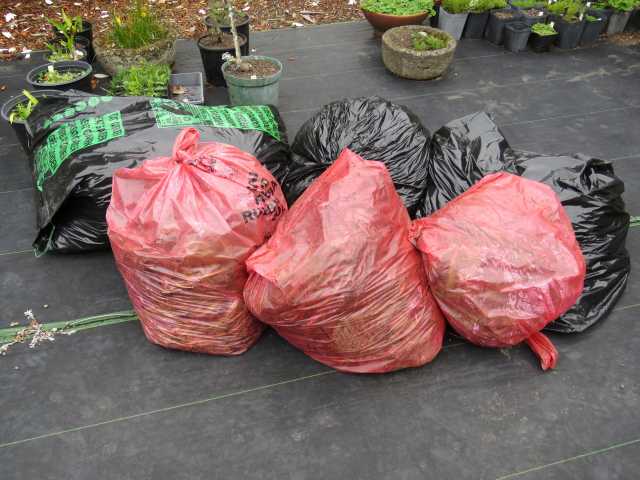
Bluebells have no place in the cultivated garden. I found a couple of photos from last year, recording our attempts to deal with some culled from the Avenue Gardens. I worried about how many we were dumping on our wild margins and they don’t rot down in the compost. I had the idea that if we spread them thinly on weedmat, they would dehydrate and die in the summer sun. They didn’t. They kept growing. I then thought they might compost in plastic bags in the sun, as wandering tradescantia does. Some did over the summer months but others in those bags were still firm and viable. Responsible disposal is quite a big problem.

Nor did they rot down in the plastic bags, as I hoped.

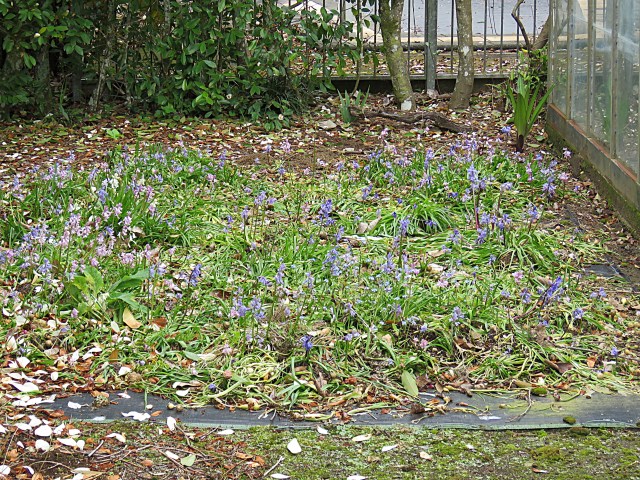
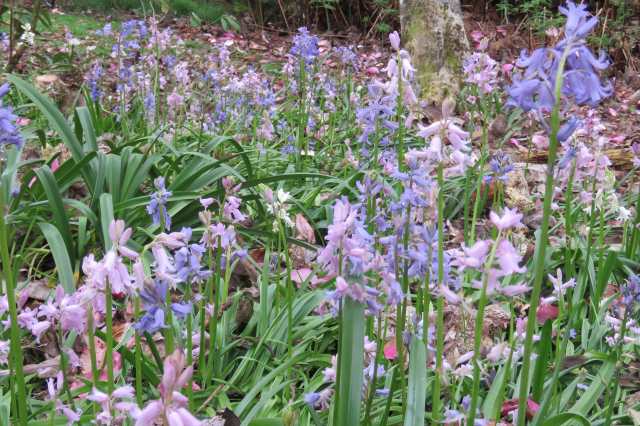
We have a lot of bluebells in the park and the Wild North Garden and they can stay there. To get rid of them, we would have to go for repeated use of some heavy-duty sprays and we try and avoid that. Besides, they are very pretty in spring. Ours are all Spanish bluebells or hybrids; the more desirable English bluebells are extremely scarce in this country. I don’t think I have ever seen them.

“If they stank like onion weed, they would be seen as a weed,” said Mark. “They are a weed,” I replied.

If we had our time over again, we would think twice about introducing them to our property. Mark put a bit of work into building up numbers in the first place. A decade or so on, I am putting a great deal more work into digging them out from some areas, all but sifting the soil to get the baby bulbs. You have been warned.

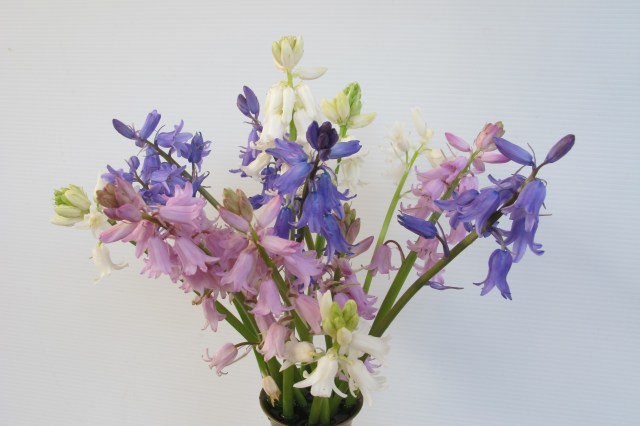
From happier bluebell days