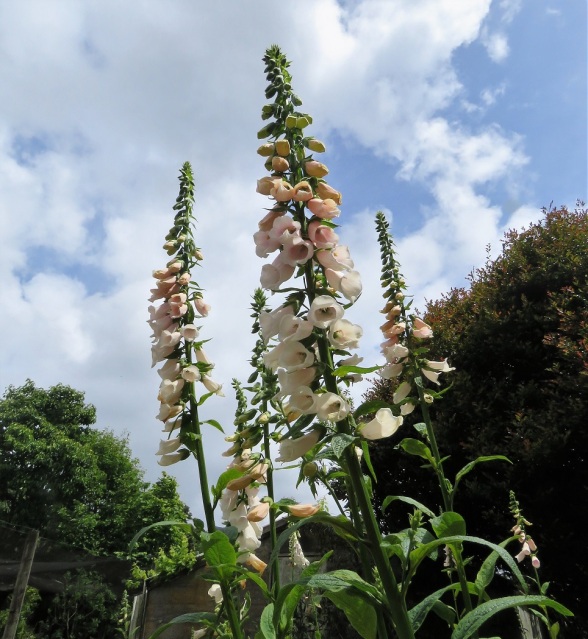
 I like foxgloves, in a wild flower sort of way. But the common pinky-purple form around here, not so much. In fact I have been pulling them out this week. I haven’t gone to the effort of trying to get white and pale ones established to see them all gradually returning to that hard shade of deep pink. I had a pretty honey peach coloured one that flowered in isolation in a gravel heap last year and left it to seed, thinking that as it was standing alone, the seedlings would be the same colour. There were over a hundred seedlings and at least half have gone back to the deep pink colour I spurn. I have been pulling them out as soon as they reveal their true colours to try and preempt the bees cross pollinating.
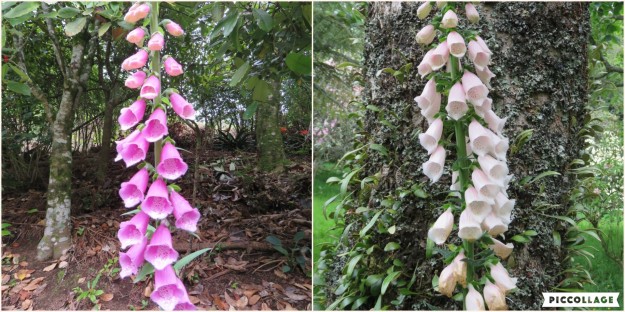
No the left, yes to the right
This unceremonious rooting out of the spurned colour was because of a series of photos I saw recently showing a local garden’s ‘English-style herbaceous planting’. Leaving aside the somewhat dodgy descriptor, what struck me was the jarring appearance of the common deep pink foxglove in a more refined garden setting. To my eye, it would have worked were these white or pastel, but in that hard colour – no thanks. It takes a deft touch to bring a local weed into a garden and make it appear harmonious.
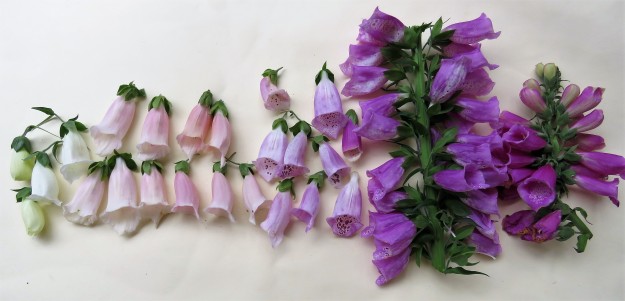
The range of shades with the common wild form to the right
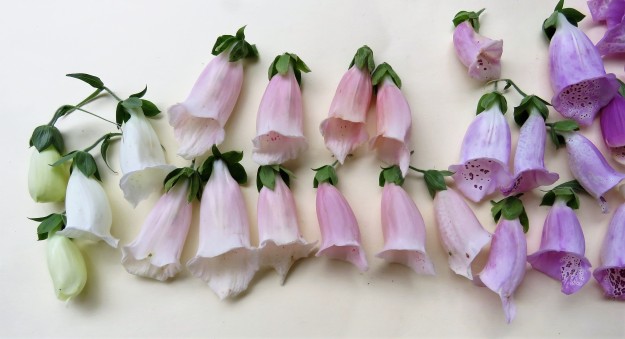
On my rounds of dealing to the plants whose sole crime is that they are an undesirable colour, I see that most of the seedlings from the pure whites we had are now more pastel. Naturally I wanted to pick an array of them to arrange in gradations of hue. There is quite a bit of variation in the size of the flowers too. Some have freckles and some don’t. I like the peachy tones more than the pale pinks.
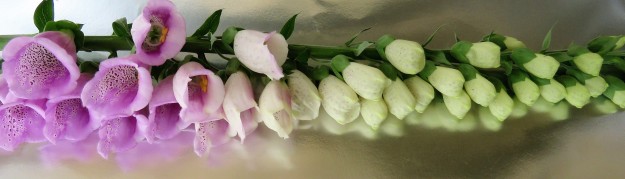
Some tried to outwit me by opening creamy lemon and ageing to purple, all on the same stem, but I can see them!
I resisted the temptation to go back to childhood habits and use them as gloves for my finger tips. In those days, we didn’t worry about their toxic properties. These days they come with a warning so I try and wash my hands after handling them without gloves. But on the scale of poisonous plants, they aren’t up there with the most toxic ones.
There are about 20 different species of foxgloves but only Digitalis purpurea has naturalised in the countryside here. I bought some seed of a yellow variant from a local supplier but Mark tells me that only one germinated. It will take years of culling to get the more desirable shades established as the dominant plant here.
The best ornamental planting I have seen remains the white foxgloves at Hidcote that first inspired me to look more closely at this plant. I wonder if they start afresh each season or let them seed down? But maybe they don’t have any other colours around to contaminate the purity of the white strain.
Mark was raised on the flower fairy books by Cicely Mary Barker. I can’t think how my English mother ever missed out on introducing them to me, especially as the author bears the same uncommon spelling of her first name as my mother did. But we raised our own children with them. Though if I am honest, the charm lies more in the illustrations and the small book format than in the poetry which never scanned sufficiently well to read aloud comfortably.
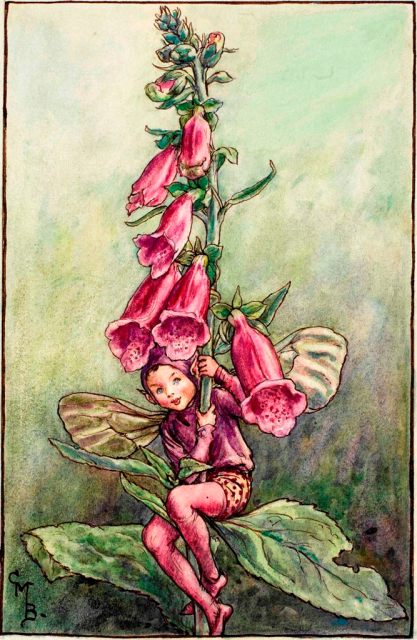
“Foxglove, Foxglove,
What do you see?”
The cool green woodland,
The fat velvet bee;
Hey, Mr Bumble,
I’ve honey here for thee!
“Foxglove, Foxglove,
What see you now?”
The soft summer moonlight
On bracken, grass, and bough;
And all the fairies dancing
As only they know how.
Cicely Mary Barker, 1927.


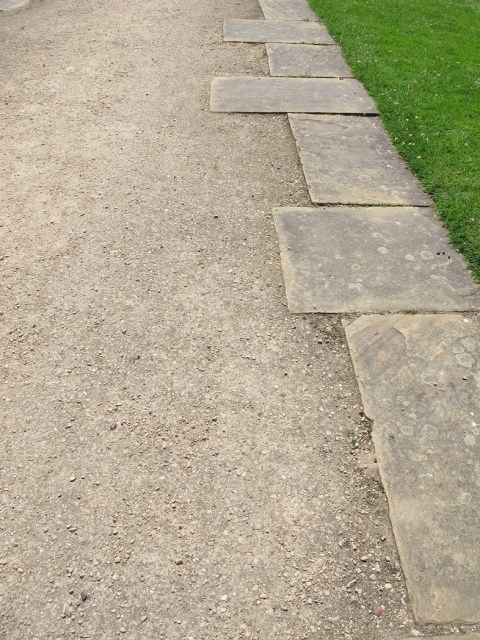
 I photographed this casual arrangement of river rocks defining a woodland path because it struck me at the time that the rocks were wrong. Unless you have a rocky stream flowing through your woodland, then the rocks are out of context. Some form of wood off-cuts or branches would seem more logical because they belong in that scene. But others may not be as picky as I am.
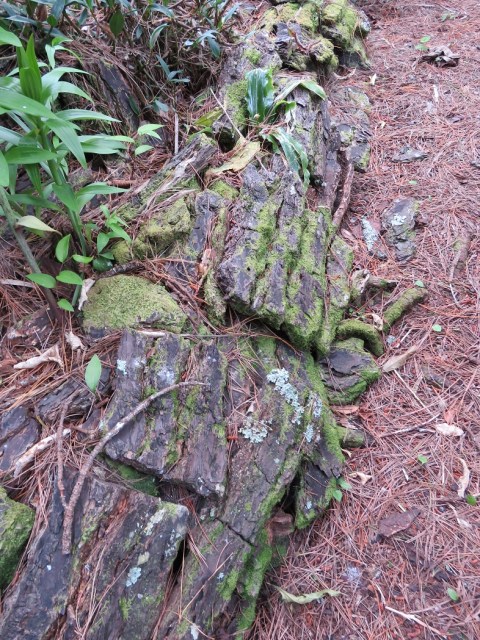 We tend to use what is at hand in the woodland areas – which in one garden means chunks of pine bark. I like the little pine bark walls that serve as an unobtrusive retaining structure while still allowing some soft definition. Pine bark has good longevity and is a natural alternative for us to use, given our pine trees. Sometimes we will use lengths of wood that have fallen from the trees above and that is a softer, more environmentally friendly option than hard edged concrete or similar. A bit like a horizontal bug hotel, if you like (bug hotels being super trendy these days).

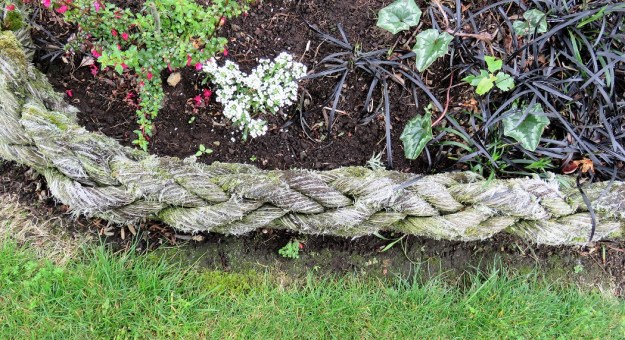
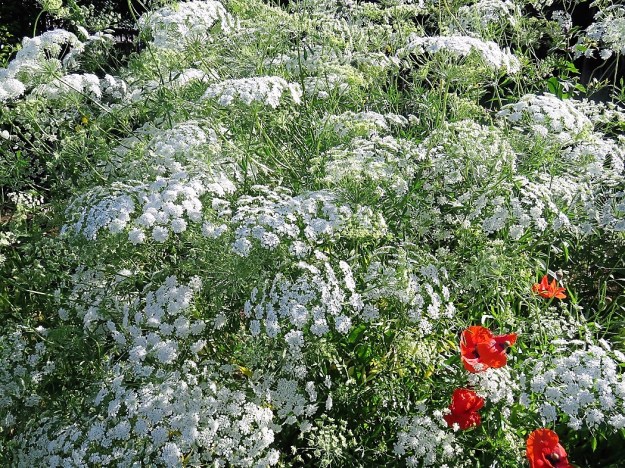

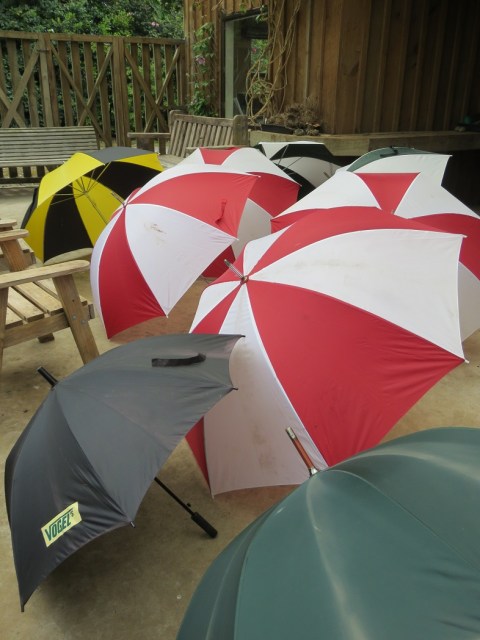 Umbrellas are a part of our lives here. We own quite a few of them and use them often to move around the property. That is because it rains quite a bit and the rain can often be torrential. We get 150cm a year (60 inches). I try and keep the respectable brollies that are in good condition tucked away for when visitors need them, confining us to the somewhat derelict ones. When I say we own quite a few, I mean getting up towards 20 of them and I don’t want to end up with 20 old, crusty brollies. Here I am, drying out some of the better ones to put away again after a garden tour last Sunday.
 The tour was a small group of British and American gardeners, led by a tour host whom we particularly like, which is why we agreed to their visit when the garden is otherwise closed. It is a very different dynamic to host tours with a knowledgeable leader and plenty of time for a leisurely walk around followed by morning tea. We really enjoy their company and that has not always been true for garden tours down the years. The more you get, the less personal the experience and, I am sure, less rewarding for the visitor too. The rain didn’t even matter much and it stopped soon after it started.
 The English visitors felt right at home as soon as we reached the park and they saw the meadow although one of them marvelled, looking back and seeing our native tree ferns growing amongst the trees – they are self-sown here but very highly valued in the UK. Though truth be told, the most common tree fern grown overseas is the Tasmanian species, Dicksoniana antarctica.

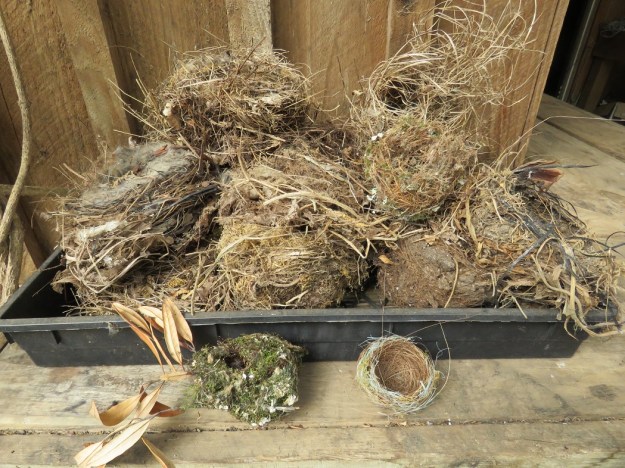 I have a collection of birds’ nests and have been wondering how to display them. I have at last found a suitable tree skeleton that I think can be severed and brought under cover so I can tie the nests to the bare branches. Whether I can do it without it looking terribly naff remains to be seen.
 Gardening is a wonderfully cyclic affair. Is there anybody as finely tuned to the seasons as the keen gardener? Yesterday was the first pick of the roses for the season. All but two of these have such scoury foliage that they have been banished to Mark’s vegetable garden (a large area that he refers to as his allotment) so the only reason they still survive is for the cutting of the blooms. Not only is gardening cyclic, it can also be distinctly ephemeral. But often those ephemeral pleasures can be the most charming on the days when they are at their best.

 I got to thinking about this because the Resene magazine ‘habitat’ (the lower case indicates modernity, darls) turned up in my letter box. Resene is a leading paint brand in this country. And I burst out laughing at the guide to ‘your next big colour trends’. This is because we are renovating our two main living rooms so I know that the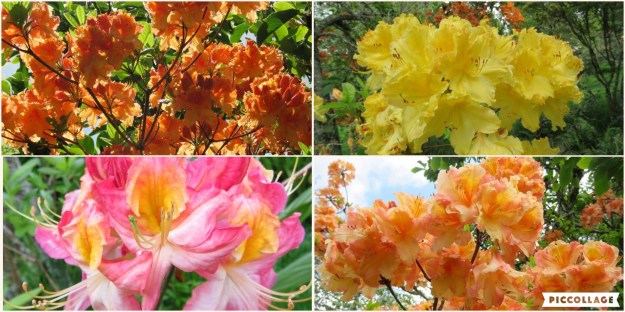
 All this return to colour thinking was also sparked by wandering through our park and looking at the deciduous azaleas with their OTT, unabashed vibrancy – vulgarity, some may think. And I remembered the man who came around the garden when we were still open and asked ‘what is the big orange rhododendron behind the house’. We have garden borders behind the house but I couldn’t think of a plant like that there so I suggested he go and pick a flower and bring it to us. Well, not only did it transpire that ‘behind the house’ meant the spacious park area but he returned bearing an entire head of an orange azalea that he had snapped off, not the single bloom. After all that, we did not have it available for him to buy.
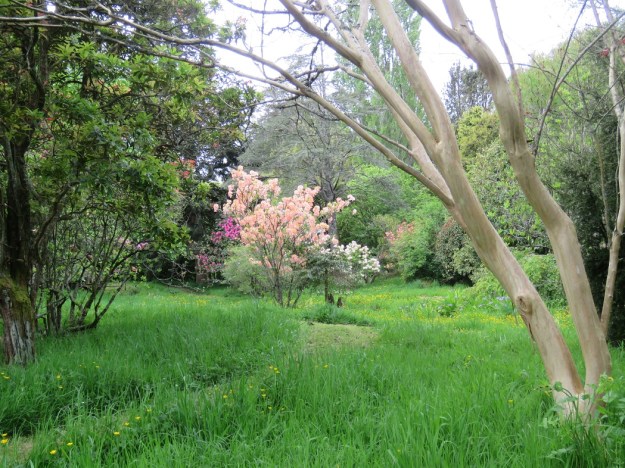 In self-defence, I say that our bold azaleas are mostly interspersed throughout the park, so surrounded by acres of verdant green rather than being planted en masse to dazzle the eyes. And they have been there quite a long time so endured the changing fashions of colour down the decades.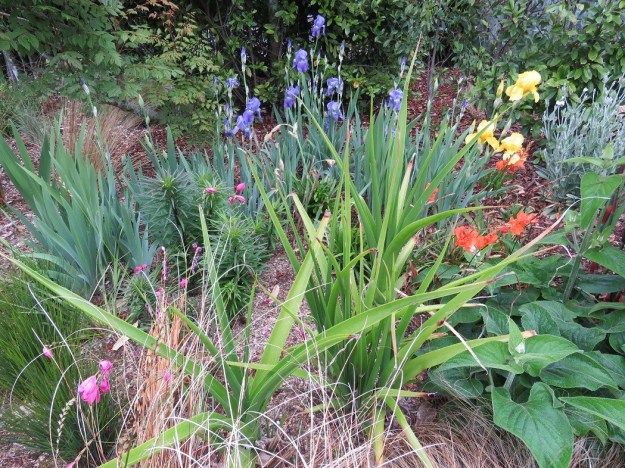
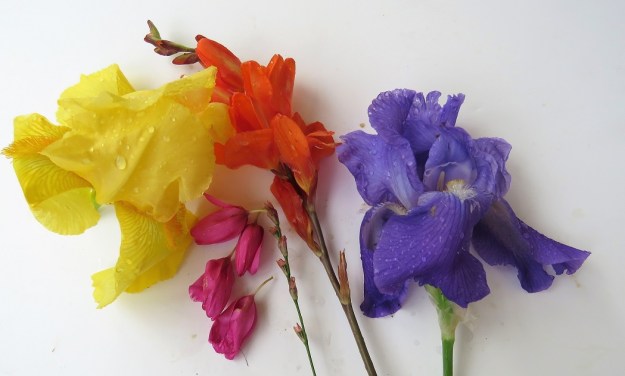 I was slightly alarmed by an inadvertent colour combination in my new borders. I picked a flower of each to show the colours more clearly. I am pretty sure I thought the bearded irises were all yellow when I planted them but 80% are purple. While the colour is sparse in these early stages of planting, I am thinking ahead to when each forms a large wodge of colour.
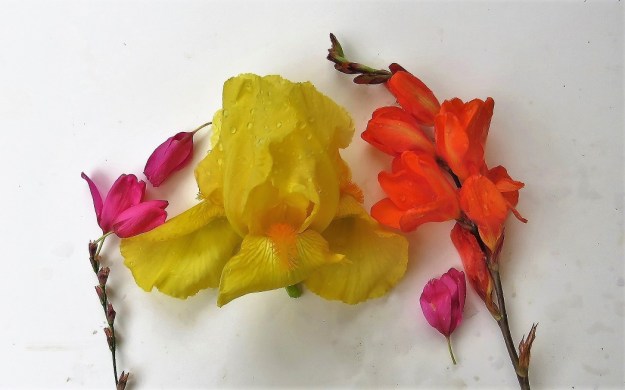 Take the blue-purple out to keep the ramped-up colour.
 Or take the yellow out and it looks very different, toning it down considerably. I am marking the ones flowering yellow. I think I prefer the second version but it all comes down to personal taste in the end.
