Tikorangi Notes: Flowers great and small. With added lemons.

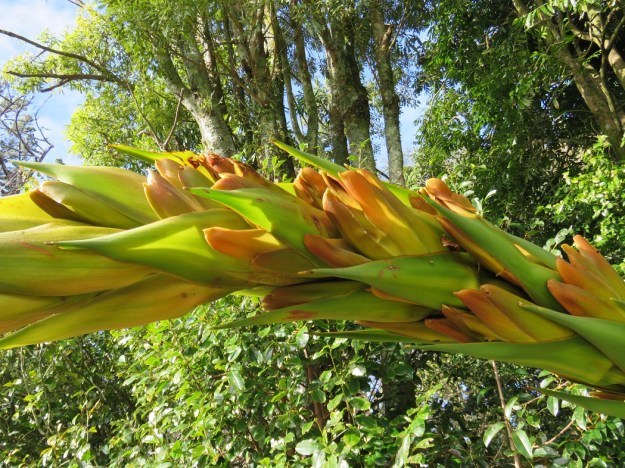
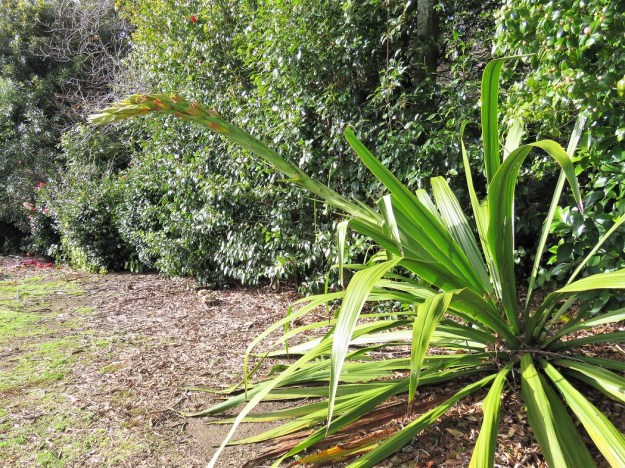
Doryanthes palmeri or giant spear lily. Certainly shaping up to be giant

Behold Doryanthes palmeri! The giant spear lily from eastern Australia. It has never flowered for us before so the three metre, sturdy flower spike is a thrill even though it has yet to open. This particular plant is a nursery relic, by which I mean that it was not planted in this position. More, cast aside from nursery crops (we once produced a few to sell) and left to its own devices. Now the grass garden is planted beside it and it looks quite at home. This is just as well; each pleated leaf is about one and a half metres long and I don’t fancy moving it. I am hoping the flowers will open in the next week or so.
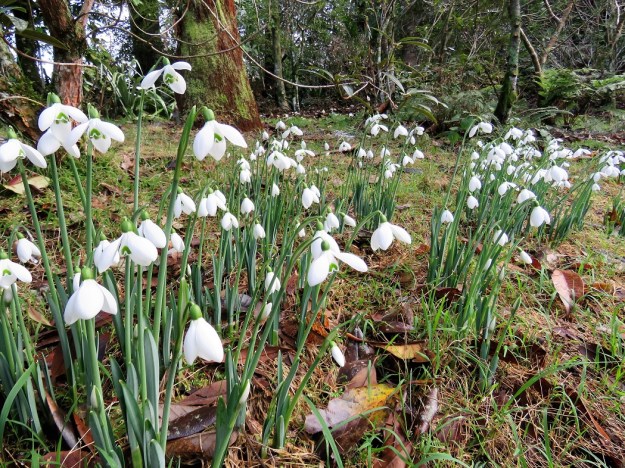
Snowdrop season! Galanthus S. Arnott

From the massive to the tiny, it is snowdrop season here. We are not really-o truly-o good snowdrop territory and Galanthus ‘S. Arnott’ and G. elwesii are the two main varieties that perform consistently well and multiply for us. Mark would dearly love some later flowering ones to extend the rather short season but while he went through a stage of gathering various different varieties, none of the later ones have thrived. Undeterred, he is trying some hybridising to see if he can get some variety but these projects, you understand, never yield instant results. It is more like a ten or twenty year plan, all to get the extended snowdrop season.
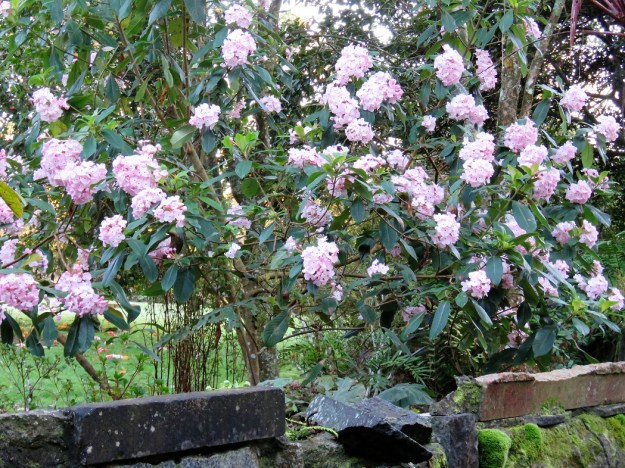
Luculia Fragrant Cloud keeps on flowering this season

It was a full month ago that I wrote about luculias. The bright pink ‘Early Dawn’ is well finished, white ‘Fragrant Pearl’ still has a few blooms but the main specimen plant needs some attention (a bit more judicious pruning and more light – it has flowered better in the past). But ‘Fragrant Cloud’ has been in full flight ever since and still looks good. This is the very best I have ever seen it and the scent is divine.
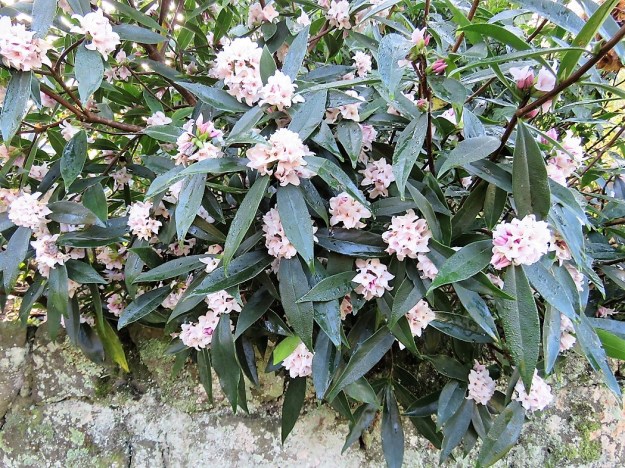
Daphne Perfume Princess

Equally fragrant are the daphnes in full bloom. We grow a number of different daphnes but a fair amount of them are our own ‘Perfume Princess’. Mark has bred other plants that are showier and more spectacular (especially the magnolias), but this obliging daphne represents a breeding breakthrough in some aspects and may well end up as the one he is best known for internationally. It is certainly the one that enabled us to retire early. Given that, we are deeply relieved as each year it proves itself again as a garden plant and a superior daphne which will stand the test of time.

I admit that as this post goes live, we are far from Tikorangi. Well, not that far. Just ‘across the ditch’, as we say, in Australia. While we need passports to travel to Australia it never feels overseas as further, oft more exotic, destinations do. It is just that all three of our children live in Australia these days and we are all joining the celebration of the second birthday of our only grandchild. So not a garden or plants-focused visit but I am sure we will find matters botanical of interest on the way. While I love the place we live, I have been missing the stimulus of travel this year. I need to find somewhere interesting and new for a trip next winter. By the time we arrive home, we should have the first colour showing on Magnolia Vulcan and M. campbellii should be in full bloom in the park. Winter will feel as though it is on the wane.
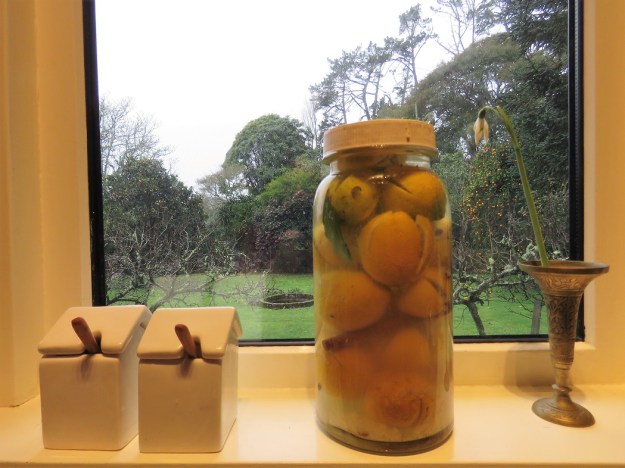
Preserved lemons – the liquid is opaque because some of the salt has yet to fully dissolve

Before we left, I made another jar of salted lemons, having noticed a heavy crop and smaller fruit on our main tree. Smaller fruit fit in the jar better. I prefer to make salted limes but the lime tree is having a year (or two) off fruiting. They are dead easy to do, store for many months in the fridge and are very tasty as a flavour addition. They can make couscous flavourful (though I have gone off couscous since I realised how highly processed this product is), add taste to rice and all manner of stuffings or savoury dishes. I resorted to buying lemons one year, in the absence of a good lemon crop at home, but if you are buying fruit, pour boiling water over them and stand them for a few minutes first. Some are, I read, coated (in wax?) to help their storage life and you need to get rid of any coating or spray residues before preserving them.

Just looking at the jar is like looking at a ray of Italian sunshine on a winter’s day in Tikorangi.
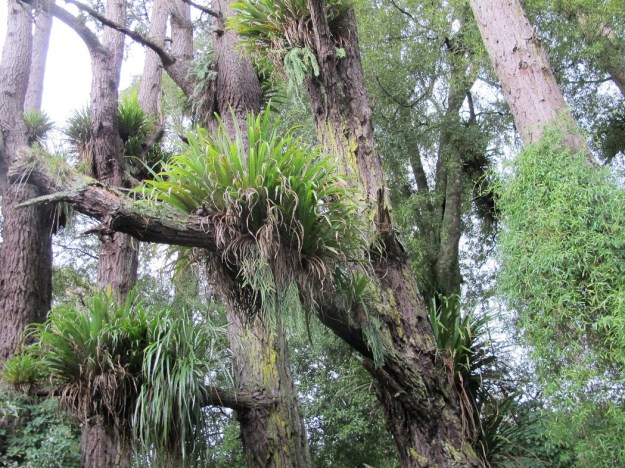


The weight of epiphytes

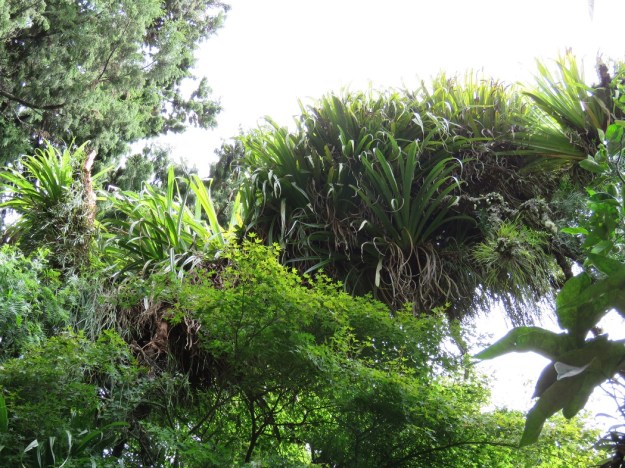
Over a century of epiphytic build up

When branches fall here, they often bring down a mass of epiphytes with them. It seems likely that, in some cases, it is the weight of those that causes the branch to fall. A combination of mature trees and a benign and humid climate means that epiphytes are a significant feature of our canopy. ‘Widow-makers’, Mark says, utilising the term for things that have the potential to fall from above and kill. It is a gender defined term, which I guess comes because it has a longstanding application in forestry which remains a traditionally male occupation.

There is an entire self-sown and self maintaining environment in this one tree

One of the characteristics of New Zealand native forest is the high incidence of epiphytes which are simply organisms (in this case, plants) that grow on the surface of another plant, getting moisture and such nutrients as they need from the air and rain and then from the debris that builds up around them. Because these epiphytes are perched up trees, they are vulnerable to drying out so are more commonly found in areas protected by other trees rather than on solitary specimens standing in exposed isolation. We also get regular rain here and have high humidity levels no matter the season. Add to that the fact that our native forest and bush is almost entirely evergreen. There are very few deciduous natives – a total of only 11 different species that are fully deciduous in winter. Most New Zealand gardens use a wide range of evergreen plants and shrubs, usually outnumbering the deciduous selections. So we have situations that are hospitable to epiphytes.

Add in to that mix, maturity. Because we have many well-established trees here, some dating back close to 150 years, there has been time for epiphytes to get a grip on their hosts.

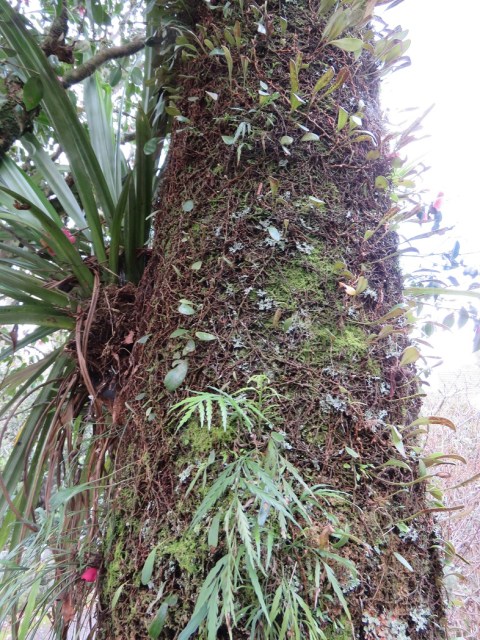
Drooping spleenwort and leather leaf on the trunk of a tall queen palm

Where do these plants come from? Mostly a combination of wind and birds. Some of our trees have entire mixed colonies growing in them. The dominant epiphyte here is the collospermum, C. hastatum, but we have other species of both collospermum and astelia perching up high too. Also assorted ferns, particularly the native climbing ferns, Pyrrosia eleagnifolia or ‘leather-leaf’ fern and Asplenium flaccidum or ‘Drooping Spleenwort’ which is prettier than it sounds. We even get native orchids appearing in these epiphytic colonies but NZ native orchids are perhaps best described as being very subtle in appearance.

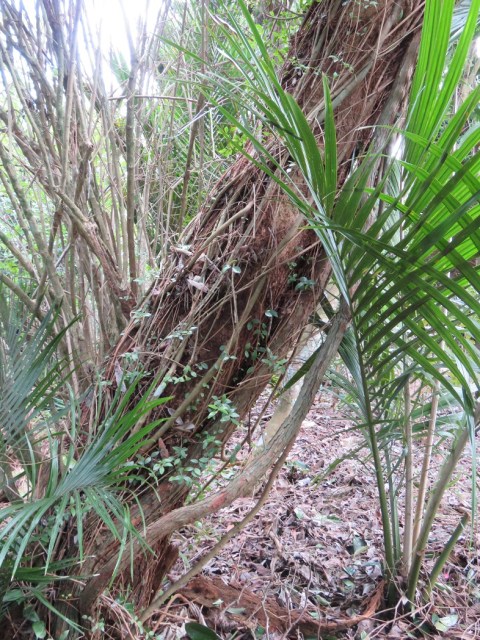
The host tree is leaning badly, the twining vines and thicker trunks are all southern rata

The rata is to the South Island what the pohutakawa is to the North Island, though we do have the northern rata as well. These are all the same family (so all metrosideros) but different species. Think of them being like cousins, perhaps. So the South Island rata is M. umbellata. That rata is an epiphyte, relying on an established tree to climb. Unlike most of the perennial types of epiphyte, it can eventually kill its host. In forest conditions, the rata is so well established by then that it can stand on its own, forming a hollow-trunked tree (the hollow centre being where the host tree has decayed away). We think it far more likely that our rata will not be sufficiently anchored to the ground to stay standing. The nearly deceased host tree – a eucalypt – has developed a definite lean and we think the whole shebang may fall sooner rather than later.

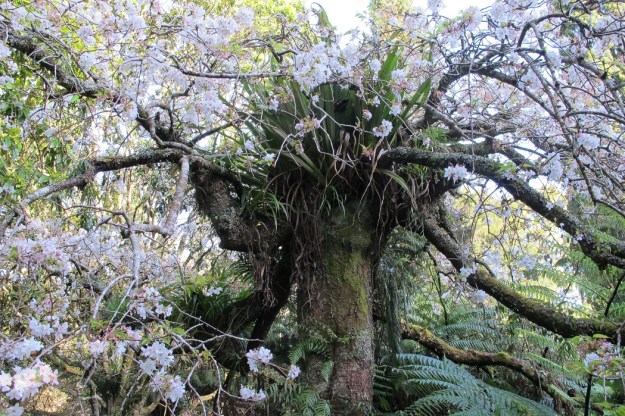
Like an octopus, Prunus yedoensis ‘Ivensii” with epiphytic collospermum

I did get the ladder and do some tree climbing to take out most of the collospermum from the Prunus yedoensis ‘Ivensii’ because I like this flowering cherry and I could see the collospermum were getting the upper hand rather than maintaining an equilibrium.

Generally, we just leave the epiphytes alone. Sometimes the weight will get too much and massive clumps will fall, often bringing down branches on the way. They are usually so heavy we have to dismantle them to remove them. In times gone by, Mark used to follow the Orchid Society practice of gathering up the decaying gigi (fallen collospermum) to use as potting mix for the growing of orchids. That was before the days of granulated bark potting mixes. Left to their own devices, epiphytes are just a part of nature – a naturally occurring matrix in fact. It adds an upper layer of interest to the garden while also creating its own ecological environment quite independent from human intervention.

Whenever we have to do a clean-up that involves fallen epiphytes, we just relocate the largest pieces we can manage to the back areas of woodland where they can continue to provide habitat and add diversity.

Mark is surveying a sizeable branch brought down by the heavy burden of epiphytes

In the meantime, there is another branch waiting to fall…

A quilted flower

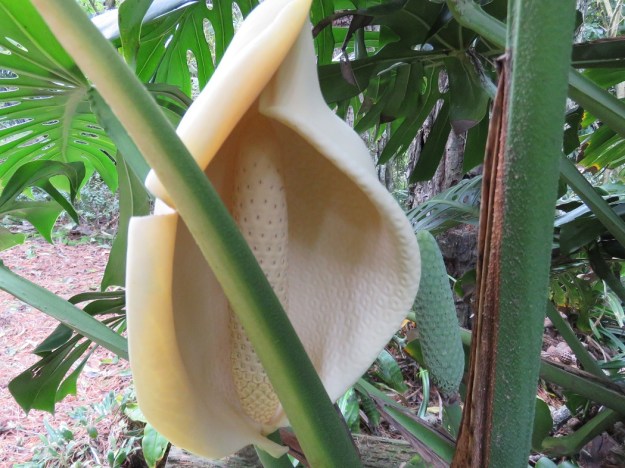
The quilted spathe of Monstera deliciosa with the distinctly phallic green fruit from a previous bloom to the right

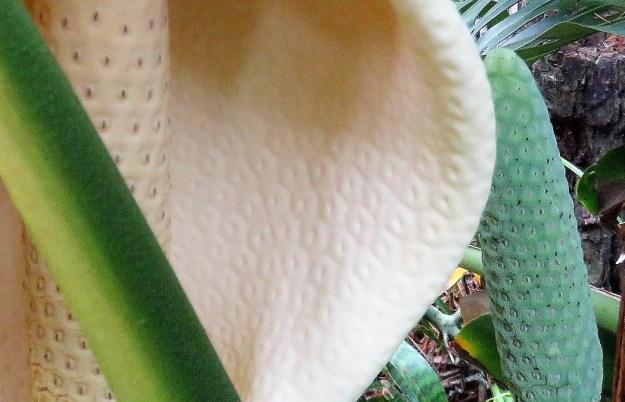
I had not noticed until yesterday that the interior of the spathe on the Monstera deliciosa is delightfully quilted. For quilting enthusiasts, they are hexagons – six-sided figures. The spathe is the curved hood on the flower – botanically a modified leaf but most of us will continue to call it a flower. Some readers will know the monstera better as the fruit salad plant – most often seen as a house plant or perhaps more as an office plant where there is greater space. I would rather doubt that it flowers, let alone fruits, when it is treated as an indoor plant.

We have it as large, shade plant, climbing our trees and furnishing some of the back areas of the woodland gardens where it never gets frosted. It is a bit rampant, a monster even, although easy enough to cut back when it roots its way along the ground. It is more difficult to contain when it romps its way up the trees because it puts out strong aerial roots all the way and our largest ones are now a good ten metres up the trees. Looking tropical, even in the depths of winter. Fortunately, this is not a plant that will smother or strangle its host tree.

Monstera deliciosa can indeed be a monster plant when liberated in the garden

Our plants set fruit but we are not hot enough to ripen them to the allegedly delicious stage. Sometimes we get them to the point where the segments are ripe enough to fall apart, as they do, but the taste, while somewhat ‘tropical fruit salad-y’ in flavour, remains too sharp to eat many. A bit like cut glass, we say, which is apparently to do with oxalic acid. Our guess is that in hotter climes, the oxalic acid is less dominant.

Coming back to the flowers, I hadn’t really noticed how lovely they are until I saw this one yesterday and noticed the matching quilting on the central spadix (which develops into the phallic shaped fruit) and the interior of the spathe which embraces it.

Arum lilies, photographed in somebody else’s garden

“Aroids”, Mark said which had us googling a few other plants with flowers of similar form which were otherwise totally different and yes, they are all members of the araceae family, though not all are members of the aroid sub family.  Arum lilies are probably the best known. Arums are a great deal more prized overseas than in New Zealand. Here, they are seen as an indicator of poor land management (our pioneer roots are as farmers in this country), invasive and widely banned from sale but not on the total eradication list, as far as I know. As a garden escape, the problem with arums is that stock don’t eat them and they are difficult to control once they have established themselves. I once wrote giving advice on how to get rid of them. The coloured calla lilies are still grown as ornamentals but I dug most of mine out this year. I found them shy flowering and they didn’t justify the garden space. Too much foliage for too few blooms.

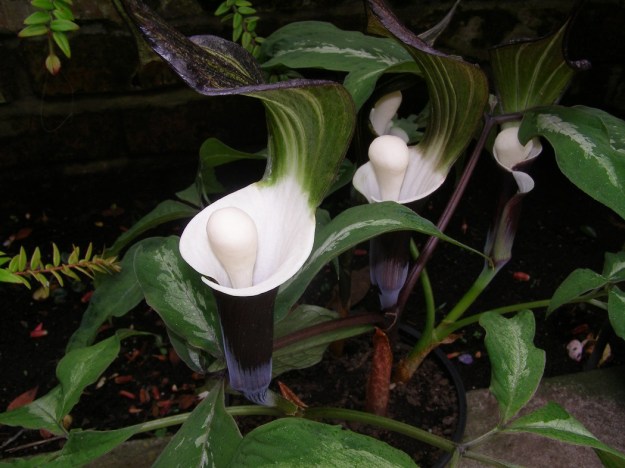
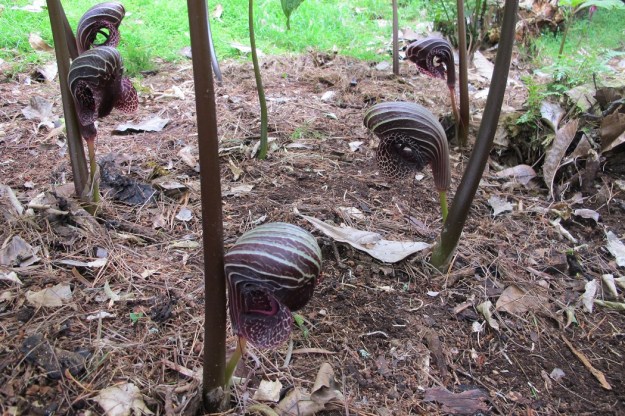
Arisaemas we grow a-plenty. Theirs is a very curious plant group, though not beautful in the usual sense. A. dahaiense

What surprised me more was to find that arisaemas and lysichiton are also members of the araceae family. They have the distinctive hooded flowers, but that is about all that looks the same as monstera or arum. I am sure I have photographed the lysichitons here (unromantically referred to in common parlance as ‘skunk cabbages’) but I can not find the photos in my files. We have both the yellow American species (americanus) and the white Asian species (camschatcensis) which we grow as bog plants.

Alocasias also belong to the same family. This includes taro, which is widely sold in New Zealand because it is a food staple for Pacific Island people, though it has never made its way into the general diet of most others and I admit I have never tried it. It has never been touted as delicious. Should you happen to be in Missouri, the botanic gardens there have the world’s largest collection of members of the araceae family. Munich Botanic Garden also has a splendid collection owing to world expert working there, the ever-handy internet tells me. I was just a bit surprised by the diversity of araceae we grow here. I was looking up the toxicity because some can cause burning of the skin and I wondered if it was connected to the aroids. But no, it appears that it is only a characteristic of some family members – chemically speaking, calcium oxalate crystals in the form of raphides. So now you know. This will explain the sensation of eating tropical flavoured glass shards when sampling the monstera fruit that are less than perfectly over-ripe.

Arisaema sikokianum – not easy to keep going as a garden plant but eye-catching

When a handle is a thing of beauty

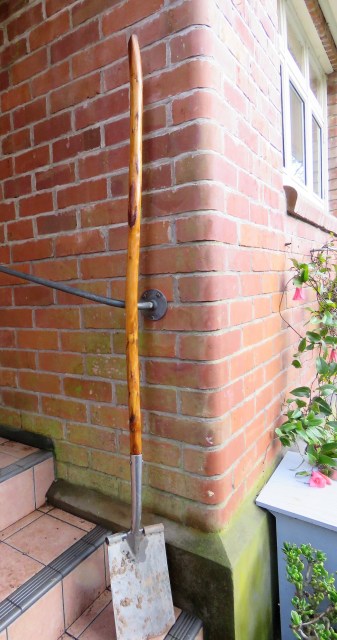
Behold a simple thing of great beauty. At least that is what I thought when I saw it leaning against the side of the porch. This is Mark’s designated spade for the digging out of trees and large shrubs. It is not that he is seven feet tall, but that he likes a long handle to avoid having to bend his back. He is a man who has learned the hard way to be seriously protective of his back.
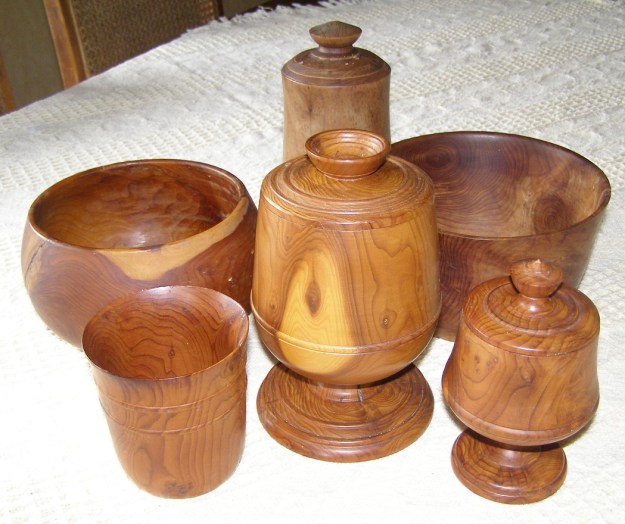
The handle is yew, harvested from a dead tree in the park, hand whittled to size and required smoothness, oiled with linseed applied in repeated thin coats. You can’t feel it in the photograph, but I can assure you it is wondrously smooth and tactile, for nobody wants to get splinters from a spade handle.

Mark has always been a fan of yew as a timber. Back in the days when he was a woodturner, the favourite timber of most was, and probably still is, NZ kauri. That is because it is so easy to work with – in Mark’s words, it cuts like butter. It doesn’t have a particularly interesting grain like other woods, including heart rimu. Yew is not native but it also cuts like butter, so to speak, and has a beautiful grain. It was the traditional timber for longbows, presumably because it is both long lasting and stable. It does not warp and bend out of shape as readily as many other timbers. Just perfect for a long handled spade. I see another long handle being prepared for the drainage fork we use to clear out water weeds.

These examples of yew treen date back a few decades to when Mark was a craftsman woodturner, before his nurseryman, plant breeder days but post his university days.

Yew – commonly Taxus baccata, although there are other yew species.
NZ kauri – Agathis australis
NZ rimu – Dacrydium cupressinum

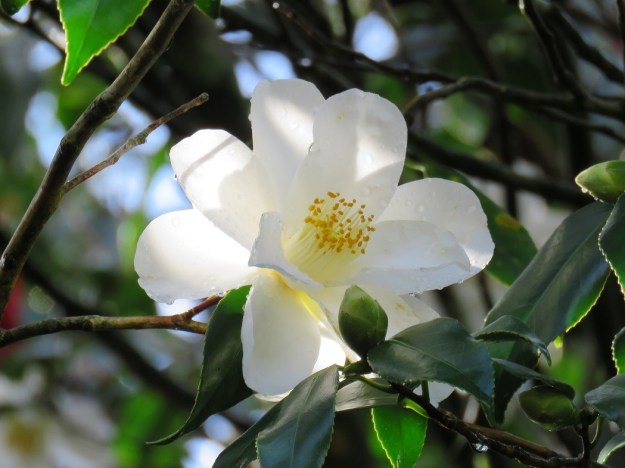
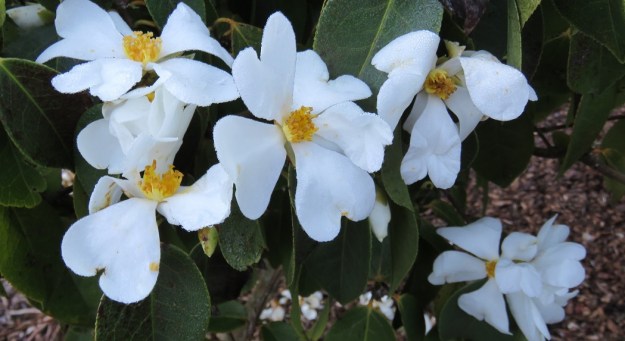
Our winner in the white camellia stakes – C. yuhsienensis

Camellia yuhsienensis

The world of white camellias is quite heavily populated, especially if you narrow it down to white species camellias. Over time, we have gathered up most of the species that have been available to us, and very lovely many of them are. But the one we have singled out as the most attractive specimen plant is Camellia yuhsienensis.

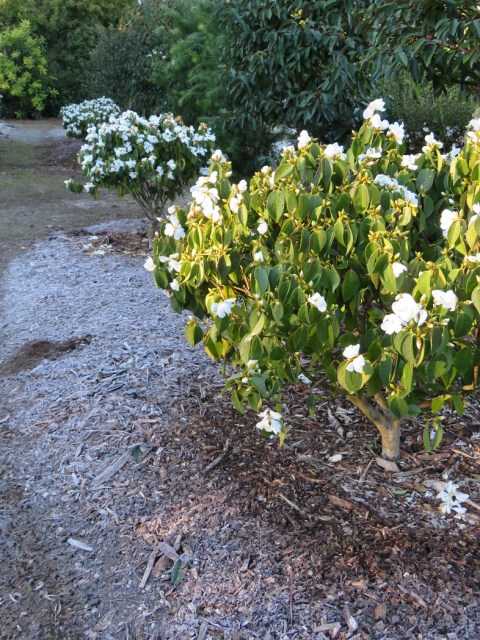
You can tell how much we love this plant by the fact that we have chosen to use it as a feature plant. I just counted and found we have no fewer than seventeen of them as specimen plants, each sitting in its own space – not hedged or jammed in with other plants. It is not usually our style to repeat a single cultivar like that. Mark threaded it through the new gardens – the grass garden and the lily border – to give winter interest.

Threaded through the lily border to give winter interest. That is visible frost this morning. And a freshly dug rabbit scrape. The rabbits are still winning here. We may yet have to get a cat again, given our dogs are pretty useless on the rabbits.

What do we love about it so much? It has handsome, bullate (textured) foliage which is not the usual shiny green associated with japonica camellias. It sets an abundance of buds in pointed clusters and opens them over a long period of time. But it is the flowers that are the real delight – pristine, white single blooms, good-sized and looking more like michelia or magnolia than classic camellia. And it holds its blooms well out from its leaves and branches. The blooms are not substantial but that can be an advantage in a camellia, especially when there is a long succession of fresh blooms waiting to take over. It is just a delight to us.

Some reports mention an overwhelming fragrance but we think that either that claim is exaggerated, the Chinese have greatly sensitised nasal capacities or the clone we grow here didn’t get much fragrance. It is really only lightly scented and that requires sticking one’s nose right up to the bloom. Nothing, alas, is perfect and we need to give the bushes an occasional shake or brush to get rid of spent blooms because they don’t always fall cleanly.

For NZ camellia purists, we grow the mounding selection chosen by Neville Haydon, back in his days at Camellia Haven

The native habitat of C. yuhsienensis is in the Hunan area of China which is, loosely speaking, southern(ish) and inland, with mountains, so it is not a tropical area. We have found it to be completely hardy in our conditions, although our winters are hardly testing. Because it is a species, plants raised from seed will show species variation. We started with two forms but always vegetatively propagated them to keep the selections stable. We had an upright columnar form but ended up cutting it out because the foliage and flowering were nowhere near as good as the mounding form we kept.

The bad news is that I doubt that it is commercially available these days in NZ so you will have to search hard to find one. I have to say that because it is disconcerting to me how many people read these posts and assume they are commercially driven and we must therefore be selling the plant and can send them one. Um, no. I write these posts because I am a writer by nature, we love gardening and it is greatly rewarding how many readers share this pleasure. I appreciate the comments. The phone calls and emails trying to order plants from us – not so much.

Superstar

And just because I took a nice photo of it this week, I close with Superstar. It grows at least four times the size as C. yuhsienensis, probably with a quarter of the flowers, if that, but it can show a lovely bloom. It is hard to beat a beautiful white camellia on its day.