Mark’s story

* as told to The NZ Rhododendron, the annual journal of NZRA Council and Pukeiti Trust Boad. December 2017. Photos are mine. 

Mark could perhaps be described as having chlorophyll running in his veins. He was the afterthought child in his family, quite a bit younger than his brothers. He remembers tagging along with his parents and visitors, listening in as they discussed plants around the Tikorangi garden in North Taranaki. “It was quite a lonely and isolated life in the country and I really wanted the social contact, even if it was with older people. It was only later that I realised what I learned in those early years.”

Mark was determined to head off to university, the first in his farming family to do so. It was not an easy path but he graduated with Bachelor’s degree in Social Sciences, majoring in Psychology. He enrolled in a post-graduate diploma in guidance and counselling but withdrew half way through the year. “I was the youngest on the course and all the others were teachers with regrets. One would have liked to be a potter, another dreamed of running a country pub. I didn’t want to get to my late 40s and look back with regret. By that stage, Abbie and I had already been married a couple of years and I went home and told her I wanted to withdraw from the course and follow some dreams.”

From there, he taught himself to draw from a book by John Ruskin, taught himself to turn wood to a high quality and then set out to learn how to propagate and, from there, to build a nursery.

“When I started here, there was no nursery. Dad was a just a farmer and a gardener who liked to breed plants. He had taught himself the rudiments of propagation. I started to build the nursery from one wheelbarrow up and I set out to learn how to propagate and to grow plants commercially. It was a case of learning through trial and error. It has always surprised me how successful the nursery was.” Mark credits the access to his father’s plant hybrids for giving him new material to mark out his nursery as different to the rest. “Dad had pretty much stopped hybridising by then. It was only ever a hobby for him. I started more systematically to see how far I could push plant breeding. And as the plant breeding grew in range and scale, I had the nursery to cope with growing on the material.” He started with saturation coverage of a large plant of Camellia pitardii in a Urenui garden.

From an early stage, Felix made it clear that the garden he and his wife Mimosa had built would pass to Mark and his family. Mark and Abbie are demonstrably aware of what it means to be on a family property that is already on its fourth generation.

Arisaema seedlings are for the garden at Tikorangi, not commercial release

Mark is clear in his mind about the hybridising he does which has commercial potential and that which is solely to try and get better plants for their own garden. He is currently working with galanthus, aiming for later flowering cultivars which perform as well in Tikorangi conditions as Galanthus nivalus ‘S. Arnott’. He is continuing the efforts of his late father with cyclamineus narcissi, looking for sterile selections that bloom from every bulb, as Felix Jury’s ‘Twilight’ does. In the hellebores, improving garden performance and getting cultivars which hold their blooms above the foliage are the aims, as well as looking for sterility if possible. In the arisaemas, he wanted to extend the colour range and the season and to get some hybrid vigour into A. sikokianum types. He is often to be found out and about with his magnifying glass and paintbrush.

The garden is always the star in Mark’s mind. “This is a poor man’s garden,” he says. “It was never made with a big budget and if we had to buy in all the plants we want, we could never afford to keep it going, let alone expand as we are. To get masses of snowdrops to the point where they naturalise themselves to or to get a new 40 metre of border of auratum lilies, we have to raise our own from seed. And when raising from seed, I often like to start with controlled crosses to see if I can get better outcomes, rather than just using open pollinated material.”

The garden is a treasure trove of plant material, some of which may or may not go into commercial production at some stage in the future but which currently has no market. “We have some thrip-resistant rhododendrons with full trusses if that plant genus comes back into fashion. At the moment, the market is so small that there is no commercial advantage in releasing them.” The same is true of coloured and variegated cordylines and a range of camellias.

Magnolia Felix Jury

The creation of new cultivars with international potential has been a major focus. In the deciduous magnolias, Mark has named and released four out of many hundreds that he has raised. But he says he has the next three possibles under trial. Of those released, the magnolia that he named for his father is his greatest pride. “It is what Felix was trying to get to – good colour in a large cup and saucer bloom, so I called it ‘Felix Jury’. This one is doing really well internationally which is particularly pleasing. It has already been given an award of garden merit from the RHS.”

A range of michelia seedling blooms

Fairy Magnolia White, with bonus kereru

The michelias are a source of frequent disappointment to Mark. “We have raised so many of them now and have a good range of new colours. But it is so difficult to get everything in one plant – clean colour, good size of bloom and plenty of them over an extended period, compact, bushy growth, easy to propagate and scented. Keeping the scent is the most elusive attribute of all.” Mark has named three so far, marketed under the ‘Fairy Magnolia’ brand, but there is a long way to go yet and he keeps persevering, often with several hundred new seedlings a year.

Camellia Fairy Blush, Rhododendron Floral Sun and Magnolia Honey Tulip

Amongst the camellias, Mark names his selection of ‘Fairy Blush’ as his personal favourite. He and Abbie have chosen to use it extensively for clipped hedging in their garden because of its long flowering season and its good habit of growth. ‘Floral Sun’ remains his pick amongst the rhododendrons.

Daphne Perfume Princess

Ironically, it is a daphne, a one-off plant from a speculative breeding effort, that may prove to be the most lucrative cultivar internationally. ‘Perfume Princess’ basically looks like an odora although it often flowers down the stem like bholua. It is the size of the flower, the vigour of the plant and the length of the flowering season that sets this plant apart from other daphnes. “It is just a brilliant plant to grow and a terrific nursery plant to produce,” Mark says. “That is not true of most daphnes which can be very difficult to produce in containers.” Both the local and international markets for a daphne eclipse the market for magnolias, even if the plant itself is less spectacular.

“We stopped doing mailorder in 2003, stopped wholesale in 2008 and phased out retail after that. The phone calls and emails in search of plants haven’t stopped in the time since but we were really glad to shut all that down. Abbie always described nursery work as being like factory work but in better surroundings. There was no fun in it but it enabled us to get to where we are today.” Mark is quietly proud of the fact that royalties on plant sales, particularly overseas, are what enabled them to retire from the nursery trade and pursue their interests in the garden.

The garden is still expanding. They closed to the public 3 years ago and have been enjoying the freedom to experiment.  “We’ll open again at some stage, maybe 2019. For the annual garden festival, at least. Though we are unlikely to ever open again for extended periods during the year.”

Mark and the Magnolia Felix Jury tree at Wisley on the left. Mark with a collection of blooms from different seedlings at home in Tikorangi

Biennials, are they worth the effort, he asked.

Verbascum creticum, a biennial with presence in our rock garden

Each Sunday morning at 7.45am, I have a chat with Tony Murrell on Radio Live’s Home and Garden Show. We cover a wide range of gardening matters and during the week before we have a discussion by phone or email to agree an upcoming topic. As an aside, the recent release of very encouraging listener figures for this time slot has sharpened our focus somewhat. There is a scary number of folk out there who listen at that hour.

Today we talked about gardening in the very dry conditions that much of the country is currently experienced, which was my suggestion. Tony’s suggestion of ‘biennial plants – are they worth the effort?’ was put off until next Sunday. But since he suggested it, I have been thinking of biennials which I had never considered as a plant group before.

Ranunculus cortusifolius in biennial for us

Yes! Biennials are worth their place in the garden. I am struggling to imagine our garden without the biennials. Mind you, we don’t put any effort at all into most of them. They are plants that we let seed down, pulling out those which are in the wrong place and letting the other volunteers remain to continue their life cycle.

Annuals are plants that complete their lifecycle in under a year from germination to setting seed and dying. Biennials have a two year life cycle. Most of them will establish themselves in the first year but not bloom until the second. Because of that year spent establishing themselves, many of them can be quite large growers – thugs, even, as Mark calls them. To let these types of biennials seed down, you do need quite a bit of space.

Common they may be, thuggish even, but foxgloves have presence

Some of our key plants are biennial. I am thinking of the large flowered, yellow Verbascum creticum, the biggest geranium of them all, G. madarense, Angelica gigas and … foxgloves. Foxgloves really do fit the thug category but we are fond of them, even the common pinky purple one that is regarded as a weed in this country. We have been working to get the white ones naturalised around the place. “Are you going for the Hidcote look,” Mark asked, for that is the first place where I saw extensive and eyecatching use of pure white foxgloves. I also like the pastel shades, especially pastel apricots, so I have been summarily despatching the deeper pink forms anywhere near the pale ones to stop the bees from cross pollinating the colours, lest they all return to the dominant dark pink over time.

Sadly, most of these meconopsis have died out in this border now

Not all biennials are self-sustaining and strong growing. The highly desirable meconopsis, Himalayan blue poppies, which are extremely difficult in our climate, tend to be biennial – even those that are touted as perennials in more favourable climes. And it has never seeded down for us. To keep it going here, we have to gather seed and raise it in trays to plant out once it is growing. Ranunculus cortusifolius is also biennial in our conditions but it seeds down and keeps going as long as it has its own area where it can be left to do this.

Parsley is biennial, fennel usually so, and what would life be like with parsley in the garden? Once you have it, you just have to make sure that you leave at least one plant a year to seed down in order to keep a permanent supply.

Biennials, like annuals, only represent effort if you are having to raise them from seed or buy them to plant out each year. If you allow them to seed down and find their own niches in the garden, they can be very rewarding, requiring minimal effort. Wanting such plants to seed down is yet another argument for not being too quick to get out the glyphosate and control any germinating plants by spraying them out as soon as they appear, on the assumption that they must be weeds.

Speaking of verbascums, can any UK readers enlighten me on what happened to the blue as blue verbascum named ‘Blue Lagoon’ that debuted at Chelsea in 2012? We have never seen any mention of it since, let alone seen it incorporated into any of the gardens we have visited so wonder if it was a fizzer in the end.

Blue meconopsis take a lot of effort to keep going here. But for this sort of display, the effort is worth it


The ongoing saga of Stachys Bella Grigio

From one plant to six, soon maybe sixty and garden domination

I wrote about Stachys Bella Grigio in January. A new release in this country, I had bought one plant to try and it certainly thrived. The trouble was that it was not so much the grey of grigio as a startling, silver white. In our mellow style of gardening, it shrieked for attention and looked completely out of place in the rose garden. When I found my eye drawn to its glaring presence every time I looked at that area, I dug it up. Not being of a profligate nature – and there was nothing wrong with the plant, just my placement of it – I potted it up and kept it in the nursery until I could find it a better home. I also thought it likely that it would be one of those whizzy bang plants that we call an Upanddieonyou. In other words, of short life expectancy and prone to fail.

When a visiting landscaper friend looked at my new patch of Bella Grigio, he asked whether I had bought multiple plants. I laughed. Old habits die hard and we are still economical gardeners. I had just bought the one. But after a mere six months in the pot waiting to be replanted, it had multiplied to the point where I now had seven good-sized clumps. Since planting it out a couple of months ago, it has romped away to the point where by the end of the season, should I want them, I could have seventy plants. Not an Upanddieonyou at all, it turns out.

The basket fungus was the inspiration for this new stretch of garden

I think it will be fine visually in the new garden area. As part of our garden developments in the old nursery area, Mark has created a planting of the small-leafed, small-flowered Camellia microphylla, using the geometry of the basket fungus. The hungry and unkempt camellias were moved in this winter just past and need to get well established before he starts shaping and clipping them next winter into what he envisages as an undulating green caterpillar in basket fungus formation. The design has created central, enclosed spaces where he wants plants that will rise above the caterpillar hedges – I have planted the first one in the white rugosa rose, Blanc double de Coubert with an tall echinops. Another will, in due course, be home to the blue veronicastrum, another is to be blue hydrangeas with pale foxgloves and so on. The colour scheme is whites, blues, purple and lilac hues. The outer bays are more numerous and it is in one of these that I have planted the thriving stachys. In a sunny, open spot in what is a more contemporary area of the garden, it no longer looks startlingly out of place. It can stay after all.


Tikorangi Notes: Things that go crash in the night, recommended hostas and our pretty meadow

It was not Dudley crashing in the night but he did look somewhat noble down in the meadow yesterday

Things that go crash in the night. On a dead calm night, both of us heard the unmistakeable noise of a large branch falling to the ground. I was pretty sure it was not an entire tree because there was no whump as it hit the ground so it clearly did not bounce, as large trees usually do. Morning light revealed that it was as expected – a branch from one of our old man pine trees. In this case it must have fallen 30 or 40 metres to the ground and it appears to have taken out the two camellias that had more or less staged a revival from being clipped by the last two falling trees.

The damage from a falling branch

As usual, we will gather all the pine cones and get out what firewood we can but it appears that there is some surrounding damage this time.  We are philosophical. It is just part of gardening beneath huge trees that are now up to 145 years old. The fallen epiphytic collospermum may be a clue as to why the branch fell. There will be a big weight in just that chunk of vegetation sitting on the branch. The birds spread the seeds and they can germinate, grow and hang on for grim death up high.

It may have been this massive epiphtye that caused the branch to break

Blue hostas raised from seed

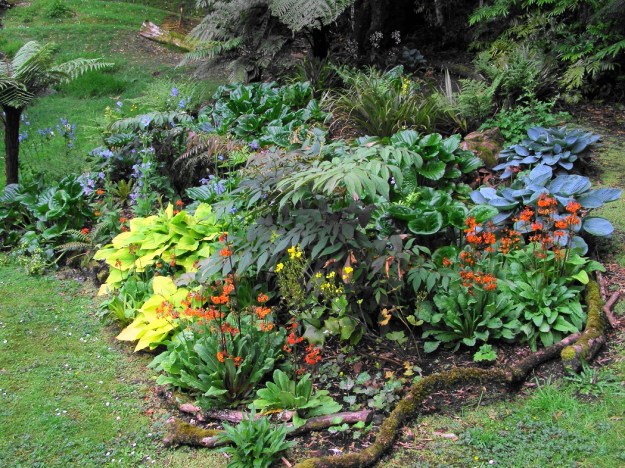
After last week’s post on Hosta Jade Cascade (which is settling in just as well in other parts of the garden where I planted it out), I have been looking anew at the varieties that are thriving on zero maintenance. Some of the enormous clumps will have been in 20 or more years now and just keep reappearing a little larger each season. A lot of our big blue clumps are unnamed, raised from seed – some of them from Hosta seiboldiana.

Hosta undulata variegata is getting smaller, I think, over the years

In a big garden, we need big clumps of plants to have an effect. In this area, the stand out gold is Goldrush, raised and named by Felix Jury. It is a terrific performer and puts up a good floral display of purple flowers. The blue is a seedling. Neither of us can name the variegated hosta which is not the showiest of varieties but it has done well and that is not to be sniffed at. There aren’t many variegated hostas that we have planted that have thrived in garden conditions under a regime of benign neglect. Too many, like this poor little specimen of H. undulata variegata have reduced in size over the years, rather than grown larger.

In the smaller growers, variegated Golden Tiara is again not particularly exciting but a very good garden plant. The blue green, little Flora Dora has increased freely and gold Blonde Elf has also surprised me with how well it has established for a very small grower. On the other hand, I haven’t seen dwarf Kabitan for a while so I wonder if it has shrunk away altogether, which would be a pity.

It looks like Guacamole to me and I am not making up that name

Of the variegated types, this one which I think is Guacamole from memory, is doing very well. It is a reverse variegation sport of Hosta Fragrant Bouquet. I will have planted out large specimens of the latter at a similar time as Guacamole but I have yet to find them in the garden, which means they are not growing as strongly at all.

Sum and Substance

Add Blue Boy as a good, reliable garden plant. We stopped growing it commercially towards the end of our time because there were other, showier, bluer cultivars that sold more readily but while they are not starring in the garden, Blue Boy is a strong survivor. That is my short list of top performers as garden plants that have caught my eye this week and that have proven themselves over several years. Oh, Add Sum and Substance which is surprising me by its willingness to grow suitably large in the spot where I planted it.

As a postscript to the hostas, these are grown with no slug bait or slug and snail control. We now have such a rich bird life that they enable us to grow these plants without having to protect them. Well, I assume it is the birds carrying out this task because there is no reason at all for us to have any fewer slugs and snails to start with than anybody else gardening in similar conditions.

The meadow! The meadow!

At the risk of repeating myself – but we all know that gardening is a seasonal activity that is, by definition, repetitive – the meadow below is bringing me great joy as the Higo irises all come into bloom, interspersed with the Primula helodoxa that has been at its peak for a full month now. What more can I say?


A love-hate affair with rose bushes continues

Is there anything lovelier than beautiful, soft, fragrant rose blooms? Not for me the stiff, hybrid tea types. I will leave those for others. But the David Austins are so deliciously voluptuous that I just want to bury my nose in all those scented petals. In a vase. And therein lies the rub.

The rose garden here is on borrowed time. It dates back to Mark’s mother who had a love affair with old fashioned roses and it has undergone several makeovers in the decades since. But it just doesn’t work aesthetically. We are not a good rose climate here – humid and high  rainfall without enough winter chill to kill off the greeblies, fungi and diseases that afflict roses. Our rose garden is too sheltered which restricts air movement. One of the beds is now too dry and the competition from the roots of our massive rimu trees nearby are an issue. Mark has always refused point blank to spray roses, being of the opinion that they must thrive on their own merits.

I have tried. Oh I have tried. I was recommended varieties by experienced rose producers and growers and I have crowd sourced others. Alas I have pulled out and burned more roses for poor performance than any other plant I have had to buy. After 20 years, I am going to cut my losses this winter and pull out the central beds that surround our sunken garden.

Not all will be burned. Fortunately we have large vegetable gardens, but not a picking garden as such. A couple of years ago when I was getting discouraged at  the underperforming, defoliated, ugly rose bushes, I dug some out and Mark planted them in a row in one of his veg gardens. He has several. Veg gardens, that is. The rose bushes with the most gorgeous blooms can be added to that row. It does not matter there if they have black spot and are defoliated and ugly. I can go and pick the blooms when I wish. But only those with gorgeous blooms will be relocated to this position.

It is very, very pink is Rose Flower Carpet Pink but just look at that foliage. Superb.

Rose Flower Carpet Appleblossom – a prettier pink, still with good foliage though it does not flower as long through for us. The white version flowers all year round, however.

Not all the roses are a dead loss. What the Rose Flower Carpet series lacks in individual flower form and scent is more than made up for in fantastic performance throughout the season and brilliantly healthy foliage. They are what we call *good garden plants*. Not blooms for cutting, but all-round garden performers.

Mme Plantier, I believe?

Madame Plantier is only once flowering but I can forgive that for her month or so of glory, her gorgeous scent and healthy foliage. There is one super healthy rose that I think is a David Austen but I have lost its name – again lush, strong growth and very good blooms in apricot pink. That one is to be relocated and trained as a climber up a pergola pole. Though as the pergola is not yet built, it may have to go to temporary quarters. The white rugosa, Rosa Blanc Double de Coubert, stays a healthy bush for us though there are more prolific bloomers in the rose world.

The central borders in the grass are to go. This may take a year or so.

The sunken garden, seen here at its tidiest, is to be the feature without the distraction of the borders

The so-called rose garden here is the area of the garden where I have put in the greatest effort  over the last 20 years. And while it has times when it looks pretty enough, I have come to realise that it is also the one area of the garden that I really do not enjoy maintaining at all. In fact, I avoid it as much as I can which is an indicator that all is not well. A landscaper friend looked at it recently and immediately suggested that we pull out all of the central borders that edge the deep, marble and granite sunken garden. “Feature the sunken garden,” he said. “The borders just detract.” I had to think about it for a while. But he is right. It was just a bit of a shock after all my efforts down the years. More on that in the future. We can’t do much going into summer but mentally I am relocating the plants that are worth saving and discarding the rest.

And I am mentally remaking the one border that we will save but renovate which runs along to the left. It is the garden we look out to from a favoured late afternoon seating position. Not a lot has changed in the nine years since the photo above was taken. We are still often to be found in the same seats in the same location. But it is a good reminder of why we want that one border looking good with a high level of plant interest, because we see it often.

“Doing the flowers” in the laundry. I only show this for overseas readers because I love my laundry room, a space much favoured in NZ and Australian houses that does not seem to be adopted as widely in other parts of the world. I can’t imagine living without a separate laundry room.