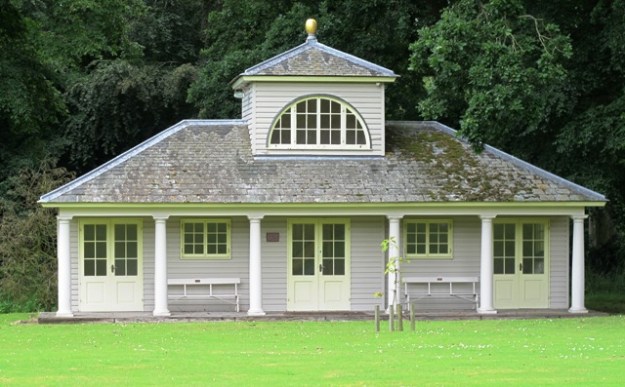
We lack a cricket pavilion in our garden. To build one, even as attractive as this one, would look sadly out of place
I have been pondering focal points and garden structures. This was partly initiated by an email from an overseas friend who, while praising our garden, was lamenting the lack of “features”. By features, he meant man-made features. He mentioned such things as tempietto, summer houses, maybe even ruins in the William Kent style of Palladian garden architecture. I laughed. I do not think he has quite got to grips with the differences in New Zealand. This is a man, after all, who has a splendid garden full of substantial features including his very own cricket pavilion which was designed to be used for the annual village cricket match.
We lack an amenable village nearby. Such a pavilion might look a tad pretentious in our situation. And we have always subscribed to the view that it is better to have nothing than to have a cheap imitation. I have yet to see a New Zealand garden that imports classical European or indeed Asian antiquity-inspired features and settles them well into our New World gardens. Summer houses built out of tanalised timber – which are commonly favoured here – have never appealed to us. Painting them white does not necessarily improve them, either.
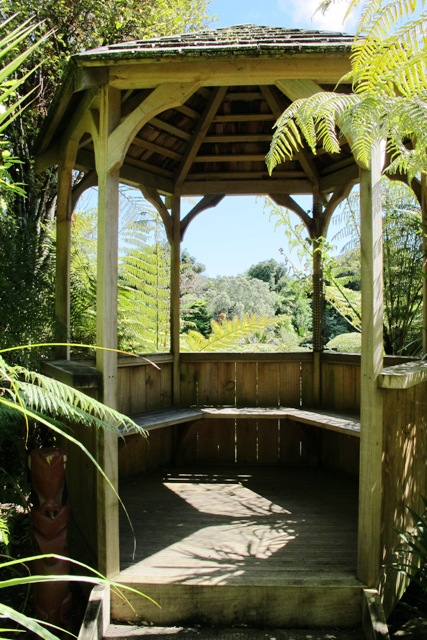
The tanalised pine gazebo is much favoured in New Zealand gardens, often as a focal point
I have seen a fair few around the country in my time, and often situated where they are to be a focal point, a feature, rather than to be used as an outdoor entertaining area. I guess what it comes down to is that we have different spending priorities in the garden. A well designed garden room that is both functional and architecturally attractive would be nice to have but would cost a great deal more than a kitset, octagonal gazebo.
Maybe we are just too ingrained with functionalism because we would place a garden room in an area that is most convenient and attractive for use, rather than where it would serve primarily as a visual focal point. I find little gazebos marooned forever as an unused, ornamental point of interest a bit sad, really.

An outdoor seating area marooned forever as a focal point more than a social centre
The same philosophy applies to seats, in my book. Seats are to be sat upon and therefore situated in a position where there is a reason to sit rather than to be cast in the role of focal point. But I am a lone voice in the wilderness on this topic. A brightly painted chair is often forced into fulfilling this function.
If you go back to basics, the purpose of a focal point is to focus the eye of the viewer. It may be to serve as a punctuation point to end a view, or it may be to channel the eye towards a desired feature, maybe a vista or a borrowed view if you are lucky enough to have one. It creates an illusion of depth but if you already have depth, you may not need one at all. If you clutter the place up with endless focal points (a common mistake in small gardens), it becomes bric-a-brac rather than a statement. Less is more. And remember that the focal point is what attracts attention, often to the detriment of the areas of garden that lead to that point.

Miscanthus and alliums gave a subtle end point to a long walk at Gresgarth
Because we have always leaned more to plants than structure, we prefer the judicious use of plants as focal points. It is a softer, more naturalistic approach which does not immediately claim centre stage. We had watched a television interview with Lady Arabella Lennox-Boyd, one of Britain’s foremost gardeners and garden designers. She was commenting about needing to terminate her herbaceous borders in some way, to create a visual end-stop. She would have liked water but that wasn’t possible and she didn’t want the cliché of a statue. Instead she decided to use miscanthus grass which, she commented, looked somewhat like water.
We remembered her comments when we visited her personal garden at Gresgarth. There was the miscanthus bed, with the globes of giant allium seedheads rising above and giant cardoons flanking either side.
It wasn’t a strong visual statement. It didn’t shout “look at me! Look at me!” It provided a gentle endpoint to what was a complex and highly detailed walk along battlemented herbaceous borders with interludes of detailed mosaic paving – an exercise in subtle understatement. We really liked the effect.
Similarly, a clipped or shaped plant can give a point of interest which keeps harmony with the surroundings while giving an accent point. Because we have a garden richly endowed with large, established plants, we have tended to head more in the direction of using plants as visual focus points rather than dropping in manmade objets d’art, or, worse: objets sans d’art.
Statues, urns and sculptures? Now that is a whole can of worms to be returned to at a later date. Decorating one’s garden can be a minefield.
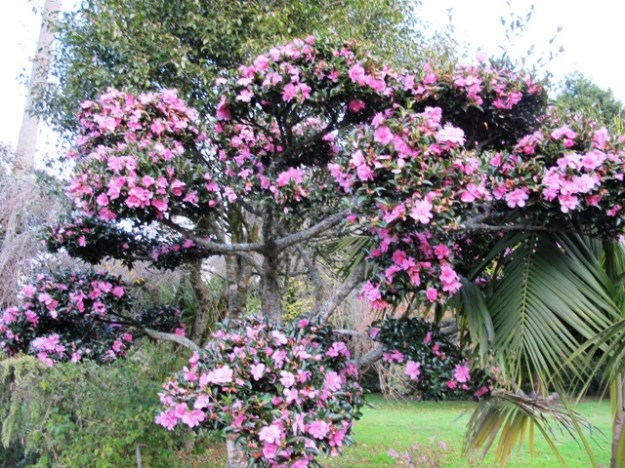
Camellia Elfin Rose, cloud pruned in layers to give an accent point
First published in the Waikato Times and reprinted here with their permission.



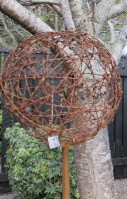 3) I admired these rope balls constructed around a metal frame at Winterhome Garden near Kaikoura. Garden owner, Sue Macfarlane, told me she had made them herself because she wanted an avenue entrance for a wedding party. I saw something similar offered for sale recently – though smaller and made from recycled barbed wire, which gives a distinctly rural New Zealand flavour. However, because barbed wire is somewhat hazardous, these balls would need to be placed where nobody is likely to brush against them or hit their heads standing up after tending to any garden below.
 4) Personally, I am not a fan of classical-inspired statuary in New Zealand gardens. The cultural reference of such works is usually to Europe and to me it looks out of context here. I might be tempted to make an exception for this piece but it is the studied nonchalance of the setting with its long grass and the artfully casual placement which makes it such a romantic image. I also photographed it in an English garden, Gresgarth, where it looked wonderfully at home.
 5) Unable to hold back my didactic tendencies, I include this example as a message. Dear readers, a beautiful pot does not need to have a plant in it. It can exist as a decorative feature in its own right and will often look a great deal better for the absence of a plant. I don’t know the origins of this pot – it looks like a lime-washed oil jar – but I think the phallic trichocereus cactus spoils it, even without the plastic stake which is out of sight in the photo.
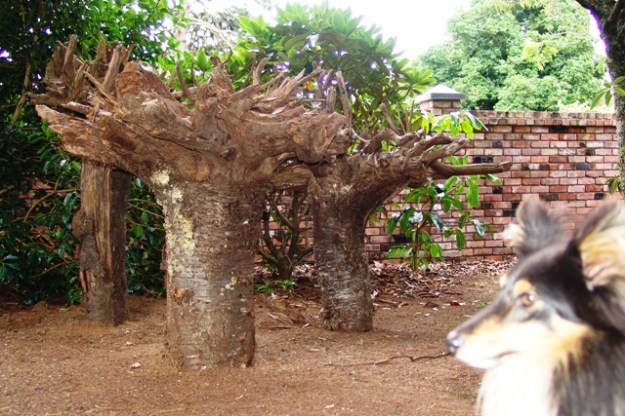 6) Finally from our own garden, I offer the inverted plum trees. These were dug up and reburied upside down to make the root systems the feature. We did not treat the trunks to preserve them. Eventually they will rot out and fall over but they have been in place at least a decade now and are still stable. The white stones were a gift from a geologist friend who gathered them from somewhere on the Marlborough coast. I bleach them once a year to remove lichen and discolouring and they just sit casually on a stone table.