Tag Archives: Abbie Jury

Plant Collector: Strelitzia reginae

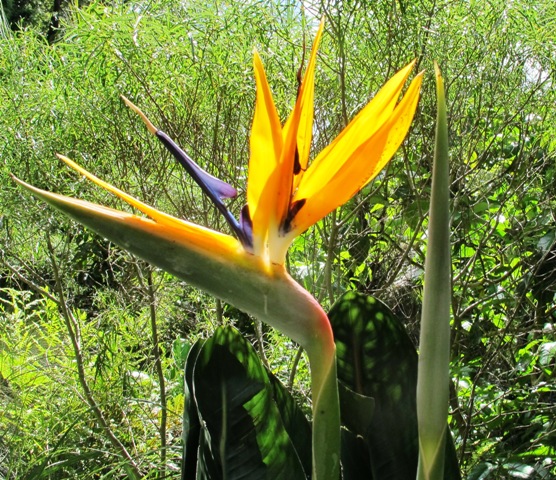
Strelitzia reginae or the bird of paradise

Strelitzia reginae or the bird of paradise

Is there anything more exotic, more tropical in appearance than the bird of paradise plant? In fact it is native to South Africa which is not the usual “Tropics”, though it is now grown widely throughout the temperate and tropical world and is not as fussy as one might think. In its homeland, it is commonly called the craneflower because of the resemblance to cranes – which are heron-like birds.

It is a very curious bloom, almost two dimensional. The actual petals are the blue centre to the flower and it is this that holds the pollen and the nectar which is what attracts the birds to achieve pollination. The leaves are like paddles with very long stems (technically called petioles) and are heavy textured.

There are about 5 different species of strelitzia but this is by far the most common and therefore probably the most adaptable variety. It is never going to like heavy frosts and wants some warmth but is not too fussy. Looking at photographs, I think it must flower more profusely in hotter, drier climates but it is a pretty low fuss perennial in coastal areas of the North Island and some protection from frost will extend its range inland. For us it reaches about 120cm in height. Mark tells me he has the giant Strelitzia nicolai waiting to be planted out. That apparently reaches closer to 10 metres. If it only flowers on top, we will be wanting to plant it down a slope somewhere if we are to see the blooms.

First published in the Waikato Times and reprinted here with their permission.

“People who remain convinced that fashion does not enter the garden can think again. Almost every year one or two plants go “out” and others come “in”. You’ll have to be really on the ball to keep up…”

Alan Titchmarsh: Avant-Gardening, A Guide to One-Upmanship in the Garden (1984)

IMG_6027 - Copy

The Fashionable Umbellifers

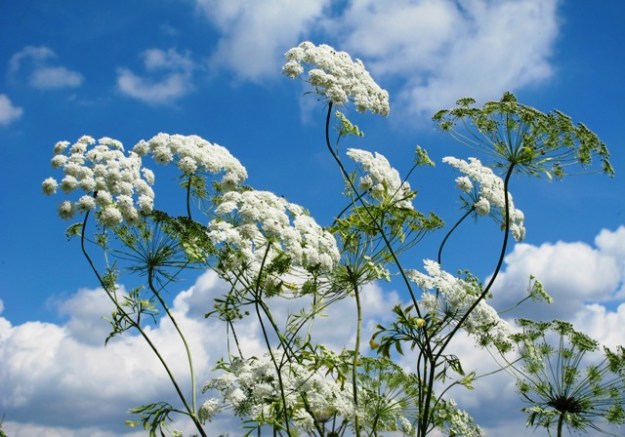
I do not often give fashion advice but today I will give a tip. Umbellifers, dear reader, umbelliferous plants are hot overseas and we usually follow fashion. Preferably in white but that is not a great problem because it is the most common colour. If the flower looks familiar, it is because the apiaceae family that spawns most of the plants with these flat headed flower clusters called umbels, includes carrots, parsley and coriander. Also fennel, though that has soft yellow flowers.

The umbellifers include a number of wildflowers or roadside weeds, depending on which camp you fall in to. A fair few appear to be referred to as Queen Anne’s Lace, or common cow parsley, but we have failed to disentangle the many different species. There is a very large one referred to as giant hogweed that we saw growing wild in England. It is renowned for its caustic sap and the advice is to avoid ever touching it, let alone growing it from choice.

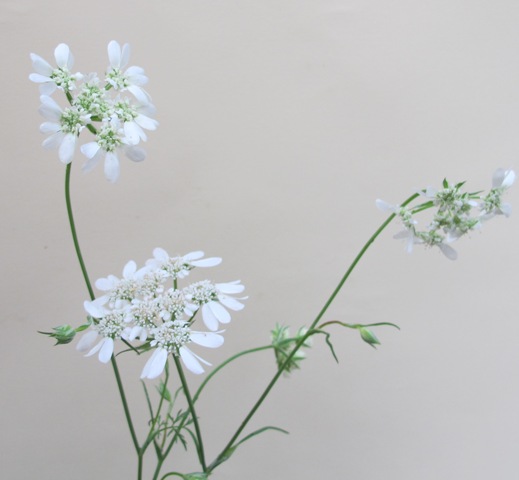
Why are the umbellifers so popular? They make a huge contribution to the nectar and pollen supply. Most have finer foliage and the flowers can rise above and appear to be dancing lightly in the air. Compare them to the chunky, compact bedding plants available today, and you can see how ethereal these simple blooms appear. Jaunting around a number of local gardens recently, I saw the annual Orlaya grandiflora being used. This is sometimes called French cow parsley or white lace flower. It is a smaller growing option available on the local market (Kings Seeds have it listed). Apparently switched-on gardeners have already picked up on the simple charm of umbellifers.

Pretty little Orlaya grandiflora

Pretty little Orlaya grandiflora

First published in the Waikato Times and reprinted here with their permission. 

The November Garden – rose time

November is peak rose season for us

This is the first spring in twenty seven years that our garden has not been open to the public. It has been something of a revelation. We have so many friends and colleagues who open their private gardens for at least some of the year that it had become normal – an integral part of our lives and how we gardened. We wanted a break but the main driver for the decision to close has been the high impact of the petrochemical industry. From being a sleepy little rural enclave, in a few short years Tikorangi has become Petrochemical Central and this has sent scarily large amounts of heavy and often hazardous transport past our gate. It is not a good fit with an open garden. We take the long view here. Our garden is built around trees originally planted by Mark’s great grandfather from 1870 onwards. The house gardens have been intensively worked since they were first put in by Mark’s parents in 1950. It seems likely that the garden will still be here when the gas has been pumped out from the ground below us and the petrochemical companies have moved on from fossil fuels – to renewables, we hope. In the interim, I don my iPod because I would rather listen to music in the garden than heavy industry. Now we garden for our own pleasure and without having to titivate to open garden standards – or garden grooming we call it.

Cymbeline, on of the David Austen roses

Cymbeline, on of the David Austen roses

November is peak rose season for us. I have a love-hate affair with roses. I am forever debating with myself whether the beauty of the blooms outweighs the foliage and form which are often disappointing – even more so as the poor defoliated things battle through summer and autumn. But is a large, comprehensive garden ever complete without roses? The problem is that we don’t spray our roses. Ever. I never spray anything and Mark point blank refuses to do roses. If they don’t perform without spraying, rip them out and replace them is his view. We do a bit of that and we are trialling some almost thornless pillar roses for a new pergola we have planned.

Mme Plantier, I understand

Mme Plantier, I understand

Mme Plantier, I understand [/caption]Personally, I am not a fan of hybrid teas. They don’t even rank amongst desirable cut flowers for me. I much prefer the informal floribunda types. We have a wonderful white shrub rose which was finally identified for us as Mme Plantier. It keeps excellent foliage without intervention, flowers in abundance and is sweetly scented. But it is only once-flowering and so many gardeners now refuse to grow any rose that doesn’t repeat-flower through the season. We don’t expect other shrubs to flower continually but poor roses are now judged by a different standard. Is six weeks not enough?

Rose Flower Carpet Appleblossom

Rose Flower Carpet Appleblossom

While the Rose Flower Carpet series never attract descriptors such as delicious or exquisite, as high health backbone plants, we have yet to find anything to rival them. Year in and year out, they flourish despite our high humidity and high summer rainfall.  The somewhat vibrant pink form that was the first to be released and the white have particularly long flowering seasons. In fact the white is rarely without blooms. The bright pink looks great when surrounded by large amounts of background green. It took me a few attempts to find the right locations. I prefer the paler apple blossom pink but it doesn’t repeat as well and blooms can ball in heavy rain. While we don’t spray, I am old fashioned and prune by the manual, even though there is research which says that a pass over with hedge clippers is just as effective. We keep roses in open, sunny positions with good air movement. As a point of principle, we do not routinely add fertilisers to our ornamental gardens but we mulch often with homemade compost. That is their feed. If any roses can’t perform well enough with the same regime of care that the rest of the garden gets, then I am afraid they are not for us. But those that do well here are a November delight.

First published in the November issue of NZ Gardener and reprinted here with their permission. 

Plant Collector: Davidia involucrata

???????????????????????????????
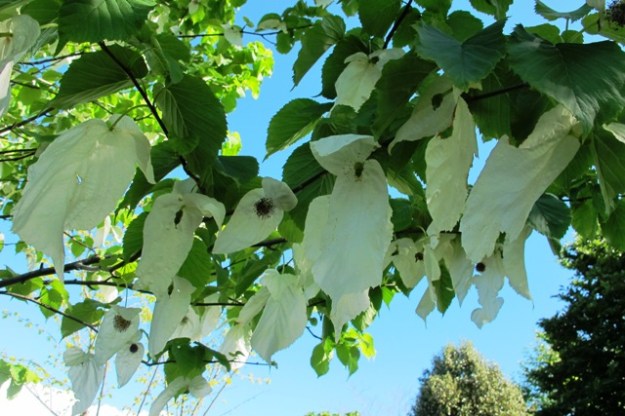
Many readers will know this tree by its common names – variously “Dove Tree”, “Handkerchief Tree” or “Ghost Tree”. I’m going for the handkerchief. In full flower it does look as little as if somebody has pegged white hankies all over it. In fact the showy white bits are not flower petals, they are what are called bracts – specialised leaves which are an adjunct to the flower structure. The actual flower is pretty insignificant. It is the same with bougainvillea where the showy, colourful bits are bracts, not petals.

The davidia is a deciduous tree from central and western China which means it is cold hardy. It is a medium sized tree, upright and conical in habit, reaching maybe 10 metres in height. It needs a bit of age before it reaches flowering size so is not a tree for the impatient gardener. Keep an eye out for damage from cicadas which can weaken branches.

The davidia makes a handsome tree with lovely, light green, pleated leaves – not unlike a tilia or lime tree but more compact in the longer term – with a floral display which is quite remarkable.

First published in the Waikato Times and reprinted here with their permission.
Garden Lore: Friday November 14, 2014

Garden Lore

“Consult the genius of the place in all.”

Alexander Pope, Epistle to Burlington (1735)

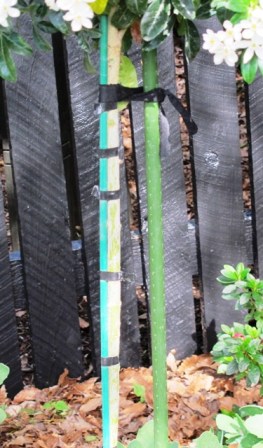
Plastic stakes and ties - never a good look

Plastic stakes and ties – never a good look

Staking plants

I know I have repeatedly mentioned staking of plants in recent months but I found a prime example of the reason why. I was out and about garden visiting last week and I took this photo in an otherwise immaculate garden where the owner paid great attention to detail and was fastidious in her presentation and maintenance. The staking, however, is awful. What you are looking at is one of a small group of standard lollipop Choisya ternata, sometimes called Mexican or mock orange-blossom because of its white scented flowers. The stem is not yet strong enough to hold the head up without snapping. The stake to the left is the nursery staking and tying, put in place to train the plant up. The stake to the right has been added, I assume, by the gardener who was presumably worried – and rightly so – that the nursery stake might not be sufficient in her garden. Both are green plastic and the nursery has used a shiny, commercial black plastic tie.

If the look doesn’t worry you, then it doesn’t matter. To me it stuck out like a sore thumb. If the plant had been positioned with the stake around the back, it would have helped. But it would look much better without the plastic. A discreet length of rusted metal would be my choice. When replacing a stake, don’t force the new stake in hard by the trunk, making a new hole. You are severing the roots and will do more damage than good. Try and use the existing channel made by the stake you have removed to avoid fresh damage.

First published in the Waikato Times and reprinted here with their permission.