
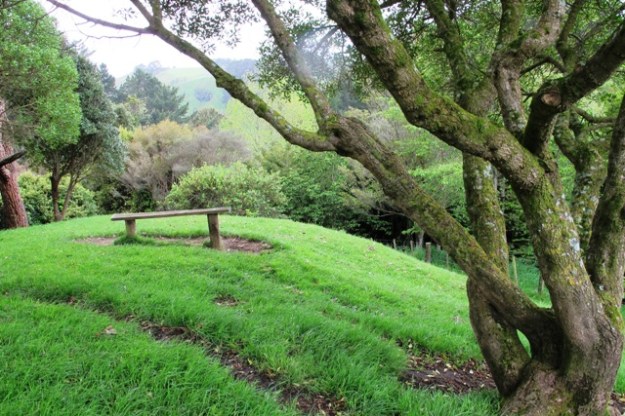
 1. Sometimes it is the setting, not the seating which is the important feature. A simple bench is all that is needed to draw attention to the beautiful long vista, inviting you to take the time to sit and look. You need tanalised timber of course and farm posts are the most practical option. Make the bench long enough to hold two people and their coffee mugs without having to be too close, but not so long that it sags if somebody sits in the middle. This lovely scene is at Puketarata Garden near Hawera.
 2. How could I not include this example from Wairere Garden in Gordonton? Obviously there are a few practical issues when it comes to sitting on this hand crafted bench which looks as if it has been made from old fence battens. With that length it would only be suitable for a single person or two young lovers. I really liked the sense of enclosure with it being placed inside a curved hedge and the contrast between the lichen-encrusted, rough simplicity and the clipped formality behind.
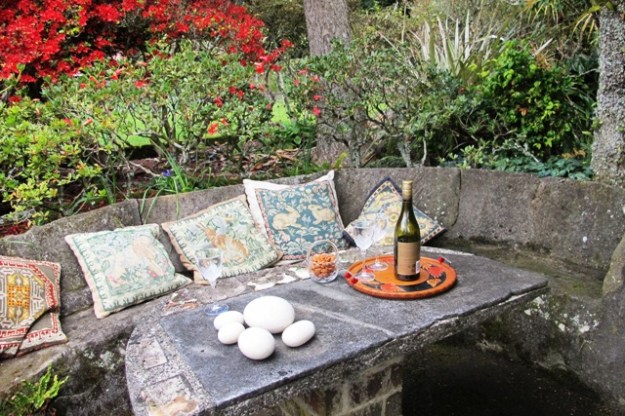 3. This is one of our own favoured seating areas, especially in summer when there is dappled light through the trees above. It is comfortable enough even without the tapestry cushions made by my late mother. The curved bench seat is stone, the table concrete on a brick plinth. I am guessing it was Mark’s mother who inset the vintage tiles around the edge of the table to add detail although few remain now. It does not always come equipped with the bottle of wine.
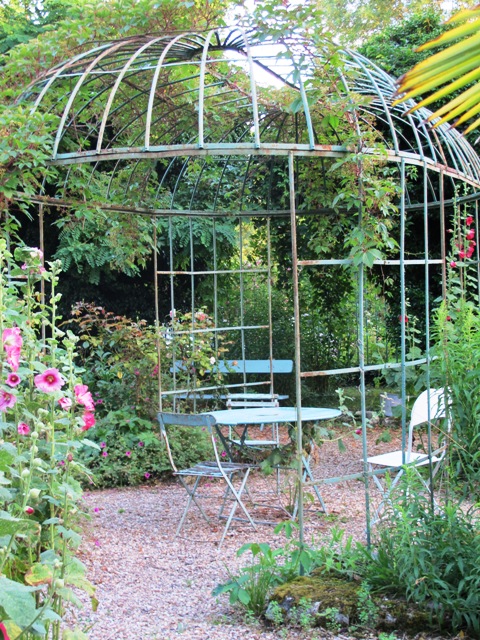 4. From home to away – the garden out the back of Restaurant Baudy in Giverny (where Monet himself used to dine with friends and you can repeat the experience to this day) applied casual French deshabille style to the outdoors. You would not want to be of large stature and trust to this outdoor setting, but the hollyhocks and gently rusting iron are the epitome of what is sometimes styled shabby chic in modern parlance.
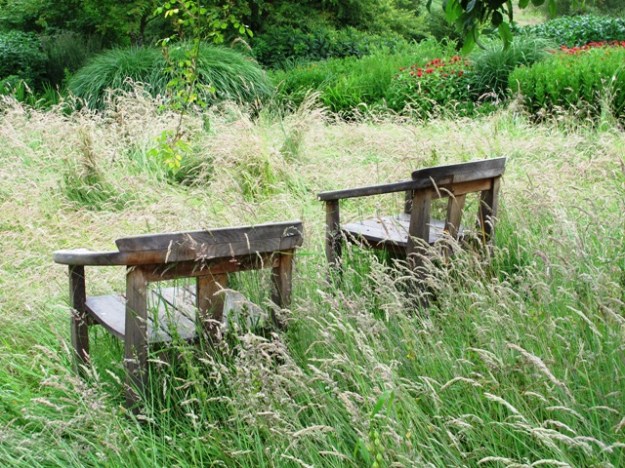 5. Let’s be honest, you would not be wanting to sit on these chairs when the grass is wet, but then if it has been raining, outdoor seating will be wet too. The absence of worn track marks to the chairs suggested that they were not in great use when we visited this garden near Stratford on Avon. But that long grass, meadow look is very charming. And at least if the seats are sited in the long grass, the legs will not be making holes in the lawn and you don’t have to move the furniture to mow.
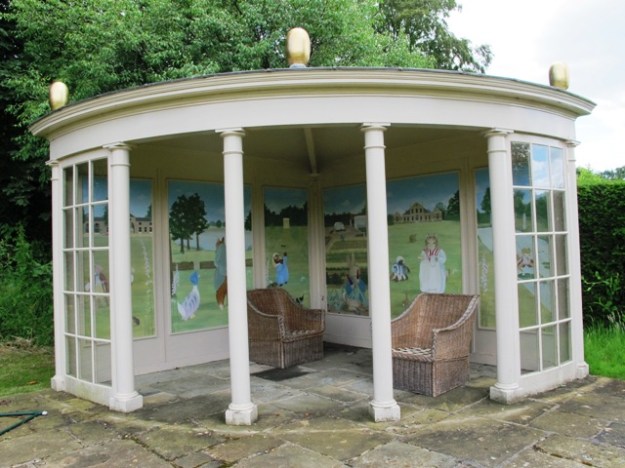 6. This is in a private Yorkshire garden and is, believe it or not, the children’s pavilion though I doubt that the comfortable cane chairs are there for the children to sit upon – far more likely for adults. Traditional cane needs to be under cover. It is only the all weather modern synthetics that can be left out in all weathers but modern or old, I have yet to meet outdoor seating that is more comfortable than cane. Personally I covet a little semi-enclosed pavilion like this one – with or without the Beatrix Potter wall paintings. In a climate which is never quite as warm as I would like, this type of outdoor room seems eminently practical.
First published in the Waikato Times and reprinted here with their permission.
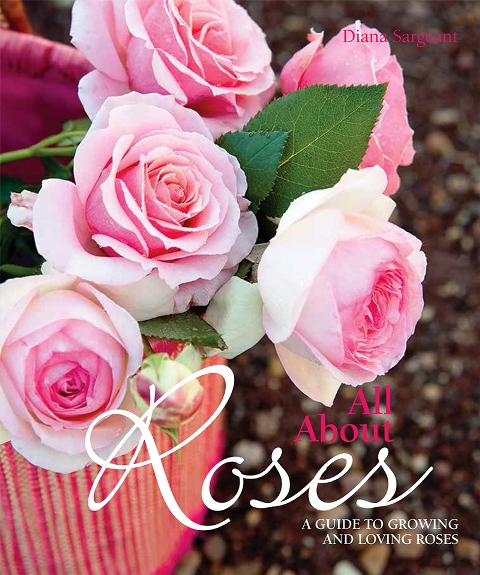 I approached this book with a little trepidation because it seemed to be part of the trend to release Australian publications in this country, assuming that they will be equally relevant here with no significant difference in conditions and plant varieties. In this case it works. This is a charming and helpful book written by somebody who combines vast experience with a genuine love for the topic. The author ran a rose nursery for 25 years where they chose to go to organic production well before many others came to realise that our growing of roses had become bad practice environmentally. There is no doubt it would be easier in Australia to grow good roses without chemical intervention because of their dry climate, but her experience is invaluable. I am not sure how readily available some of her alternatives are in this country yet – but they are stocked even by Bunnings in Australia so if the demand is here, I am sure we will see them soon. That is eco-fungicide, eco-oil, eco-neem and eco-amingro.
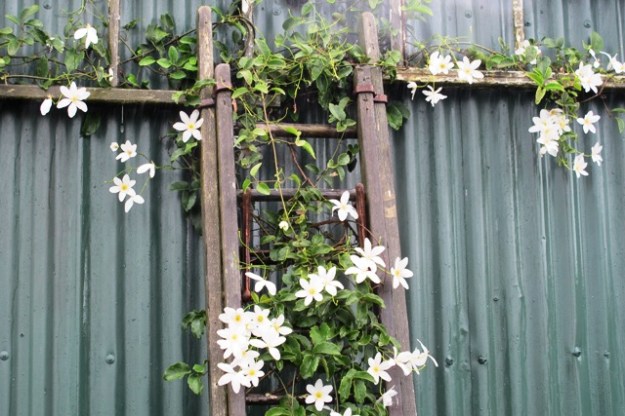 1) The old wooden ladders, one vertical and one secured horizontally across the top, are the effort of a creative gardener down the road. The clematis appears to be a strong growing variety which will cover pretty much the entire shed wall in relatively quick time. If you can find old ladders cheaply, it is a quick solution but I do not think that old aluminium ladders would be so pleasing visually.
 2) Where you have masonry or brick surfaces, separate framing can avoid the need to drill holes. Here we have constructed a simple bamboo grid, tied together with twine, to give a light weight frame for the seasonal climber, Tropaeleum tricolourm. Gridded wire used to reinforce concrete can also make a handy and economical frame for climbers which can be cut to the required size.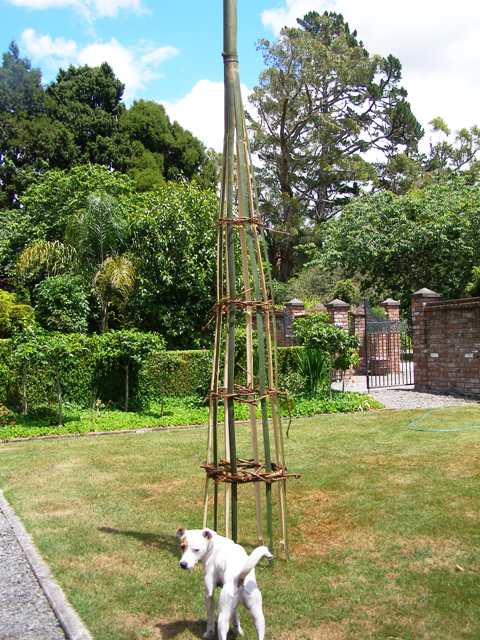
 3) We make our own bamboo obelisks specifically to hold clematis. They last for several seasons you need access to fresh giant bamboo to use as the raw material. That is grape vine pruning holding the verticals apart. You can improvise something similar with wooden or cane teepees. If you want step by step instructions for the bamboo,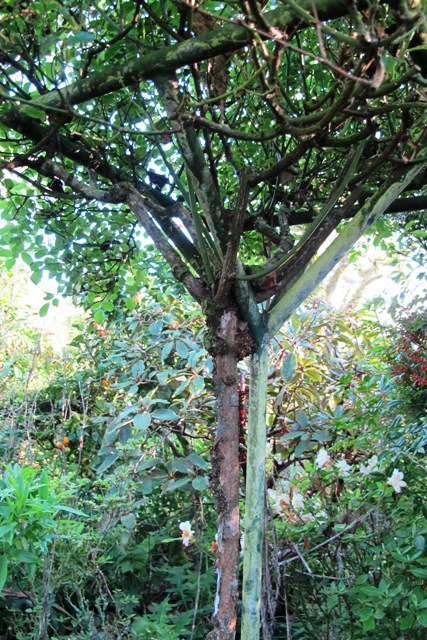
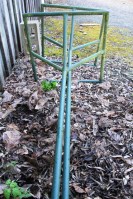 4) I had these pipe frames built to hold my tall weeping roses, though I am now using two of them for wisterias. They were not cheap at the time, but they have proven their worth over more than 15 years. They need to be driven a long way into the ground – around 40cm at least – to keep them rock solid but they are capable of supporting a weighty mass of foliage at the top. Top heavy plants can readily snap off when only the stem has been staked.
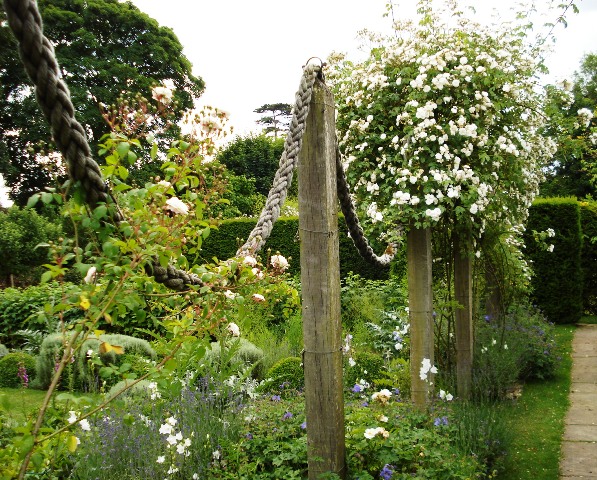 5) Tanalised timber posts and old maritime rope have been used to construct this frame which gives a simple garden structure as well as a support for climbing plants. It should last for many years and the only stumbling block I can see is sourcing the rope. The aesthetics rest entirely on having heavy, old rope. Modern, coloured nylon rope with a thinner girth just will not cut the mustard.
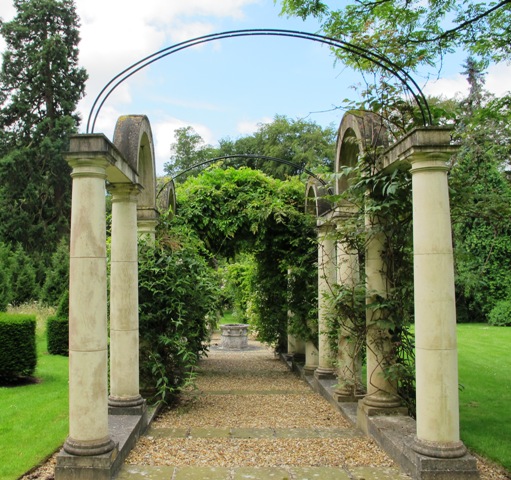 6) From the cheap and cheerful, to the mid priced permanent, to this handsome splendour – which I photographed in a Yorkshire garden. The owner deprecatingly refers to this modern recreation as a “plant carrier”. It is there solely to support climbing plants and to provide an attractive structure within the garden. It is all concrete but using the ground-up local stone added to the concrete mix gives it a weathered stone appearance and colouring that fits the local environment.
