Tag Archives: Abbie Jury

Garden Lore

“It is a greater act of faith to plant a bulb than to plant a tree.”

Clare Leighton, Four Hedges (1935)

Do we really believe that cabbage whites have large enough brains to be duped?

Do we really believe that cabbage whites have large enough brains to be duped?

Garden Lore: Cabbage whites and brassicas
Brassicas are like ambrosia to the cabbage white butterfly. Or maybe heroin. For this reason, we prefer not to grow brassicas during the summer months when the cabbage whites are at their most active. I am a reluctant consumer of cabbage, broccoli and cauliflower at the best of times. The latter two are passable in a winter soup flavoured with cheese (blue cheese is the classic, but any cheese helps). However, many of the increasingly popular Chinese greens also belong to the brassica family, and these are acceptable to me at any time of the year.

You can net the vegetables, but the netting needs to be raised clear so that the winged parent cannot land and lay eggs through the netting. If you want to spray, talk to your local garden centre about BT (which is a bacterial based treatment) or pyrethrum-based options. Pyrethrum is the active ingredient in flyspray and was originally extracted from a daisy. These days it is more likely to be synthetic but it remains a pretty safe control. Vigilant digital control (squashing with the fingers on a daily basis) can work in the early stages. We think it is a myth that egg shells on sticks will confuse the butterfly and they will fly away. White butterflies show no territorial instincts at all, that we have ever seen.

If you don’t like added protein to your cooked vegetables (while Mark does not mind the odd cooked caterpillar, most people find them very offputting), you can sprinkle lots of salt over the florets or leaves as you prepare them, then cover them with cold water for a few minutes while the caterpillars die. Rinse them thoroughly, inspect closely and cook with no added salt.

First published in the Waikato Times and reprinted here with their permission.
Plant Collector: Crocosmia “Lucifer”

Red Crocosmia 'Lucifer' with yellow anigozanthus

Red Crocosmia ‘Lucifer’ with yellow anigozanthus

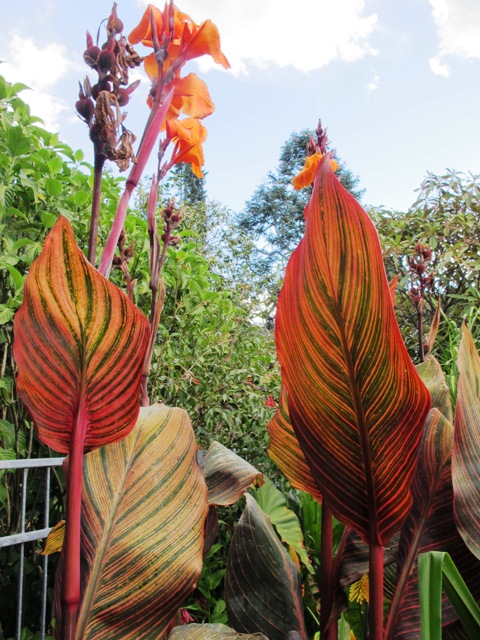
When they are roadside weeds, these bulbs are often referred to as montbretia. Treading on thin ice, I admit that we have orange-red ones growing amongst agapanthus on our roadside. At least it is better than the dreaded bristle grass that is the scourge in our area. “Lucifer” is a superior form, a hybrid with bigger flowers and stronger colour, making it popular as a garden plant. It is strong growing and both the pleated leaves and the flower spikes can get above waist height and it is almost indestructible. I like to keep it confined but it makes an attractive display beneath the apple trees and also alongside an equally strong growing yellow anigozanthus (kangaroo paw) which we have at the front of the rockery.

The bulbs are not unlike gladiolus corms and form chains below ground. It is the ability to grow when the chains are separated that makes these both easy and verging on weedy in some situations. We have a much larger flowered golden orange form which may be “Star of the East”. I say we have it, but we are waiting to see if indeed it is still here because it has been nowhere near as vigorous as “Lucifer” and each year we worry we have lost it.

Crocosmias are a small group of South African bulbs belonging to the iridaceae family. They are winter dormant, but their one drawback as a garden plant is that it takes a long time for the foliage to die down and they can be unattractive in autumn. That said, they are such toughies that I often trim the foliage off early to tidy them up.

First published in the Waikato Times and reprinted here with their permission.

Garden Lore

“Once it has a toehold, incongruity has a way of advancing systematically through the garden like quackgrass.”

Des Kennedy, Crazy About Gardening (1994)

A wonderful blue but don't trust this commelina in NZ

A wonderful blue but don’t trust this commelina in NZ

Garden Lore – weed plants

We bought a packet of seed of this pretty Commelina coelstris ‘Sleeping Beauty’ a few years ago and we have been working on eradicating it ever since. Mark decided it was dangerous as soon as he saw the seed set, even before we found that if you fail to remove all the tuberous roots, it can stage a comeback. It has such a pretty blue flower and we are fans of blue. Mind you, it is not as if it flowers in abundance like the common lobelias that seed down here and do no harm at all. I checked an American website and opinion was divided on the invasiveness of this plant but its ability to grow across a huge range of climatic zones, in every soil possible and in both sun and shade is a good indicator of weed potential in the hospitable conditions we have in this country. Pretty wildflowers in harsher climates can be an environmental curse here.

We haven’t complained to the seed company selling the commelina. Last time we mentioned to them about the weediness of a line they were selling (it was so-called strawberry spinach), the response we got was a dismissive: “Nobody else has had a problem with it”. The sub text to this might be: ‘we have no intention of stopping selling this plant and clearly you have no idea what you are talking about’. Since then, we have noticed others complaining about strawberry spinach. It took us years to eradicate it. It wasn’t even particularly appetising. Buy this, or the commelina at your peril. Campanulas are a better option for easy-care blue flowers.

First published in the Waikato Times and reprinted here with their permission.

Garden Lore

“I always think of my sins when I weed. They grow apace in the same way and are harder still to get rid of.”

Helena Rutherford ElyA Woman’s Hardy Garden” (1903)

Sago!

Sago!

Garden Lore: Friday 10 January, 2014

Most of us above a certain age grew up with milk puddings. Semolina, sago and tapioca were the most common thickening agents. Until recently, I had vaguely assumed that they basically derived from the same source of starch and the difference was in the grade of grain. Not at all. Semolina is usually durum wheat-based. After the outside husks and wheat germ have been removed, what remains is the inner part, or middlings. This is what gets ground into flour but before that stage, basically it is semolina. It can also be obtained from rice and maize crops – the latter becomes the dish known in USA as “grits”. Modern times have seen old fashioned semolina give way to the trendier North African couscous, which is essentially very similar in makeup but sold as a quick-cooking product having been steamed and then dehydrated. Israeli couscous (which resembles tapioca or frogs’ eyes) is simply further processed to this larger form.

Sago, on the other hand, is a starch that comes from the pith in the trunks of various palms but particularly Metroxylon sagu and is largely a product from New Guinea and South East Asia. Tapioca has an entirely different origin, being from cassava (Manihot esculenta) which grows as a tuberous root and is a tropical plant which originated in South America but is now a staple food in the Pacific and Asia as well.

These days, I only have sago in the kitchen cupboard. That is because I sometimes use a recipe idea which is vintage Alison Holst. When stewing rhubarb, add sago with the diced fruit (1/4 cup to 4 cups of fruit). It takes a little longer to cook, but the result is somewhat jellied and the acidity of the rhubarb has gone. It is very palatable, even for non-rhubarb fans.

First published in the Waikato Times and reprinted here with their permission.

Plant Collector: Justicia carnea alba

The white candles of Justicia carnea alba

The white candles of Justicia carnea alba

Christmas candles? Reminiscent of the tufting of old fashioned candlewick bedspread? It has also the unromantic name overseas of shrimp plant, a reference to the shape of the flowers. The white justicia has been bringing me a great deal of pleasure in recent weeks. We have always had the pink and yellow forms but I thought we had lost the white until I found it looking a little ragged and squashed by surrounding plants. I moved it and it hasn’t looked back. It can be a bit of a straggler so I constructed a discreet little bamboo frame to hold the plant together.

There are over 400 different justicia species, mostly from tropical to warm temperate Central and South America (think Brazil, amongst others) but J. carnea appears to be one of the showiest and is the most common in cultivation in this country. It has a very long flowering season across the summer months. This plant is only a metre tall at this stage but left to its own devices, I expect over time it will reach the 2.5 metres of the pink and yellow ones we have.

There aren’t many plants which will flower profusely in heavy shade. Most plants need sun to bloom. So it makes an ideal larger woodland plant with one proviso. The information online says it will not take below 7 °C. I don’t think it is that sensitive. We can get colder than that here and it has never shown damage but clearly it is quite cold sensitive and is regarded as a glasshouse plant in many areas of the world.

Justicias belong to the acanthaceae family.

First published in the Waikato Times and reprinted here with their permission.