Tag Archives: Abbie Jury

Garden lore

“… the truly formal garden is all about showing off your ability to groom and control. The more attention you pay to detail and maintenance, the better your garden will look, so don’t go there if you take a casual approach to chores. Consider rethinking the way you mow. The perfectionist will always mow lawns in straight lines parallel to the main axis.”

Xanthe White , NZ Gardener (May 2013).

???????????????????????????????

Pine bark
Pine trees produce a prodigious amount of loose bark and given the number of pine trees we grow in this country, pine bark has become a garden staple. Ground up and composted, it is now the major source of potting mix. As a renewable resource, it has done a great deal to save the peat and sphagnum bogs formerly raided for this purpose. Chipped to various grades, it is widely used as garden mulch. But, you need to understand that the reason pine bark is so useful is because it is remarkably inert and stable. It takes years to rot down so it does next to nothing to condition the soil even though it is an organic product. When a whole branch or trunk is chipped or mulched, it will break down quickly and add carbon content, but not straight bark.

So stable is pine bark that we use large flakes from our trees as an informal garden edging, stacked as you might stack thin pieces of old concrete. It lasts for years. If you are buying bark mulch, the mixes of bark and pine fibre will look more natural (and the fibre will break down faster, adding some nutrient to the soils). The chunkier bark nuggets look a little… clunky but will last for ages. The finer screened bark mulches will look smart in that urban landscaped look but can wash away in heavy rains. I have not seen the horror of died bark mulches that are favoured in Australia. Don’t go there. Your garden will not look better for being mulched in red, tan, blue or green pine bark.

First published in the Waikato Times and reprinted here with their permission.

Gardening crimes against nature

The banks of waterways should not be sprayed

The banks of waterways should not be sprayed

There is a wonderfully self-satisfied confidence in many gardeners that their hobby is good for the environment and that they are working with nature. On the contrary, too often gardening is in direct opposition to nature and many gardeners are guilty of environmental crimes. This has probably escalated considerably since the 1960s when all manner of nasties became available to the home gardener in order to control the excesses of nature.

Lawns are arguably the greatest gardening crime against the environment. Edwin Budding would have had no idea of what he was unleashing on the world in 1827 when he invented the lawnmower. It took until much later in the century before a motor mower appeared. Until then, all grass was cut by scythe and would have been grass, not lawn as we know it. Now we prize lawns that resemble lush bowling greens, but at what cost?

Take a demerit point if you remove all clippings from your lawn but then turn around and fertilise it regularly to compensate. At least buy a mulcher mower next time you replace your machine. If you mulch your clippings back into the lawn, you don’t need to buy fertiliser to give it a boost.

Take three demerit points if you put your lawn clippings out with the green waste or in your wheelie bin. There can be no justification for the public sector having to dispose of domestic lawn clippings.

More demerit points can be added if you insist on spraying your lawn with hormone sprays (which of course means you cannot remove the clippings to the compost heap but must find some other way of getting rid of them for the next six months). The most common spring time enquiry we receive about distorted leaf growth on deciduous trees, particular magnolias, is directly attributable to the use of hormone sprays on lawns. Quadruple your demerit points if you are one of the environmental vandals who insists on spraying your lawn to kill the earthworms beneath so they cannot spoil the effect with their worm casts. Shame.

Not taking responsibility for plants you may be growing which have the capacity to escape beyond your patch is a crime against nature. Too many of our weeds in this country are garden escapes – erigeron daisies, self seeding campanulata cherries, old man’s beard (Clematis vitalba), wild gingers, to name a few. Without ripping out every seeding or suckering exotic plant, gardeners have a moral responsibility to make sure they keep such things under control. Potting them up to sell at your local school gala or a car boot sale is not acceptable. Not at all. You are merely dispersing plants with weed potential.

Using plastic coated bubble slow release fertilisers in the garden warrants demerit points, no matter what your garden retailer may tell you. These were developed for container plant growing, not for general garden usage and, believe me, those plastic bubble coatings last for many years in the environment. If you are going to use bought fertilisers, then make sure you are using ones which are fully biodegradable. Better still, make your own compost.

Growing plants that you have to drench regularly with fungicide, insecticide or even simple copper sprays in order to keep them alive and healthy needs review. Get the message – these plants are not happy in your conditions. It is only a triumph to grow something difficult or different if you can give it conditions that make it relatively happy and healthy. Regular human intervention with a chemical arsenal is not good gardening practice. Once a year is neither here nor there but more often than that, and you should be asking yourself questions. I include copper in that list. While relatively benign, there is evidence that repeated applications over time kill earthworms, bacteria and other soil organisms which are part of the natural environment.

An array of edging tools - preferable to spraying garden edges

An array of edging tools – preferable to spraying garden edges

While on chemical sprays, I acknowledge we are growing increasingly conservative about their usage. In our gardening opinion, they are best as a last resort rather than a routine management tool. As such, I rail against the sight of sprayed edges. Invest in a repertoire of edging tools and get rid of the nasty brown sprayed look which is a crime against both nature and aesthetics. And when you routinely apply herbicide, you create a vacuum which nature will invade. In sunny areas, this will be with weeds and in shady areas, it is likely to be liverwort.

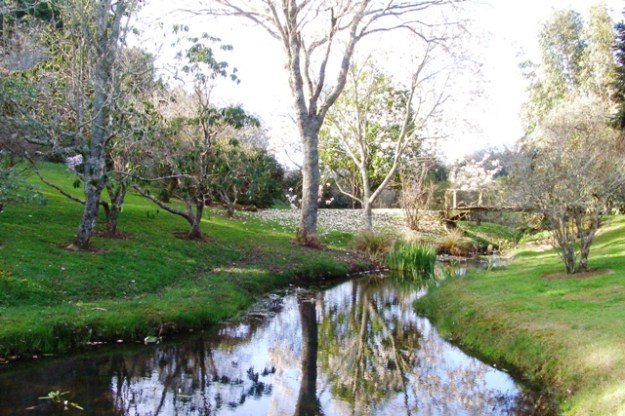
The same goes for banks on waterways. We should be avoiding all man-made chemical usage near waterways so err on the conservative side. A line trimmer or a scythe can be used to cut back and will leave cover rather than dead brown vegetation and then bare soil to erode. Pioneer farmers knew to plant trees along waterways to shade out weed growth.

Fortunately the horror that was the minimalist garden died out quickly after its heyday in the 1990s. That was the three large rocks, white pebble mulch with one sanseveria (unkindly known as mother-in-law’s tongue) and three green mounds of hummocky scleranthus. Contribution to nature? Less than zero. Demerit points? Top of the scale.

First published in the Waikato Times and reprinted here with their permission.

Plant Collector: Astelia solandri

The quiet charm of self sown Astelia solandri

The quiet charm of self sown Astelia solandri

While we don’t have the global monopoly on all astelia species, most New Zealand gardeners don’t think beyond Astelia chathamica (with its big silver leaves) and bronze ‘Astelia Westland’. A. solandri is not usually available commercially, although I see Oratia Native Plants sell it if you want to have it. Ours are all seedlings, dispersed by birds and most grow as epiphytes perched on the big old trees in our woodland areas. Its common name is the perching lily, no doubt because of this ephiphytic inclination, and its Maori name is kowharawhara.

When it is not in flower, it is just a green leafy plant, akin to a softer, narrow leafed flax in appearance, with leaves over a metre long arching outwards, somewhat silvery beneath. Essentially it acts as green furnishing detail in the garden. But when the flowers come, there is a delightful twisted tangle of stems and foliage. The flowers come out creamy yellow and age to this soft pinky colour.

I hope the ignorant claim that our native plants are all boring is dying out. A. solandri may not be spectacular and showy, but it brings a quiet charm to the autumn woodland.

First published in the Waikato Times and reprinted here with their permission.

Garden lore

“In the plan of human conduct there is a marked difference between the mind which sees beauty in a simple violet and that which sees it in a pompous rose or dahlia. On the one hand we have a love for the free and untampered flowers of God’s creation, on the other hand for a flower of social ills, sophistication and conceit.”

Jens Jensen , Siftings (1939).

The aphid infestation on old hellebore leaves

The aphid infestation on old hellebore leaves

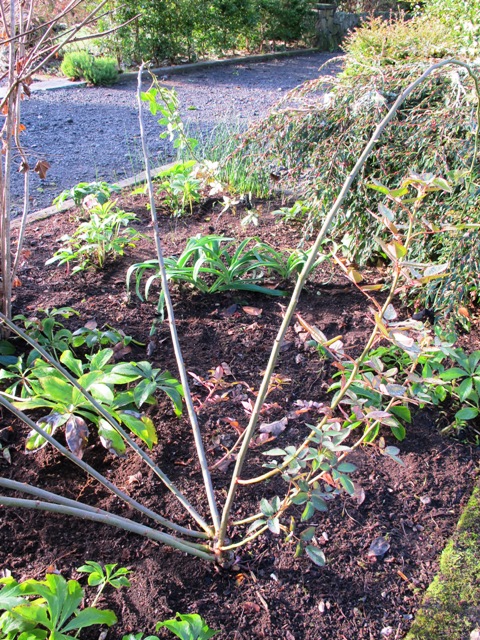
Hellebores in autumn Hellebores are one of the easiest care perennials there is, but even the most common H. orientalis benefits from a bit of seasonal grooming. I dead head in spring to stop excessive seeding and because the spent flowers can get heavily infested with aphids. By autumn, the foliage can be infested too. There are the tiny white tufty aphids and a whole lot of sooty residue which is the result of their honey dew excretions. I am going through now removing most of the old foliage. It looks a little bare until the fresh leaves and flowers appear, but it means the nodding blooms are much more visible and the new foliage is much prettier, while reducing the aphid infestations. Auckland plantsman, Terry Hatch, once told me he puts the lawnmower over his hellebore patches. I do it by hand with snips. I also remove the abundant fresh seedlings. A blanket of compost tidies up the area afterwards and feeds the plants. Timing is everything. If you leave the trimming too late, you have to work around each emerging flower and new leaf which makes it a fiddly job.

First published in the Waikato Times and reprinted here with their permission.

Plant Collector: tree dahlias

???????????????????????????????
The only resemblance these dahlias have to trees lies is in the astonishing size they can reach in the space of the summer growing season. Some can get up above 3 metres high. They are just dahlias, growing from the usual tuberous roots and because they are deciduous, they die back completely every year. The best known tree dahlia is the species D.imperialis which is also the largest variety and hails from Central America. Prominent NZ plant breeder, Dr Keith Hammett, has been working with dahlias over time and using other so-called tree dahlia species in ever more complex crosses to bring different colours, flower form and sometimes more compact growth into the range.
???????????????????????????????
Tree dahlias are not the easiest plants to place in the garden. They need full sun and protection from wind because their growth is somewhat brittle. They also need some sort of support to hold them upright. They flower now, in mid to late autumn, much later than the summer dahlias and this makes them vulnerable to early frosts. If you have the right conditions, plenty of space and are willing to build some sort of structure to support them (we are fans of thick bamboo corrals), they can be a welcome addition to the autumn garden but they are never going to be tidy, well behaved plants.

Reasonably sure this is the one named Timothy Hammett

Reasonably sure this is the one named Timothy Hammett

First published in the Waikato Times and reprinted here with their permission.