Tag Archives: Abbie Jury

Grow it yourself: cape gooseberries (Physalis peruviana)

Physalis peruviana - commonly known as cape gooseberries

Physalis peruviana – commonly known as cape gooseberries

Few people know the proper name of the cape gooseberry, though Physalis peruviana gives a handy clue on origin – Peru. So it joins other South American fruits such as feijoas, the NZ cranberry and the tamarillo which are easy to grow here. This is a wild fruit that you leave growing more for browsing upon or for encouraging children out to forage rather than for substantial harvests. That said, if you can get enough, it stews well and makes a fine, tasty jam.

Cape gooseberries are a solanum and you may spot the physical similarities to other solanums like tomatoes, aubergine, potato and even the nightshades. Tomatillos are also related. They all look even closer relatives at this time of the year when mildew blights the foliage. Theoretically, you can certainly grow them as a tidy row in the vegetable garden but in practice, most people just let seedlings go in rougher areas or margins of the garden where a bit of untidiness doesn’t matter. The little green fruit which turn yellow when ripe are extremely decorative in their papery sheaths, but the rest of the plant is pretty scruffy. In mild conditions, the plant will stay as a short lived perennial but in colder areas it is generally treated as an annual. The more summer heat it receives, the better crop you will get.

If you have a friend with a plant, get a ripe squishy fruit and grow the seed. Once you have it growing, it gently seeds down. It is sometimes available for sale in the garden centres but all plants grown in this country will be seedlings, not named selections, so you might as well start from free seed if you can.

First published in the Waikato Times and reprinted here with their permission.
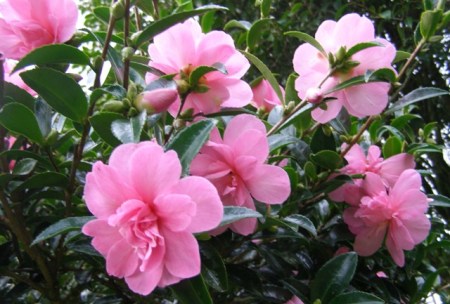
Plant Collector: Vireya Rhododendron Satan’s Gift

Satan. I'm afraid it is vireya rhododendron "Satan's Gift", not Santa's Gift

Satan. I’m afraid it is vireya rhododendron “Satan’s Gift”, not Santa’s Gift

The trouble with vireyas is that they have an aversion to frost so they are really only a garden option for those in mild, coastal areas. Inland (where frosts are much greater), you need to be a careful gardener willing to give them protection and maybe bring them under cover. But they can be such a rewarding plant with their extended flowering habits. This one is Satan’s Gift, one of the best varieties named by the late Felix Jury and certainly the showiest and the most fragrant.

Felix was a complete agnostic so the word Satan merely evoked hot colours to him but over the years, we have seen more religious people struggle with the name. Indeed, we have seen it offered for sale as Satin Gift, Jury’s Gift and the hilarious Santa’s Gift. (Note to such people: it is fine to shun a plant because you don’t like its name, but it is not okay to rename that plant to something you find more acceptable). We were once told that it was the only plant in Eden Gardens in Auckland, a memorial garden, without a name plaque. We just think it is a splendid cultivar to have in the garden.

This is a cross between two different species (konorii x zoelleri) which gives it hybrid vigour. It is particularly bushy and well furnished and flowers more than either of its parents.

Besides not liking the cold, vireya rhododendrons need great drainage. The fastest way to kill one is to keep it with waterlogged roots, whether in a container or the garden. In the wild, most are epiphytes and grow up in the trees.

First published in the Waikato Times and reprinted here with their permission.
In the garden this fortnight: April 26, 2012

A fortnightly series first published in the Weekend Gardener and reproduced here with their permission.

The pretty Moraea polystachya has a long flowering season

The pretty Moraea polystachya has a long flowering season

We are not noted for autumn colour here. I can’t think that anybody has ever said: “Oh but you simply must go to Taranaki to see the autumn display.” The trigger to deciduous plants to turn is temperature related and we drift so imperceptibly from summer through autumn to early winter, that even plants renowned for their capacity to blaze with colour are usually a disappointment. Besides, we are so verdant and green and our native plants are all so resolutely green that all we can do is to admire the occasional single deciduous specimen. Generally it is inland areas with drier climates and much sharper variation in seasonal temperatures which put on the big displays.

However, our autumn is marked by much smaller, pretty pictures of autumn bulbs. We garden extensively with bulbs. In a large garden with some huge trees, it is the dainty, often ephemeral pictures which give the charm and detail. Autumn flowering bulbs are harder to find for sale because most people don’t think beyond the more common spring bulbs.

Cyclamen hederafolium - the easiest of the species in our climate

Cyclamen hederafolium - the easiest of the species in our climate

At the moment, it is the pink and white Cyclamen hederafolium, blue Moraea polystachya (autumn peacock iris), a rainbow of colours in the ornamental oxalis, bold lilac colchicums (often incorrectly referred to as autumn crocus), the real autumn crocus and the beautiful hybrid sarniensis nerines which are carrying the season in the rockery. Out on the roadside, the belladonna lilies are in bloom. Some, like the colchicums, do not flower for long but are very showy. Moraea polystachya is a gem of a bulb. It flowers down the stem so it has an exceptionally long season stretching into months rather than weeks. It can seed down but is easy enough to thin out if necessary.

Cyclamen hederafolium (formerly known as neapolitanum) is the easiest and most reliable of the species cyclamen. It too has a long flowering season, followed by attractive, heart shaped leaves with white markings. It combines very well with black mondo grass and in places we have English snowdrops (galanthus) to come through in late winter, extending the seasonal interest amongst the cyclamen foliage.

Top tasks:
1) Cut off all last season’s leaves on the Helleborus orientalis and remove them to the compost heap. We have done this for many years now, following the advice from Terry Hatch at Joy Plants. It removes any build up of aphids and it means that the flowers are highly visible as they come through with just delicate new leaf growth. As the season progresses, the new foliage takes over and fills the whole patch. Timing is important – if you leave it too late, you have to trim carefully around all the emerging flower stems.
2) After raking off the hellebore foliage, I will weed out the rash of germinating seedlings and then cover the whole bed with a mulch of compost to a depth of about 3cm. This feeds the soil and discourages weeds. Hellebores are one perennial that is best left undisturbed. It is better to raise seed than to try and divide existing clumps. They can sulk for years before recovering.

The Nerine sarniensis hybrids are a real autumn feature in the rockery

The Nerine sarniensis hybrids are a real autumn feature in the rockery

Grow it yourself: feijoas

The ubiquitous feijoa

The ubiquitous feijoa

There are a number of plants we have embraced with such gusto in this country that we have all but made them our own – Pinus radiata, yams, kumara, kiwifruit… and feijoas from South America. Every family should have at least one feijoa tree. They are wonderfully easy to grow, requiring no special care at all once established. Find a position in full sun and preferably not in the full blast of the prevailing wind for best cropping.

It is usual to harvest feijoas as windfalls

When it comes to buying a feijoa, choose a named cultivar (“Unique” is probably the most widely available). If you buy a range of different varieties, you can extend the fruiting season and solve pollination issues. “Unique” is self fertile but most others need a pollinator, though feijoas are so widely grown that often a neighbour’s tree will do the job. Don’t fall for cheap seedlings, even for hedging. They may never fruit well, or indeed at all. Breeding and selection has given much larger fruit and better cropping. If you are going to give garden space, you might as well grow a good variety. The other important thing to know is that the advice sometimes given that you can use feijoa as a clipped hedge plant (I have even seen it suggested as a replacement for buxus) is particularly ill-informed if you want a harvest. You are likely to cut off most fruiting shoots. When it comes to pruning, it is better to thin the canopy, cutting branches off right back at the trunk, rather than trying to clip all over. Generally, a feijoa does not need pruning but allow for them to reach about four metres in height. Keep the ground beneath clear if possible, to allow for easy collection of fruit as it falls.

Feijoas are not particularly easy to strike from cutting but if you have a home propagation unit, it is worth a try. Use new season’s growth which has hardened off – in other words, the branch tips.

First published in the Waikato Times and reproduced here with their permission.

Outdoor Classroom: digging out large, clumping plants.

1) Huge, clumping plants which have outgrown their space can be a challenge because it is not always easy to know where to start and they have to be dug out, as opposed to cutting off woody plants. This is an unusual plant called Curculigo recurvata which has grown enormous but many home gardeners may have large clumps of flax or astelia. (The dog is Zephyr.)

2) A reasonably fit and strong person is necessary, armed with a sharp spade. Don’t try it with a blunt spade because it requires a combination of cutting and digging. Sometimes an axe is helpful to cut through big masses of crown. (The suitably strong person is our Lloyd.)

3) Sort out if you have any underground wires or pipes before you start. We didn’t this time. Fortunately the pipe supplying water to our house was alkathene so it was easy to repair.

4) Clear a space around the plant. You need room to move so lift anything precious close by. Starting from the outside perimeter of the clump, take off the sections piece by piece. Don’t try and dig the whole plant at once.

5) Taking it off in sections makes the process manageable. Because this is a relatively rare plant, we will be using some divisions elsewhere in the garden and potting some for sale.

6) We left three small clumps to grow again in the original position. If you are removing the entire plant, the critical part is to get all the foliage and the growth shoots from the base of the clump cut off and removed. It doesn’t usually matter if some of the fibrous roots remain because few plants will grow away again from severed roots. Leaves such as flax or astelia take a very long time to rot down and don’t compost well so we chew them up in the mulcher. You may need to take them for green waste recycling or put them in a discreet place to rot down over the next few years.