Tag Archives: Abbie Jury

Plant Collector: Sasanqua camellia Crimson King

Crimson King - harbinger of autumn

Crimson King - harbinger of autumn


Crimson King forms a graceful, open shrub when mature

Crimson King forms a graceful, open shrub when mature

Crimson King heralds the arrival of autumn. It is a sasanqua, one of the autumn flowering camellia family from Japan. Too many people seem to think that sasanqua is synonymous with Setsugekka (how clichéd is the Setsugekka screen planting?) and only comes in white. In fact there are a relatively large number of family members, including Crimson King. It has the usual sasanqua attributes of finer foliage and a graceful, open habit of growth as it matures. In addition to that, the exceptionally long flowering season means it will last well in winter.

Single flowers have just one row of petals and exposed yellow stamens in the centre. The birds and the bees, and indeed the butterflies, need these stamens exposed to be able to feed from the flower. Big full forms or sterile formal flowers are not a source of pollen and nectar. Most sasanquas lack the highly refined flower forms so prized in japonica camellias but single flowers like this shatter and dissipate without ever leaving a sludgy mess below. There is also a simple charm in such a simple flower.

Sasanquas are renowned for being one of the most sun and wind tolerant types of camellias. They also flower early enough in the season to avoid the dreaded camellia petal blight. Overseas reports say that they can suffer from this dreaded fungal ailment but we have never seen it in our sasanquas here. Crimson King has a pleasant scent if you stick your nose right in the flower but I think that the faint waft of fragrance in camellias is rather over-hyped.

First published in the Waikato Times and reproduced here with their permission.

Tikorangi Notes: Friday April 13, 2012.

The Cyclamen hederafolium are a delight

The Cyclamen hederafolium are a delight

Latest Posts:

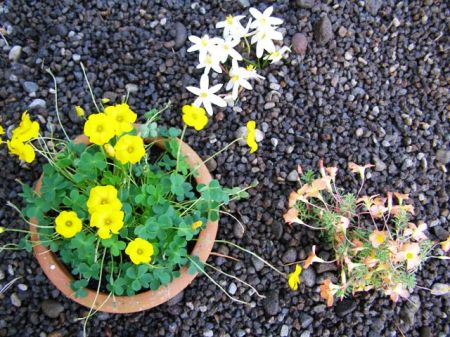
1) Those who shun all of the vast oxalis family because of the abominable habits of a few miss out on the autumn delights like Oxalis massoniana.

2) Raised beds and to dig or not to dig – that is the question. It seems these days that the rage is for raised beds, irrespective of whether they are needed.

3) GIY broad beans – we are very partial to this crop in our household.

4) Common wisdom is that you should only grow plants well suited to your area and conditions but Real Gardeners know this is a fallacy. It is wonderfully rewarding to succeed with marginal plants. My latest garden diary from Weekend Gardener magazine.

5) Secrets of a Lazy French Cook – nothing whatever to do with gardening, this one. But one of my other activities is book reviewing – mostly recipe books and children’s books (in addition to the gardening ones I receive.) This one is an entertaining read and a handy starting point for classic French dishes.

There has not been a whole lot of gardening going on here in the last week or two – too much energy and time required to renovate our one and only rental house on our property across the road. I think the role of property owner and landlord is much over-rated. But I did finally get to visit New Plymouth’s much loved and awarded new bridge on its coastal walkway. And it is a sensation, evoking the rolling waves so close by. It is wonderful to see a bridge that goes way beyond utilitarian and is dedicated entirely to pedestrians and cyclists. On a gloriously sunny and calm autumn day, it was a magical scene which left me in awe at the beauty of the district where we live.

Plant Collector – Oxalis massoniana

Oxalis massoniana

Oxalis massoniana

Envy the gardener who has not had to battle invasive oxalis. Most of us know only too well how difficult it is to eradicate the weedy ones. But there are only a few villains in a very large family and unfortunately, most people shun the lot because of those few. We wouldn’t be without the decorative oxalis and O. massoniana is just one putting on a splendid display at this time.

I think we must have around 30 different oxalis in pots and in the garden here and they are just a drop in the bucket of the many hundreds of different species. Flower colour ranges from white, through the gamut of pinks, lilacs and lavenders, crimson red, yellows and oranges. The foliage is also varied from the clover type leaves to fine and feathery, trailing and even miniature palm leaves. We must have them flowering for six to eight months of the year. I should comment that some have a flowering season lasting a long time, while others are a bit of a flash in the pan.

Some oxalis are garden safe but if in doubt, keep them in pots where they are wonderfully forgiving of benign neglect. The flowers only open in the sun so the pots make a lovely seasonal feature on a sunny doorstep. I have tried massoniana in the garden but it seems to be happier and showier in a big, shallow container.

The apricot and soft yellow two-tone colouring is very pretty and the flowering season lasts a good length of time. As with most of the autumn and early winter flowering oxalis, it is native to the bulb wonderland of South Africa. If you can’t bear the thought of growing oxalis, just call it by its more romantic sounding common name overseas – wood sorrel.

First published in the Waikato Times and reprinted here with their permission.

Raised beds and to dig or not to dig, that is the question.

Raised beds have their place, but not necessarily every place (Photo Joe Mabel, Wikimedia Commons)

Raised beds have their place, but not necessarily every place (Photo Joe Mabel, Wikimedia Commons)

Maybe the gardening world divides into diggers and non diggers. The non diggers favour raised vegetable beds and no dig gardening methods. We old diggers, on the other hand, are closer to our peasant ancestry.

Digging is not an activity to be feared. The physical effort is terribly good for you and it is only hard the first time. The more you work the soil, the easier it becomes. One of our vegetable gardens has been tilled for anything up to ten decades in some places and it is like working in potting mix. While Mark prefers to dig with a shovel, I swear by a good, sharp spade. People often neglect sharpening their spade but it makes a huge difference if you keep a good cutting edge on it.

Being of the digging persuasion, we have never felt the need for raised beds. If you put some effort into turning over the soil of your raised bed, it will fly in every direction, spoiling your surrounding paths. Lesson number one, should you decide you want them, is to keep the soil level lower than the surrounds and leave room to build up further as you add compost, green crops and all the additions which keep it fertile and friable over time.

Raised vegetable gardens have their uses in certain situations. Obviously they are of inestimable value for disabled gardeners or those who cannot bend comfortably. They can be useful where you are trying to garden in an area choked with old tree roots or with really bad drainage. They are, my daughter tells me, particularly useful in Canberra where a combination of clay, a new puppy and a heavy population of ground birds named choughs (pronounced chuffs) condemn any vegetables at ground level. But in the main, if you have halfway decent soil, I think it is actually easier to follow the traditional way and garden at ground level. The current vegetable garden craze has seen a building boom for raised beds and too little questioning of the rationale.

For starters, there are issues related to the construction of raised beds. Brick or concrete block is permanent and relatively expensive – devilishly difficult if you change your mind about your garden layout further down the track. Hardwood railway sleepers are expensive and heavy to handle. Most people end up with pine. Herein lies a major problem. If you use untreated pine in a high rainfall climate, it is going to start breaking down within a couple of years. Don’t forget it is permanently wet on the inside of the bed. So what about tanalised pine?

“No,” said my scientist daughter in Canberra. I trust her judgement in these matters and she did spend one summer as a chemistry student looking at sap staining on tanalised timber. She comments that the information on the internet is not particularly up to date, and in the absence of scientific evidence proving safety, she certainly would not want to be growing anything edible near tanalised timber. She points out that the preservative was, and may still be, a mixture of arsenic and chrome and plants are very good at absorbing and holding heavy metals. She wouldn’t risk it. She is constructing her raised beds out of untreated pallet timber which will break down in due course but is at least free, recycled and will last longer in her dry climate than here. She has also coated it with linseed oil.

The conventional approach to vegetable gardens, though one hopes the timber sides are not tanalised

The conventional approach to vegetable gardens, though one hopes the timber sides are not tanalised

Once you have built your raised bed, you have the problem of filling it. Too often, I have seen people on TV wheeling in large, heavy grade plastic bags, each containing 40 litres of soil mix bought from the garden centre. I can’t think of much that is less environmentally friendly. If you are not going to go down the expensive, convenience route, you are going to have to find or create your own soil. It takes a much greater volume than you would ever dream of to fill a raised bed. Then you have to shovel or lift the soil in. Don’t underestimate the size of the task.

At this point, some advocate going the no dig route. I know the theory, but being diggers, we have never done it. It consists of layering a mixture of compostable materials and leaving the worms to do the task of breaking it down. So you layer green material (but avoid weeds, seeding plants and anything diseased such as mildewed tomatoes) alternately with dry matter (fine twigs, newspaper, even old woollen carpet, straw and the likes). Essentially you are building a cold compost heap. It takes time for it all to break down and form a tilth and longer term, it matters a great deal what your proportion of green matter to dried matter is. Kay Baxter of Koanga Institute has written about this and why she chose to abandon the no dig approach after many years to return to old fashioned double digging.

If you want to hasten your no-dig garden, you end up adding large quantities of compost and humus and this is where my vegetable growing husband draws the line. We make large quantities of hot compost here and as far as he is concerned, that compost is destined to be spread annually to a depth of no more than 5cm across as much garden as possible – thereby feeding and conditioning the soil while acting as mulch. There is no way he will allow a single garden bed, whether raised or not, to absorb more than its allotted share just to avoid having to dig the soil.

Raised beds and no dig gardening require higher inputs for the same, or often less output. We are waiting for practitioners with several decades of experience to convince us that these gardening techniques are an improvement, rather than recent converts.

First published in the Waikato Times and reprinted here with their permission.

Grow it yourself: asparagus

Asparagus is a long term crop. For me it ranks as my number one all time favourite vegetable so I am happy to see it in our garden but, as a permanent crop which completely monopolises its allotted area for a decade or even two, it might not be such a worthwhile option in small gardens. Added to that, you can’t start harvesting it for the first couple of years so it is not ideal if you plan on moving or you are renting. We once moved just as an asparagus patch was coming on stream and remain scarred by the experience.

Asparagus does not fit into the current no dig craze. It is a clumping, deciduous perennial and it needs to go into ground which has been very well prepared and which has excellent drainage. The usual recommendation is to dig very thoroughly, creating a trench and adding plenty of well rotted manure and compost. Make sure that you are not planting on top of fresh manure. Give it time to mature. The aim is to create a bed of fertile and friable soil. Asparagus is generally planted as divisions in winter, reasonably deep at 15cm and about 30cm apart. Don’t refill the trench completely on planting. Just put a few cm of dirt on top and keep filling as the fresh shoots grow, otherwise they may never penetrate the surface. It is not the easiest crop to get established but once away, all that is required is regular hand weeding and annual mulching with compost. The compost feeds the asparagus crowns and discourages competing weeds.

If the asparagus crowns you have purchased look very small (and we have had that experience), you may find it more successful starting them in pots until they look sufficiently vigorous to plant out.

First published in the Waikato Times and reprinted here with their permission.