Tag Archives: Abbie Jury

Dramatic dahlias

When the sun returned on Friday, I realised that it was not the rain that had dampened my spirits, it was the low light levels. Clearly, I was never destined to live in northern Europe where I am sure I would suffer from seasonal affective disorder for months every year.

Here in Taranaki, Aotearoa New Zealand, we sit at 39°S which is a similar latitude to California, Ibiza and Sardinia – or Madrid is the usual northern latitude comparator to our country. Not that our climate bears any resemblance to those locations. We are a long, thin country set in the middle of vast oceans which moderates our climate and brings us regular rain – too much rain of late. We have a very clear atmosphere and that clarity of light is apparent in every season where we live. At the winter solstice, we still get around 9 ½ hours of light a day and that is often bright light. No wonder I am accustomed to high light levels.

I have few photos of herbaceous dahlias but this one in an open garden in Canberra, trained, cosseted and protected by an umbrella amused me at the time.

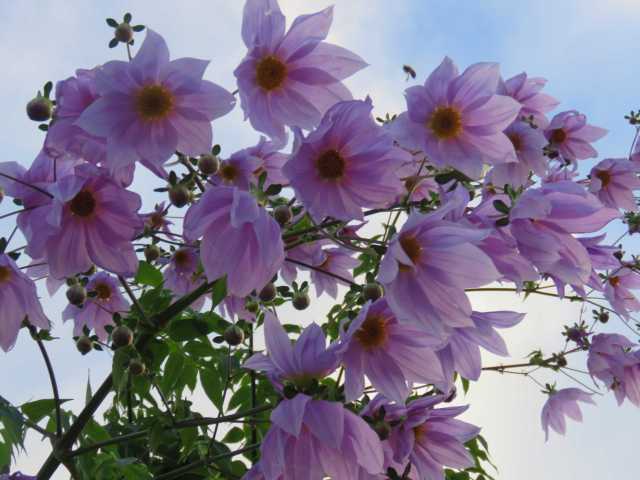
The return of the sun had me out looking at the tree dahlias. These are difficult plants to accommodate in the garden but they certainly have the wow factor at this time of the year. All summer, I have seen friends posting photos of their prized dahlias and, while I admire their enthusiasm, the big, blousy, summer dahlias do not bring me joy. Too many murky colours and novelty forms for my personal taste. The tree dahlias are a different matter.

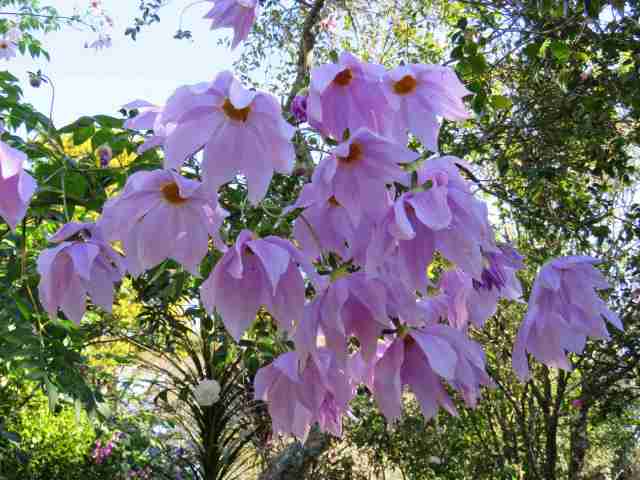
Dahlia imperialis

What is not to love about the soaring heights of D. imperialis lilac chalice blooms? When I say soaring heights, because we are growing them in semi shade, they can be stretched up to around 5 or even 6 metres.

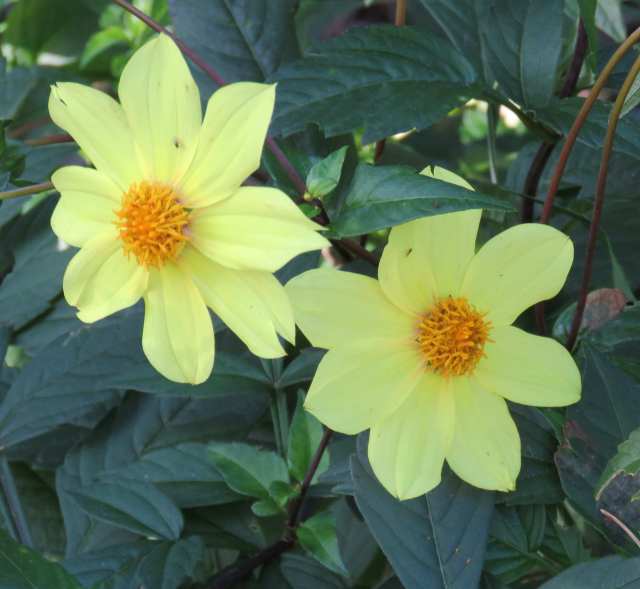
Dahlia ‘Conundrum’

D. imperialis is of course a species and the other species we have, D. excelsa, flowers even later in the season and grows even taller. It is not even showing colour yet. New Zealand plant breeder, Dr Keith Hammett, has done a lot of work over the years to create more amenable tree dahlia hybrids. We don’t have many of them and don’t have the right places to grow many more but I wouldn’t be without his yellow ‘Conundrum’ which flowers pretty much all summer and autumn coming into winter.

Dahlia ‘Timothy Hammett’

‘Timothy Hammett’, named for Keith’s son, is a beautiful and unusual shade of cerise-purple with smaller flowers. Because these tree dahlia blooms have visible central stamens and pollen, they are alive with bees and butterflies at a time when other food sources are getting sparse.

I watched the monarch butterfly flicking away the bee in an irritated manner

I have long since lost the name of the larger flowered, strong pink one we have – if it was ever named – but it is another worthwhile Hammett hybrid. If you want to know more about Keith’s tree dahlias, this article by him in the April Gardener is well worth reading. There is an impressive flower lay showing the range of colours he has reached in his breeding, starting from just four different tree dahlia species.

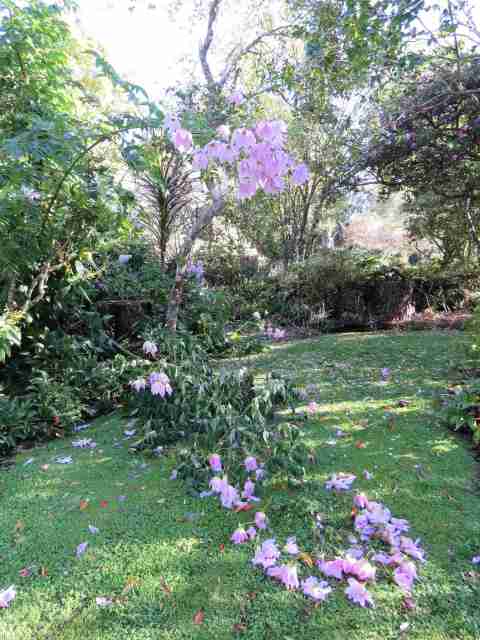
All too common a sight as one of the leaders falls over

I think we need to lift and divide our plants. This has not been done for many years and the tubers on some are very close to the surface. All we have done is to cut them down to the ground when they have finished flowering and reached their weather-beaten, scruffy stage – that is, if they have not fallen over with their own weight before then. They are brittle and vulnerable, especially the tall species. They are not exactly on a scale that I can stake, either.

A small but showy array

I think if we lift them and thin out the tubers, replanting them somewhat deeper than they have been, they may well reward us with sturdier growth and, hopefully, stay upright longer – or at least until they have finished flowering. Until then, I will just enjoy their glorious display as we count down to winter’s arrival. I prefer my life filled with light and colour.

From flowers in the gloom to the Coronation quiche

You can tell from the peeping blue sky that this photo is from my archives and not from the unrelenting greyness of yesterday. But the Dahlia imperialis is in flower again and looking very pretty, despite the rains.

We may be growing older but at least we keep learning things. I recall when our nation first learned about liquefaction in the Christchurch earthquakes. Next was graupel which must have been during the snow event of 2011. This year it is atmospheric rivers. I doubt too many of us knew about these before the Auckland anniversary floods followed by Cyclone Gabrielle. We received weather alerts this week about a potential atmospheric river becoming stalled over Taranaki from Wednesday.

In the event, it didn’t amount to anything close to the devastating floods suffered by many in more northerly and eastern areas of the North Island already this year. It rained hard on Wednesday night – over 90ml which is heading towards 4 inches, Mark tells me from his rain gauges – but since then it has just been showery and drizzly and unusually gloomy. Given that an atmospheric river can release more water than is in the Amazon, we feel we may have dodged a disaster this time.

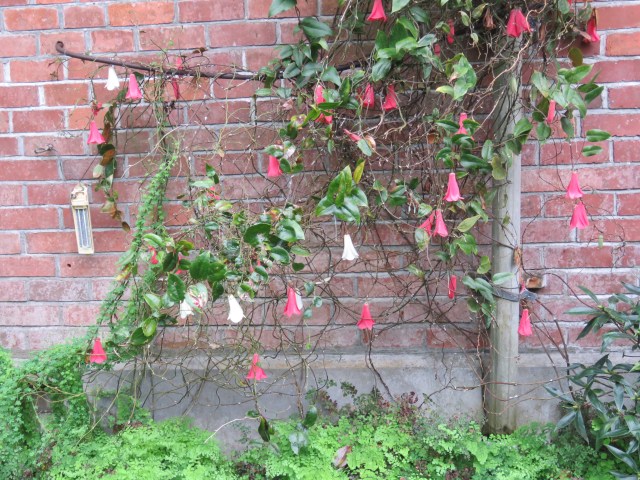
Lapagerias in red and white at the back of the house beside the wheelie bins. They are not a tidy climber and usually need a great deal of patience but, once established, their flowers through autumn and winter are a pleasure.

But gloomy is as gloomy does. At least it is not cold. While autumn is here, our daytime temperatures are still sitting around a pleasant 20 celsius and the nights are mild. When the rain stopped yesterday, even though it remained unrelentingly grey, I walked around the garden looking for bright spots.

Salvia madrensis in yellow with Chionochloa rubra in front and Miscanthus ‘Morning Light’ behind
Salvia mexicana ‘Limelight’ with Elegia capensis

I have been slow to be won over to the charms of the salvia family. The plants tend to be rangy, leggy, things lacking form but now I have the right places to grow them. They are generous in their blooming habits, flowering for months on end and what I earlier saw as formless sits comfortably in more casual plantings. I think I may need to expand the range and there are certainly plenty to choose from.

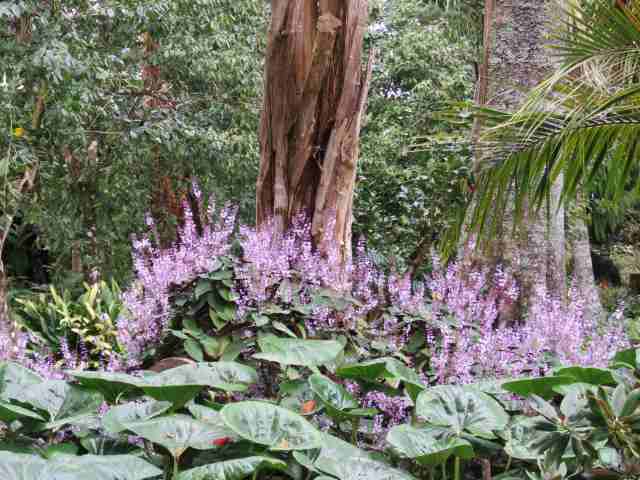
Plectranthus don’t have a good reputation but we accept a few in more casual areas. At least they are easy to hack back and to pull out when they start straying beyond their designated home space. I enjoy that lilac-blue haze behind the Ligularia reniformis. I have no idea which plectranthus this one is but it has a lovely burgundy colour on the underside of the foliage. That gnarly, dead-looking trunk in the centre of the photograph is the remains of my treasured jacaranda that was taken out by Cyclone Dovi in February last year.

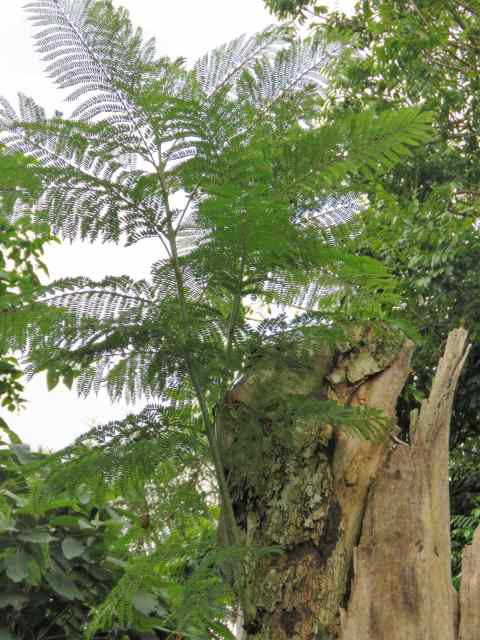
But wait! That is new life on the gnarly old jacaranda trunk. To our great surprise it is shooting again. When Zach spotted the first tiny signs of life, we thought it unlikely to survive because the outer layer of bark on the trunk had been stripped away entirely and we didn’t see how it could sustain new life. But here we are. That shoot is already quite substantial.

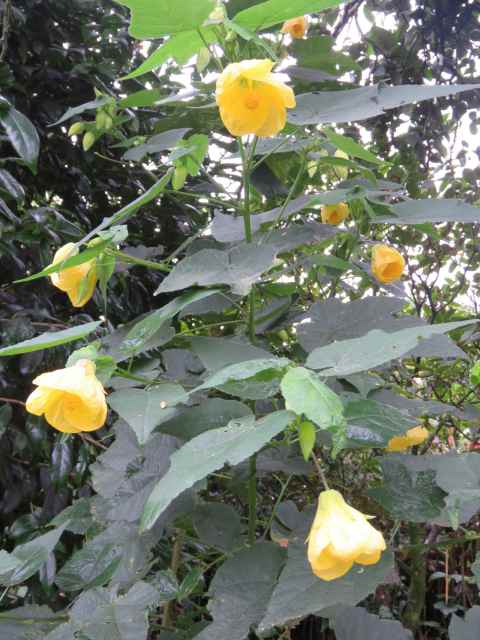
I am somewhat dismissive of abutilons which seed way too readily. We weed out most of them but I try and keep the odd one in pure yellow, at least one pure red one and any that have clearly crossed and come in a pleasing orange shade. Anything in murky colours – and there are plenty of those – or in the wrong place is unceremoniouly pulled out and consigned to compost.

Underneath the rimus, the bromeliads provide us with winter colour and a somewhat unique perspective on exotic woodland plantings. Ralph is a bit underwhelmed but he does have a resting sad face and that does not indicate a sad nature. The startling pink variegations in that photo with him are pretty interesting and seem to have stronger colour this year for no discernable reason.

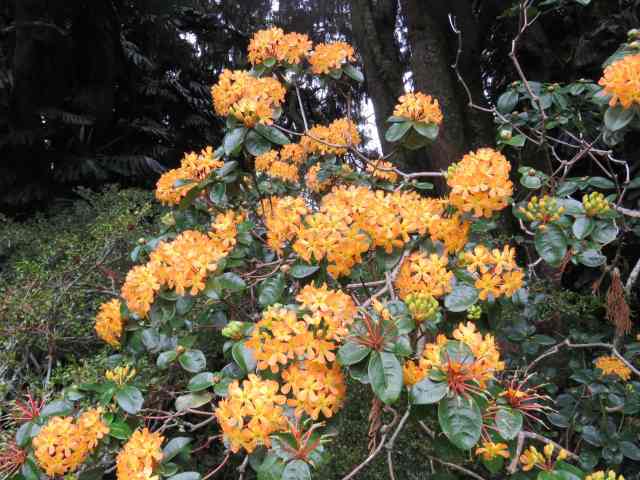
Vireya rhododendron macgregoriae

Right on cue, Felix’s New Guinea collection of R. macgregoriae flowers again, as it has done for sixty-five years now. For a vireya, that is an extraordinarily long life span. In our conditions, they are all too often short-lived. All we ever do is dead head it and take out any dead wood. It doesn’t get fed at all but each year it puts on a mass display.

I can not in all honesty say that my corner of the world has been gripped by Coronation fever but I was amused when Canberra daughter announced that the Coronation Quiche looked preferable to its predecessor, Coronation Chicken. Never having tried the latter, I had to google the recipe and that combination of chicken and dried apricot with mayonnaise is very 1950s/60s. Daughter entered into the spirit of the occasion by making an acquaintance with lard, albeit Australian lard, and even posted a photograph of her preparations.

Sadly, she was underwhelmed by the result. While the lard gave a good, flaky pastry, she declared the ratios to be “a bit weird, it’s a lot of cheese and a lot of spinach. The spinach made it a bit earthy and herbaceous. Plus I had forgotten I don’t really like tarragon.”

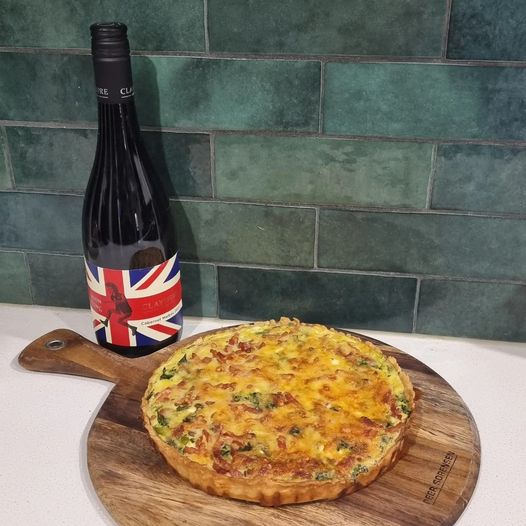
Not the Coronation quiche, in the end

She remade it, substituting parsley for much of the spinach and adding bacon and declared that preferable.

Going back to Coronation Chicken, I do hope that the New Zealand version was not prepared with Highlander mayonnaise back in the day, Highlander mayonnaise being of a similar era and based on a can of sweetened condensed milk. But I bet it was. With added curry powder from Greggs. ‘The horror, the horror.’

Feijoa mania in autumn. Every autumn.

Feijoa season! Very much a New Zealand experience, it seems.

There is something so innocent and wholesome about peak feijoa month in Aotearoa New Zealand. In a time when the world is chaotic and unpredictable, when problems seem to be mounting ever higher and the daily news is pretty darn bleak, this little green oval fruit appears in abundance and suddenly we are all talking about feijoas. Tables appear by gates as children gather the fruit and put them out with an honesty box. $2 a bag seems to be the going rate here, which is usually between a dollar and  $1.50 a kilo.

News outlets come out with the usual fluff pieces. “Today, we have a guest in the studio who has never tried a feijoa (collective gasp of shock) and we are ready with the fruit sliced and a teaspoon for him to have his first taste.” True, I heard that on Radio New Zealand this week. And an evening TV show put up a segment on what to do with your surplus feijoas. Reader, I can tell you there are no magic answers to that issue. All they came up with was to give away your surplus to less fortunate folk who do not have their own, stew them, make feijoa crumble, muffins or feijoa chutney and not much else. I stew some for the freezer, dehydrate them for using in baking and muesli and we eat huge amounts fresh but that is about as far as it goes.

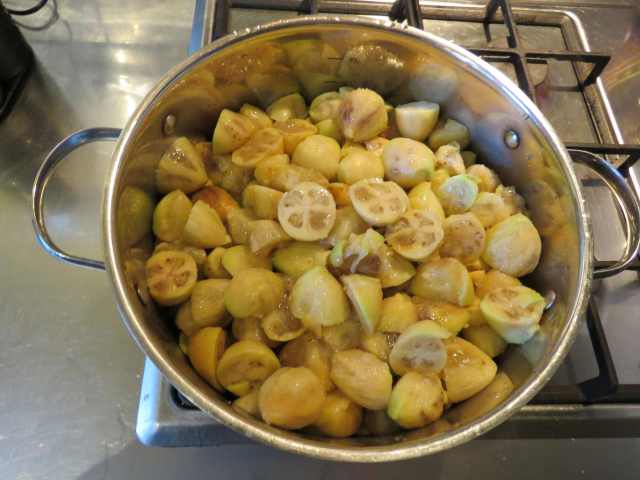
Scooped with a teaspoon and stewed. I don’t add sugar because we find they are sweet enough without.

Predictably there are the naysayers who don’t like the taste or texture but they are a minority. While feijoas have a fairly widespread distribution throughout the country, being a warm temperate to subtropical plant, there are areas where they don’t grow or, if they grow, they don’t fruit consistently because of cold winters. People in those areas must wonder what feijoa mania is all about. But when it comes to home gardens across the nation, feijoas must rank close to lemons and daphnes as being one of the most ubiquitous plants grown.

This popularity has grown through the decades. They have been here since the 1920s but I had never heard of them until I moved from Dunedin to the North Island. With new and improved selections becoming available, their popularity and distribution have grown exponentially.

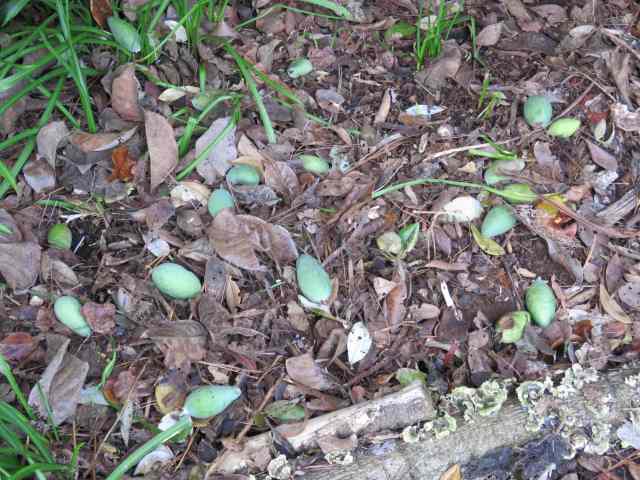
it is usual to wait until the fruit fall and then pick them up from the ground – for home growers at least – so it is best if the surface beneath them is fairly bare but with a good layer of leaf litter or mulch to give them a softer landing.

They are often referred to as the most democratic fruit or even a socialist fruit but Mark commented this week that really they are egalitarian more than democratic. Despite efforts over the years, they are not a high production commercial crop. They are so easy to grow and fruit so prolifically that their perceived dollar value is low and they bruise easily, making the repeated handling and shipping required by distribution chains problematic. There is an overseas market that is higher value but challenging to meet. The domestic market is very small because so many of us grow our own. Feijoas are something you share around; maybe they are our most socialist fruit after all.

Feijoa sellowiana syn Acca sellowiana is native to South America, particularly Brazil but apparently, we were the first country to introduce preferred selections as home garden plants. Why so popular? Because they are probably the easiest fruit of all to grow. They are evergreen. They don’t need feeding, they don’t need spraying, they don’t get diseased, they have few insect attacks and they are quite happy if you never prune them. You can just plant them in full to half sun and leave them. If you have a good variety and your winters are not extreme, they fruit generously every year.

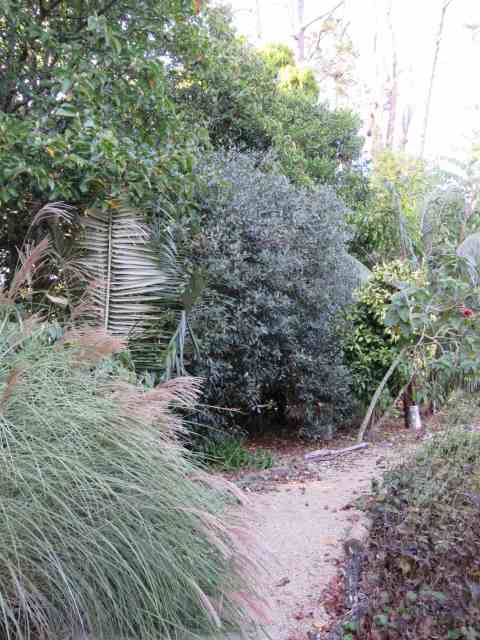
The dark foliaged plant in the middle is the feijoa. I would describe it as a large shrub rather than a tree. We have four established plants of different named cultivars and have planted another three to cover both early and late season.

In days gone by, seedlings were often sold as hedging plants but honestly, seedlings are not worth having because they are extremely variable and usually have tiny fruit that are mostly skin. Buy named varieties from the garden centre. You won’t regret it. It can be the difference between fruit the size of your thumb versus fruit the size of duck eggs. If you live some distance from neighbours, you either need to buy a variety that is self-pollinating or grow at least two because not all feijoas are self-fertile. It is not generally a problem in urban areas because there are so many growing that your neighbours’ trees will be pollinators.

Sadly the guava moth has arrived in our country, likely blown over from Australia. It is another pest we could have done without. And in areas further north where it has become established, it spoils the reputation of the feijoa as the most easy-care of fruits. There is a lot of work being done on environmentally benign interventions to control guava moth infestations. The internet or your local garden centre will be able to advise you if you are finding fruit with nasty caterpillars and poo inside them. It hasn’t made its presence felt here in the mid-north but I am sure it will at some point in the future.

Even if we have to resort to pheromone traps or other techniques, it will be worth it to preserve our most egalitarian and generous fruit.

Notably nerines

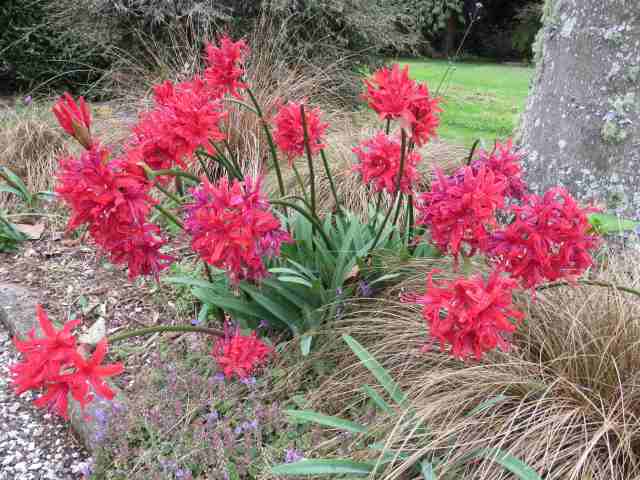
Nerine sarniensis hybrids in the rockery

It is nerine season and they certainly put on a great display. I don’t love them in spring when the foliage is slow to die off and looks scruffy as all the spring bulbs light up the rockery, but, come April, all is forgiven.

I need to put a tie on the two pink ones which have inveigled their way amongst the orange-red so I can move them. While we are fine with the adjacent blocks of clashing colour, they look better to my eye if they are adjacent, not mixed together.

Most of our nerines are sarniensis hybrids which give the range of colours and full heads of flowers. Often referred to as ‘Guensey lilies’, their connection to Guernsey is solely due to the cut flower trade because they are native to the Cape area of South Africa.

One of Mark’s unnamed hybrids that matures to purple, planted amongst our native carex grasses. It is a very good head of flowers with long stems but the stems really need to be a little more sturdy to hold the big head upright.

The sarniensis hybrids need really good drainage, open conditions and sun. Because they are in leaf in winter, they aren’t suitable for areas that get heavy frosts. These are bulbs that want to grow where their bulbs can bake in the sun so the rule of thumb is to plant them to a depth of no more than half the bulb with the other half and the long neck above the soil. They are also happiest in a crowd and can form a clump above the soil. I will divide the clumps when they get too congested and I discard the many small bulbs before replanting the larger ones close together.

Smoky shades
Undeniably vibrant shades. I find the highlighter pink particularly so.

We have a few of the early Exbury hybrids and the rest are all the result of Mark’s dad, Felix, hybridising to get a wider range of colours, along with some by Mark in days gone by. Felix particularly liked the smoky shades and they have a subtle charm of their own, as do the ones that mature to blue-purple shades. That said, the vibrant orange, clear red and highlighter pink ones are unashamedly bold and make a loud statement of their own.

The sarniensis hybrids are not that easy to find for sale. Local readers might like to hop in their car right now and head out to the Inglewood Sunday car boot sale because I saw somebody selling a really good selection of different colours in bloom there last Sunday. It is likely they will be there again today and maybe next week while we are at peak bloom. Beyond that, I don’t know where they are available but don’t expect them to be cheap like mass produced daffodils and tulips.

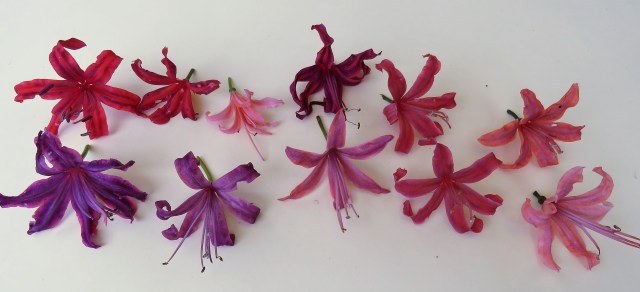
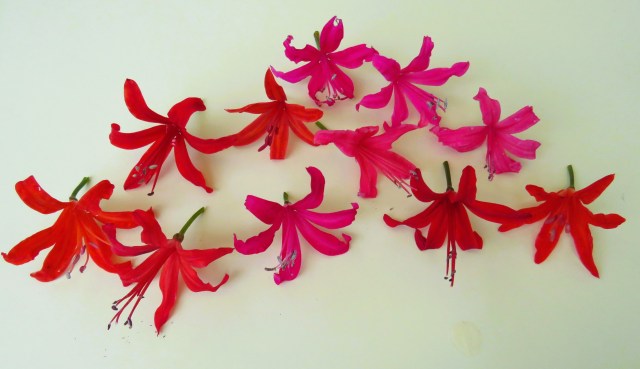
As I gathered single flowers to show the range of colours we have here, I picked up a few that had been snapped off. The one in the centre I think I can blame on Ralph dog who is no respecter of gardens. The ones on the right were clearly leaning over onto the grass where they fell victim to the lawnmower. The ones on the left are weevil damage on the rockery. If you zoom in on the second left, you can see the telltale damage on the stem which eventually weakened it to the point of breaking and flopping near the flower. Notwithstanding an exuberant dog, lawnmower and our localised patches of weevils, there isn’t much else that attacks these plants.

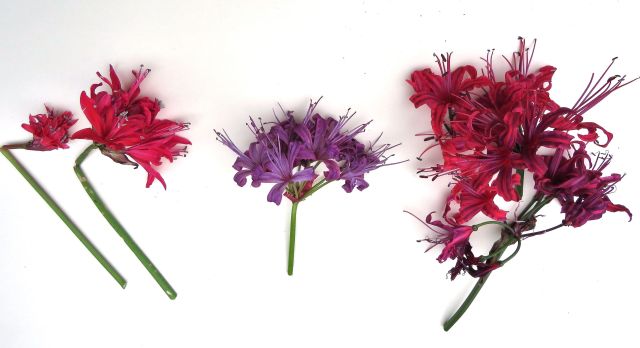
Nerine pudica on the left and bowdenii on the right

While we favour the sarniensis hybrids as garden plants, we also have a fair swag of N. bowdenii seen here on the right. There was only stem open so far two days ago when I took these photographs because it comes into bloom a little later than the sarniensis. It is easier to grow with stems that are strong enough to hold up the truss of flowers and is certainly more widely available than most others. On the downside, its truss is not as full of flowers and it basically comes in shades of hot pink although there is a white form, the internet tells me.

On the left in the photo above is N. pudica which I had forgotten about until this stray pot in the nursery opened its blooms. Several years ago, I planted a whole lot out, mostly in the rockery, and I had forgotten about them because I can’t recall them ever flowering there. I think I have found one patch of them which I shall watch to see if they do bloom. The same thing happened with the Lycoris aurea that I planted in the rockery a decade ago. They have never flowered again which is a pity because they were lovely – a most attractive shade of yellow and looking just like a yellow nerine except they are a lycoris, not a nerine. I live in hope that they are still there and pretending to be a mound of non-flowering nerines, so they can spring forth one year and delight me.

A range of the colours we have from pure white (named ‘Sacred Heart’ from memory) through soft pinks to alarmingly bright pink, coral, smoky shades, blue tones, reds through to bright orange

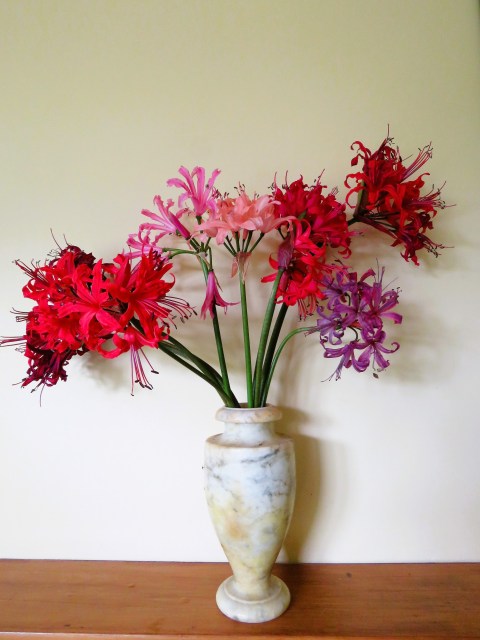
Nerines became popular as a cut flower because they have long stems and last well in a vase – hence the ‘Guernsey lily’ moniker. I rarely pick them because they last longer in the garden and, when a bulb only puts up one flower stem, it feels like flowercide to cut it to bring indoors to die. They are not as easy to produce as many other flowers for the cut flower trade so I would not expect them to be cheap to buy.

‘Say it with flowers’

Back in the prehistoric times before the internet, sending flowers to somebody in another place usually happened through Interflora – organised by telephone (land line, of course) or in person. The Interflora group ran extensive advertising and their slogan was ‘say it with flowers’. I have been thinking about that all week in various contexts – letting the flowers tell the story.

The free-form version

When daylight saving ends here in the southern latitudes, we have to accept that autumn has arrived and this always happens around Easter. The rockery has its second coming and oh my, but it is pretty at this time of year.

Cyclamen with amaranath and the first nerines

In early spring, the highly detailed rockery is dominated by the yellow of dwarf narcissi and every lachenalia we can grow here, across the range of colours. In autumn, it is mostly pink and white with masses of Cyclamen hederafolium and the Nerine sarniensis hybrids we can grow well.

Can one ever have too many of the species cyclamen? I think not. They are seen here with the lilac blue of the autumn crocus from the C. serotinus group, maybe salzmanii. Our rockery is immediately in front of the house so we walk past it often every day and really it is very, very pretty at this time.

The Wild North Garden has largely become our gardener Zach’s domain and he is continuing to add suitable plants that are surplus to the more tightly managed garden areas. He was so pleased with how the Japanese anemones he planted last year have settled in that he is adding more this year.

The dahlias have also settled in well to this controlled wilderness. I am pretty sure this is Dr Keith Hammet’s Dahlia ‘Conundrum’ which certainly increases well and flowers for a very long time.

The Wild North Garden may be Zach’s special area but the summer gardens are mine and I love the Court Garden in early autumn as the tall helianthus come into flower and the sun drops lower in the sky to shine through the flower spikes of the tall grass, Miscanthus ‘Morning Light’.

Personally, I would have called it ‘Evening Light’ or maybe ‘Late Afternoon Light’ but that has to do with location and the direction of our lowering sun.

I captioned the top pastel pink, blue and white confection as ‘the free-form version’. This more explicit floral version of a flag would have worked better had Japanese anemones also come in pale blue as well as white and pale pink but we make do with what we have. It reminds me of the floral confections the very late Queen Mother used to wear. Some of you may remember her many appearances where it looked like she was wearing pretty hydrangeas on her head. I went looking for images but they were all copyrighted so if you are curious, google ‘Queen Mother’s petal hats’ to behold the visions.

Sometimes in life, we need to stand up to be counted and I will stand up and be counted in support of the extremely marginalised group this flag stands for as they face an onslaught from people who want to erase them from history, from the present and from the future.