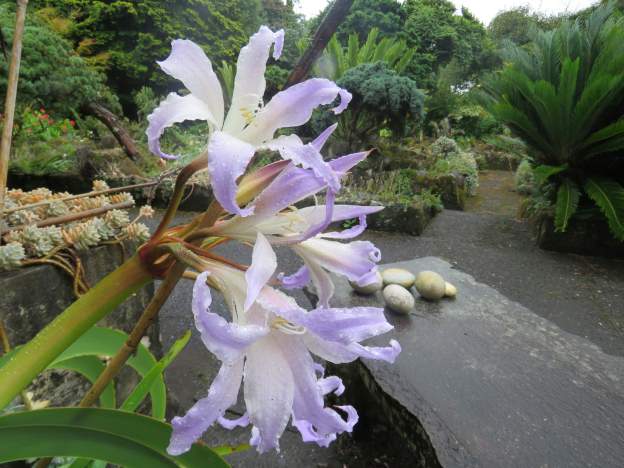
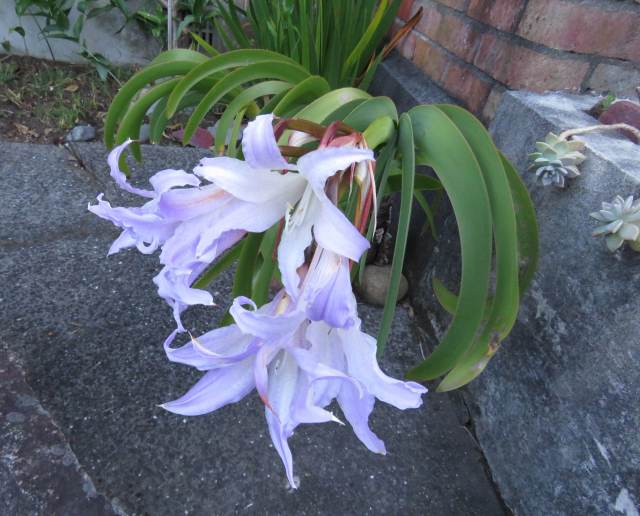
It seems that our highly prized Worsleya procera is more highly valued than we thought. I mention it most summers because it is lovely, really lovely, in bloom, usually late January to early February for us. It is unusual and even more so to manage it as a garden plant, which we do. In cultivation, it is commonly kept to a container and grown in controlled conditions. That is unless you happen to live on a granite cliff beside a waterfall in Brazil, that being its natural habitat.
How beautiful is the worsleya in flower?
I knew it wasn’t common and that is because it is very slow to produce offsets (new baby bulbs), that while it can be grown from seed, it is not usually self-fertile and you need two different clones to get viable seed. Then it is likely to take 15 years or more from seed to get a bloom. So it is not what is known in the trade as a ‘good commercial plant’. I doubt that it is available for sale in this country.
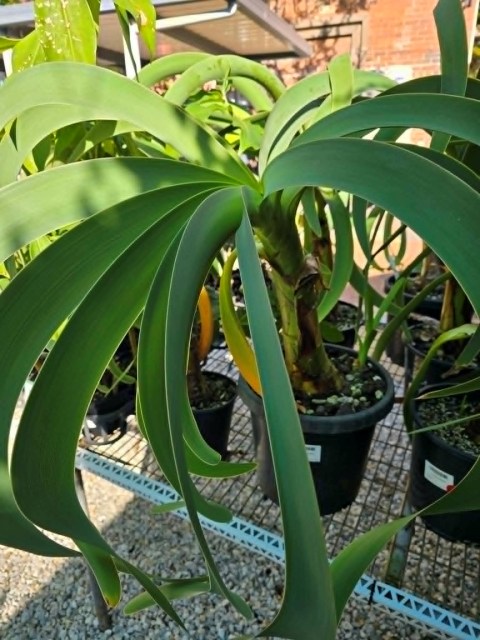
I discovered recently that it is highly prized in Australia. It popped up on a Facebook page for aficionados of unusual bulbs in that country. Canberra daughter is developing an interest in unusual bulbs and she tells me the worsleya is a hot fashion item. She stunned me with a photo of a single bulb, close to flowering size, that she photographed at Sydney Botanic Gardens.
It is a good plant but the price is next level
$980. Australian dollars. For a single bulb. That is $1141.74 New Zealand dollars on the day I write this. You could have knocked me over with a feather, even allowing for the bulb being blooming size. Small bulbs are available in Australia at $A90 for a one year old and $A180 for a three year old. They may flower in a decade’s time if you take care of them.
That is an astonishing price, to me at least.
Tulip mania is the term coined for the time from 1634 to 1637 when a peculiar event happened in the Netherlands and a single tulip bulb of a desired clone could be valued as highly as ‘four fat oxen’.
Similarly, but a great deal more recently, a single bulb of a special snowdrop (Galanthus) sold in the UK in 2022 for £1,850 ($4317.09 NZ at today’s exchange rate).
The worsleya has yet to reach these heady levels but we do not have a snowdrop with a bright yellow ovary in our garden. Nor do we have a seventeenth century tulip called ‘Viceroy’. But we do have about a dozen worsleyas, of which maybe four are flowering size. Maybe the rest will bloom before we shuffle off the mortal coils in a decade or two.
I am not sure that Mark ever paid above $15 for a single bulb of any plant and he probably had to have a cup of tea and a wee lie-down to recover from that extravagance. With inflation, we might pay $30 or $35 if it was something we really wanted and we were reasonably confident it would grow and flower here, in our conditions.
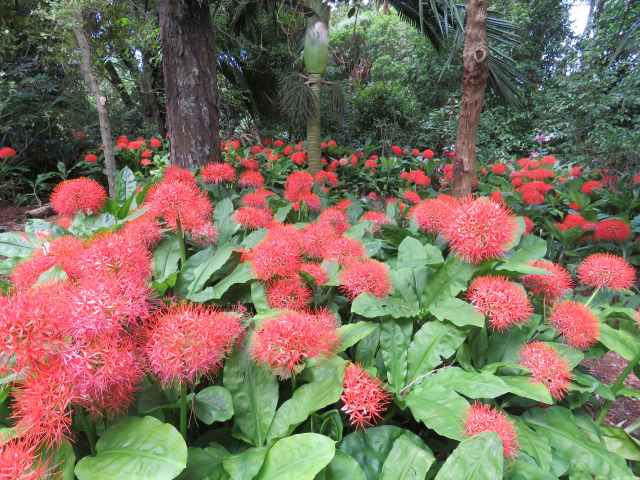
We lead a life that is rich in Scadoxus katherinae if not so rich in dollars. But I think we could flood the market if we dug them all up to sell.
I was shocked enough to be told that somebody our Zach witnessed was paying around $40 per bulb for single potted specimens of Scadoxus multiforus ssp katherinae which were not yet flowering size. We have a very large amount of it here and it is easy to grow, to increase and to naturalise. The same can not be said of the Worsleya procera so maybe its sale price matches its rarity.
Or Merry Christmas from New Zealand. Although, as one who favours ‘seasons greetings’ for those of us who are not affiliated to any church, maybe it is time I worked on committing “ngā mihi o te wā” to memory.
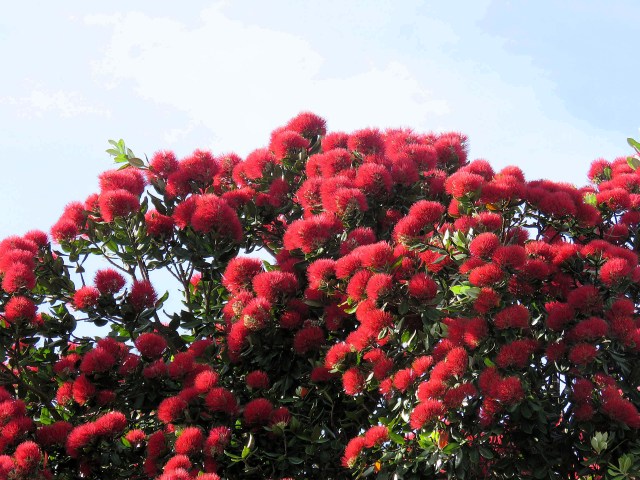
The flowers are what is often referred to as the New Zealand Christmas tree (on account of it blooming around Christmas), known here as the pōhutukawa (botanically Metrosideros excelsa).
Given its natural distribution is roughly a west-east line from where we are in North Taranaki across to Gisborne, I sometimes wonder how people in more southerly climes feel about it being the designated national Christmas tree. It is a remarkable tree with its capacity to grow in perilous positions on windswept coastlines. Being an archipelago of fairly small islands set midst vast oceans, we have pretty wild coastal areas. Our nearest small town of Waitara is right on the coast and there are two trees that dominate that urban setting, two trees that will not just survive, but thrive in that exposed situation. One is the pōhutukawa, the other is the Norfolk Island pine (Araucaria heterophylla).
I set out to find a good specimen of the pōhutukawa in Waitara to photograph. I don’t want to burst sentimental bubbles, but this is a variable species. Not all pōhutukawa are equal when it comes to blooming. They all seem to grow well enough but quite a few flower more brown than red, some have but a sparse display of blooms and some don’t seem to flower at all. Also, maybe I had better whisper that its season in bloom is but short. I had to pass a lot of trees on the waterfront and on streets to find this one that stood out for its floral display.
In its urban context in the town of Waitara. A street planted with pōhutukawa, one of many such streets, where this specimen stood out as blooming particularly well.
I am sure I have noted before that many, if not most, pōhutukawa that are sold are seedlings. They will be variable and looking at the make up of the ones in this area, the majority will vary to the less showy side. If you are going to plant a single specimen, buy a named form because it should have been selected for its good flowering and propagated from cutting so will stay true. If you are going to plant many, find a good seed source because the percentage of better forms in the seedlings will be higher.
Go well. Stay safe. And may 2026 bring at least some of what you hope for.
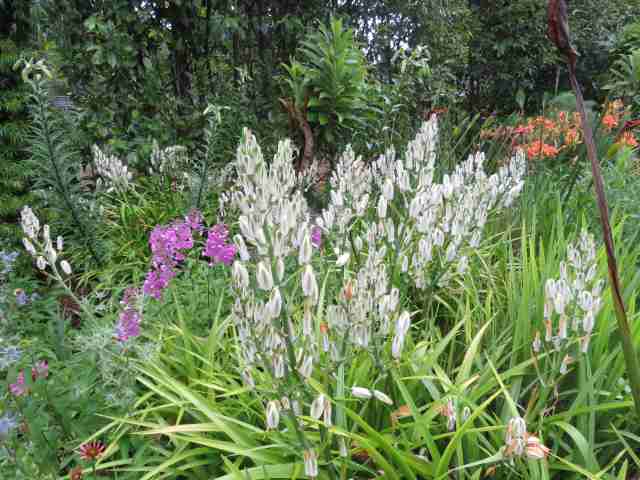
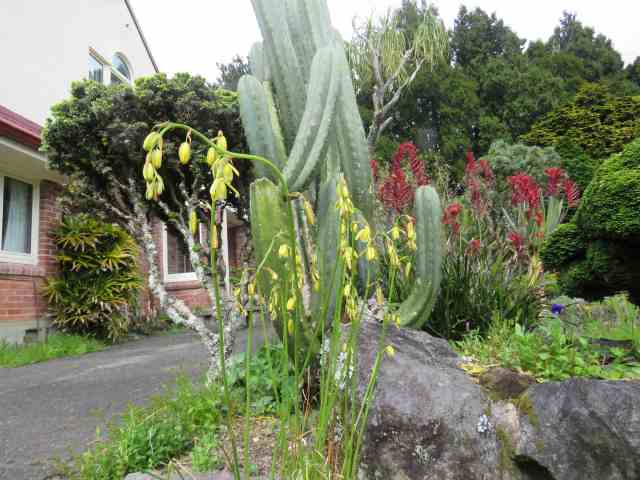
Sprawling might be the best description of Albuca nelsonii in flower
We have always grown the large Albuca nelsonii and its green and white bells have often featured in any Christmas floral staging I do because it cuts well. I included it when I planted the Court Garden and I worried about its somewhat unwieldy habits. Staking those tall, curvy flower spikes was… challenging, shall I say? All that changed when I looked up the albucas in an attempt to get a species name on its half-sized cousin with very similar flowers. I found a reliable site that described the characteristic of the plant that the flower spikes naturally become pendulous to prostrate. Why fight nature? I now allow them do as they wish.
Apparently useful for warding off sorcerers when mixed with one of the red hot poker species
Randomly, I also found the information that an “infusion made from Albuca nelsonii bulbs and tubers of Kniphofia species, known as icacane, is taken as an emetic as protection against sorcery.” Just in case you need that handy hint.
Albuca batteniana, I believe. If you look carefully, you will see a few tufts of orange that appear as the flowers open but disappears soon after.
Often mistaken for A. nelsonii is its half-sized cousin. As far as I can make out, this is Albuca batteniana. The little orange tuft – actually the calyx that holds the petals – that appears at the top of the flower spike when it first starts opening is a distinctive characteristic. The flowers, bulbs and foliage are very similar to A. nelsonii and it is a better-behaved garden specimen in that somewhat suburban, tidy manner. Its flower spikes do not lie down on the job; they stay obediently erect. It is a good garden plant which I have used in the twin borders but it doesn’t make me smile as the more exbuberant and wayward big A. nelsonii does.
Dainty but prolific Cyanella capensis
These days, the abundant blue mist that shrouds the rockery is not the bothersome geissorhiza, about which I have written often. It has taken years for me to encourage the dainty Cyanella capensis with its tiny blue flowers across a long blooming season. Only now am I thinking I may be getting too much of it. At least its bulbs are large and easy to remove. I just have to be a bit more vigilant on deadheading it because it is spreading by seed, not bulb.
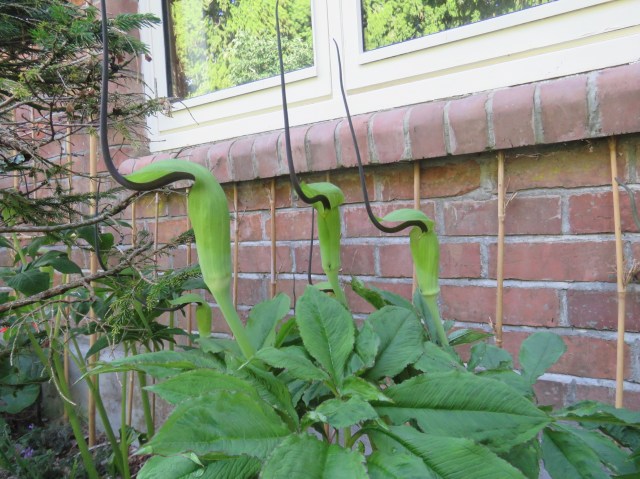
Arisaema tortuosum holds its head above the foliage, unlike many of the arisaemas. It also spreads too enthusiastically if the seed heads are not removed.
I have missed the arisaemas in previous months’ bulb articles. We have a reasonable range of arisaemas, some of which are much more choice than others. But it is really only the easy and common A. tortuosum that makes me think of them as the meerkats of the plant world. I deadhead them thoroughly and weed out strays because I do not want the alert meerkats of plant world all over the place but in their allotted space, they are an annual delight. And quite bizarre.
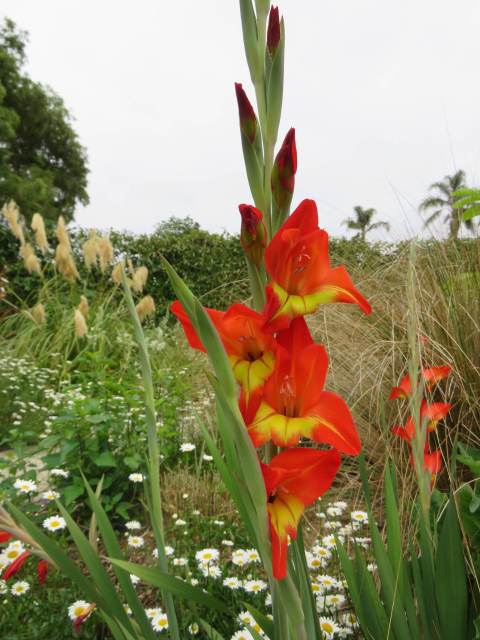
There is not much subtlety in Gladiolus daleni
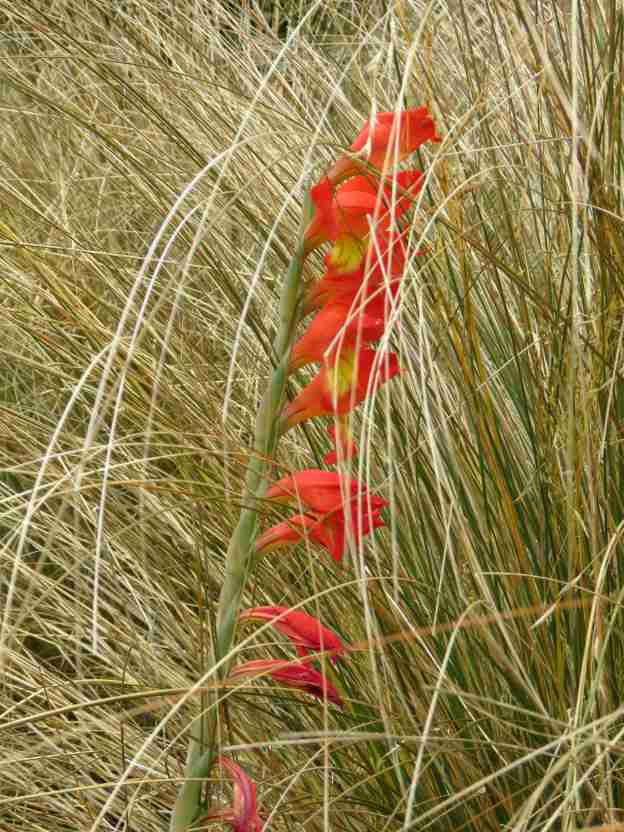
Gladiolus – there are a few that I appreciate, mostly species. And a few that I tolerate. The overbred, overblown hybrids of Dame Edna fame have never appealed but I accommodate the ones that date back to Mark’s mum. As she died back in 1986, I feel a begrudging respect for those that have survived down the years and they seem to fit in okay to the exuberant and largely uncurated floral abundance of the Iolanthe garden. Gladiolus dalenihas been in flower for a few weeks now but the star this week is the gorgeous red Gladiolus papilio X ‘Ruby’. One of the problems with gladiolus, though, is that they open their flowers in succession so no matter how attractive the freshly unfurled buds are, they share their stem with ones that have withered, browned and died. It seems a design flaw to me.
A legacy from Mark’s mother
The four gladioli on the left are all survivors from Mimosa Jury, top right is the amazing burgundy of papilio x ‘Ruby’ and beside it the usual species form of Gladiolus papilio. Lower right is daleni which is clearly a breeder parent of the one on its left which is larger and more coral coloured with a less obvious yellow flare.
The topic of gladiolus reminds me of this passage I wrote in a book review some years ago. I am still quite proud of it.
By the way, Penguin (Publishers) , it is time you dispensed with the auto spellchecker. The author of this book winning prizes for exhibiting her Gladys rivals a previous author counselling readers to throw out their Algarve. The author may have been using the colloquial term of gladdies, but even that is inappropriate for the text on page 164 and 165 where poor Gladys has her name taken in vain repeatedly. Gladiolus stands for one, gladioli for more than one. Gladdie is the vernacular, not the common name. Gladys is somebody’s grandmother.
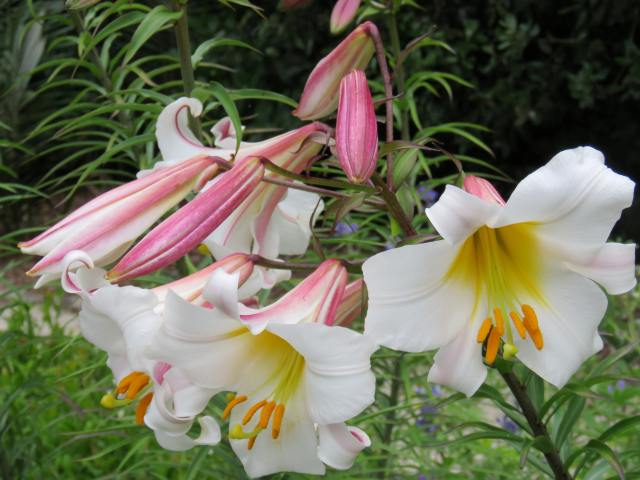
What we call a Christmas lily here is Lilium regale
The first of the Christmas lilies is in bloom and the buds are fattening on the golden Aurelian lilies. But I think we will leave the lilies for January when the auratums star.
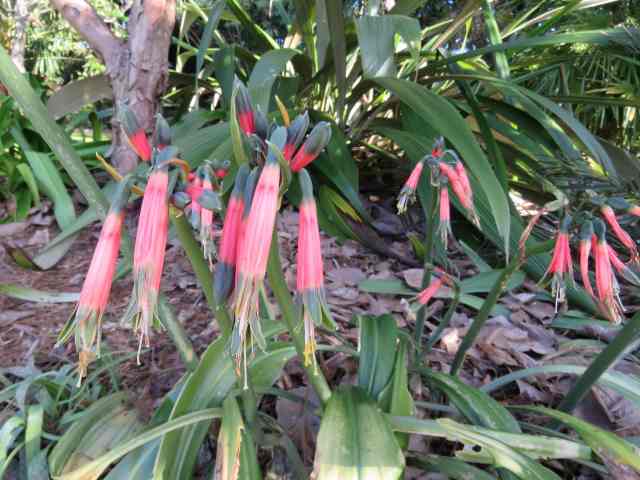
There are of course, other December bulbs in flower. That is a Phaedranassa cinerea above (great name!). From Ecuador, no less. I can’t think we grow many plants from Ecuador. And what we still call Urecolina peruviana (from Peru, presumably) but may be more accurately called Stenomesson miniatum blooms on. One day I might sort out which bulbs we have are South American as opposed to the majority that are from South Africa.
Stay safe and our thoughts go to Australians in this week. Mass shootings are so rare in this part of the world that it shakes our nations to the core when they happen.
Written for and first published in the Royal Horticultural Society yearbook of the Rhododendron, Camellia and Magnolia Group 2025.
Over our years of experience with the michelia group of the magnolia family – en masse, so to speak – we have learned that we can treat them as we treat camellias when it comes to clipping and pruning in our climate. I italicise those last words because I hesitate to advise gardeners in more extreme conditions.
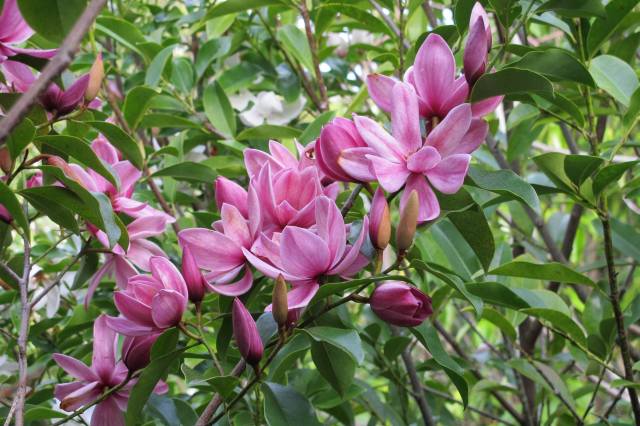
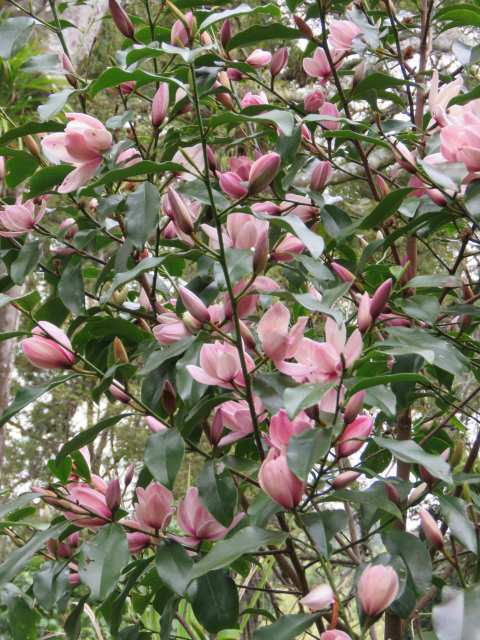
In a world where hardier michelia species are generally white or maybe cream, this is an example of Mark’s breeding programme getting more colour options into the future.
We have a very soft climate. We are never very hot and never very cold, regular rain falls all year round but our sunshine hours are high and we are on friable volcanic soils. If that sounds like gardening paradise, it probably is, as long as you can cope with the wind we get here on the west coast of the North Island of Aotearoa New Zealand.
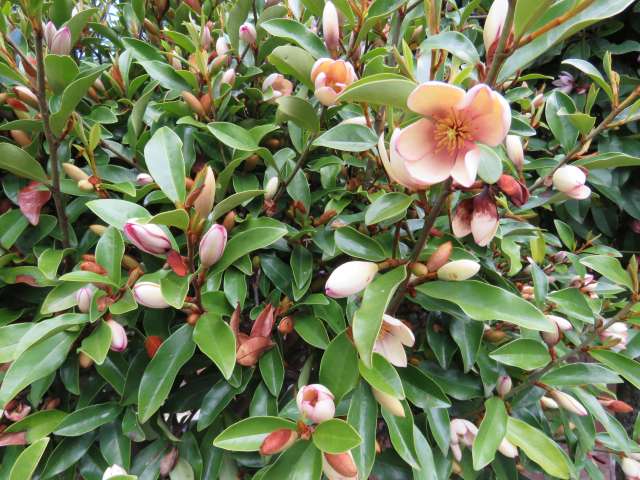
We also have an abundance of michelias to work with, as a result of my husband, Mark Jury’s breeding programme with the genus down the past 30 years. We have never kept track of the numbers raised here but it will be in the thousands. From those, three have been released under the Fairy Magnolia™ branding; there are two more in the pipeline for release shortly and we are in the process of selecting maybe another three. That leaves many, many seedlings that have been rejected along the way, including entire crosses that he has decided are not worth pursuing. Most get cut out but some we have utilised as screen hedging and shelter belts. There is no shortage of raw material here.
I often claim that we don’t do a lot of heavy clipping and shaping; I have seen Italian gardens and compared to them we are minor players indeed. We do a lot of pruning because our garden is mature and is strong on trees and shrubs which take management down the decades. When it comes to detailed clipping and shaping, it is mostly on camellias and michelias.
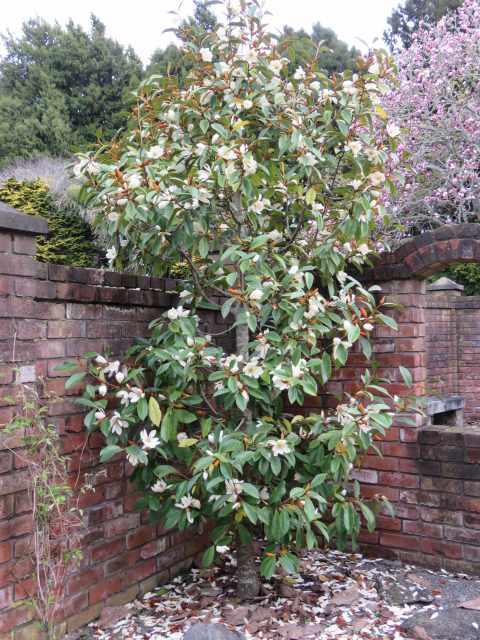
Fairy Magnolia® ‘Blush’ soon after planting, circa 2005
And in 2012
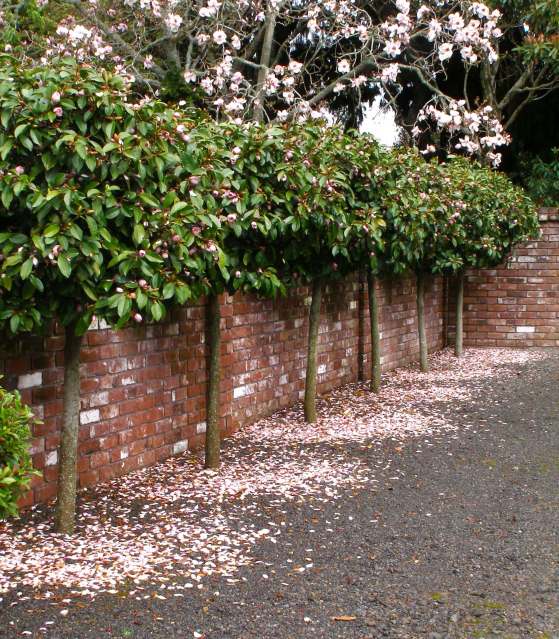
We started with Fairy Magnolia® ‘Blush’, planted twenty years ago in front of our brick wall. These were original stock plants grown in large containers in the nursery so they went into the ground with big root systems. We gave them a season to get established and then started shaping to lollipops. They have grown a little larger over the years but not hugely so. Every spring, as flowering finishes, we clip them hard, removing somewhere between 30% and 50% of their foliage.
Pruning in 2013. We remove more these days to keep them to size.
More or less frozen in time by 2020. The untrimmed section on the plant in the foreground is to allow the blackbird babies in a nest time to fledge and fly. We try to avoid ornithological infanticide – a hazard of early spring pruning.
We clip for future blooms so we only clip once a year, as they finish flowering. By the end of summer, they can be a bit woolly in appearance but if we cut again then, we would be removing many of the flower buds. If you want a sharp form all year round, don’t start with plants you want to flower well, at least not michelias or camellias. We use secateurs to trim. Hedgeclippers may be faster but they cut all the external leaves, the edges of which then go an unsightly brown. There is only a day’s work in clipping this row and cleaning up.
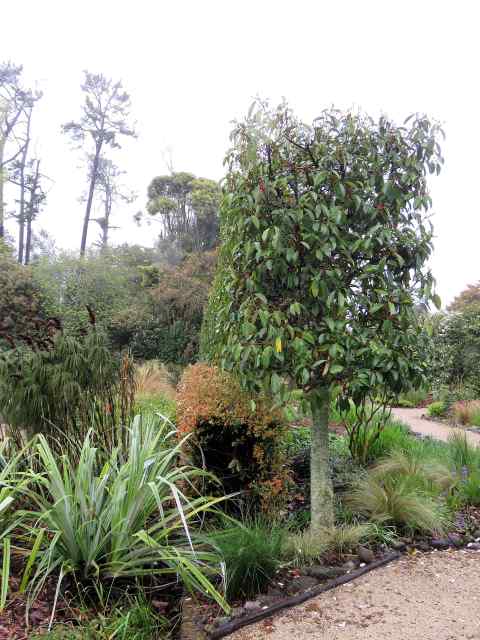
We have two smaller umbrella shapes which will now be well over 20 years old. The variety is to be released internationally this year under the name of Fairy Magnolia® Petite Peach. The photo above shows how much growth we are removing each year to keep the plants to a set size.
Fairy Magnolia® ‘Petite Peach’
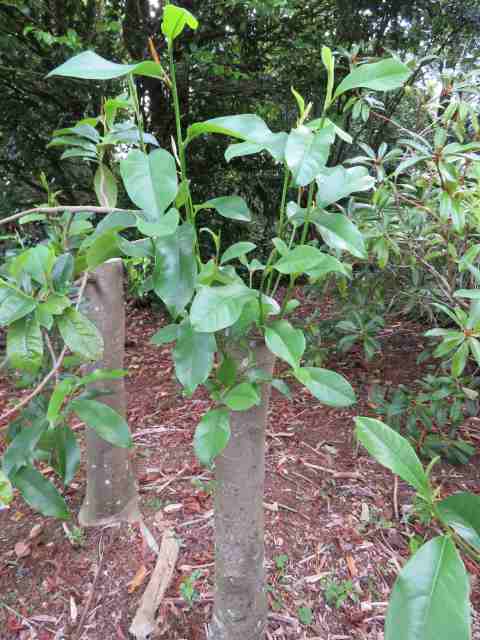
If you want to create standardised lollipops, be patient. Let the plants become well established and growing strongly before you start serious shaping. You need a strong central leader to hold up the weighty head. Too often, I have seen plants in garden centres that have been *trained* to standards with a spindly trunk and all side growths removed, so it is entirely dependent on the strong stake holding it upright. You will have a higher success rate if you start with a plant which has a central leader as well as multiple side growths which you can trim but not remove entirely until later. Reduce particularly strong branches which are competing with the central leader but those side growths give the plant more strength and vigour. The leader doesn’t have to be dead straight to start with. What looks like a kink in a stem that is one to two centimetres across will have disappeared by the time it is five to ten centimetres in diameter. Don’t stake unless you have to. Long term, you want the plant to stand straight on its own and plants that are staked from the start come to depend on the stake rather than developing their own strength in the roots and stem. Once the plant has reached the height you want, then you can start serious shaping and when the central leader is strong, you remove all side growths below the top knot.
The side-on view shows the width we are keeping these plants – Fairy Magnolia® ‘White’
They were somewhat large plants on our very small tractor when we moved them from the open ground in 2015
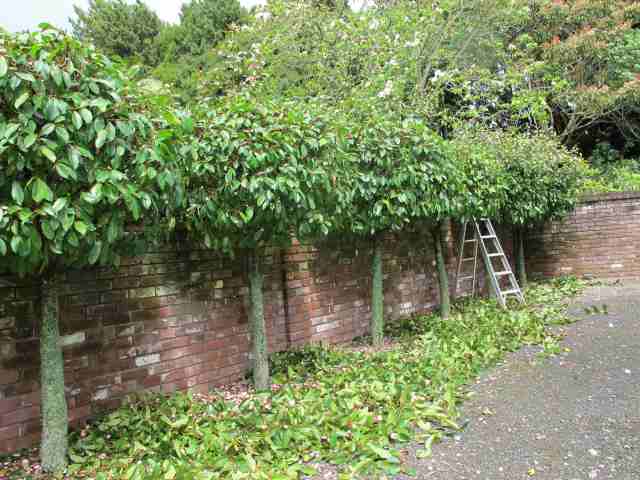
Our pleached rows of Fairy Magnolia® ‘White’ have taken patience. Pleaching is basically a hedge on stilts. These came in as large plants we dug out from the field where they were growing in 2015. They have looked good and flowered well in the intervening decade but it took until last spring’s pruning for me to look at them and sigh with satisfaction. At last we had that two dimensional plane sitting above the camellia hedge below that we had envisioned from the start.
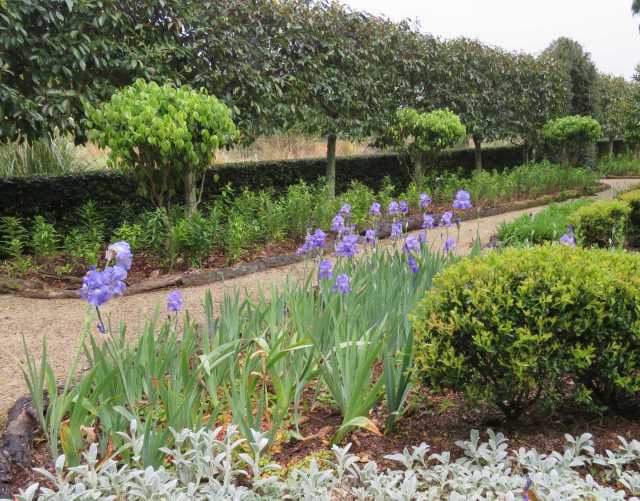
We have two matched lengths either side of a central court garden, trimmed flat down the length
Again we trim hard once a year, as flowering finishes, using secateurs and loppers to remove probably 40% of the foliage to freeze them in size and to create the form we want. They are bigger plants and surrounded by gardens, so trimming them is more challenging and slower than the aforementioned lollipops. Good ladders help. We bought both an orchard ladder and a platform ladder and I see our gardener, Zach, has both of these out when it comes time to trim the pleached rows.
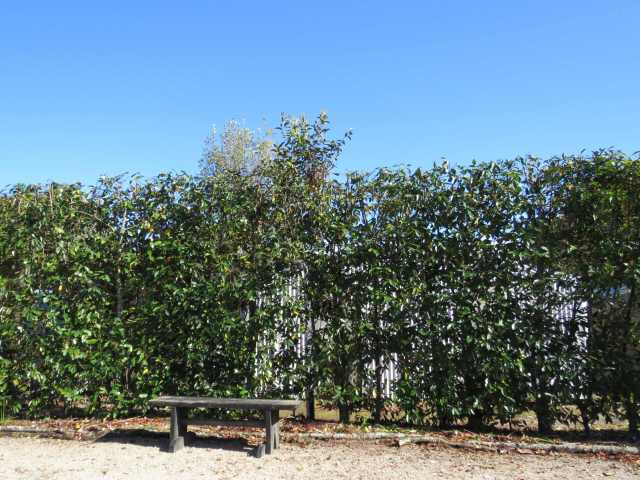
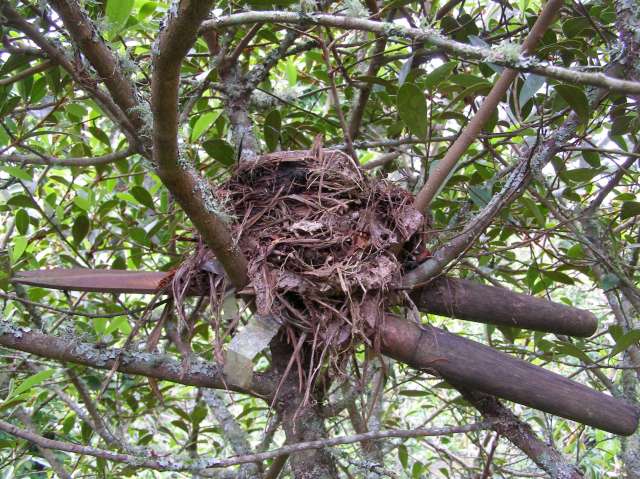
A tall hedge of michelia seedlings straight after trimming in October (above) and nine weeks later below, showing how quickly the new growth fills the gaps. The untrimmed tuft on top in the photo above is because of a bird’s nest. When we trim and prune in spring, we are mindful that it is nesting season and work around any we find.
We also use michelias as tall screening hedges kept to about three metres and these, too, get trimmed after flowering. They can look a little sparse when first done but it is only a matter of six weeks before the flush of new growth fills in the spaces.
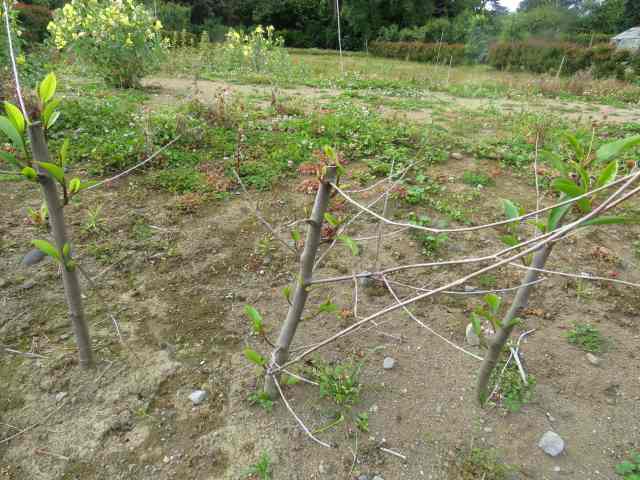
The same hedge as planted in 2017 – seedlings cut hard back to allow them to grow afresh.
About once every five years, these plants need to be picked over more thoroughly, to take out dead wood in the middle where branches have not resprouted. It saves them from getting woody and ugly over the longer term.
Magnolia laevifolia ‘Velvet and Cream’ was cut back hard to bare wood in 2023 but was bushy and flowering again the next season.
I only include this photo because it still makes me laugh. We used to trim with hedge clippers. When I found these making a handy platform for a bird’s nest in the M. laevifolia. Mark’s comment was, “Oh. So that is where I lost them.”
Well established plants that are growing strongly can be trimmed back to bare wood, as can camellias and rhododendrons. It is a last resort when a plant has got away on us but we have done it successfully, notably on M. laevifolia. The plants may take another year or two to flower again but they will reshoot from bare wood.
Michelias can be pollarded and respond by putting up straight shoots.
Unexpectedly, michelias also have potential as a coppiced crop, or what we refer to as a sustainable wood-lot, much as hazel is used in the UK. We found this out by chance when we were running low on winter feed for our very small number of beef cattle – more a group of cattle than a herd. Mark started trimming michelia branches as stock food (do NOT try this with rhododendrons which will kill animals) and they were perfectly happy eating the foliage. The plants which were cut to the ground, allowing us to use the trunks for firewood, responded by reshooting from the base with very straight stems.
Another of Mark’s oretty seedlings
In our climate, michelias can set prodigious amounts of seed. In fact, setting too much seed is one of our most common reasons for rejecting a cultivar as unsuitable for commercial release. They are not as prolific in harder climates but if you can find one that sets seed, raising the seed is not difficult and the results are reasonably quick, by woody tree and shrub standards. You will get seedling variation; if you want a hedge of identical plants you need to buy or propagate by cutting or grafting to get them all the same. We like the seedling variation which makes for a more interesting, though less formal, flowering hedge. If you are using seed from the same source, the variations are more likely to be subtle, not radically different. It is likely that Magnolia laevifolia will be the most common seed setter in the UK and Europe. It clips well but can be slow to get established. If you can find a hybrid that sets seed, it generally brings a degree of hybrid vigour.
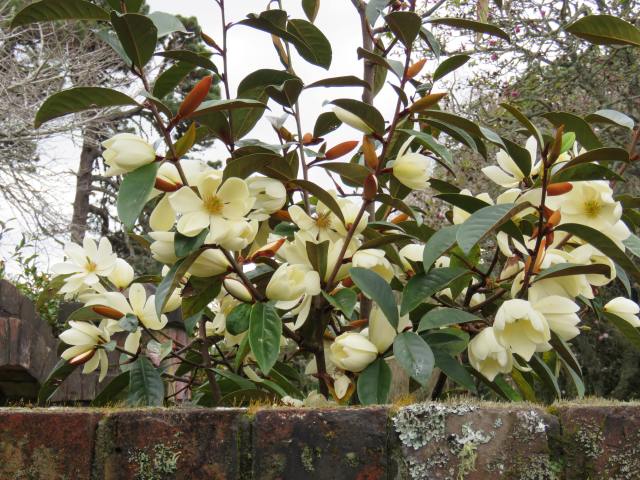
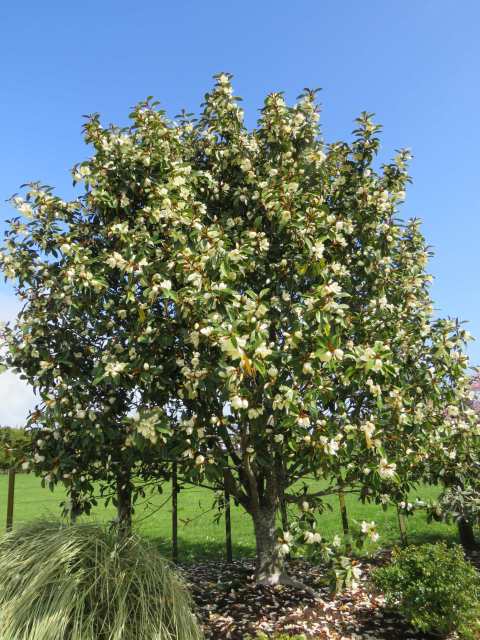
Fairy Magnolia® Cream is strongly scented
With most michelias, there is the added bonus of scent. In our humid climate, camellias are ravaged by camellia petal blight and we no longer get the mass displays on the reticulatas and japonicas. To some extent, the michelia group have filled the gap and they are rewardingly free of pests and diseases.
A note on nomenclature: Michelias have been reclassified as magnolias so all species are now listed as magnolia. The Jury hybrids are sold under the trademarked name of Fairy Magnolia®. For purposes of clarity, we continue to refer to them as michelias in common usage, to differentiate them from both deciduous magnolias and other species of evergreen magnolias, particularly M. grandiflora.
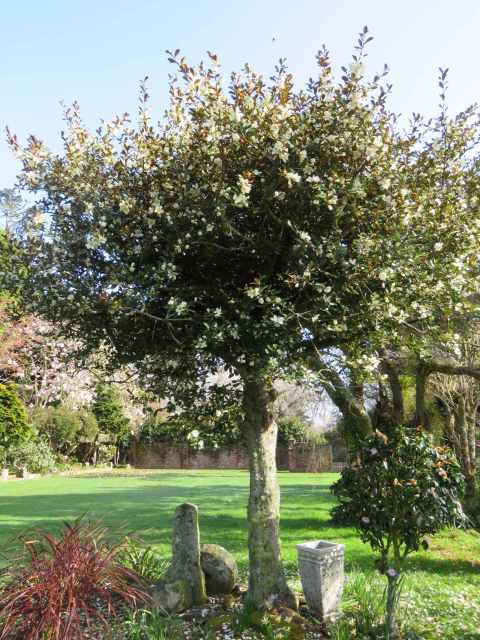
We have a matched pair of Fairy Magnolia® ‘Cream’ at our gateway which we prune to restrict each year. The photo below shows it growing as a roadside plant with no pruning. We can’t allow our gateway plants to get to that size in the space they are in so we are pruning to freeze them in size.
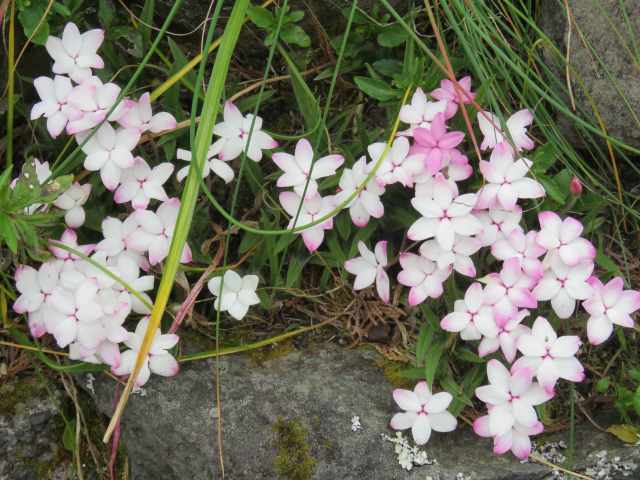
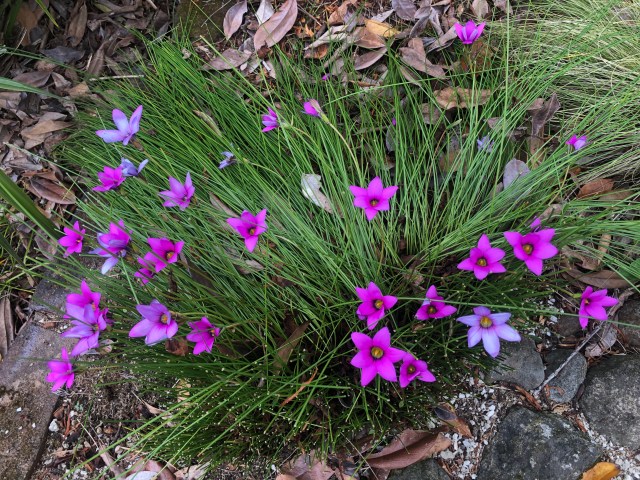
Arguably, rhodohypoxis could be the provincial flower of Taranaki. Like clockwork, they bloom on cue for the garden festivals which take place here at the start of November and there wouldn’t be too many gardens that don’t have rhodohypoxis growing either in garden soil or, more commonly, in shallow pots. They may hail from southern Africa, but we have made them our own.
Rhodohypoxis baurii ‘Ruth’
For all our years opening the garden and when we had the nursery, we would pot up what seemed like an inordinately large number of these little rhizomes in shades of pink, white and deep carmine. I wondered if we would reach saturation point when every local gardener and any return gardeners from out of the region already had them, but we never did. It seems the market for these charmers – referred to as ‘roxypoxies’ by more than one customer – is endless in the month of November.
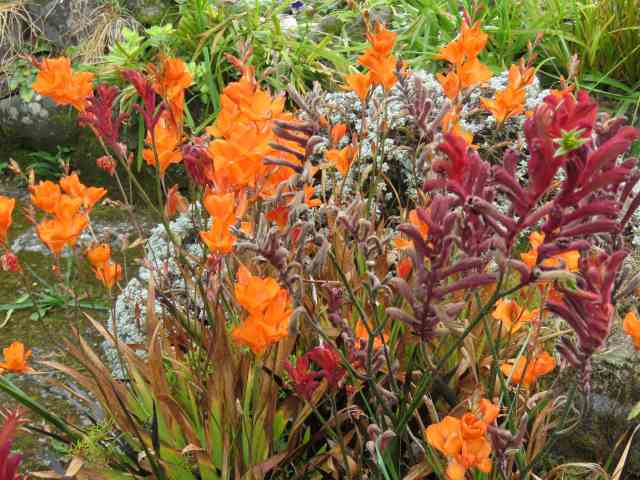
Orange tritonias
Also standing out are the orange tritonias. There is nothing subtle about these easy bulbs, also from South Africa. They need to be managed and used thoughtfully or they just look a bit… vulgar really. They pull their weight in vibrant meadows, set against deep blue flowers or in predominantly green situations.
I am pretty sure those are pastel tritonias at the front of the borders at Riverlea Garden
I am pretty sure the muted pink clumps repeated down the front of the borders at Riverlea Garden are also tritonias, or a close relative. They were very pretty and maybe easier to place in the garden than the orange.
White ixias in the front left. And of course those red and yellow alstromerias on the other side are also rated as bulbs. And I would assume that the Iris sibirica ‘Blue Moon’ can be included in the bulb fraternity with its underground rhizomes.
Also in the ‘easy’ bulbs class are ixias – African corn lilies. Not that all ixias are equal. I had a brief look at the ixia family and it seems there are somewhere around 100 different species and there seems to be quite a strong correlation between different colours and different species. Our form of Ixia viridiflora – the best known and unusual coloured one in strong blue-green – is a poor form. Despite my best efforts, it never flowers well and I have seen photos of way better performing selections. It is the pure white ixia that delights me this week, both in the Wild North meadow and in conjunction with the blue Iris sibirica in the borders. We also have ixias in various shades of pink from pastel to cyclamen pink, in lilac and in yellow.
Romulea rosea
Romulea candidissima
Romuleas can be a bit too enthusiastic on the reproduction stakes but both R. rosea (in brightest pink) and R. candidissima (in pure white) are earning their keep this week. Mark tells me that the best romulea is R. sabulosa but it is also the most difficult to grow and we lost it.
It has taken us a long time to get to the name of this – Herbertia lahue or prairie nymph
Crossing the ocean to the central and southern Americas, we get Herbertia lahue with the charming common name of Prairie Nymph. Neither Mark nor I have known what this was until now, although Mark gave his assessment that it ‘looks dangerous’. He is right that the visible evidence of seed development is scary, but in all the years we have had it, it has not become an invasive problem.
I have brodiaea firmly embedded in my brain so I may struggle if in fact it is now a tritelia
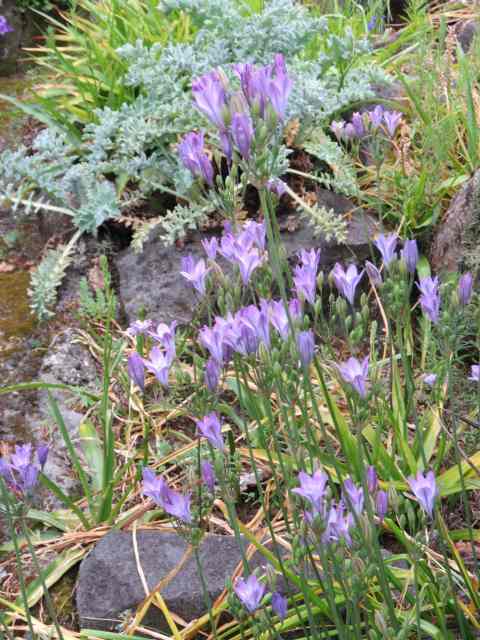
Then there are the multitudinous but welcome plants of Brodiaea laxa ‘Queen Fabiola’. Or is it definitively reclassified as a tritelia these days? This I do not know. It has built up most satisfyingly here without becoming a problem. In a climate where the giant blue alliums are not a starter for us – or indeed for many people in this land, given the whopping price per bulb let alone sparse availability – I see my brodiaeas as the poor man’s alternative to swathes of late spring blue. True, it falls over in the rain but it stands up again when the rains stop.
Flattened by the rain this week but what I think of it as the poor man (or woman)’s blue allium replacement
Albuca flaccida (not canadensis!)
It has taken a few years (read: quite a few, possibly many years) to build up Albuca flaccida (incorrectly named and sold in this country as A. canadensis, including by us) in sufficient numbers to put on a show but we are finally there. In the class of graceful, hooded, hanging bells in yellow with green stripes, this South African bulb is a winner and even more charming when in a clump of many. The bigger growing white and green albucas are only just opening and we will get to them next month.
I will struggle with remembering Sinningia instead of gesneria but the cardinalis remains the same
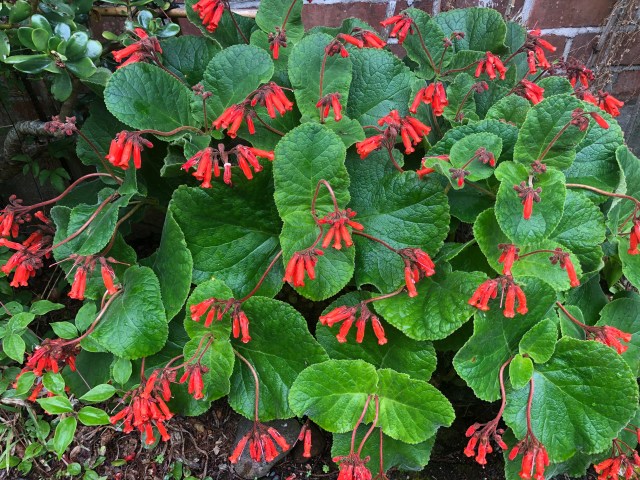
Sinningia cardinalis (alternatively known as Gesneria cardinalis) is one of our curiosities here, built up over decades to be standout clumps of foliage and flowers that attract attention. I am not aware that it has a common name but it belongs to the same family as African violets, streptocarpus and some gloxinias. You don’t see it around much because it doesn’t appear to reproduce easily from seed and its large tuber doesn’t set offshoots so propagating it requires a bit more skill than most bulbs.
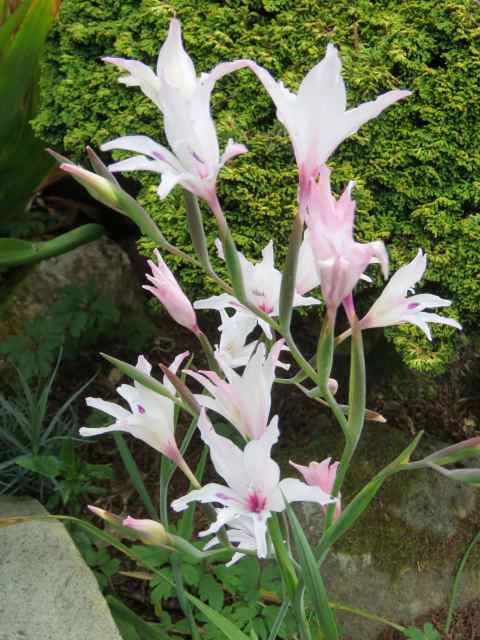
Pretty sure it is one of the gladiolus species but we don’t know which one. These often seemed to be loosely grouped into G. carneus but that may not be right
Our interest in bulbs largely begins and ends with what we can grow as garden plants. We have enough garden without having to faff around with pots. Some bulbs are easier to manage in pots, particularly those that are being grown outside their climatic and geographic areas. It is easier to manage water and growing medium requirements in pots, as well as controlling temperature and day length. It is also easy to take your eye off pots and find the contents withered away to nothing in high summer, eaten out by hungry mice in winter, or sprouting with unwelcome seed from invasive neighbours. Ideally, potted bulbs should be replanted in fresh mix every year. We prefer to keep them to the garden once we have enough to plant out.
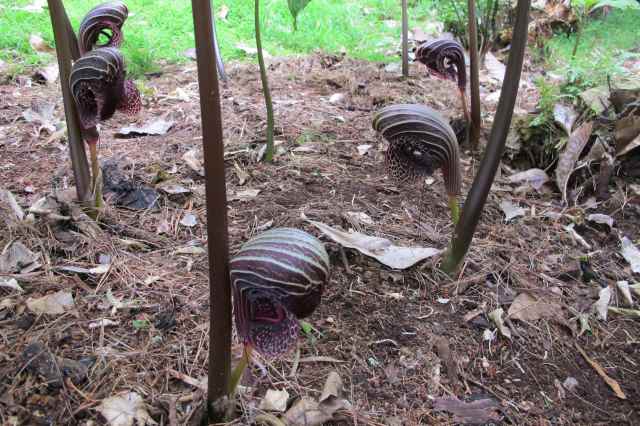
But wait there is more! I had forgotten entirely about the arisaemas, which is quite a big oversight on my part. This oddity is A, dahaiense.



















 Tikorangi The Jury Garden