Tag Archives: Abbie Jury

Tikorangi notes: April 6, 2010

Latest posts:

1) April 1, 2010 Garden tasks for the week, from buying bargain woody trees and shrubs from last season to autumn harvests.

2) April 1, 2010 Trimming and clipping formal hedges, our latest Outdoor Classroom. There is no doubt if you are going to have the sharp definition of a formal hedge, it might as well be done properly. We can’t do the traditional English yew in our climate – we have too high a rainfall and they get phytophthora and tend to die young.

Spike, to the left, ate the Easter bunny. Zephyr would have but he is no match for the speedy Spike

Easter has been and gone. Alas, few Easter eggs here as Spike ate the Easter bunny. Buffa the cat has probably eaten a fair number of the Easter bunny’s brothers and sisters too. We are dealing with a rabbit explosion and would have preferred the early settlers from Britain to have left the rabbits back in their homeland rather than introducing them to this country back in the 1800s. We would have been better off had they also left the possum in Australia. While on the subject, one wishes they had spent the long voyage at sea ridding the plants of the slugs and snails that hitched a ride.

Our autumns tend to be long and mild here, drifting slowly from summer to winter, which makes for brilliant gardening conditions.

Awaiting the mulcher machine, nikau palm to the fore.

The latest project is redeveloping an area of woodland. Most large gardens have messy patches – the areas one walks through quickly with eyes averted but I could no longer ignore this particular area. Lots of lifting and limbing and the removal of surplus plants have allowed more light in, the rediscovery of lines long blurred by too much growth and a feeling of open space again. The piles for the mulcher (chipper) have been prodigious and even the occasional nikau palm (Rhopalostylis sapida) has been sacrificed. This may seem too much for those who treasure the world’s southernmost palm, but they self seed freely here and while very beautiful, there is a limit to how many we need in the garden. Similarly the tree ferns, known here as pongas, seed all round the place and are often removed with the chainsaw. Having seen these greatly prized in Italian and English gardens, we are always a little amused that they are taken completely for granted in this country.

In the garden: April 1, 2010

  • If you have harvested potatoes with a nasty brown split and blemish inside tubers which look perfect from the outer (our Agria are particularly badly afflicted this year), Plant Doctor Andrew Maloy says the most common cause is a fungal blight. As the spores remain active in the soil, make sure you plant your potatoes in a new area next time where you have not grown solanums (potatoes, tomatoes, aubergines, capsicums etc) for several years. Fungal diseases are exacerbated by heavy soils, too much water and too little air movement so free drainage, full sun and space will reduce dependence on fungicides.
  • Easter, like Labour Weekend, is a big time for garden centres – long weekends and the change of seasons gets people focussing on gardening. Quite often there are clearance sales of last season’s woody plants and if you are tempted by these, they may need some TLC to thrive. Water, water, water to combat our dry soils. Make sure the root ball is saturated because if it is very dry it can actually repel water, even after planting. That is why you soak the root ball before planting. Cultivate the soil well – don’t just dig a hole that fits the plant. Dig at least twice the size and break up clods of dirt well so the roots have some good soil to extend into. Make sharp cuts down the root ball if it is really congested, cutting through any roots which have wound round and round the pot or bag. Cut the bottom of the root ball if it has folded in to its planter bag (like an envelope). Resist the temptation to tease out the roots – you will do more damage than good. Put any fertiliser around the roots at the side, rather than sprinkling on top and mulch with compost.
  • Sow your new lawns this weekend and over sow bare patches in existing lawns.
  • It is time to do the big autumn clean up in the vegetable garden. Remove any badly blighted or mildewed plants altogether to reduce future infestations. Don’t dig them in and only compost them if you are very confident that you make a hot compost mix. Ditto any seed heads.
  • Save seed of crops as you harvest – beans, peas, corn, tomatoes, capsicums, melons etc. Most experienced veg gardeners agree that saving your own seed is a most satisfying part of the cycle. Always save the seed from the very best, strongest, healthiest specimen not some poor thing that is hardly worth eating.
  • There was an alarming news item at the weekend to the effect that fresh fruit and vegetable sales dropped by over 30% during our latest recession. While I hoped that this might be an indicator that more people were growing at home (it is enormously satisfying to walk briskly through the produce section at the supermarket without needing to stop because you are self sufficient), the fact that takeaway food sales increased massively tends to suggest this is not the case. So be virtuous and get out to the garden this weekend to plant winter vegetables while there is still a month or longer of warm weather to get them growing. All the brassica family except Brussels sprouts, winter leafy greens, broad beans and even a late crop of beetroot can be planted.

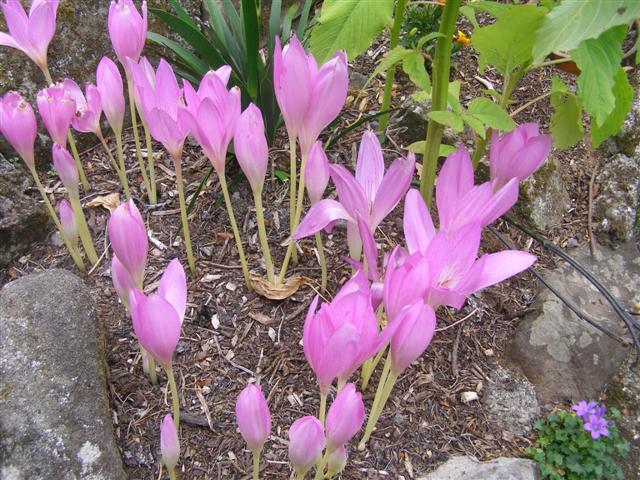
Flowering this week: Colchicum autumnale

Autumn flowering colchicum, robust growing bulbs suitable for the garden or naturalising

Now that the temperatures have dropped noticeably and I am reconciled to the thought that summer has been and gone for another year, I am prepared to welcome the sight of the colchicums in flower. These are often called the autumn crocus because their simple six petalled cup-like flowers resemble those bulbs but they are distant relatives at best. They have their very own botanical family which is colchicaceae. Their flowers are considerably larger than most crocus and they flower well before their foliage appears. Because they have very large bulbs and grow quite vigorously, they are not shy delicate little things you will lose in a garden situation. In fact they can be naturalised in grass. The flowers are more lilac than pink and are hardly long lived but you can get a succession of them from a single bulb. When the leaves appear, they are relatively large, lush and green but the downside is that the foliage hangs on for a long time into early summer by which point it no longer looks attractive at all. Autumnale is native to quite large areas of Europe.

Colchicums are the source of colchicine, a controlled pharmaceutical of considerably potency used in cancer treatments and also to cause mutations in living cells, which is sometimes advantageous but does need to be handled with care. These bulbs are also the true Naked Ladies though we more commonly refer to belladonnas as bearing this politically incorrect epithet.

Tikorangi notes: March 26, 2010

Latest posts:
1) March 26, 2010 The colchicum autumnale are at their very best this week.
2) March 26, 2010 I think it is a myth that the mixed border is easier to maintain than a proper herbaceous border – Abbie’s column.
3) March 26, 2010 Dealing to the dreaded cabbage white on brassicas and other garden tasks for this week.

The small pictures of autumn - Moraea polystachya

Autumn is the season that makes us feel just a little forlorn here. In winter (which is fairly short and certainly not cold by international standards) we are always busy preparing for spring. Spring is abundant with flowers and certainly the prettiest time here. Summer is for sitting in the shade sharing conversation and a bottle of wine while enjoying the warmth. But autumn just means it is going to get colder and wetter sooner than we would like. It is not even as if we get good autumn colour, or much autumn colour at all for that matter. New Zealand’s native flora is all evergreen so our landscapes are dominated by green foliage twelve months of the year. And good autumn colour requires sharp changes in temperature as a trigger, best complemented by forests of deciduous plants. We just drift so slowly and imperceptibly from one season to another, particularly in our mild coastal location, that few plants get the message right.

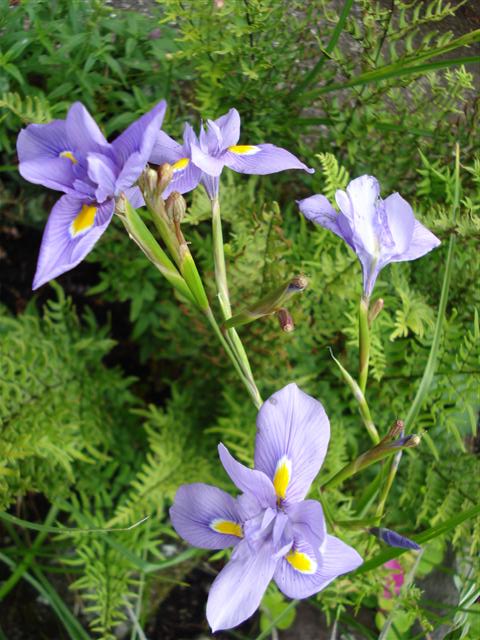
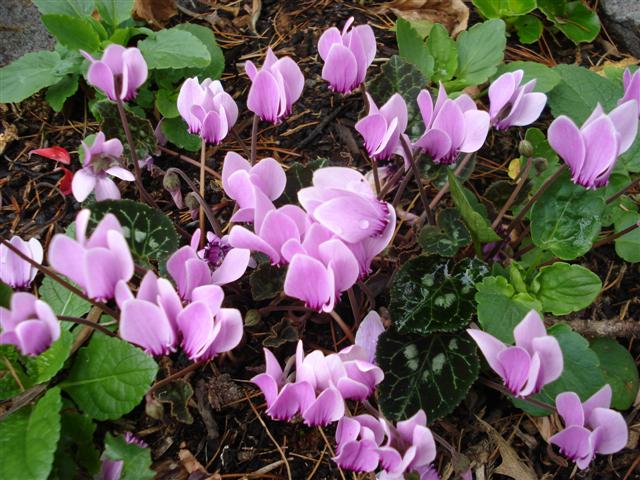
But what we do have are autumn bulbs. Cyclamen hederifolium, Moraea polystachya, the nerine sarniensis hybrids, colchicums, Haemanthus coccineus and ornamental oxalis are coming into their own and make very pretty pictures. They offer some compensation for the fading summer and remind us why, in a large garden, we treasure the very small seasonal pictures that the bulbs contribute.

The autumn cyclamen flower for a satisfyingly long time

The myth of the mixed border

A typical type of mixed border with boundary hedge behind

A typical type of mixed border with boundary hedge behind

Just at the moment I am somewhat fed up with mixed borders, or mixed beds for that matter. I am of the opinion that it is a myth that the mixed border is easier to maintain than the herbaceous border. It is easier to leave alone, but not to maintain.

The mixed border is a term coined to describe plantings which are typically a blend of small shrubs, perennials and annuals all frothing together to create a picture of flowers and foliage. It is pretty much how most people garden, certainly in freshly planted situations. The woody shrubs give year round structure often with the bonus of seasonal flowering while the clumping perennials and showy annuals fill in the spaces between and give a well furnished look, usually with the attribute of prolonged flowering. The calibre of the plant combinations speaks volumes about the skill and experience of the gardener.

This is also the face of the modern rose garden. Gone are the designated rose beds where there were only roses planted in well cultivated but bare soil with plenty of air movement – utility, lacking in aesthetics but a practical approach to growing these thorny, disease prone plants with fantastic flowers. Nowadays we generally integrate roses into mixed plantings which have a fair debt in history to the chocolate box English cottage garden. Most rose plants are not attractive in their own right so the mixed plantings mask the ugly bushes and, commonly, the diseased foliage while allowing the flowers to star.

So you plant a mixed border or bed and it looks perhaps a little new and bare in its first year, good in its second year, possibly even fantastic in its third year and then, imperceptibly, season by season, it changes over the subsequent years to the point it all becomes a little blah. The woody plants grow and start to dominate while at the lower level, it is survival of the fittest amongst the perennials. Anything rare or choice is by definition not a plant thug so will give up the fight and disappear quickly. Besides, the establishment of the woody plants is likely to have changed the micro climate and that will be compounded exponentially if you also enclosed your bed or border in a nice little hedge. Soon the well cultivated, freshly dug soil and open, airy, sunny conditions that your perennials loved has become compacted and congested with competing root masses from the woody plants, not to mention growing areas of shade.

This is the voice of experience here. I have been micro gardening the area we loosely refer to as the rose garden. By micro gardening, I mean taking apart as much as I can of the whole area and reassessing the role of every single plant. Because we also garden extensively with bulbs, there are limited times of the year when we can take apart a garden to recultivate and replant in this manner. As well as the roses, I had planted dwarf camellias for winter interest and all year round form and the site demanded a carpet of low growing perennials and annuals below. Said carpet had been looking a little moth eaten for some time – too many holes I had attempted to plug (or darn). In fact it all looked rather tired and messy. Successive applications of mulch had raised the soil levels above the surrounding edgings, compounded by the escalating invasion of masses of fine roots from an avenue of huge trees some distance away.

I am so over roses. Every time I turn around or move, I seem to get snagged on their thorns. There are times this week when I have contemplated pulling out and burning all but the standard roses. It is only the memory of their stunning November display that has given them a stay of execution. That, and the feeling that a complete garden includes at least some roses. I certainly will not be wanting to use roses extensively in any future mixed plantings.

Painful irritant though the roses are, they are not the major problem of the mixed border. It is what goes on below the ground that is the inherent structural weakness of the concept. We only view what happens above the ground but that is entirely contingent on the roots below. And the problem is that perennials and annuals are not particularly compatible with many woody plants. The latter determinedly extend their roots and prefer to be left undisturbed. In fact they can get downright touchy if you do too much poking around in their root zone. Whereas clumping plants like perennials and indeed all annuals much prefer extremely well cultivated, friable soil along frequent lifting and dividing of the former. Long term they are mutually exclusive plant families and it is the permanent roots of the woody plants which will dominate. In fact, the mixed border concept is a garden solution for the short to mid term only. In the long term, the bottom story planting of perennials goes into decline, only the tough thugs survive and it gets increasingly difficult to maintain suitable conditions even for them.

The classic herbaceous border is seen as extremely labour intensive and accordingly admired but shunned by most gardeners in this day and age when we lack legions of loyal, hardworking, devoted minions to do our bidding in the garden. Herbaceous plants are those leafy, clumping plants without woody stems and trunks and they tend to be seasonal. In fact many, such as hostas and asters, go dormant and disappear over winter. As I micro garden our mixed plantings in the rose garden area, I am thinking to myself that the digging, dividing and replanting that is the key to a good herbaceous border is not necessarily to be feared and it would be a great deal easier if there were no woody plants (and definitely no roses) in amongst them. No bulbs either. There are other places in the garden for bulbs but they don’t exist that happily in areas where you are forever plunging the spade into the soil to keep it friable and to lift plants for dividing. I have stumbled on rather too many by severing them in half.

Using hedges as a backdrop or as an edging is also problematic. At Great Dixter in the south east of England, Christopher Lloyd paid tribute to his father’s foresight in establishing a solid barrier below ground at the time when he planted the yews which are now major topiary features and hedging in that garden. It is more likely that Lloyd Senior had a man in to do it, but such long term vision stops the problem of competing roots. This sort of below ground barrier is recommended when planting invasive bamboos but I have not seen it done as a matter of course in this country with hedges. It makes sense if you garden with a long term view in mind even if it requires considerable effort in the establishment stages. You need to make sure that the barrier is far enough away to allow the hedge roots sufficient space or you will end up with poor, stunted and yellowed specimens.

If you want to reduce the amount of maintenance your garden requires to keep it looking good, turn to the shrubbery concept in preference to the mixed border and reconsider the role played by dinky little edging hedges beloved by gardeners throughout the country. What these do is give a sharp line, a definition which can also be achieved by the use of pavers, hard edges or even a low wall. None of these alternatives will cause problems with their roots, require clipping or suffer from the dreaded buxus blight.