Tag Archives: Abbie Jury

The winter solstice, Matariki and the start of a new gardening year

The winter solstice – midwinter. The time when we have the longest night of the year and the shortest period of daylight. In exact terms, this means that our daylight will be 9 hours 25 minutes and 11 seconds long today in Taranaki. Tomorrow will have two seconds more of daylight. I looked it up. Close to nine and a half hours of daylight in midwinter is still quite a lot compared to many locations but it is our shortest day.

For the northern hemisphere, the start of the new year comes within ten days of the winter solstice whereas for us, New Year comes as we enter mid-summer.

It is perhaps little considered that the calendar we all use dates back to Julius Caesar in 45BC, refined to its current form in 1582. Certain things are fixed in time including the length of the individual months and dates for equinoxes and solstices because these are derived from earth’s position in the solar system.

The arbitrary date of New Year being January 1 is not fixed by such external considerations. It is a convenient convention, that is all. The world does not come to a halt because Chinese and Indian peoples have long continued to celebrate the start of a new year at different times. So too Maori, who linked the start of a new year to Matariki – the rising in the sky of the star formation known as the Pleiades and the start of the new lunar year.

It just so happens that Matariki usually occurs within ten days of the winter solstice in New Zealand, though it is a little later this year. Here in the south, the indigenous people observed astronomical patterns and arrived at a time for new year that corresponds almost exactly with the time determined in the northern hemisphere. It is six months out of step as far as the calendar goes but synchronised with the seasons.

Apparently, Matariki was widely celebrated until the 1940s but dropped from favour until its relatively recent revival. There is now a growing focus on Matariki and there is certainly a logic underpinning it that is ours, all ours, independent from the dominant northern hemisphere cultures.
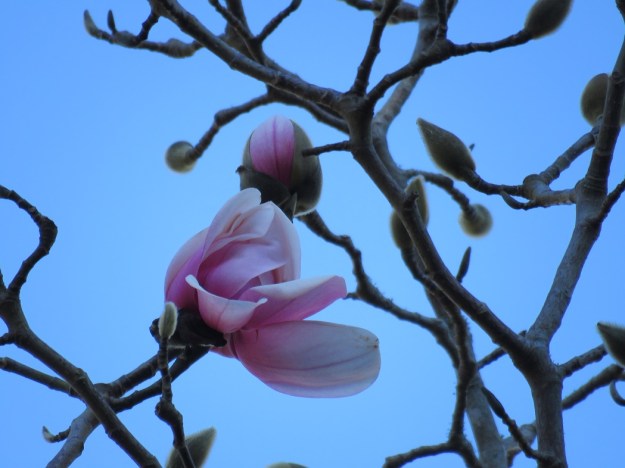
I do not expect to see the first bloom of the season on our Magnolia campbellii for another 10 to 14 days but, to coin a phrase from television cooking shows, here is one I prepared earlier. July 4 in a previous year.

This was a revelation to me because I have long declared that the opening of the Magnolia campbellii in our park signals the start of a new garden year. And the first blooms appear more or less in time with Matariki. North meets South meets the Far East because our form of pink M. campbellii originated from Darjeeling in India. In the wild, most M. campbellii are white but in Taranaki where we live, the most common colour is pink.

Magnolia campbellii is always the first magnolia of the season to open for us. Our tree was one of the first plants Mark’s father, Felix, put into the south sloping paddock behind the house in the 1950s.
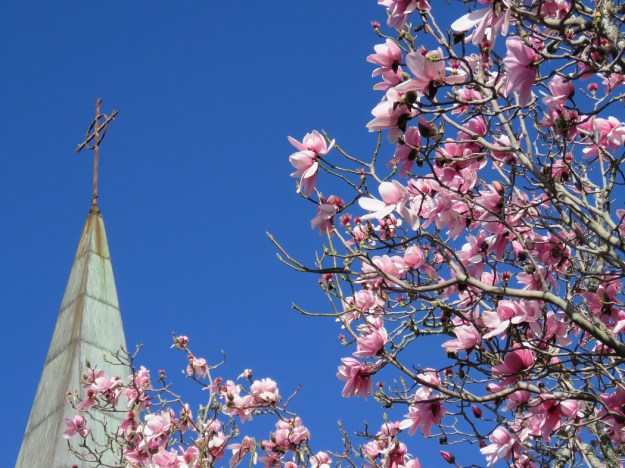
And another I prepared earlier – Magnolia campbellii at the Anglican church in our local town of Waitara, though a little later in July when it reaches full glory

The first bloom opening ten days or so after the solstice is very specific to our plant which is in the coldest part of the property. Even just two kilometres away, my friend’s plant had already opened its first bloom on June 16 and I photographed the same plant by St John’s Church in the local town of Waitara with a few blooms open on May 15. Waitara is clearly significantly warmer even though it is all of seven kilometres from us.

The winter solstice heralds the worst of winter. We drift slowly into winter and after the shortest day of the year, we get maybe four to six weeks of dreary weather through to early August, but never unrelentingly so. To see the opening of the magnolias means that, in the depths of winter, we are already seeing the palpable arrival of spring.

In terms of shaking up our world view, this map is fascinating. It shows the traditional world map that we all know in pale blue with the actual size of countries in dark blue. The difference is stark and comes down to the Mercator projection, devised in the main to assist marine navigation back in history – in 1569, in fact. Some of those northern countries are… well, quite a bit smaller than we have been led to believe.

It could, of course, equally be shown like this. It is only convention that puts the north at the top of maps and globes, nothing whatever to do with physics, geography or logic. The equator could have been chosen at the top or the South Pole and, prior to the early 1600s, they often were.

Amusingly, one of the map issues where there has been something of a change of heart in these times of pandemic is when New Zealand is left off world maps entirely. If you do a net search, this is more common than you might think and has been a source of considerable indignation. Now that we are more or less Covid-free (slightly less than more this week, but those five cases are all border-related), there is strong support on my social media for the idea of dropping NZ off ALL world maps. Many of us do not want to make it easy for people from other countries to find us at this time in history.
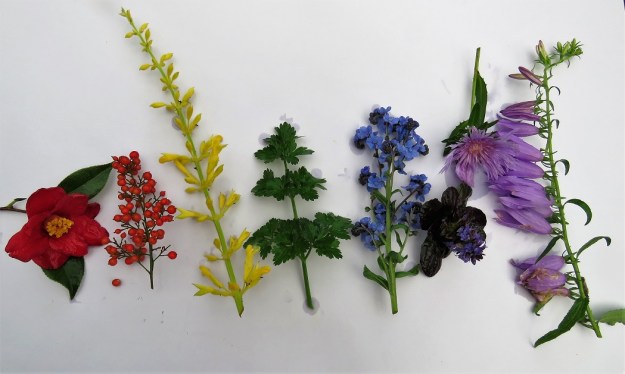
A midwinter rainbow of flowers (and a couple of colourful fruits)

Left to right: a camellia seedling beloved by a tui, Nandina domestica berries, Salvia madrensis, parsley, perennial forget me not, Ajuga reptans, stokesia and a late campanula flower spike

It was a throwaway comment from Mark that started me on my solstice rainbow. “Really, June is the month that we have the least colour in the garden,” he said as we stood looking at some bloom or other. And he is right. Come July, we have early magnolias and michelias, a whole lot of camellias, snowdrops and early narcissi are opening and there is plenty to keep our spirits high in the coldest month of winter.

We like flowers. Yes foliage and form are important in the garden. Of course they are but for us, they are the backdrop for flowers not an end in themselves. We prefer to be surrounded by colour.

I may have been listening to the Rolling Stones “She’s a Rainbow’ for a touch of nostalgia. I mention this in case you want a sound track for this post.

ROY G BIV as many of us learned in our childhood.

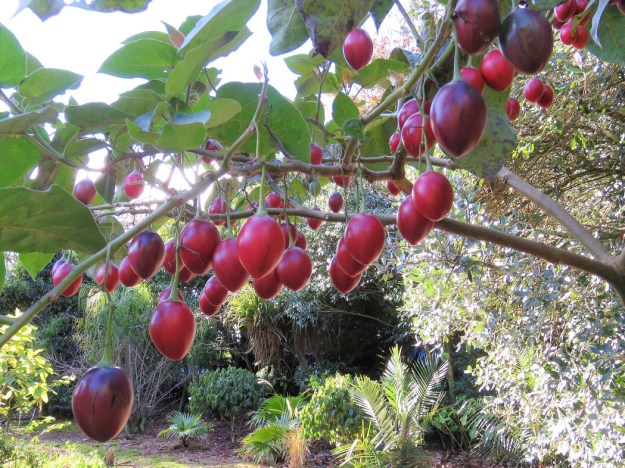
Tamarillos ripening on the bush

For red, may I give you the tamarillo plant – self-seeded but cropping very generously. It is another of those fruits from South America that we have taken over. Botanically Solanum betaceum, some of us are old enough to remember when they were still called tree tomatoes. True to form, it was a New Zealander who dreamed up the name tamarillo back in the late 1960s. I did not know until now that the wild forms are commonly yellow or purple and the red form we regard as the norm is another NZ creation dating back to the 1920s. I feel we may have hijacked this fruit in a manner similar to the kiwifruit which is actually Chinese. So now you know, too.

There were many other reds including camellias, vireya rhododendrons and the eyecatching red seedheads of both the arisaemas and clivias but I will stay the course with just the tamarillo.

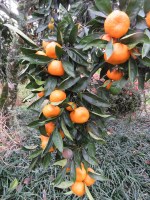
Orange – it was a close-run thing with the kniphofia (red hot pokers) and the nandina berries but for a big hit of orange, it is impossible to beat the mandarin tree. Okay, so the photo of the tui in the mandarin tree with the starburst of Cordyline australis ‘Albertii’ is an old image but it is still one I love and have so far failed to capture again since I upgraded my camera.


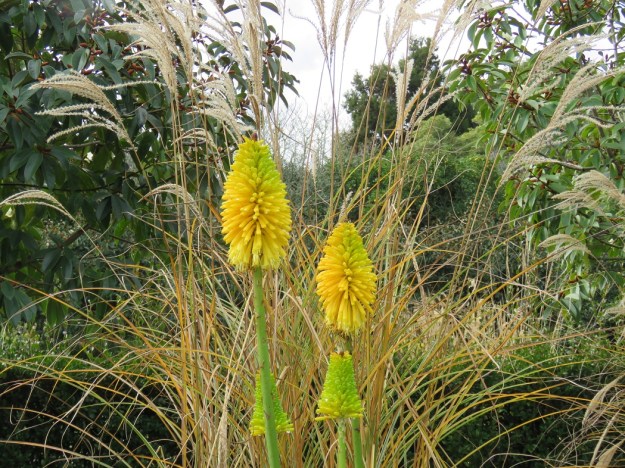
Yellow I will give to the kniphofia. This one, Mark retrieved from one of our fenced shelter belts where a neighbour had been dumping his garden rubbish so that was a find. I like the clarity of the yellow as a garden plant, maybe even more than the orange forms.
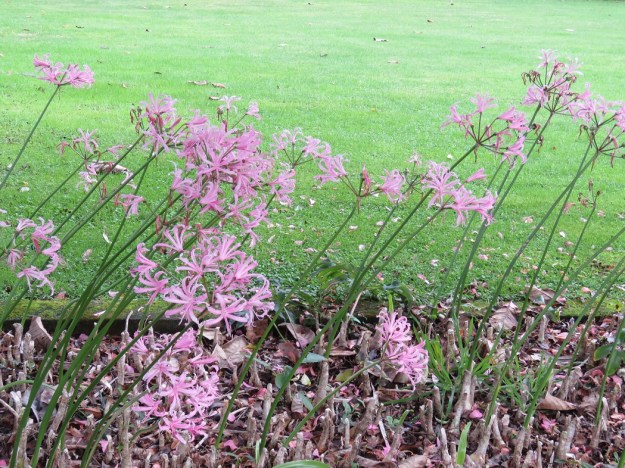
Green. Where to start? In our climate we are green all year round. Not for us the white of snowbound winters, nor the unrelenting grey of climates where the sunshine hours plummet in winter and the sun barely rises over the horizon. Nor the soft beige-golden tones of a dry climate like Canberra. We are verdant green all year round. It is why dairying is so successful in this area. You are meant to be looking at the green lawn, not the late flowering of Nerine bowdeni. Unlike colder and drier climates, lawnmowing continues all year round here, though once a fortnight suffices on the house lawns in mid winter.
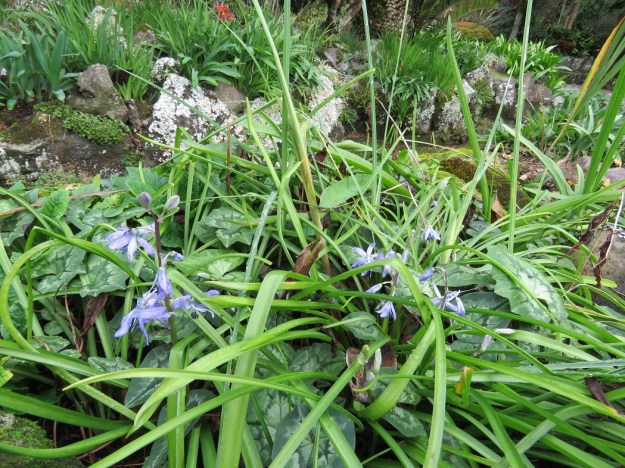
Some scilla, or squill, with a ratio of foliage to flower that is too high to make it a great garden plant

I struggled somewhat with the blue, indigo and violet end of the rainbow colours. Much as I love blues in the garden, there aren’t too many at this time of the year and it seemed a bit taunting to feature our blue-as-blue winter sky on a sunny day. Instead, one of the early scillas is already in flower. It is one of the obscure species where the foliage to flower ratio is somewhat too high. I once unravelled the different species we grow but failed to commit the details to memory. I failed even to remember where I recorded the details. I see there are anything up to 90 different scilla species and all I can say is that a fair few of them seem to be more showy than this one.

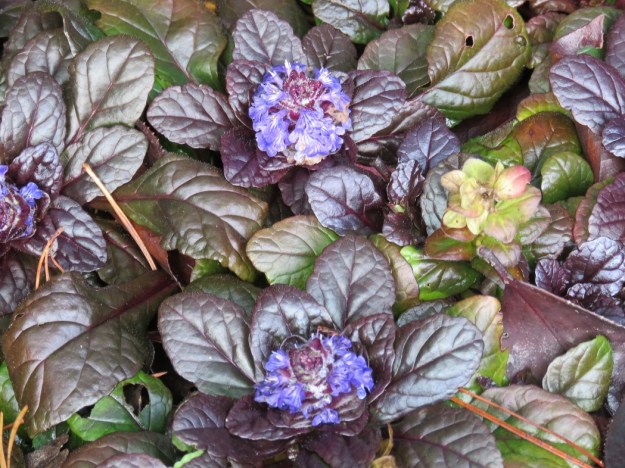
Indigo – just the ajuga which is perhaps an under-rated groundcover for woodland areas. The deep blue is a bonus with the dark burgundy foliage. What is indigo even doing as a colour of the rainbow when you think about it?
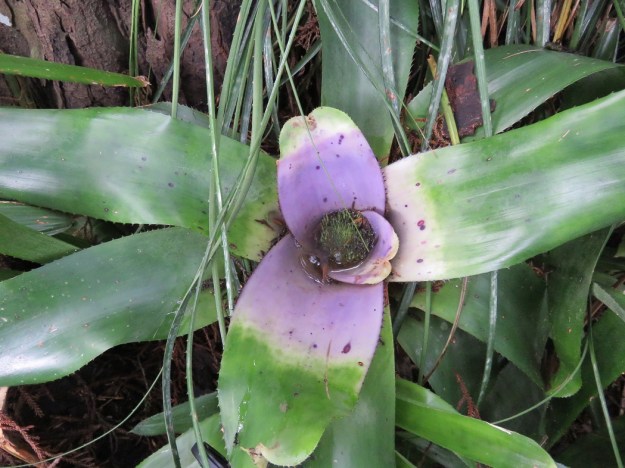
And finally to violet and while I entertained the violet hues of the stokesia that flowers all year round for us, I settled on a bromeliad with an indubitably lilac centre at this time of the season. Is it a neoreglia? Feel free to correct me. Bromeliads are not my forte.
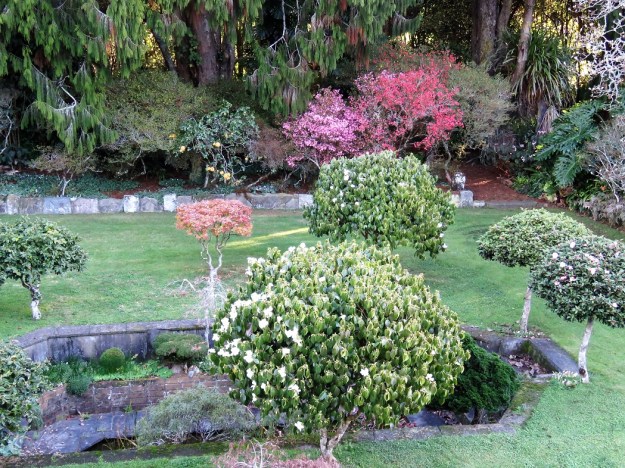
Confining myself to the rainbow hues left out all the pink and white blooms. We have a lot of pink and white in mid-winter but my foray into the pretty world of marshmallow tones will have to wait for another week. I may buy a packet of marshmallows to focus my thoughts on this very topic. I can not think that I have bought marshmallows since our children grew past the age of toasting them over a fire and that is a long time ago.

A midwinter view from an upstairs window. Azaleas, a vireya rhododendron, cyclamen and herbaceous begonia all in flower and camellias coming into bloom.

Seven days from the winter solstice – Tikorangi this week

IMG_7033

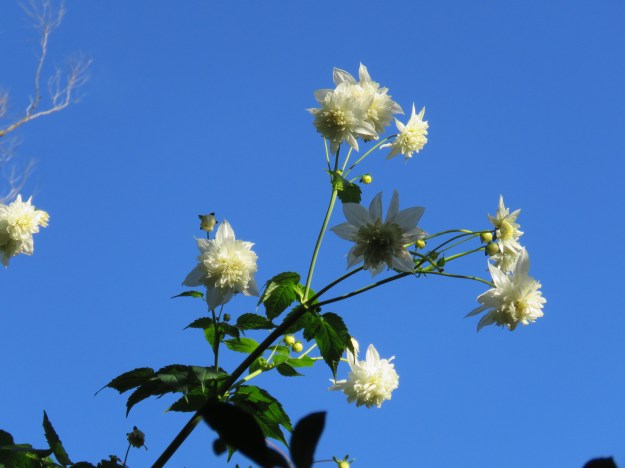
The white form of Dahlia imperialis

The last tree dahlia of the season is in bloom. Dahlia imperialis alba plena is the towering giant of them all, way up in the sky, not blooming until well into winter so particularly vulnerable to frosts and winter gales. I took this photo yesterday to show those in other climates the intensity of winter light that we get here on sunny days. It is different to those who garden where the winter sun hangs lower in the sky. We are not tropical; I don’t want to mislead. It is almost mid-winter and can be quite chilly. However, it is a lot less depressing to the spirits when you live somewhere with this clarity of bright light, even on the shortest days of the year.

IMG_7045

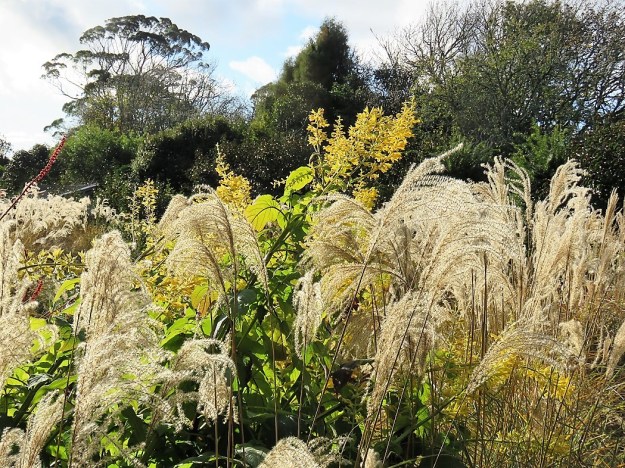
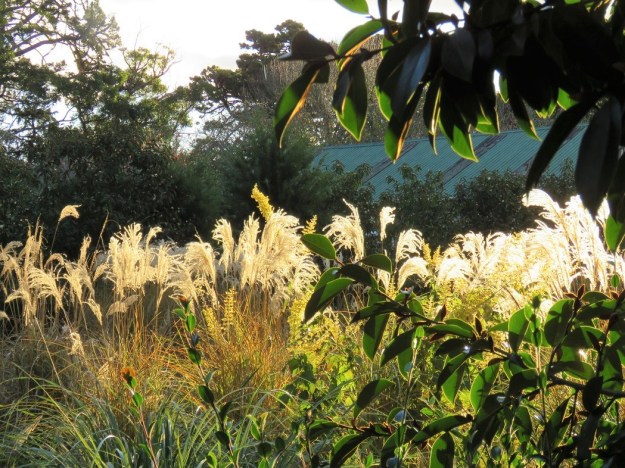
Miscanthus ‘Morning Light’ shimmering in the late afternoon light

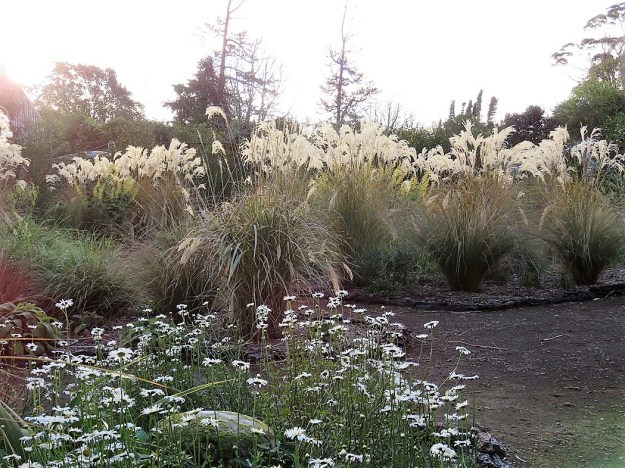
IMG_7040We are now well into what Piet Oudolf refers to as the ‘fifth season’ and the new Court Garden brings me much pleasure, especially in the late afternoon when the sun is dropping lower and shines through the miscanthus grasses. I have used a lot of miscanthus running through the garden in waves and the plumes shine in the light and wave gently in any breeze.

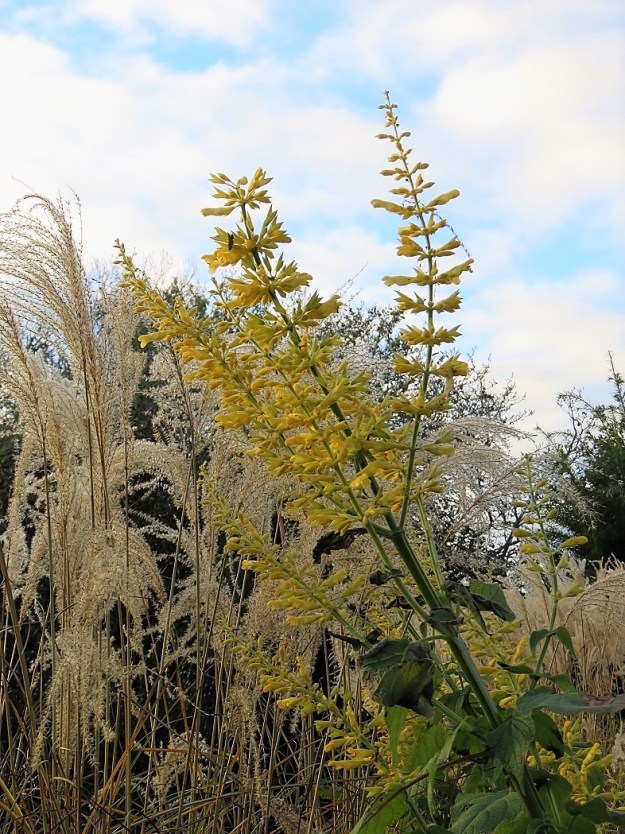
IMG_7031IMG_7039I have finally found a place where this large yellow salvia can grow with sufficient space and it is a late autumn – early winter highlight. We have never had a name on this variety so if any readers can identify it for me, I would be grateful. It stands a good two metres tall so it is a large plant to accommodate. *** Now identified as Salvia madrensis, thanks readers.
Tips and techniques for the week:

IMG_6920

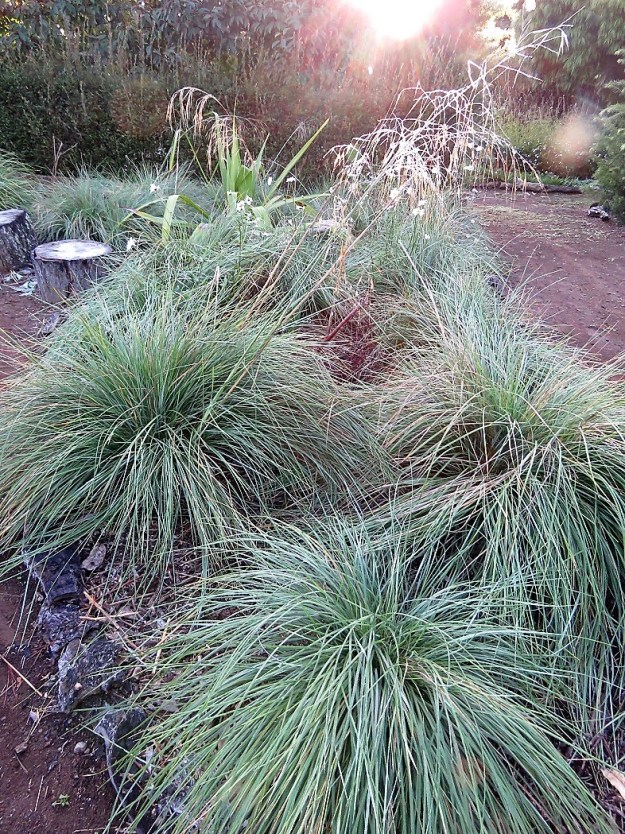
Stipa gigantea after a major thinning exercise

  • I took a before photo of this block of Stipa gigantea in the new Court Garden but I appear to have deleted it when I was filing photos. It looked fine at the end of its first year but I knew it wouldn’t stay looking fine and it was already too congested to allow the plants to fountain out and show their natural form. Last week, I took out well over half the plants and gave them away. I did have to lift some of the remaining plants to centre them to their own space but I am much happier with it now so it was worth the effort. I haven’t grown this stipa before and hadn’t realised how much space each plant needs. I am hoping this can now be left alone for a few years at least. It has a white field daisy growing between which I have learned I can get two, maybe three successive flowerings from spring to autumn if I cut it back to the base rosette at the right time.

    IMG_7050

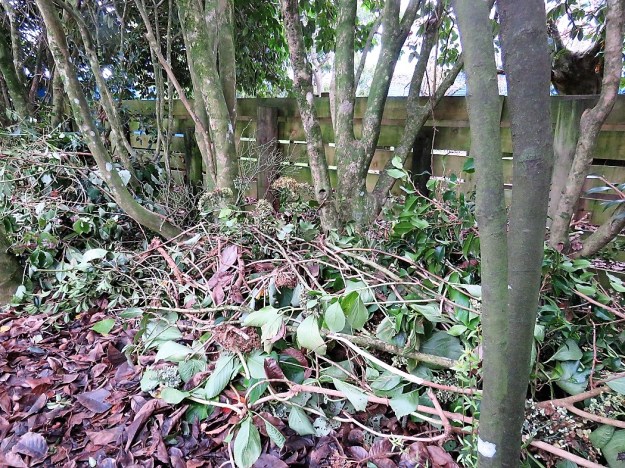
    Layering up the prunings at the back, more or less out of sight

  • Out of the ‘I thought it would be a straightforward job that would only take a day and a half at the most but actually took four full days and still isn’t quite finished’ school of thought, I spent this week clearing the wilderness of boundary plantings that separate the caterpillar garden from the boundary with the neighbours’ wool shed and yards. People with big gardens will understand that you have areas which get planted and then mostly left to their own devices. It is one of those jobs you finally tackle when preparing to open the garden to the public again. Nobody will notice I have done it, but they may well have noticed had I not. Over the years, it had become largely impenetrable with self-sown camellias, layered hydrangeas, native seedlings, especially kawakawa and various mounds of vegetation where I had emptied the wheelbarrow of prunings that I didn’t want in the compost heap. It amazes me how far I can get with a sharp pruning saw. Because there was so much of it, I dragged all the debris to the back and layered it by the boundary fence. At some points, it is quite a bit higher than in this photo. It can gently rot down there, adding humus and carbon to the soil and is a lot lighter on labour than carting it all away to compost and mulch. It is a technique we are using quite extensively now and is a tidy, unobtrusive way of dealing with excessive amounts of garden waste. That said, it is a big garden technique, rather than one for small town gardens.

    IMG_7047

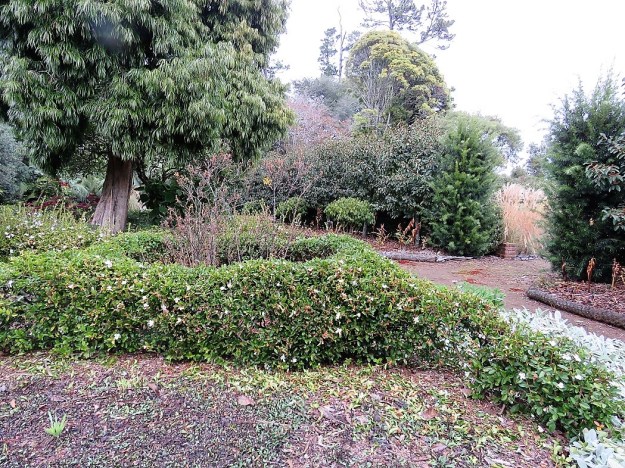
    On track to be an undulating, curvy hedge like a moving caterpillar

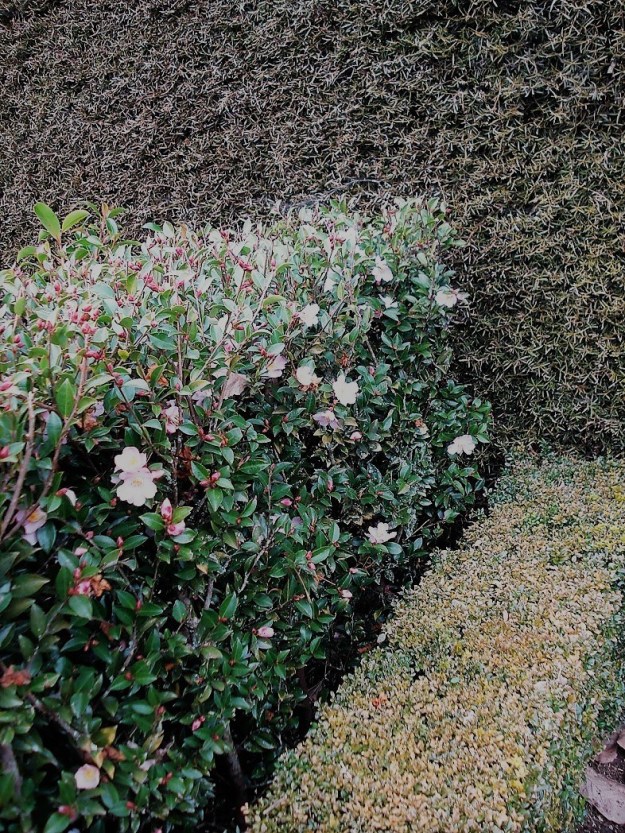
  • I have started a major clipping round on the hedges in what we call the Caterpillar Garden. The hedge is Camellia microphylla, already nearing the end of its flowering season. The plants were pretty neglected -raised from seed and cuttings many years ago and then left to kick around the old nursery until we were ready to use them. We planted them two years ago and the hedges, laid out in the shape of the basket fungus, are still a bit patchy. Mark’s plan is to clip these hedges into mounded, free-form shapes like an undulating caterpillar in the style we associate strongly with UK designer, Tom Stuart Smith. I am doing the first clip this season and have told Mark it is his job to come through and do the final clip of the top to get the mounding shapes he wants.
    OCcamellias 014

    The straight-edged, hard clipped approach

    Most of our clipped hedges here are very straight sided with the top meeting at right angles. Lloyd does them with a string line to keep the lines straight and the hedges a uniform width. He has a good eye for these things. But after spending a fair number of hours clipping and shaping the caterpillar hedge, I can tell you that it is a great deal easier and more pleasurable to work with a more organic shape and form than that military regimentation of the sharper-edged hedges. Informality is much more forgiving than formality.

Escaped root stock

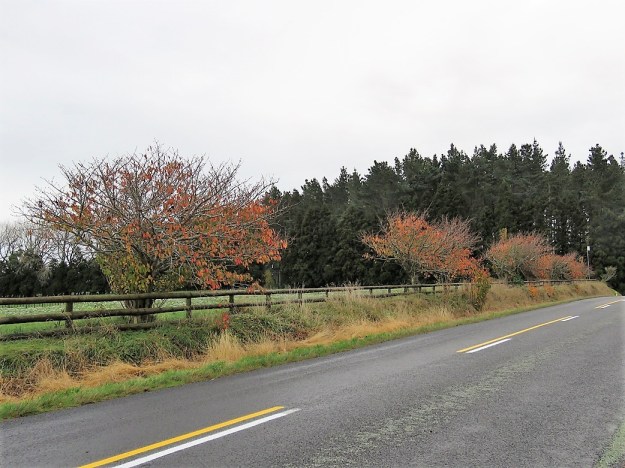
Many years ago, neighbours planted a row of flowering cherry trees on their roadside. Mark and I were discussing how long ago and he thought somewhere over 30 years, maybe even more. I recall when they first went in and they struggled for at least the first decade. There used to be quite a few more but these are the survivors.
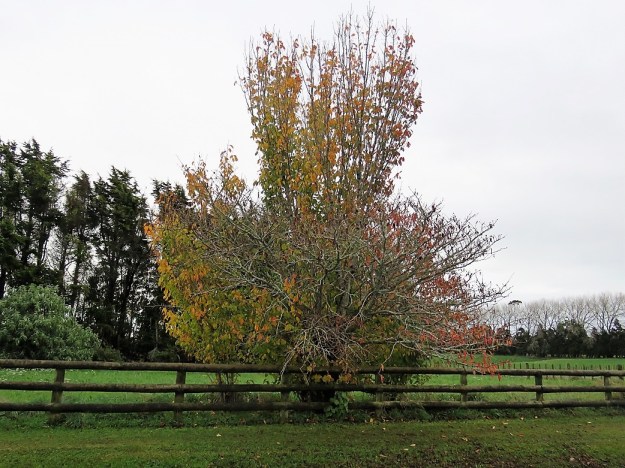
We are not good territory for prunus and these were in a particularly exposed situation – windy, in other words. They may not have been planted very well but that is just a guess. To add insult to injury, I asked Mark if he could remember seeing them flower because it suddenly occurred to me that I had no memory of them in bloom yet we drive past them every time we leave our property. He couldn’t remember either so I guess we can conclude that the flowering is not anything remarkable at all, possibly occurring at the same time as the trees leaf up for spring. I shall try and take more notice this spring. They do at least colour up in autumn.

Two different growth forms on the same plant – one upright and one spreading

We can’t identify the variety but it is clearly not well suited to our climate and conditions. However, it is a named cultivar because these are grafted plants. How do we know? Take a look at this one in the row. It has the same spreading form as all the others but in the middle is this upright shape. That is escaped root stock.

There are many reasons for budding or grafting onto the roots of another plant. Some selected varieties don’t grow well on their own roots or can’t be struck easily from cuttings. Depending on the chosen root stock, it can either increase the vigour of the plant or it can dwarf it and slow it down. Fruit trees are often put onto dwarfing stock. If material of the chosen cultivar is in short supply, budding or grafting can make it go a lot further with a higher success rate in propagation. While it takes more technical skill to bud and graft than to take cuttings and the selection of appropriate root stock is very important, it is possible to get a higher percentage through the propagation process and to reach a saleable grade faster than from cuttings. Many plants are budded or grafted, Budding, by the way, is usually easier than grafting. Once the bud or graft has taken successfully, the original growth from the root stock is removed entirely.

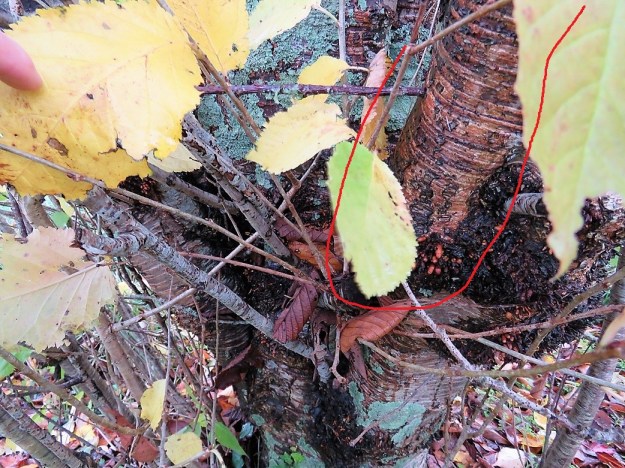
When I looked at the base of the plant, it was clear that the upright section all came from one strong shoot close to the base – outlined here in red

Problems come when the root stock puts up a shoot that is allowed to grow and that is what has happened to this tree. Occasionally we get asked why somebody’s magnolia has two different types of blooms (one that flowered both yellow and pink comes to mind). It is always escaped root stock and while it may have a certain novelty value, it does not make for a good long-term plant. The root stock – which is commonly grown from seed and only chosen for its strong growth and good root system – on most plants is stronger growing and it will overpower the chosen plant variety in time.

I think this cherry tree may be well past the time when removal of the escaped root stock is an option but, to be honest, when the cultivar isn’t worth growing anyway, this may not matter much in the greater scheme of things. But I recommend that if you ever see strong growths rocketing away from the base of a tree or shrub, it may well indicate that the plant has been budded and it is best to remove escaping root stock when it is young.

Winter in Tikorangi

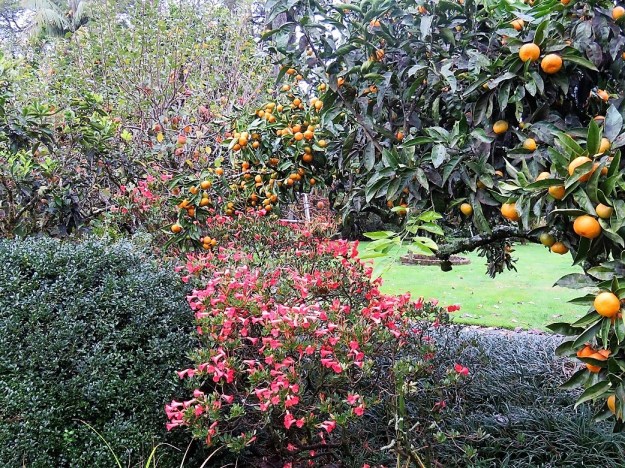
Finally, because it is indubitably winter here now, being June, I give you a Tikorangi winter. Vireya rhododendron ‘Jiminy Cricket’ in full bloom with a mandarin tree and Braeburn apple. It was this very mandarin tree that convinced me to live in Tikorangi. In my Dunedin childhood, the occasional bag of somewhat green, expensive mandarins was always seen as a treat. Tinned mandarin segments were reserved for decorating the Christmas pavlova. This tree showed riches the likes of which I had never seen before.


Paint it black – the wisteria bridge

Tanalised pine

Two weeks ago, I mentioned that Lloyd was reconstructing this bridge. Twenty five years ago, it was built from untreated macrocarpa that we just left to weather naturally. Now it is tanalised pine and I am not a fan of tanalised pine in its raw state as a construction material in the garden.

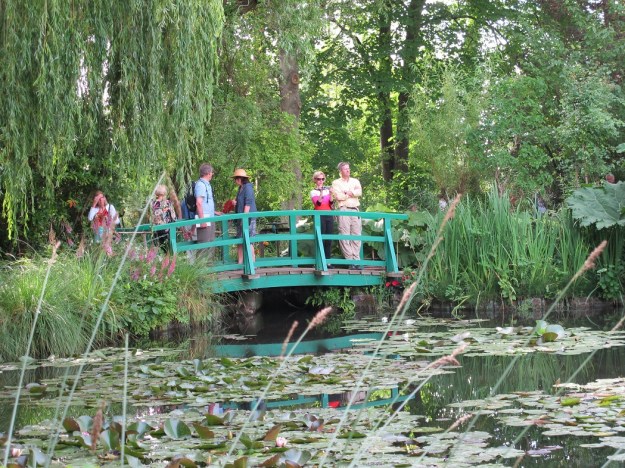
Monet’s green bridge

Monet’s bridges at Giverny are painted green. It is not a shade of green I like. In fact, I sniffily refer to it as ‘lavatory green’, on account of it being the colour that Mark’s mother thought was suited for lavatories (and kitchens) back in the 1950s and 1960s when she was choosing the colour palette for both her new house – where we live now – and the beach house they built.

Poet’s Bridge, Pukekura Park (photo credit: Wiki Commons)

Locally, there appears to be a penchant for red bridges. I attribute this in part to the decision to paint what is known as Poet’s Bridge in Pukekura Park fire-engine red. Pukekura is the much-loved public gardens in the heart of New Plymouth.

The domestic version of a red bridge in a local garden – stained, not painted, by the looks of it

There also appears to be some idea that red bridges evoke the exotic Orient – well, China and Japan at least. This red bridge is a tidy little construction I photographed in a local garden.

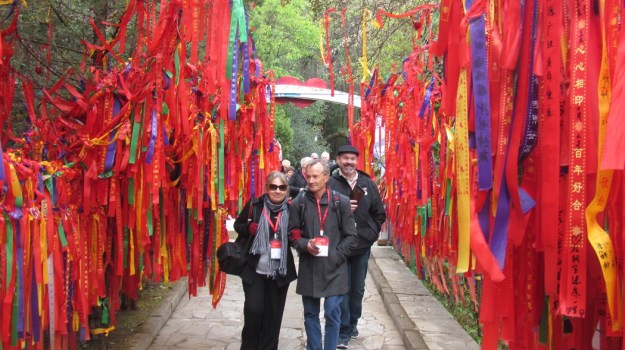
A genuine Chinese bridge, festooned

When I went through my photos from our one and only trip to China (we will probably never will get to Japan now), I had a mental image of a red bridge but I see it was Mark and me on a bridge festooned in red ribbons.

The bridge at Yu Er Park was of somewhat showier design, but not red

Other Chinese bridge photos I had were more like this.

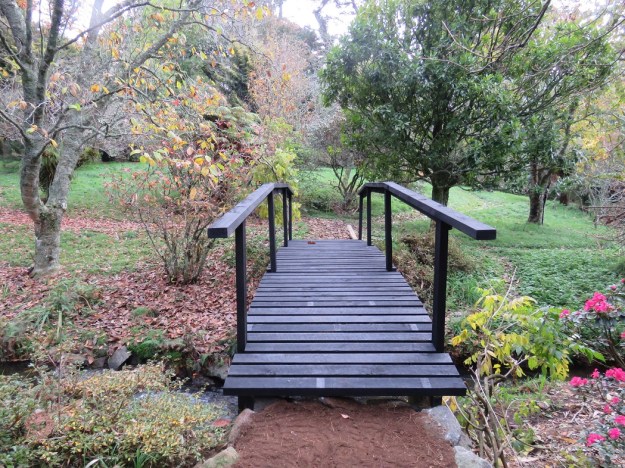
Our bridge gone black

Well, our bridge is now black. It is a bit blacker than I wanted it. Mentally I was thinking more charcoal off-black but it will fade because we have gone for stain, not paint. I am wary of painting anything in the garden because once painted, it has to be repainted as the paint peels and deteriorates. Stain can just age gracefully.

I hadn’t factored in the rather stark contrast of bird poop on the black surface but I am sure it will all find its natural balance over time. We have yet to tie the wisteria canes back in and that, too, will soften the sharp black lines. And one of the wisterias is white ‘Snow Showers’ so that will distract from the bird poop when it is flowering.

I am fine with the decision to go black and the bridge is a great deal more solid now than it was. There is no danger now of a bridge timber or railing giving way beneath the weight of an adult body.