
Verbascum creticum, a tall, large flowered biennial
We have spent a fair amount of time and energy examining meadow gardens and wildflower gardening over the years. It is not something we want to embark on lightly. With our growing conditions, the potential for unleashing a weedy mess is high. But crunch time is coming. What to do with the central court in our new garden? We do not want an actual tennis court. Nor do we want more lawn. We want something naturalistic, ecologically sound, relatively low maintenance and preferably wildly romantic.
Last year, I was still thinking of meadow-style and saved seeds of various large biennials and annuals that we could possibly use – Verbascum creticum, white foxgloves, nigella, even the red poppy. It takes A LOT of seed to sow an area as large as this and it was going to be expensive if we had to buy small packets to make up the chosen mix.
Flagged that plan. I may try it further out in the garden but in a smaller area. In the future. Maybe. This central court is too prominent and too large to experiment with random ‘wildflowers’ (not wild in NZ of course). It HAS to work rather than be experimental and to work in the longer term without creating a maintenance headache.
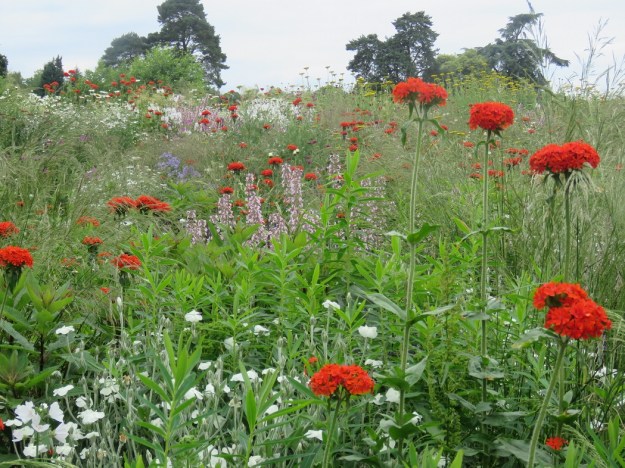
Dunnett at Trentham
While I would love to try the perennial meadow style pioneered by Nigel Dunnett and the Sheffield Movement (Pictorial Meadows) that so entranced us at Trentham last year, I also know our limits. That work is the result of years of experimentation, learning and analysis by the protagonists and the plant selections are what works in the UK. We would be starting from scratch to find what works well and how to manage it in our very different climate and growing conditions. It may also look rather flat and contrived in a tightly contained garden rather than linking to the wider landscape with natural landform.
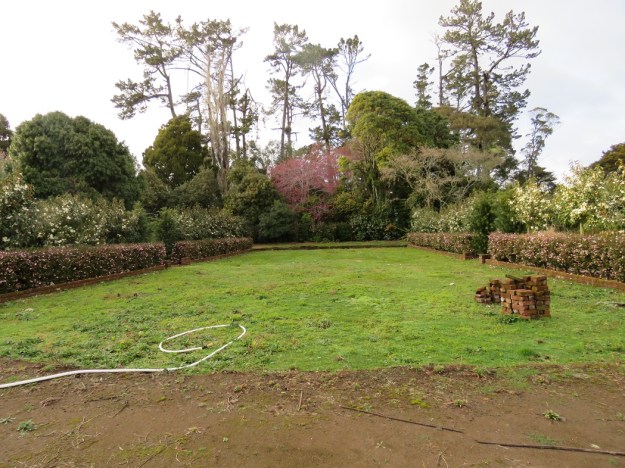
A blank canvas of about 450 square metres
This court area is about 15 metres wide and at least 30 metres long. It is a rectangular, formal shape bounded by a low brick retaining wall (still under construction) and the long sides defined by formal plantings of Fairy Magnolia White (to be pleached in due course and clipped hedges of Camellia Fairy Blush. The steps still await construction, as do the large pergolas Mark really (really, really) wants at each end. It is flanked on one side by the new grass garden and on the other by the equally new lily border and the caterpillar garden, all of which I have written about in the last year.
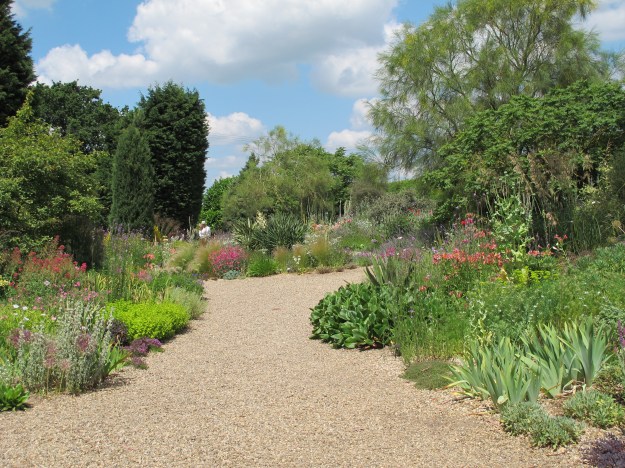
Each plant in its own space in Beth Chatto’s dry garden
The solution lay in what I have referred to as the grass garden. It isn’t really the grass garden that I envisaged at the start. It isn’t even the summer garden we initially called it, though it looks good in summer. It also looks good in spring, different but equally pleasing in autumn and has enough interest to carry it through winter. Basically, it is more an example twin herbaceous borders in a modern style, showing influences from a number of contemporary designers with some debt to Beth Chatto’s dry garden. I add Chatto, because we eventually worked out that one of the aspects that makes her dry garden so charming is that each plant stands in its own space, not jostling for room and melding into its neighbours as in classic herbaceous plantings where one aim is to have no ground space visible. It is that individual space that not only gives a very different feel – lighter, more spacious, when done with skill – but also makes maintenance far easier.
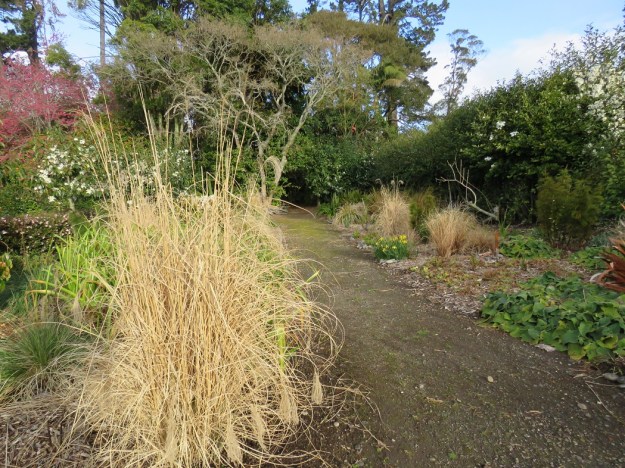
Miscanthus in winter in the new borders
There is a school of thought that digging and dividing perennial plants is an unnecessary activity, devised by those who like to make work. And that may be true in some climates and some styles of gardening – an extension of the no-dig garden philosophy, even. One thing I have learned from experience is that if you dig and divide often, it is not a big task to be feared. It is digging over-large plants in hard, compacted soils that is difficult and heavy work. I had to get Lloyd (who does the heavy work here) to dig out the enormous Miscanthus ‘Morning Light’ clump that I then cut up with an old hand saw to get about a dozen sizeable pieces. I wasn’t sure how they would respond to such rough treatment but they thrived and looked good all year. They are still standing, erect and pale and have not been beaten down or fallen apart in heavy rain and wind, as well-established clumps often do.
This week, I plan to dig and divide all the clumps of large grasses that I planted at this time last year. I shall report further if it turns out to be harder than I expect it to be, but the ground is still well cultivated and friable and I am not anticipating a killer task. I have promised some divisions to a colleague but there will be A LOT of miscanthus, Stipa gigantea and Calamgrostris ‘Karl Foerster’, along with our native Anemanthele lessoniana, toetoe (now an austroderia but formerly known as a cortaderia) and a large but graceful brown tussock that we have yet to find the name of. And there is the solution for the new court garden.
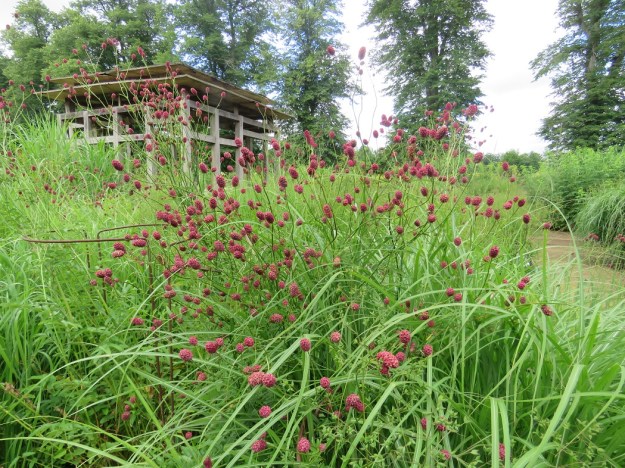
An immersive experience at Bury Court
It is to be the new grass garden, drawing on lessons learned from both Piet Oudolf and Christopher Bradley-Hole. In that large, geometric area, confined by a hard-edged boundary, I envisage an immersive experience – wandering informal paths through plantings that are shoulder high (at least when in flower), predominantly grasses. Waves of grasses (the Oudolf influence) in a limited selection. With just a few tall Verbascum creticum and foxgloves in white and pale apricot (we have both a-plenty) and maybe Ammi majus and some white daisy type plant which I have yet to find. But the big grasses will be the feature. So more ‘New Perennials’, or modern prairie on steroids than meadow.
It will take a year or two to build up enough plants to fill the area. But now that I have a plan, I am impatient to get started. The first task will be to clear the area of grass and weeds and then rotary hoe it. It will happen. It just won’t be instant.
Postscript: I have zero intention of lifting these grasses in the court garden every year. They will be planted and left, with maybe a cut around the outside from time to time to reduce the spread.

Ammi majus

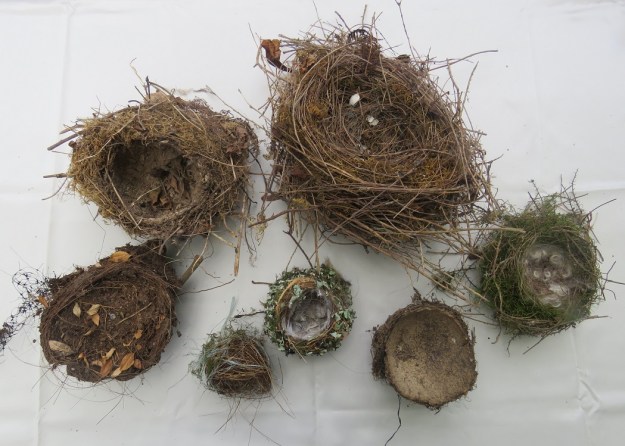
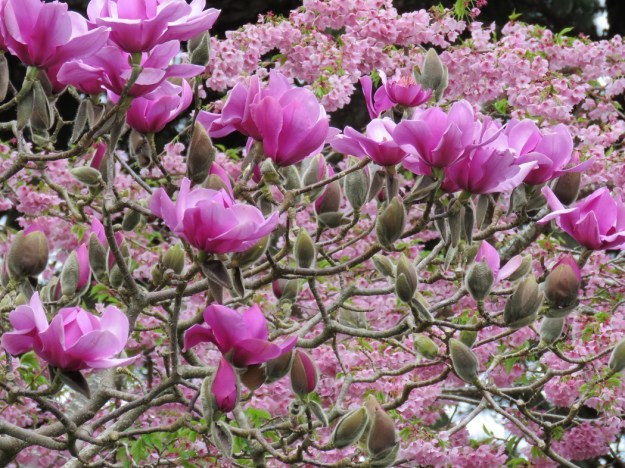 Herewith your annual reminder of three seasonal matters.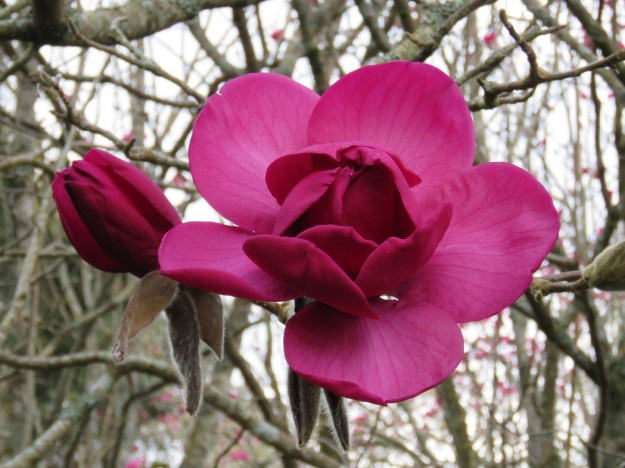
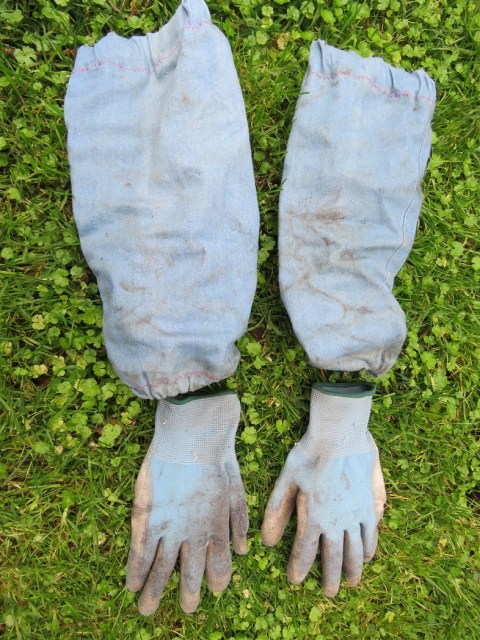 Puttees. But for lower arms. We have large swathes of bromeliads that need an occasional clean out of accumulated debris and dead foliage. Many bromeliads have finely prickled edges that can rip arms to shreds and will find the small gap between glove and long sleeves. These are my DIY solution and are equally useful for reaching into many prickly or scratchy plants.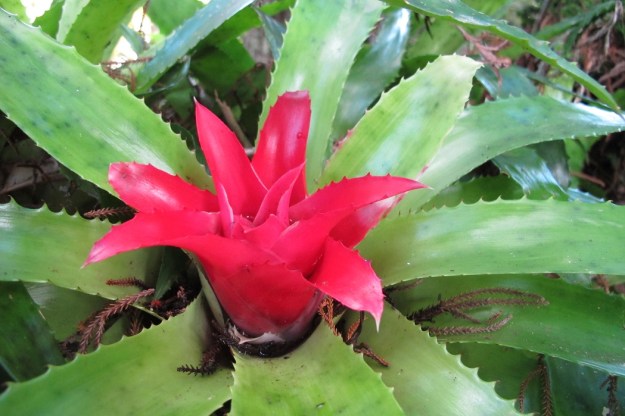
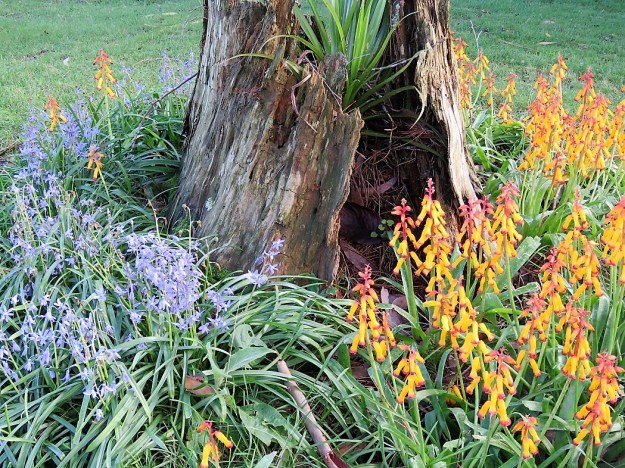
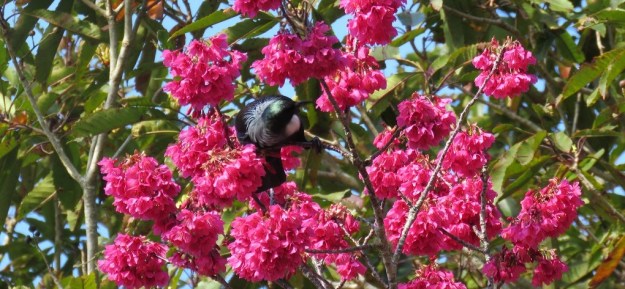
 Finally, an animal story. When we first adopted poor, unloved Spikey dog in 2009, we worried that he felt the cold badly. His coat was very thin – at least compared to the Shetland sheep dog we also had at the time – and he had not one ounce of body fat. Daughter made him a coat of many colours. I put it on him one chilly morn and Mark laughed at the ridiculous sight. Spike then hurtled down the avenue gardens after a rabbit and reappeared without his coat. Suggestions ranged from him being too embarrassed to be seen in the coat to Mark’s idea that he had regifted it to a needy rabbit family. Years passed and we never found the Joseph coat – until this week. It is a little brittle after 8 or 9 years in the open but a triumph to the resilience of yarn blends. One minute – that is how much wear that coat had.
 In the meantime, he had been gifted a genuine Harrods coat and I had bought him a little number that made him look like the canine version of Julian Clary. But we always knew that as a bogan, freewheeling dog, he would have preferred a black vinyl number with chrome studs. These days he is over 14, stone deaf with a heart condition and possibly some level of dementia so he has passed the winter days sleeping in his bed by the fire. Yesterday, with spring in the air, he came out of hibernation and could even have been described as frolicking as he accompanied us around the garden with visiting friends. There may be life in the old dog yet, if he doesn’t get taken out by a heart attack.

 You can see how much colder it is by the daughter’s Crassula ovata (commonly called the jade plant or money tree). She forgot to cover it and hopes it will survive. We never have to worry about that sort of thing and
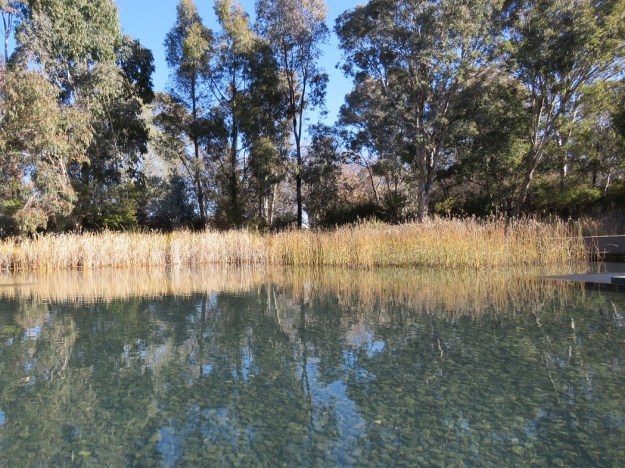 In my mind, I see Canberra as being dominated by muted golden colours. This is largely on account of it being such a dry climate. This is the entry to a major sculptural installation at the National Art Gallery. I never tire going to experience American artist, James Turrell’s Skyspace ‘Within without’ each time I visit and thought I had shared it before but it must have been just on the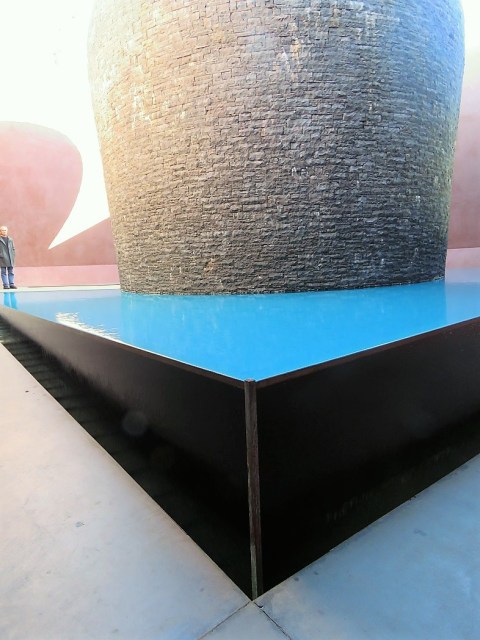
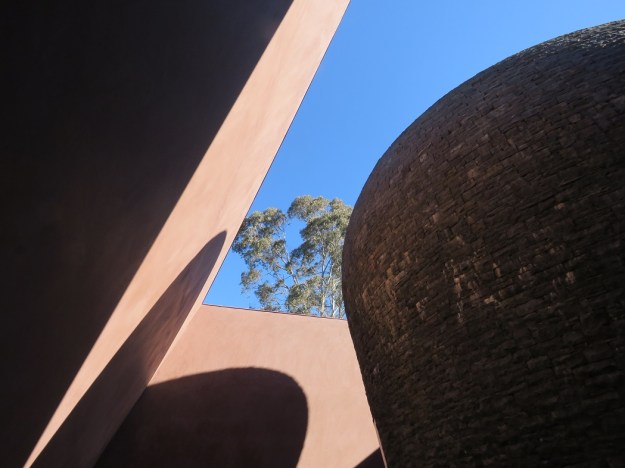
 This is the entry lane to Skyspace and probably as close as you will get to a group shot of the family on this public site. It is minus me as photographer and minus the only representative of the next generation whose second birthday we had gathered to celebrate.
 Public architecture and landscape in Australia is on a more lavish scale than we tend to have in New Zealand – a sign of a larger and wealthier economy. The parliamentary precinct houses many other facilities as well and goes well beyond utility provision of services to enable federal government to operate. I hadn’t see this particular water feature before.
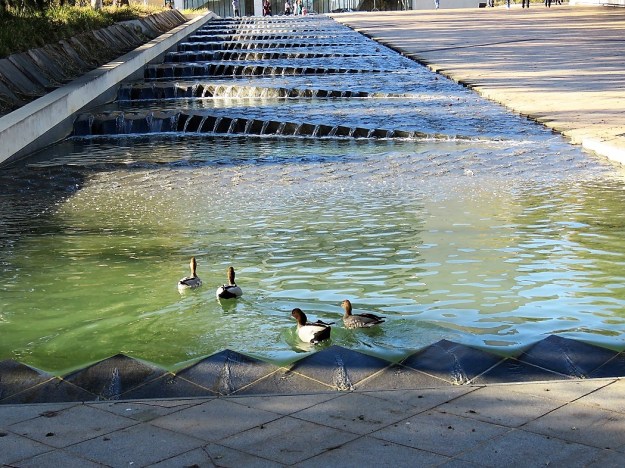 This is the wider context – a staircase waterfall, designed to be safe for the public while capturing light, movement and gentle sound in what is an arid environment.
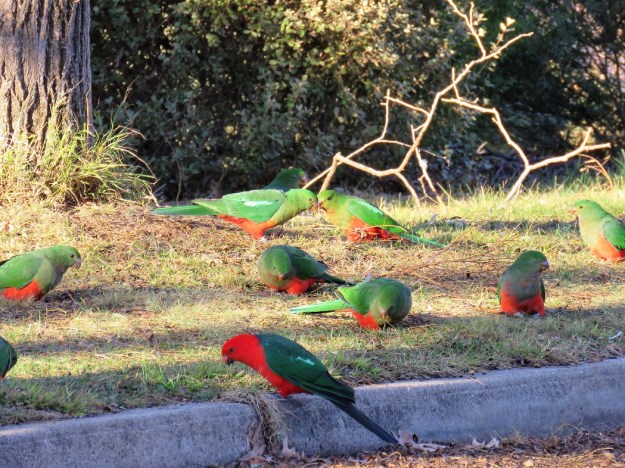 What Canberra may lack in terms of plant appeal in mid winter, it makes up for with its birds. Flocks of birds, in this case a convention of king parrots on the road side in our daughter’s quiet street. Daughter tells us that the red head on the front bird is a sign that it is the only mature male amongst the 20 or 30 juveniles in that group. New Zealand birds are generally restrained in colour whereas Australia has many birds that are bold, brash and colourful.
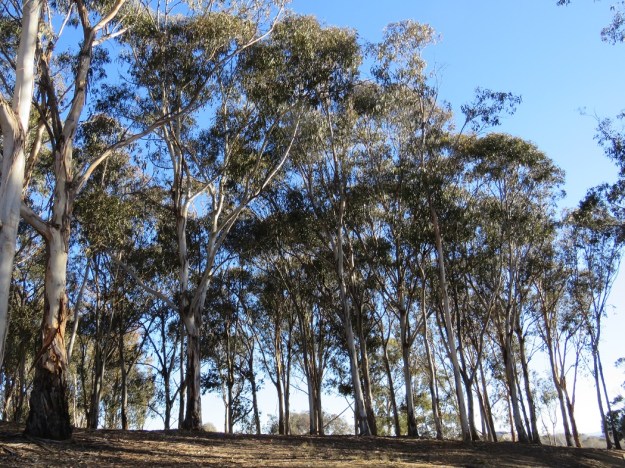
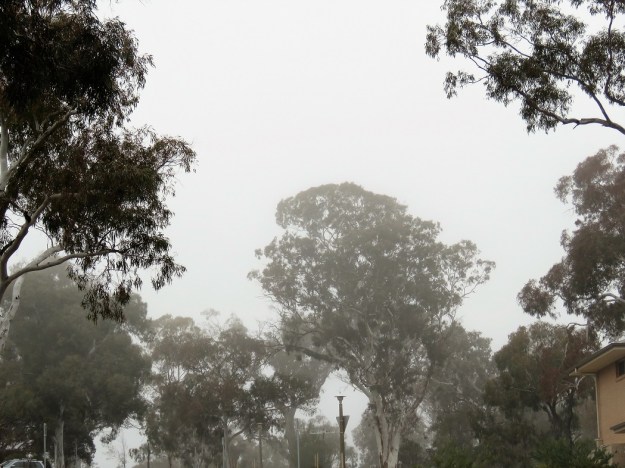 We rarely see the muted, mystical light of a winter morn in Canberra. This may be because we have far more wind – a disturbed westerly air pattern, as Mark refers to it. This is just a suburban street scene – eucalypts, eucalypts and more gum trees. But no koalas on these ones. There are more than 700 different eucalyptus species, most of which are native to Australia. I once offered to buy the daughter a book on them so she could start to learn the different ones but she did not take up my offer.
