I came over to my office first thing this morning, prepared to put in a solid hour or two on a tax return which has a deadline of Wednesday. GST, which is our sales tax. It is my six monthly ordeal by boredom. But the early light was so appealing that I grabbed my camera and was diverted to way more interesting thoughts.

Echinacea, eryngium and miscanthus in the new grass garden
I only started planting the new grass garden maybe ten months ago but over summer it has filled in and it is looking remarkably well established. Not ready for the grand photos of the whole scene yet but it is coming together and bringing me great delight. Reassuringly, given the amount of effort that is going into it, I am now confident it will work.
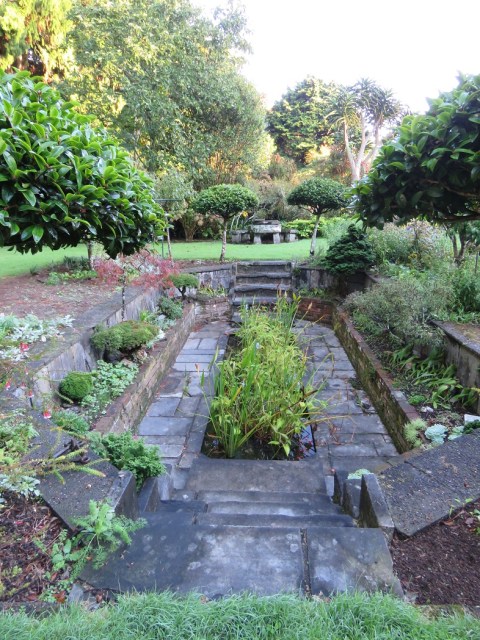
The central sunken garden is to remain
The decision to strip out the central borders of the rose garden was more recent. It was Tony Murrell, friend, Auckland-based designer and garden media personality, who suggested last October that I strip out these beds and I have now reached the point where I am fairly confident he was right. The central sunken garden will remain as the landscape feature and I have fully renovated it. We have lost more treasures than we have kept in this highly detailed area but the pleione orchids have thrived, to the point where I thought I should rename it the pleione garden. Mark’s father dug this area by hand back in the early 1950s and lined it in granite and marble.
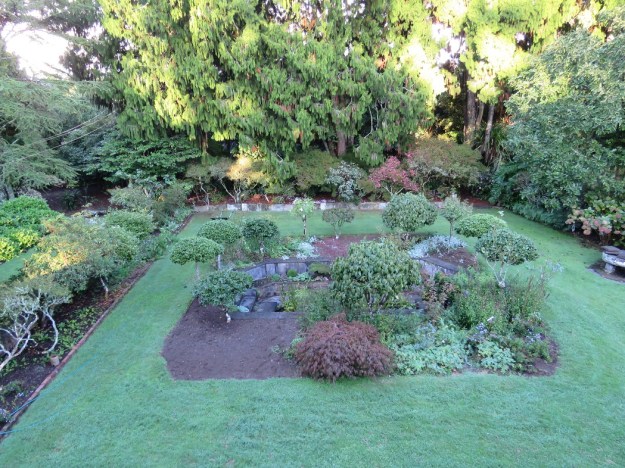
The outer concrete edging in the centre is to go and the area will be grassed around the remaining shrubs
The feature dwarf camellias, of which there are eight, and two dwarf maples, are to stay. They give some botanical interest, form and character but the outer edging in concrete will be lifted and removed and the area grassed. It should be a crisper look to an area that I have never enjoyed gardening. I knew I had to do something because I averted my eyes from it for the better part of last year and possibly much of the year before. I have never enjoyed working in this area.
I now realise if there is no pleasure in gardening a certain area, then something is wrong with either the concept or the execution. It is not for want of trying. This central area has had at least three major makeovers done on it in the last twenty years and none of them have really worked. This fourth one is the most radical. Gut most of it out and make it simpler and visually stronger.
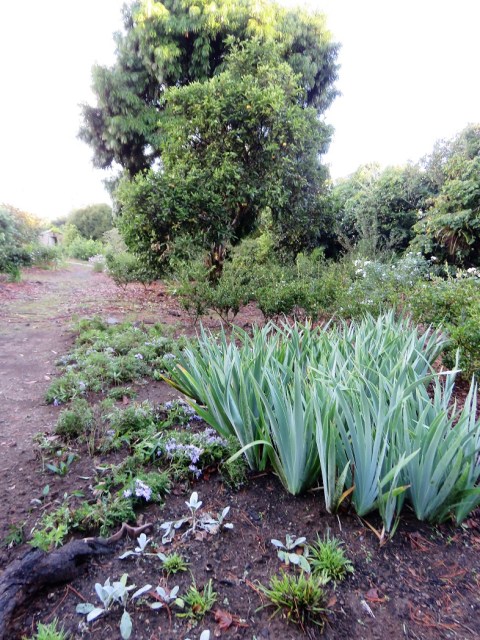
We describe the new caterpillar garden as a blank slate but we are still working around a beautiful Podocarpus henkelli and a grapefruit tree. We never get totally blank slates here.
Gutting a garden is a major task unless you are willing to scrap all the plants, which is not our way at all. No. I must lift and relocate most of them and that is a detailed job. A few went to the grass garden – irises, liriope and eryngiums, mostly. Most are going to another new garden which we loosely refer to as the caterpillar garden. This is because Mark has laid out the structure in dainty little Camellia microphylla (just coming into flower now) in the form of the basket fungus, so based on pentagons. After it has flowered for this season – and it has a very short flowering season – he plans to start clipping it into the shape of an undulating caterpillar. For this idea, we acknowledge leading UK designer, Tom Stuart-Smith.

Camellia microphylla for the caterpillar hedging. And colouring in some spaces with blue asters
The design gives separate compartments for planting, somewhat like in-fill housing. We want it simple, eyecatching and easy(ish) to maintain. Mark’s vision is of the central enclosures rising up above the caterpillar shapes in blues and whites and the outside blocks in shades of blue, lavender, lilac, white and a bit of pink but not too much. If you are trying to envisage the scene, the caterpillar garden alone is about 25 metres long and 8 metres at its widest with 5 central enclosures and about 15 outer spaces to be coloured in. It is not for the faint-hearted gardener and we could never afford to do it if we had to buy the plants in. But the gutting of the old rose garden area has supplied many which I have lifted, divided and replanted into compost in the freshly dug new garden area. These are larger block plantings in a far more modern style than we have in the older areas of the garden.
The challenge is to integrate a more modern area into the existing garden so the transition is seamless, rather than disjointed or jarring. It helps that this is a sunny, flat, open area that is by its very physical attributes different to the rest of the garden.

Morning light shining behind the first grape leaf to colour for autumn
We are not into instant gardening. These things take time and we will not be doing the big reveal for another year or two yet. But it is keeping me busy because I am doing most of the planting. I am leaving Mark to worry about the structural elements that still have to go into this area and the small matter of moving the propagation houses somewhere else entirely. It should happen. It just won’t happen in the next few weeks or even months.
I was born impatient but time, experience and age have taught me patience and how to take a longer term view. Mark describes this new garden development as ‘our last lunge’. We want to get it right before we settle down into our dotage. There is no great rush and there is much delight and satisfaction in the process. And really, for us, gardening is an ongoing process, not an end product.

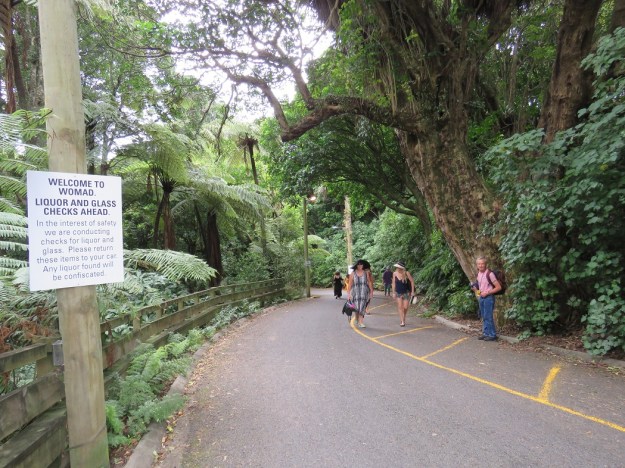 The entrances alone set the scene. That is Mark in the coral pink tee shirt, standing by George’s tree. I wrote a
 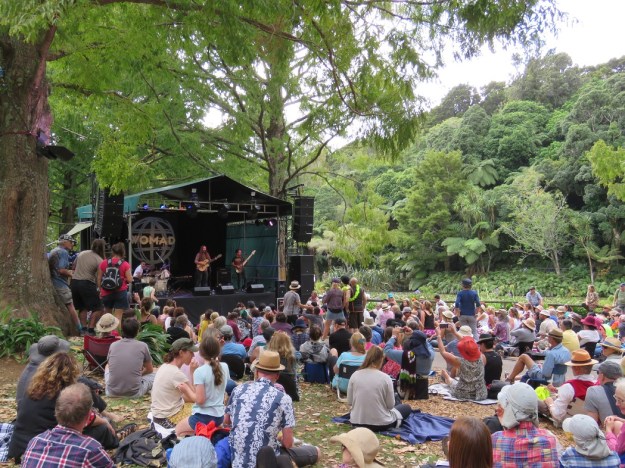 The entire WOMAD festival takes place within the embrace of trees. I particularly like the small Dell Stage for its intimacy and charm.
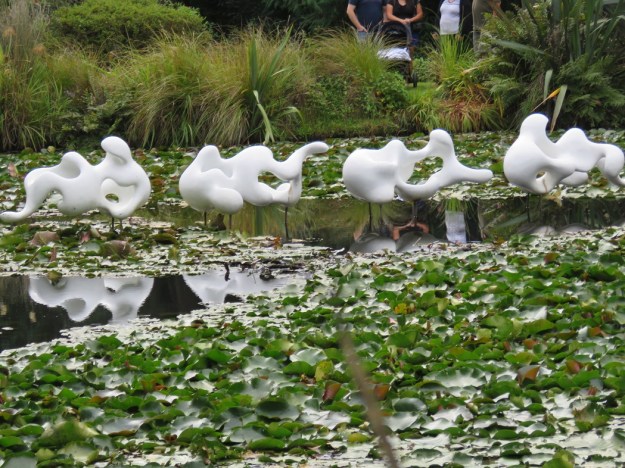 Adjacent to The Dell is this lily pond. It is a good exercise in knowing your water lilies. Some lilies S P R E A D to take up all the water, which rather defeats the reflective qualities. If you plan on growing a few water lilies at home, my advice is not to plant these overly strong triffids but to seek out smaller growing, named varieties which may be less inclined to stage a takeover bid. There are easier maintenance tasks than thinning water lilies.
 One of the other aspects of our WOMAD that really impresses me is the zero waste priority. Unlike most events that attract thousands of people, WOMAD is simply remarkable for its total absence of rubbish on the ground and the use of compostable or reusable serving dishes and drinking vessels. It is proof that with a good set-up and plenty of good management, litter and plastic waste can be eliminated.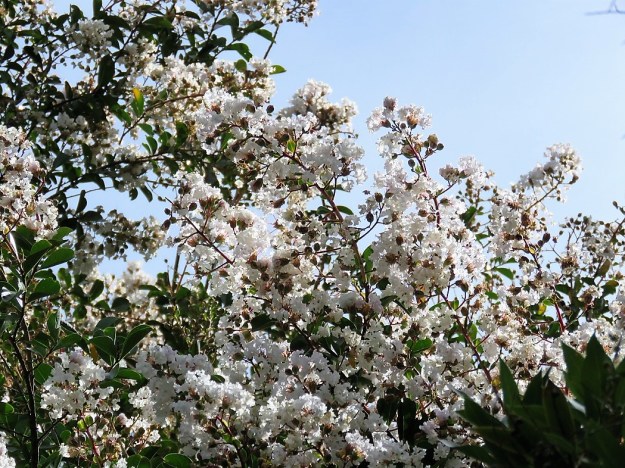
 “Daisy, Daisy, give me your answer do
 In sorting out my haberdashery – in other words, reorganising my sewing desk – I came across this delight, the Daisy Disc. I can’t recall having noticed this before so it must date back to my very late mother-in-law whose sewing desk I inherited. I see it has the price of 30c on it, so I can date it to post July 10, 1967 when New Zealand swapped to decimal currency. It was the instruction folder that delighted me, with its pictures of projects and the following bold statement:
 The instructions are something else. Step one was fine – wind the wool 2 or 3 times around opposite spokes in turn. But then we come to the second step:
 I looked at the suggested projects for our daisy motifs and I was struggling to find a clear winner. Would it be the wildly impractical baby blanket, the adorned evening shoe or the daisy earrings? But then I spotted the fez-style hat. Ladies and gents, that must be the clear winner.
 I went looking for daisies in the garden to illustrate this post but came up rather short. I did not go far enough, I tell you. I should have done some googling first. Their family of Asteraceae is huge. Not just the obvious asters which are so pretty in flower at this time of early autumn, but also cosmos, tagetes (marigolds), sunflowers, echinacea, rudbeckia, even dahlias. I was sad that one of our largest and showiest daisy plants, the spectacular


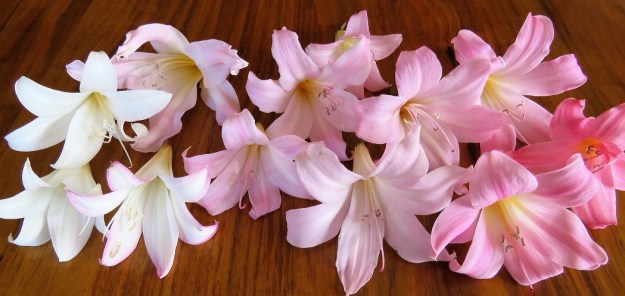
 The deepest coloured forms – cerise almost getting to red – tend to be later flowering and are the only ones that we have ever had picked by passersby. But that was years ago. These days our road verges are so steep that there is nowhere safe to stop and nowhere to walk so the flowers are safe. It is an ill wind, I guess, though we would prefer more hospitable road verges and slower traffic.
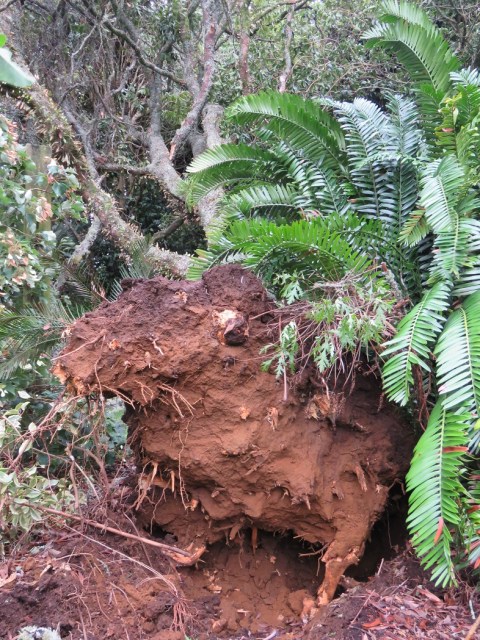
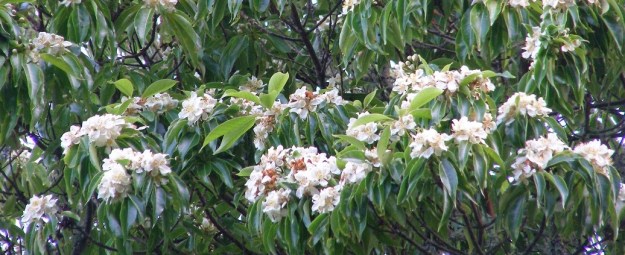
 Alas poor schima, we knew you well. In early spring you would drop all your leaves in one big whoosh (and there were A LOT of leaves because you were a large tree) and startle us for a few weeks with remarkable lime green fresh growth. You were a way finder for garden visitors. We could point you out – “see the lime green tree – you will find the sunken garden in front of that”. In early summer you covered yourself with small white blooms but no more. True, we had noticed that you were not looking too healthy on one side but now you are gone. Awkwardly – getting you down is a challenge because you are resting against other standing trees but our gratitude that you fell the way you did is great. Had you fallen the other way, you would have brought down the power lines to our house and that would have been A Major Repair.