Tag Archives: Abbie Jury

The legacy of Magnolia ‘Lanarth’ and modest Magnolia liliiflora ‘Nigra’

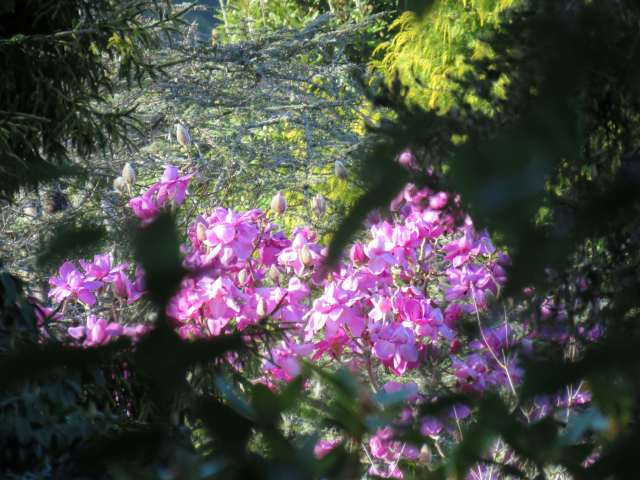
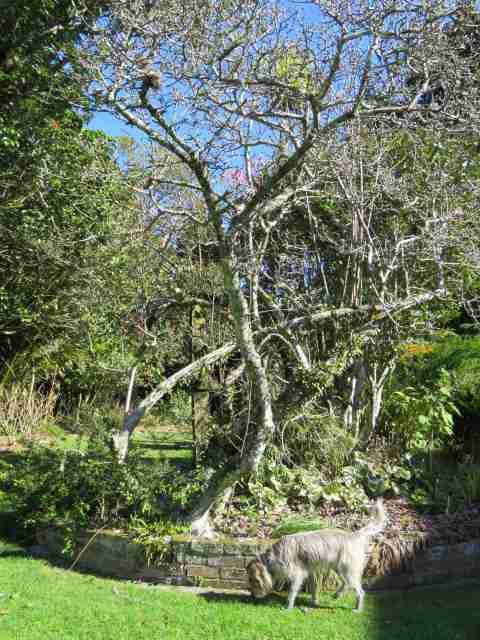
Not the best photo but I can assure you it was the best sight on its day – looking through trees to ‘Lanarth’ in the distance

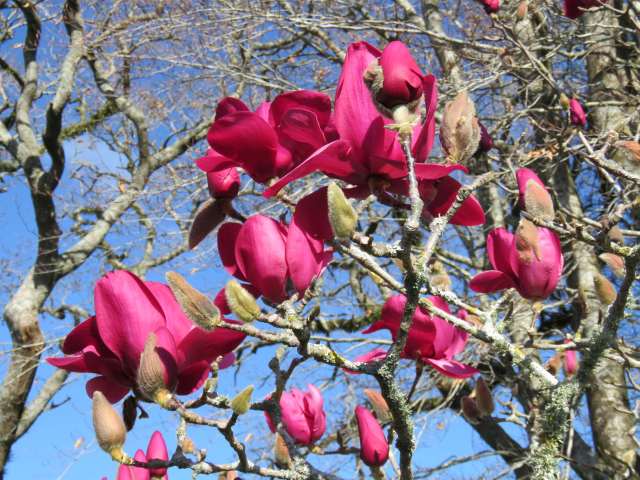
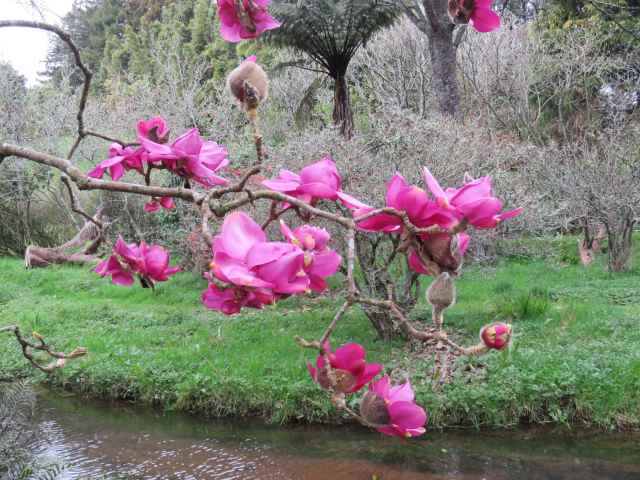
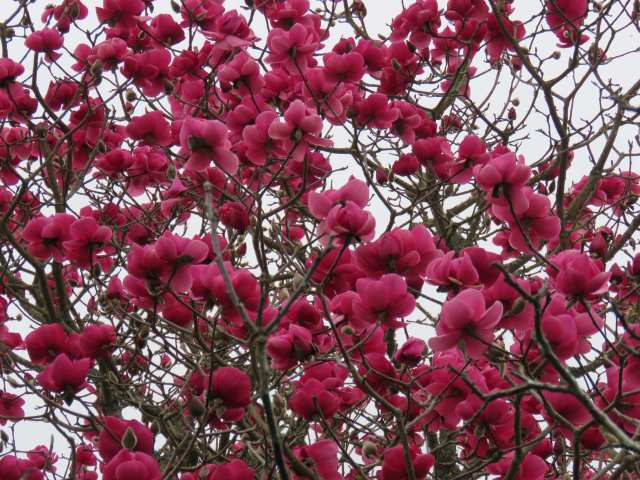
As I paused to admire the glorious purple of Magnolia ‘Lanarth’ through the trees, the thought occurred to me that the vast majority of the red magnolias raised and released around the world since the mid 1980s have descended from this particular tree down by the stream in our park. Some are several generations down the line but they trace their genes back to our tree.

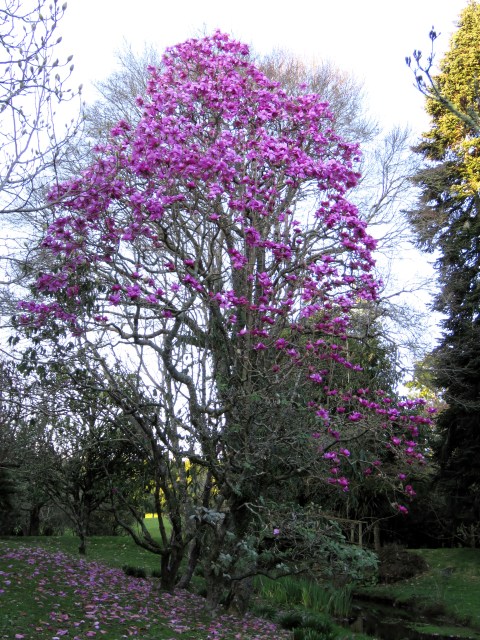
Our plant of Magnolia campbelllii var mollicomata ‘Lanarth’

Botanically, our Magnolia ‘Lanarth’ is the form distributed by leading UK nursery, Hilliers, back in the 1960s, Magnolia campbellii var. mollicomata ‘Lanarth’. Felix Jury imported it at considerable expense and thank goodness he did.

Magnolia liliiflora Nigra – red but otherwise unremarkable
and the shrubby tree of M liliiflora Nigra at about 60 years of age. It flowers later in the season so we think must have been the mother of the red hybrids, not the pollen donor.

To be fair, it wasn’t just ‘Lanarth’ that launched the platform for new generations of red magnolias. The plant of Magnolia liliiflora ‘Nigra’ in the garden border behind our house was the other parent, almost certainly the seed-setter. In the heady world of magnolias, liliiflora is not a showstopper. Our plant is more sturdy shrub than tree, the blooms are not large, typical liliiflora form which is not showy and the flower colour has none of the rich glow that magnolias can have. But it is red both inside and outside on the petals. Mark tells me we are reputed to have a particularly good form of liliiflora ‘Nigra’ in this country in terms of its solid red bloom without the inner petal being white.

Breeders and enthusiasts around the world had been trying to create good red magnolias before, like the optimistically named ‘Chyverton Red’,  ‘Pickard’s Ruby’ and ‘Pickard’s Garnet’. We have one example here but I only have one tiny photo of it and I have just found out that the name we have on it is wrong. I will have to take more notice of it when it flowers this year and try and work out what it is, only out of curiosity because it is not remarkable.  

Felix looked at his plant of ‘Lanarth’ and wondered if he could get a good-sized, red campbellii-type flower. He had already done his other breeding to reach ‘Iolanthe’, ‘Milky Way’, ‘Athene’ and the other four Felix Jury cultivars. And so he created ‘Vulcan’, a breakthrough in its day. ‘Lanarth’ contributed the flower size and form, solid colour inside and out but also the translucence, tree form and scent. M. liliiflora ‘Nigra’ contributed solid colour, smaller tree stature and, importantly, red.

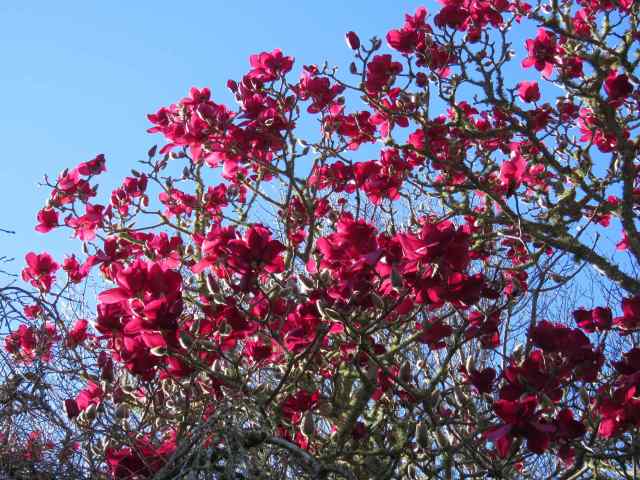
Magnolia ‘Vulcan’ this morning

We first released ‘Vulcan’ in 1989, in that wonderfully under-stated way of that era. I don’t think we sent any plant material overseas at the time but bits of it soon winged their way around the world and the rest, as they say, is history. ‘Vulcan’ is not without its flaws. It flowers too early for frosty areas (as does ‘Lanarth’); it only achieves its density and purity of colour in warmer climates and even then tends to fade out to murky purple as the season progresses. But for its time, it was a breakthrough. It was the only plant we ever released that we could track its flowering from north to south of the country by the telephone calls we received. Even today, 35 years on, it is a showstopper at its best. I had two young tradeswomen painters in a couple of weeks ago and one of them asked me about the ‘black magnolia’ as she spotted the first buds opening, declaring she had never seen anything like it before.

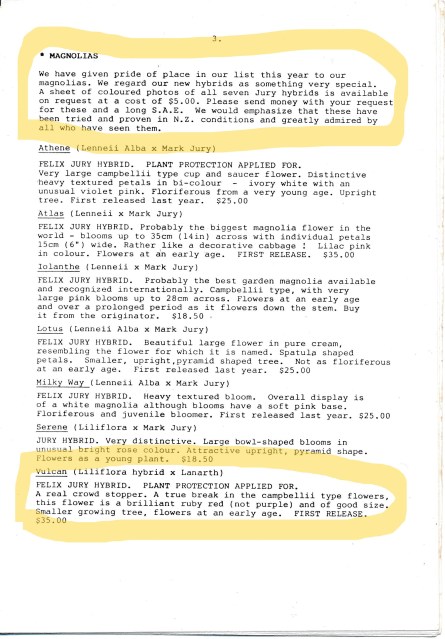
Our mailorder catalogue from 1989

Felix didn’t go any further with breeding magnolias after ‘Vulcan’ but encouraged Mark in turn. And it was Mark who created the next generation which included ‘Black Tulip’ and ‘Felix Jury’.  Other NZ breeders followed suit – notably Vance Hooper and Ian Baldick.

It seems that ‘Black Tulip’ and Felix Jury’ have become two of the more significant breeder parents around the world. I see many, many red seedlings on international magnolia pages and they are clearly descended from those early red hybrids here.

Magnolia ‘Vulcan’

Felix named one red magnolia, Mark has named and released three but there is a fourth in the pipeline. We are hoping it will be ready for release internationally next year or maybe 2026. We describe it as a ‘Vulcan’ upgrade. It flowers a little later and has an exceptionally long blooming season and is a different hue of red, without a tendency to the purple undertones inherited from ‘Lanarth’. Solid colour and cup and saucer form which is our preference – it stands out here as good and we have high hopes for it across a range of climates. I won’t share photos until we have a release date.

Magnolia campbelli var mollicomata ‘Lanarth’

The new selection also traces its origin to the lovely ‘Lanarth’ in our park. That ‘Lanarth’ originated from a seed collection by plant hunter, George Forrest, in 1924 in southeastern China, near the Burmese border. Only three seed germinated back in the UK and this one was the best, named for the garden where it was raised in Cornwall. Those are quite long odds for what turned out to be such a significant plant.

While we may only have named and released four red magnolias from the Garden of Jury, with one more to come, we have many, many magnolias on the property that come from the same breeding lines. This lovely one that won’t be selected for release is another seedling from the batch that gave both ‘Black Tulip’ and ‘Felix Jury’.

Ideas and observations – part two of two.

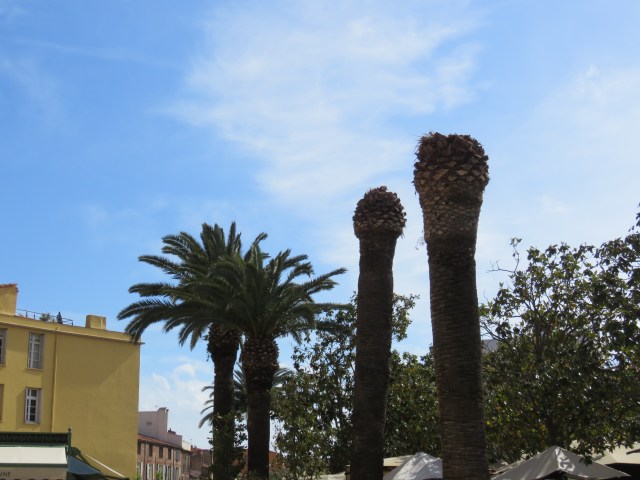
Palm trees are iconic in the south of France. There are only two native palm trees but imports are now the backbone of the landscape. Alas, the red palm beetle (Rhynchophorus ferrugineus) is likely to change that. It only arrived in France in 2006 but is so rampant that it is cutting a swathe through the trees and killing them. Many have been removed.

Dead palms in Perpignan which is across the other side of France but I saw plenty in the Riviera, too.

Apparently, it is possible to spray for it but as soon as the spraying stops, it returns and spraying tall palm trees must require a cherry picker and some heavy-duty insecticides. A horticulturist told me that the only hope for the future is finding selections that are resistant to the palm beetle. We may rail against our border controls here and in Australia but oh my goodness, this is another destructive pest that we don’t want hitching a ride here. What will the Côte d’Azur be like without its palm trees if the beetle is left unchecked?

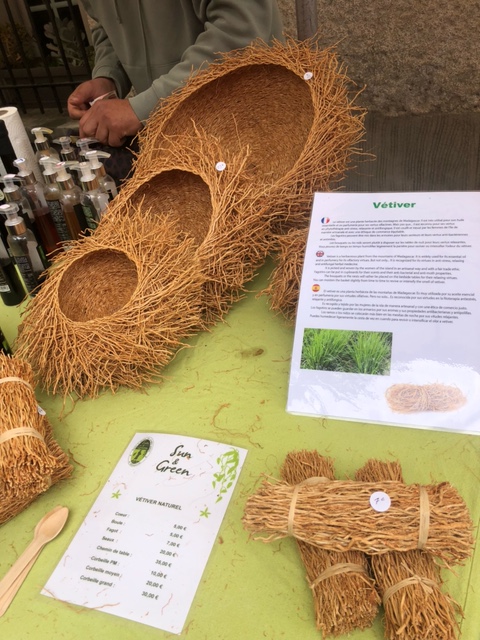
Vetiver grass products

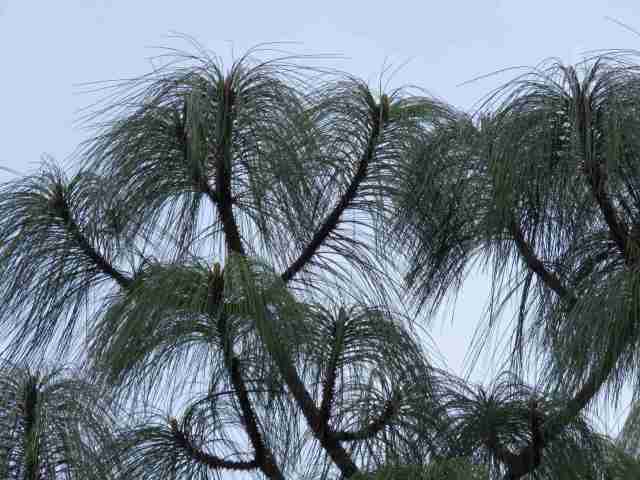
I have only ever seen vetiver grass used in this country once and I admit I was surprised our biosecurity even let it in, given that it can put its roots down to four metres deep in the first year alone. It seems that its abundant production of leaf blades can be turned to good use and there is not much danger of running out of raw material. I saw these on a market stall at the cherry festival in Céret, near the French border with Spain. They were very charming but comparatively expensive. You don’t have to have vetiver grass to make something similar. It occurred to me that, were I still of the craft-y persuasion, some of our native grasses with leaves that have some substance – Chionochloa rubra and Carex buchananii come to mind – would likely work just as well. I had a friend who was keen to try weaving with pine needles and I sent her some of the exceptionally long needles that fall from our Pinus montezumae. But she never sent a photo of the finished product so it may not have been as successful as she hoped.

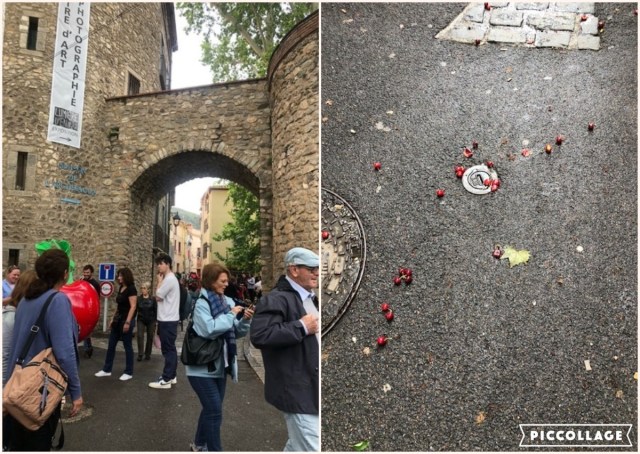
The cherries may not have been up to much but how charming is the little town of Céret?

Sadly, I have to report that the cherries at the cherry festival were a disappointment. After an unusually wet spring, they were watery, splitting and lacking sweetness, bearing no resemblance to the fleshy Black Dawson cherries I pay an arm and a leg for in season here, but there were plenty of them and the French do street festivals very well. They do love a brass band – or four or five of them on street corners in this case.

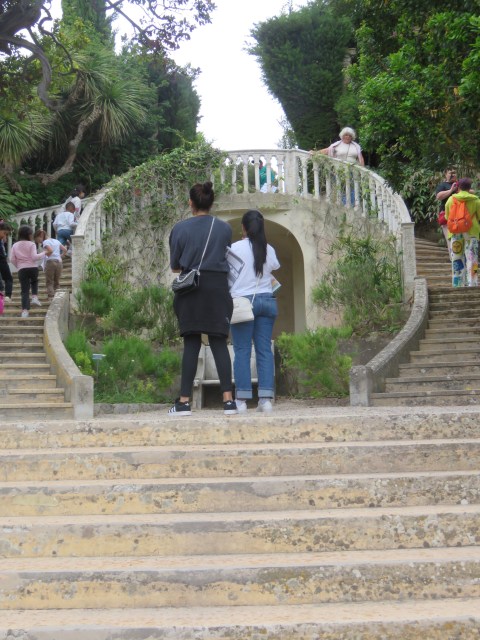
The graceful design of split steps
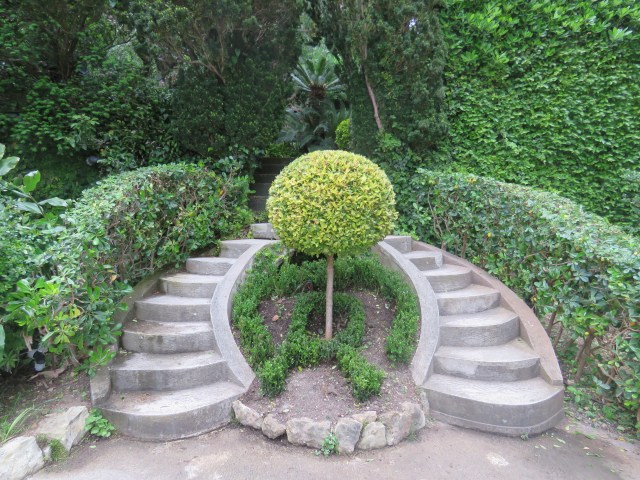
And a smaller version, also from the Ephrussi de Rotshschild garden
We could have done more with these casual steps, had we thought of it at the time.

In the Ephrussi de Rothschild garden, the Baroness who created it clearly liked split steps. There were at least three, maybe more. If you do a net search for split stairs, also known as bifurcated stairs, you will see many examples in internal situations, mostly from USA and in modern, opulent homes. I have seen them used externally on grand old villas in Italy and always thought them particularly graceful. Executed in stone – or even concrete – they are a feature in themselves which would not be appropriate in our more informal garden. It is the form I like and there is no reason why they could not be constructed in a more naturalistic style. I am rather regretting that we never even considered something more ambitious for steps in our garden. You need gradient but also space and I am pondering where we might adapt some steps to try an informal version.

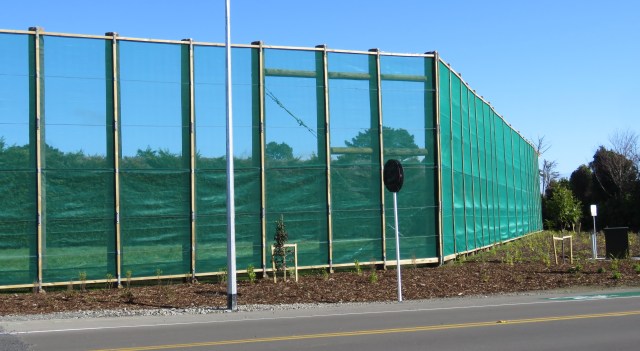
Synthetic screening in Nice
Presumably a cheap and nasty domestic version, already threadbare and dropping synthetic fibres onto the ground below.

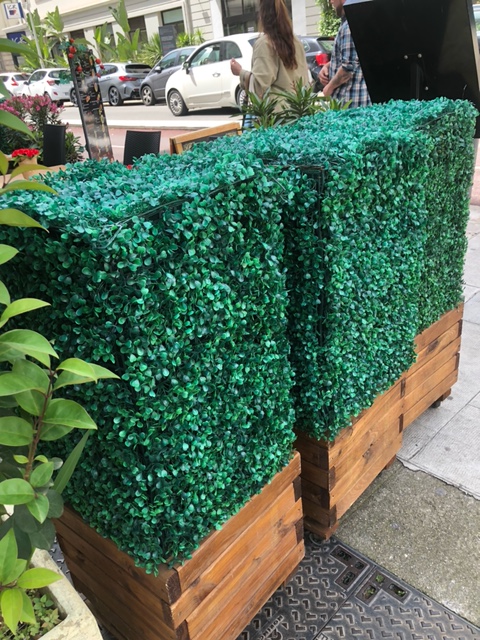
The French do many things well but these ghastly synthetic fences and screens are not one of them. No, no. Just no. They are really awful, both visually and environmentally. People lacking all aesthetic sense seem to think that the blue tones of synthetic green will ‘tone with the environment’, on account of being green. I see the same thinking down at the new roundabout finally completed where our country road joins the state highway. I get that the landowner who lost the corner of their property wanted windbreak but did it have to be so very high, built like Fort Knox but in tanalised timber and then wrapped in synthetic green netting? Black would have blended with the environment much better. Still ugly, but utilitarian ugly, not an assault on the visual senses.

No, that green netting does not blend in visually, in New Zealand as here, or in France.
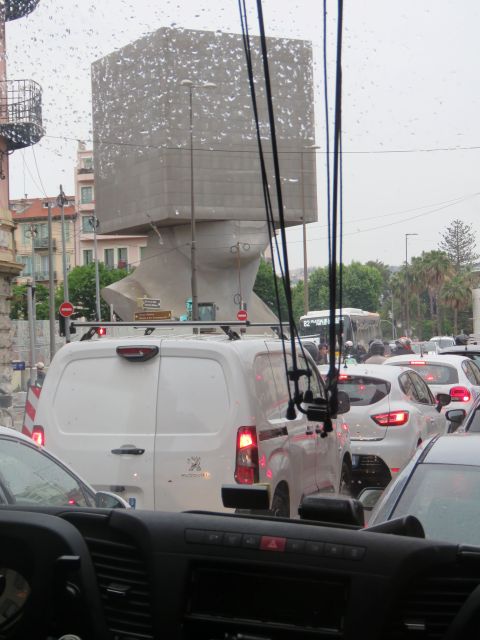
Stopped by rush hour traffic by a decidedly extraordinary commercial building

Also related to assaults on visual senses, these two commercial buildings in and near Nice were impossible to miss. I am sure they are as controversial for locals as for visitors.

I had to photograph this second one from a moving coach so you may miss the fact that the head looks mighty like it was modelled on King Charles. The similarity was unmissable. I am surprised it hasn’t  sparked a fresh outbreak of the Hundred Years War of old.

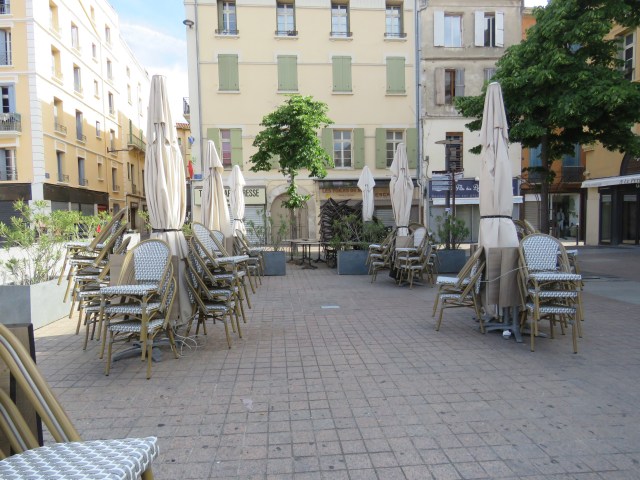
Outside of tourist areas, much of France closes on Sundays. We wandered through the near-deserted city square in Perpignan where all the outdoor furniture remained outdoors, albeit loosely tied to make it clear they were not free for the taking. Just as I marveled at the use of ceramic pots with topiaries planted in them to block off a road (instead of traffic cones?) in Malaysia, this level of trust in human decency and good behaviour made me ponder where we have gone wrong in this country.

Pinus montezumae may be suitable for weaving into craft-y baskets.

Blue sky winters

The bright pink Prunus campanulata are controversial in this country because of their seeding ways but this enormous specimen is sterile and doesn’t set seed. The greatest danger is being hit by low flying birds as scores of tui move around the garden.

We are very sensitive about criticism of the climate in our neck of the woods. It is true that other places warm up more quickly in spring, some of us would like another degree or two of heat in summer and spring can be wet and windy. For many years we would cringe as garden and nursery visitors from further north or east would come in, hopping out of their heated cars and shivering, saying how cold and miserable it was here and asking if it was always like this.  Or worse, asking “How can you grow such tender material in your cold climate?” One person clearly pushed Mark too far because I heard him reply with a dead pan face that we get out at night with little woolly jumpers and blankets to cover them up.

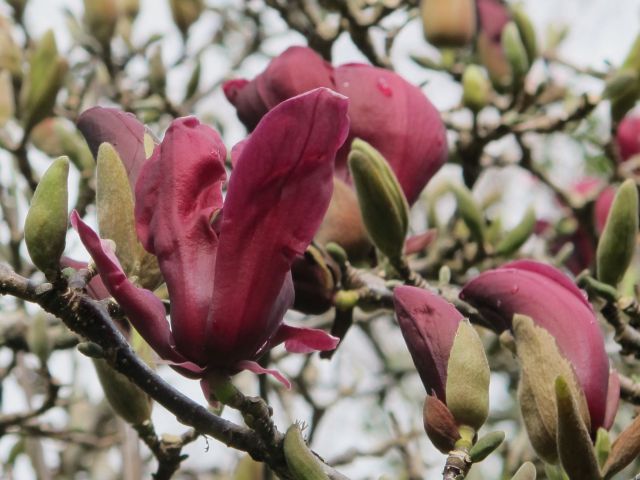
First blooms opening on Magnolia Vulcan, one of our early flagship Jury magnolias

We may not have higher temperatures in summer but we have high sunshine hours and high light levels and that makes a big difference in winter. Of course, it can get cold and we have winter storms as cold fronts move over bringing wind, rain and gloomy skies. But in between, we can get bright blue skies and sunshine for days on end. Right now, in what we deem midwinter and our bleakest month, we still get 10 hours of daylight.

Rhododendron protistum var. giganteum ‘Pukeiti – one of the big leafed varieties that flower early. We also have subtropical vireya rhododendrons in bloom.

This train of thought was started by reading a blog post by Christchurch gardening colleague and friend, Robyn Kilty. Headed ‘It’s winter drear, my dear’, it vividly conveys her experience of mid winter, where low light levels and grey skies suck the colour out of both garden and landscape.

Blue skies a-plenty. With a white magnolia – likely kobus, flowering in a garden down the road.

I have not been to Christchurch in midwinter so I have no opinion on their winter conditions. For overseas readers, we are in the middle of the west coast of the North Island. Christchurch is in the middle of the east coast of the South Island. Clearly our winter experiences are totally different and that is what happens when you live in a country of long thin islands that run north to south, surrounded by vast oceans with no major land masses nearby. There are big variations in climate.

Luculia ‘Fragrant Cloud’ flowers on, undeterred by winter.

Nobody is going to suffer from seasonal affective disorder here in Taranaki. We are at latitude 39° south. If you match that to the 39th parallel north, we correspond to places like Ibiza, Sardinia and a line through California. Not that this means in any way that our climates are similar but it does mean our winter daylight hours are greater, as is the height the sun rises in the winter sky.

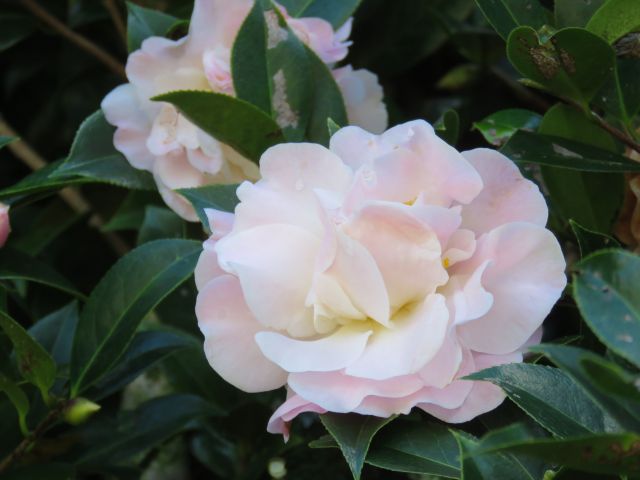
Camellias in bloom – this is Camellia yuhsienensis (syn C. grijsii var grijsii)

We garden all year round. If it is wet and windy or bleak, I will stay inside. I wait until the mornings have warmed up a bit before heading out, retiring indoors when it starts to cool off at 4.30pm. But most days, we are out and about for most of the day. I have a penchant for photographing flowers against blue skies but I don’t colour enhance my photos so what I show is colour as my camera captures it.

Loads of narcissi in bloom. We mostly grow the early flowering dwarf varieties because they are over before the nasty narcissi fly is on the wing.
Everybody grows narcissi but not everybody grows orchids in the garden. These are calanthes opening and most of our cymbidiums are already in flower.

Our winters are still filled with colour and flowers. As the snowdrops pass over – their season is but brief in our mild conditions – so much else is coming into flower that I feel that slight sense of panic that I may miss something altogether if I don’t get right around the garden every few days. At least we no longer suffer from anxious pressure at the need to get many tasks done before the garden visiting season starts – on account of us no longer opening the garden, you understand.

There are many worse places to spend winter than here in North Taranaki.

Magnolia campbellii var campbellii in our park. The snow line on Mount Taranaki is high this year, indicating a milder winter than some other years.

Ideas and observations (part one)

Just a market stall, one of many, with an outstanding display

At a time when we rail in this country about supermarkets and excessive prices – concerns also matched in Australia – the inner city Barcelona food market delighted me. The Mercat De La Boqueria in the city dates back to 1217 which is pretty astonishing. Obviously, these people shop more frequently than I do and, were I living or working nearby, I would quite possibly pop in every other day to pick up fresh food. I feel our fruit and veg displays in this country lack flair and of course, being Europe, the cured meats and variation in cuts of meat make the offerings here look decidedly pedestrian.

You can do a lot with smooth flat stones if you are willing to faff around. Attention to detail makes a difference. How much more attractive are stones embedded side on in concrete rather than a utilitarian concrete drain? I photographed this at the entrance to Villa Thuret in Cap d’Antibes.
St Paul de Vence, with a nod to modern expectations in the ugly sealed path over ancient cobbles on the right

The same flat stones were also used in subtle nod to mosaic in the medieval village of Saint Paul de Vence, the same village where Marc Chagall ended his life and is buried. In Europe, people are well used to uneven surfaces and rough cobblestones that would be seen as health and safety hazards in countries like ours. Wear sensible shoes, I say, while acknowledging that this is not an environment that accommodates people with compromised mobility.

I played ‘spot the keen gardener’ in Saint Paul. In an environment where buildings and people are crammed in like sardines, where personal space is small and contained vertically in tall buildings, largely of stone, with little or no personal outdoor space, you can’t keep a determined gardener down. This person’s home was like an oasis amongst permanent and impermeable materials.

I photographed these ideas for low fences in the Ephrussi de Rothschild garden. I particularly like the natural style and informality of the fence constructed from garden prunings. You would want to be using a hard wood rather than a softer option which would rot down too quickly. It may also be that it takes longer than one might think because much depends on selecting the right pieces and trimming to fit but isn’t it charming, in an understated way?

The bamboo fence is easier to construct in a short space of time, if you have the right sort of bamboo to hand. It appears to be tied with a natural jute string which will need replacing before the bamboo but is easy enough to do. We have swapped to jute string in the garden because it blends in and breaks down in situ but the fine string only lasts about a year at the most, the coarser jute twine maybe two years. Both these simple fencing options probably cost nothing in materials bar the string.

In Clos de Peyronnet, I noted this approach to the perennial problem of garden hoses. Hoses lying around can be a hazard and even coiling one up to hang keeps it in full view. The retractable hose reel options add more plastic to the garden and don’t usually accommodate long hoses. Dig a hole, large enough to hold the coiled hose and put a slatted cover on top. I assume this cavity was a little too small to accommodate the length of hose but you get the general idea. It could be done with more precision, but even as it is, it stops the glaring intrusion of the garden hose which is not a thing of beauty.

In the same garden, I noted the presentation of the bulb collection. They had all finished flowering but the garden is noted for its specialist collection of rare bulbs with over 200 species. This is one way to display your bulb collection – somewhat like an outdoor auricula theatre. I immediately wondered about – but failed to find – the service area ‘out the back’ where they must carry out repotting. We have a huge bulb collection here but only the most difficult bulbs are in pots and they mostly live out of sight in a covered house. Over the years, we have transferred almost all our bulbs into the garden to avoid having to repot them at least every two years but it does take an attentive approach, skill and experience to keep rare or difficult bulbs growing in a garden situation. If you have a bulb collection in pots, you may like this presentation.

I took this photo because I couldn’t help but notice how tight parking spaces were in the south of France. You drive anything bigger than a small to medium sized car at your peril. The roads, too, are not designed for the oversized SUVs and twin cab utes of modern design so favoured in this country. Indeed, in Paris the parking fees were increased by referendum.
“The increase in parking rates will affect cars weighing more than 1,600 kg (or 2,000 kg in the case of electric cars). An hour of parking for SUVs in the city centre now costs €18 instead of the usual €6, whilst in the outskirts the cost is €12 instead of €4. For six hours of parking in the city centre, SUVs will be charged €225 instead of the previous €75.”

As one who deplores the bloated size and intimidatory presence of many modern domestic vehicles (all too often, that intimidatory presence is matched by intimidatory driving), I mentally cheered when I read about some UK councils responding to approaches to make car parks larger and longer to accommodate many popular modern vehicles by… banning them. Over-sized domestic vehicles just don’t fit into existing infrastructure.

I failed to photograph the acres of truck parking at the borders but I could not help but notice the hundreds of big rigs parked up as we neared the border from Spain on a Sunday evening. That is because France has banned freight trucks from 10pm Saturday night to 10pm Sunday night. Sundays, apparently, are for safer driving on the roads by families. They do things differently there.

Of no relevance to the above writing but I wanted to finish with photos – Villa Thuret, an interesting private botanic garden which was set up to trial plants suitable for the climate
It was a little damp and gloomy on the morning we visited Villa Thuret but really interesting despite that.

Cork trees, wildflowers and vineyards in charming Occitania

Collioure in Occitania – possibly light on celebs with holiday homes, definitely lighter on tourists than the Riviera but also more charming, in my eyes at least.

I do not have a good sense of direction and what I do have deserts me entirely in the northern hemisphere. I may have known intellectually that travelling from Occitania (formerly Languedoc-Roussillon-Midi-Pyrénées) where my daughter is living across to the French Riviera (or Côte d’Azur) was going eastwards, but everything in me declared it was in a westerly direction.

That is quite some fortification in Collioure

The Riviera borders Italy and has long been the place for the rich and famous. I am not big on celebrities and my interest level in having Elton John’s villa in Nice pointed out to me is somewhere around zero. I simply felt appalled by the huge area adjacent to the airport that is set aside for the parking of private jets (it was full) and Monaco struck me as being the Dubai of the Riviera – too much ostentatious wealth, too many high-rise buildings, too little good taste and no nature left at all that I could see as we passed through.

The view from terrace where my daughter and her family are spending the year. That is the Pyrenees.

Occitania borders Spain and also sits on the Mediterranean with equally glorious sea views and coastline, but is a lot more low-key. It has many local villages which seemed to be full of locals, not the rich and famous, so I found it more charming. I also had time there to wander and look.

In late spring and after unusual levels of rainfall, there was an abundance of wildflowers. And a clear absence of glyphosate. The countryside around where my daughter lives is predominantly vineyards and cork trees. I didn’t see any farm animals although there are wild pigs which are doubtless best avoided. Daughter’s partner was despairing at the damage the pigs caused as they cut through their garden. I am trying to remember what the sapling tree was he had just planted. Maybe a jacaranda? It had been snapped off in the night, about a metre up, in an act that looked more like spite from a pig than an accident or a search for food.

An orchard of cork trees! Quercus suber.
Missing its pyjama pants

Cork is harvested from  Quercus suber. Most trees will die if the bark is cut or removed from the full circumference of the trunk but not the cork oak. The ones growing in the paddocks near my daughter’s home had been harvested relatively recently. They made me think of somebody who had forgotten to put on pyjama pants, really. Apparently the cork can be harvested every 9 years once the tree has reached 25 years of age. It is probably just as well most of the wine industry has moved to screw caps rather than single use corks because that is not exactly a high yield of cork.

That bark is an eco-system but I worried about the hornets in Italy on an earlier trip

I have never forgotten this cork tree we saw on an earlier trip to Italy. It is not just the interesting nubbly bark. This one was home to a nest of hornets. We don’t have hornets in New Zealand and the sight of just one struck terror in my heart. Imagine an aggressive wasp over four times the size of the common German wasp we have here – that was the hornet. Thank goodness for our border control.

The vineyard next door to where my family are living. I walked across it and the heavy clay soil squelched right up to the top of my shoes after a bit of rain. It is all stoney clay which I imagine sets like concrete in summer.
Terraced vineyards closer to the coast

The countryside around Occitania was undulating to steep but intensively worked, mostly in grapes. These were not like the big commercial vineyards we have in this country – soulless expanses of tanalised timber, taut wires and grapevines trained with military precision to obedient compliance. This was more laissez faire in its approach, more traditional and I am guessing pretty much managed by hand. I can’t see that machinery could be used on the narrow, steep terraces.
Collected from just one area of long grass

One side effect of this lighter-handed touch on the environment is that wildflowers can thrive. There is something delightful about seeing an abundance of wild lavender and rosemary in flower. I picked one of each flower in the rough paddock with a few cork trees behind my daughter’s current home. Where there are wild flowers, there are of course many insects and whole eco-systems that are self-sustaining.
We went for a walk around a recently installed lake near their home. I say installed because apparently it has been specifically created as a recreational reserve. At one end is zip line and tree-top adventure course, placed somewhat discreetly. I think the lake is swimmable but only warm enough for paddling that early in the season. A low-key entry track and equally low-key parking areas belied the creation of a public facility that is designed for local families and is clearly being used extensively. Most recreational areas with a natural style that I have seen were put in many, many decades ago. Modern recreational areas seem to need acres of sealed parking and turning and the installation of sealed areas for activities like skateboarding. I found this gentler approach most charming.

Civilised drinking, French-style

Being France, there was a pop-up bar near the water’s edge. Of course there was. The French don’t seem to need to separate off drinking facilities to control adults who drink to excess. It is just integrated into the wider park. We didn’t stop for a drink because our baby was due for a sleep.

It was cold and windy and not exactly a roaring trade happening at this wine bar on a roadside layby

I was equally surprised by this wine bar set on a windy promontory with a look-out to the Mediterranean Sea. I can’t imagine New Zealand ever allowing a wine bar on a roadside layby.

Near Banyul, as I recall. More terraced vineyards.

While the French seem to manage social drinking well, the same can not be said of dog poo. I first visited Paris in the mid 1990s and, along with losing our elder daughter on the underground (she was 15 so it wasn’t too big a drama) and the Eiffel Tower, I still remember the dog poo. It seems things have not changed, at least not in the semi-rural south. Many people own dogs and these canine companions seem to be well socialised and amiable. But poo-y. Maybe it is that their owners take them out of their terrace housing and apartments to relieve themselves outside. Walking along footpaths needs constant vigilance to avoid tramping in dog shit.  It is everywhere.

We could learn a few things from the French on reducing our use of glyphosate and on civilised drinking habits; the French could learn about poo bags and owner responsibility from us. A fair exchange?

Wild lavender.