Tag Archives: Abbie Jury

Pink and yellow. Together.

Bright yellow kowhai and cerise campanulata cherry at Auckland Botanic

Bright yellow kowhai and cerise campanulata cherry at Auckland Botanic

Two of the three plants on my most-disliked list are pink and yellow combinations. The first was a nasty spirea we saw in the UK several years ago. It was clearly a recent release as it was everywhere – a murky pink flower with yellow foliage. The second was a variegated oleander spotted in Spain, sporting the same colour combination but the foliage was a yellow variegation which may add yet another layer to the colour crime. The third is Rhododendron ‘President Roosevelt’ which also sports similarly freakish, variegated yellow foliage but it is more red-toned than murky pink. We are not fans of variegated foliage here, as a general rule.
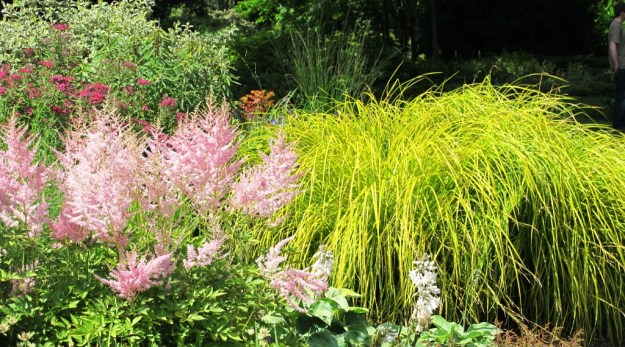
Pink and yellow in Beth Chatto's garden

Pink and yellow in Beth Chatto’s garden

In that magical garden that Beth Chatto has created, I did notice on our last visit that she quite often combined pink and yellow in combinations that would worry me in my own garden. So when I saw a bright campanulata cherry in full bloom at Auckland Botanic Gardens last week with a strong yellow kowhai planted in front, my reaction was to do a double-take. It is just not a colour combination that pleases me. As an aside, I did notice that the feeding tui much preferred the campanulata to the kowhai – which is to say that there were none in the kowhai but a whole mob coming and going in the campanulata. I take this as proof that tui lack political correctness and fail to appreciate that they are letting the side down by preferring the import to the native plant.
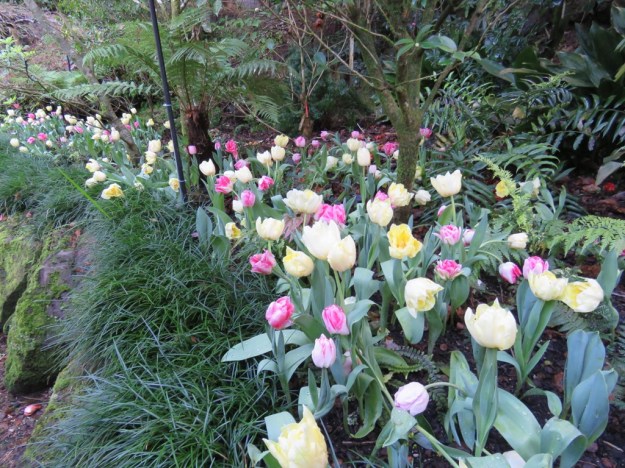
Pastel hued tulips at Eden Gardens
Pastel hued tulips at Eden Gardens

Pink vireya but with pastel yellow tulips
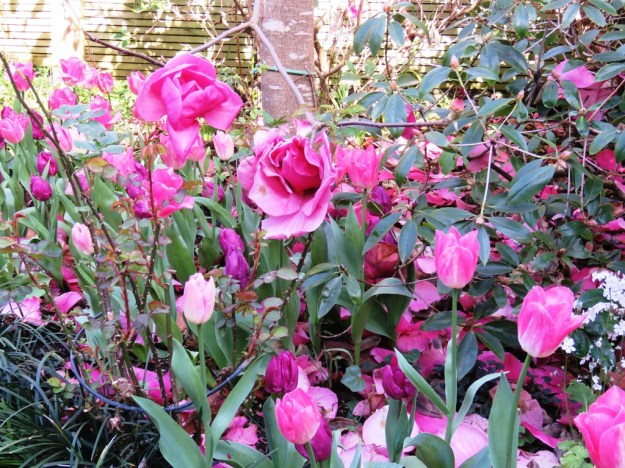
Pink vireya but with pastel yellow tulips

Because I was already thinking about that pink and yellow combo, the plantings at Eden Gardens immediately grabbed my attention. And there, the pink and yellow pleased me and I am sure that is because they were pastel and the pinks were clean hues. It is the combination of either cerise pinks, purplish pinks or muted Paris pink with bright yellow that worries me most, I decided. It is not that it should be avoided at all costs (unless it is yellow variegated foliage with murky pink flowers!), but that it fails more often than it works. A pale yellow is much easier to combine. Bright golden yellow needs more care – unless it is a narcissus. Vibrant orange needs even more caution.
Magnolia Felix Jury with colour-toned tulips at Eden Gardens

Magnolia Felix Jury with colour-toned tulips at Eden Gardens


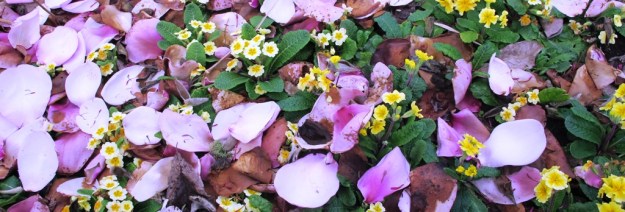
It was Peak Tulip at Eden Gardens. I have planted some tulips this year, but nothing on the scale of Eden. It is the inner conservationist conservative in me. My instincts are too frugal to be willing to buy in fresh bulbs each year, treating them like annuals to be discarded after blooming. I don’t even plant annuals. I expect my tulips to earn their keep and return each year, gently multiplying. This is, apparently, too optimistic for tulips, although I planted them deep in the soil with hope. I enquired at Eden Gardens and was told they start again with fresh bulbs each season which is why they were so showy. Away from pink and yellow, the colour-toned planting beneath Magnolia Felix Jury as one enters the garden was restrained and impeccable though it lacked the zing that can be achieved with more adventurous colour combinations.
001 (6)

Garden lore – three hedging ideas for 2015

“My garden sweet, enclosed with walles strong,

Embanked with benches to sytt and take my rest:

The knots so enknotted, it cannot be exprest,

With arbors and alyes so pleasant and so dulce.”

George Cavendish (1499 – 1561).

IMG_4441

How to punctuate the end of hedge with panache and style in 2015.

I was taken to see the gardens at The Kelliher Estate on Puketutu Island in Auckland last week. When we say island, it is connected by a causeway. No ferry crossings were required. The gardens have been undergoing a major renovation in the last few years. There is a difference between a restoration and a renovation. The former attempts to recreate the gardens as they were in their glory days. In our climate with rampant growth and a heavy dependence of woody trees and shrubs, restorations are somewhat ill-conceived, in my opinion.

Renovations are a reinterpretation of a garden and in public gardens can range from pedestrian to insensitive, from ego-driven (the modern gardener determined to ‘make his or her mark’) to compromise by committee. Occasionally they are carried out with genuinely creative flair and there were indubitably elements of this showing in the gardens at the Kelliher Estate.

IMG_4438

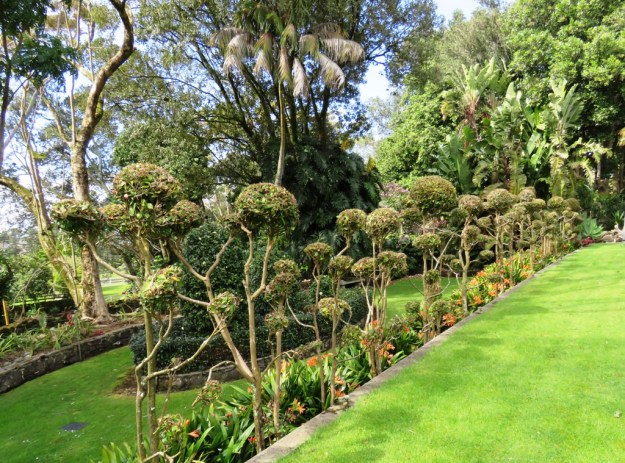
I was simply delighted by the reworking of the formerly overgrown lilly pilly hedge at the entrance – cloud pruned. With panache. I am no expert on lilly pilly. In fact it is more akin a yawning gap in my knowledge, especially as there are a number of plants which carry this common name. But I am guessing that this particular lilly pilly was the Australian myrtle also known as Syzygium smithii syn Acmena smithii (see footnote). If you are going to try something like this at home, take your time. You can’t rush the process of finding the natural shape of each individual plant. And trim flush to the stem. Nothing looks worse than nubbly elbows poking out all over the place where you have lopped off branches.

IMG_4467

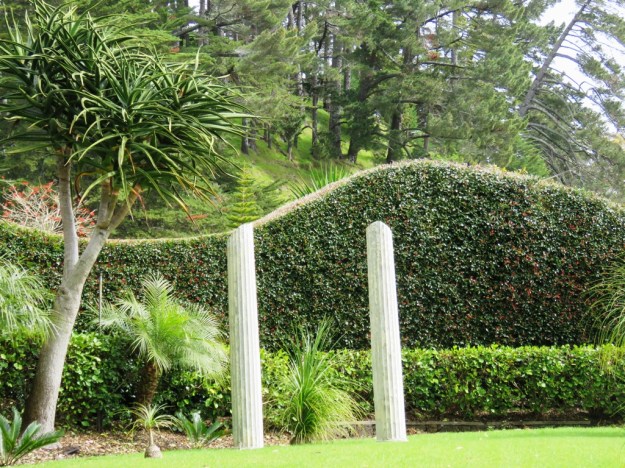
Finally the wave hedging is a device I have seen in UK and Europe but not in this country before. It echoes the natural shapes of the landscape but gives some form without the regimented and straitjacketed predictability of the usual flat topped, formal hedge.

The one key element to remember if you decide to get more adventurous with your own hedges is to ensure that they will tolerate hard pruning and resprout from bare wood if you are going to reshape. Not all hedging plants do and conifers can be particularly touchy.

Postscript: Social media can be very helpful. The following more knowledgeable comment on lilly pillies was made on the garden Facebook page by Andrew from Twining Valley Nurseries
“You’re not wrong with the naming of Lilly Pilly. I’ve been to garden centres and seen the same plant labeled with three different names!
The correct taxonomic names for the 3 most commonly grown Lilly Pilly’s in NZ are-

Waterhousia floribunda (Old name: Eugenia ventenatti or Syzygium floribundum) Common name: weeping Lilly Pilly
Syzygium australe (Old name: Eugenia australis) Common name: brush cherry or Australian rose apple and is the most common.
Acmena smithii (Old name: Eugenia smithii) Common name: Lilly Pilly (or weed!)”

Thanks Andrew.

Lachenalias part one: the early bloomers

Left to right: Lachenalia aloides quadricolor, bulbifera, reflexa hybrid, aloides

Left to right: Lachenalia aloides quadricolor, bulbifera, reflexa hybrid, aloides

Pity the early-blooming lachenalias for none of them are blue. And the blues and mauves are the sought after members of this plant family. But as winter draws to a close, it is the cheerful red, orange and yellow combinations that light up a grey day. It is all in how you use them.
Nothing subtle about aloides but great in semi-wild areas

Nothing subtle about aloides but great in semi-wild areas

I had not been a fan of the most common form of Lachenalia aloides. It lacks refinement and reminds me of cheap, fake flowers. But when I relocated surplus bulbs out to an open area near our entrance, I changed my mind. They are a bright splash of colour around an old tree trunk which makes me smile. The addition of the undervalued muscari (grape hyacinths) that remind me of my childhood adds a splash of pure blue, making the colour seem even brighter, along with an early flowering scilla. We have a particularly strong growing form in New Zealand which you can still occasionally find under its completely incorrect name of Lachenalia ‘Pearsonii’. It is just a strong-growing, tall strain of aloides with its distinctive orange and red colouring.
Same species, aloides. Quadricolor to the right.

Same species, aloides. Quadricolor to the right.

L. aloides is a variable species and one of our early bloomers is another form – L. aloides quadricolor. It has a little more subtlety than its more vibrant, stronger sibling. The individual flowers are little smaller and finer, although still on a strong stem. Quadricolour refers to the four colours – red, yellow, green and interesting maroon or burgundy tips. There is a complexity to these flowers which counters the somewhat garish effect that can be evident in the more common form.

L. aloides tricolor flowers later for us and is smaller in size and basically green with red tips. The most desirable of this set is probably L. aloides var. vanzyliae but it is the one we are struggling to get growing well. I will keep an eye out for flowers as the season progresses because it is an unusual white with pale blue at the base and bright green tips and it is just as lovely as it sounds. When I find it again – and I have it in about three places – I will lift the bulbs because I think this one will be best kept to a pot.

Lachenalia bulbifera

Lachenalia bulbifera

Red L. bulbifera is the first of the season to come into flower for us. It is easy to grow and sets a multitude of little bulbs, though not to the extent that we have classified it as invasive or dangerous. It is another one that I like planted around the trunk of an old tree giving a bright spot of colour in the distance and drawing one over for a closer look.
Mark's reflexa hybrid is stronger growing than the straight species

Mark’s reflexa hybrid is stronger growing than the straight species

The yellow is Mark’s L. reflexa hybrid. Because we struggle with the dreaded narcissi fly, he was casting round for alternative yellows to daffodils for naturalising. While not quite a pure yellow (the tips can have a red tinge), it is a strong and reliable grower and gives the yellow carpet effect though we have yet to get a major drift established in grass conditions.

Lachenalias are South African bulbs, mostly from the Cape Province. Some are very easy to grow, others less so. Naturally the very choice varieties are the ones that are less amenable but that is always the way. Some are desert plants and we struggle with those, but the ones that grow in areas of winter rainfall are generally easy and reliable in our conditions. A few, like L. glaucina, are particularly frost tender. Lachenalias last very well as a cut flower and will out-bloom most other late winter and spring bulbs in the garden. L. bulbifera is already in bloom by the beginning of July while the white L. contaminata flowers through November. A family of easy-care bulbs which gives us a full five months of blooming across the colour spectrum – what is not to like?
041

The silver fern

IMG_3735IMG_3738 - CopyAll New Zealanders know the silver fern, but usually as the logo or motif, not the real thing. Sure it is closely associated with our national rugby and netball teams, but how many realise it is a ponga? A native tree fern.

Botanically it is Cyathea dealbata. New Zealand doesn’t have a world monopoly on tree ferns but we do have some special ones which are native only to our lands and the silver fern is one. It has a wide distribution through the North Island and in the north and east of the South Island. We have it seeding down in our garden in that wonderfully casual way that pongas do. It can reach as high as 10 metres but it takes a while to get there, at which point it may also measure a huge 8 metres across.

It is only silver – or white, really – on the underside of the leaf and it takes about two years for that white colouring to develop. Maori were reputed to use the white undersides to mark tracks for travelling at night although they also stand out during the day and bush walkers often know this trick.

It was TV gardening host and now National Government minister, Maggie Barry, who presented a little piece many years ago on the silver fern which falls into the “once seen, never forgotten” category. Surrounding herself with a circle of cut fronds placed pale side up, she advised us that if you are ever lost in the wild then using this technique makes you easy to spot from the air. So there you have it – a survival strategy from Maggie.

Maggie Barry's tip, my gardening shoes

Maggie Barry’s tip, my gardening shoes

The Magnolia and the Maunga (or Mountain)

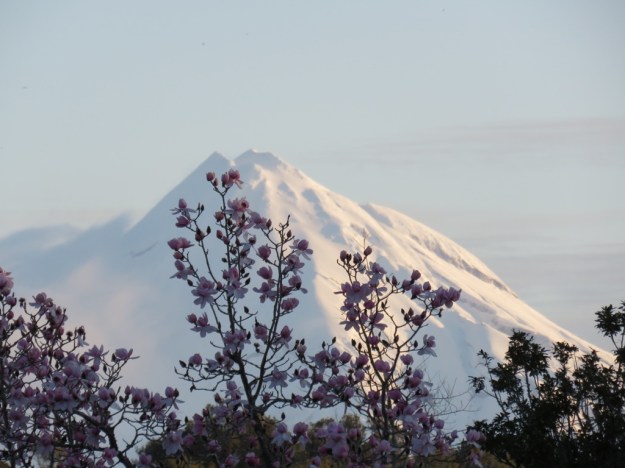
August 9, 5.07August 9 at 5.00pm as the sun is going down.
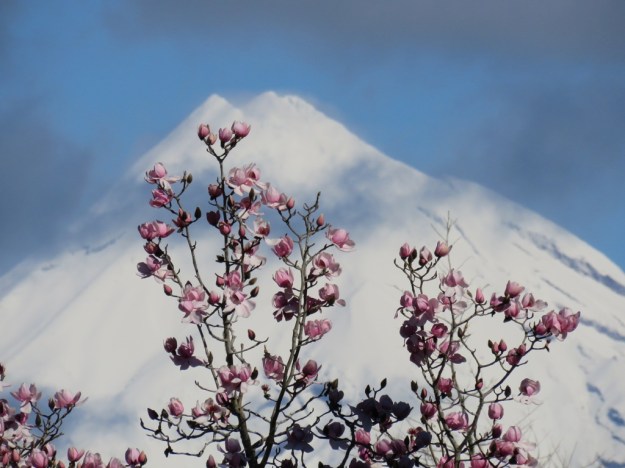
August 10, 12.38August 10, just after midday.
August 12, 9.45amAugust 12, at 9.45am.

Magnolia campbellii and Mount Taranaki, photographed from our garden.

IMG_3678At the risk of destroying the perception, this is the reality. In the bottom right hand corner, you can see the mountain which is at least 35km away from us. We do not have an alpine climate here – far from it, given that we grow oranges and avocados – but a zoom on my new camera is very good.