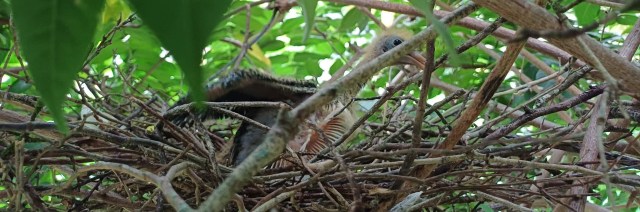
Tag Archives: baby kereru

Baby kereru

Soon after hatching – a far cry from its mature form

The kereru is our much-loved native wood pigeon. It was once a significant food source but is now fully protected and can not be hunted legally. Being a large, lumbering bird with small brain, I imagine it was easy to catch and an important source of protein in a country which lacked all mammals (bar two tiny bats that few have ever seen) in the days before colonisation brought both wild and farm animals.

They are a bird of beautiful plumage with a pigeon coo to be heard if you have them resident in your garden. But they are not at all beautiful or cute in the baby stage. Quail hatch out like the cutest little, feathered bumblebees, on the move very soon after hatching. Not the kereru.
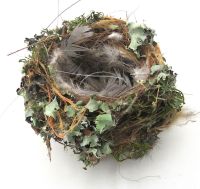
Behold the beauty and care shown by the chaffinch as compared to the disgraceful kereru efforts

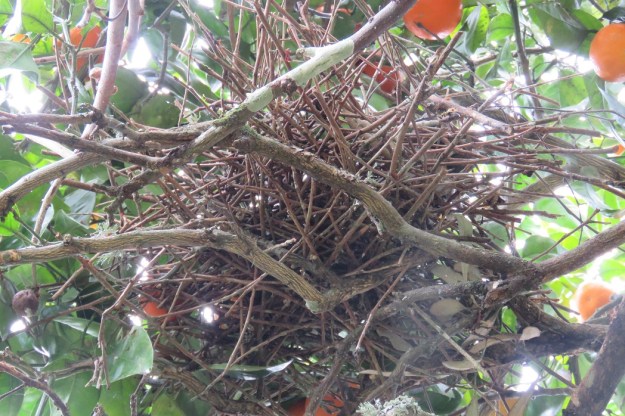
For starters, kereru parents should be ashamed of their nest-building skills. These consist of tossing a few twigs onto some sort of precarious branch and saying ‘that’ll do’. I have photographed exquisitely crafted nests by other native birds but not the kereru. They then lay a single egg and the ugliest baby hatches out and spends its first weeks perched precariously on its bunch of uncomfortable twigs.

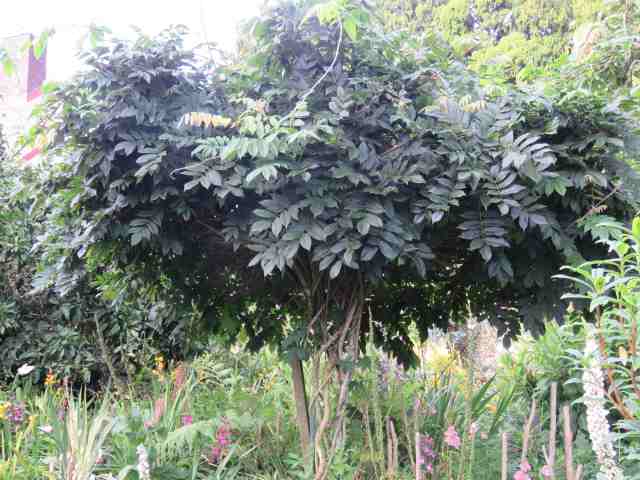
It was a kereru almost taking us out as it flapped its way to gain altitude that drew attention to its nest in the Wisteria ‘Snow Showers’, all of 150cm off the ground. It is not a particularly safe spot; we fear Ralph the dog could possible reach it at a pinch. Se we are skirting around it and trying not to disturb it.
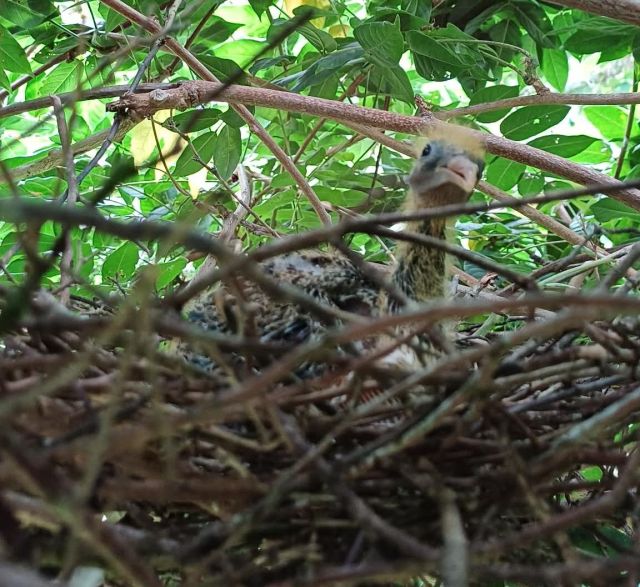
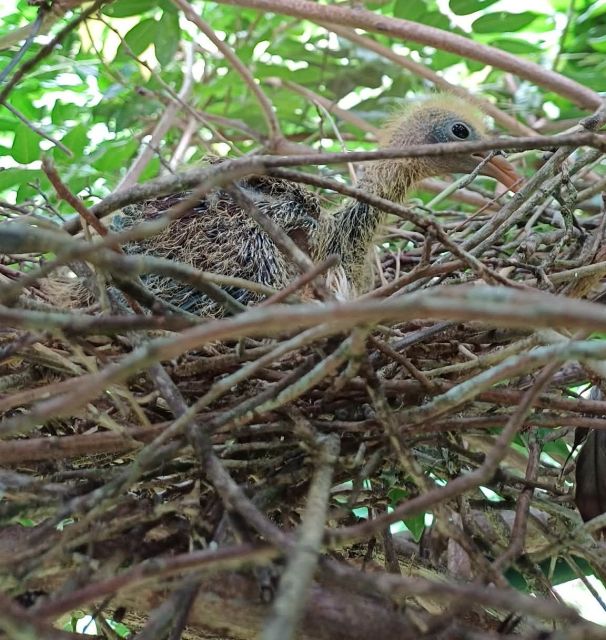
We don’t know exactly which day it hatched but this is likely a few days later

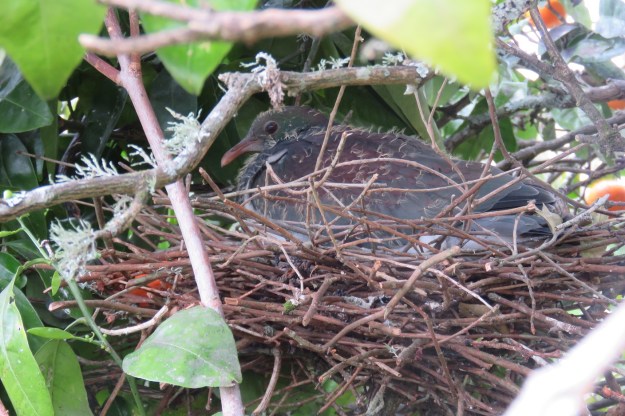
Zack spotted the scrawny little bebe about 10 days ago and came in saying, “Man that is an ugly, scrawny chick”. I couldn’t see it this week and feared it may have fallen out but no, it is still there. I photographed it yesterday morning. It is not much improved in the beauty stakes but I am sure its parents love it.
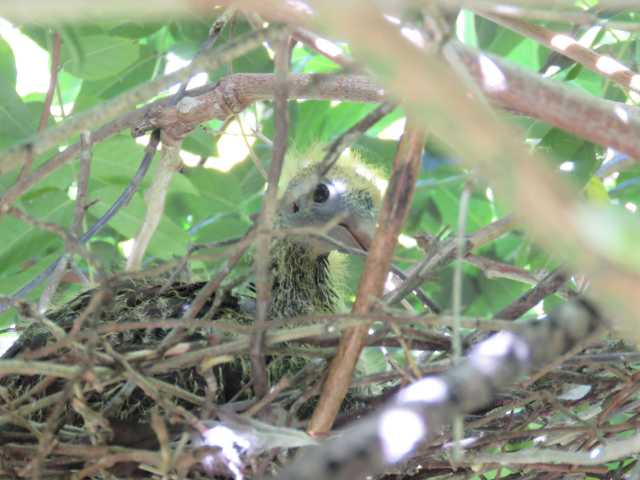
This is about 10 days later. Its looks have not improved a great deal since.

Below is a photo of one from earlier years. It has grown its feathers and is closer to fledging – a process that takes 5 to 6 weeks. There is only one chick per nest and it is a miracle any reach independence given the long process and the woeful quality of nest.
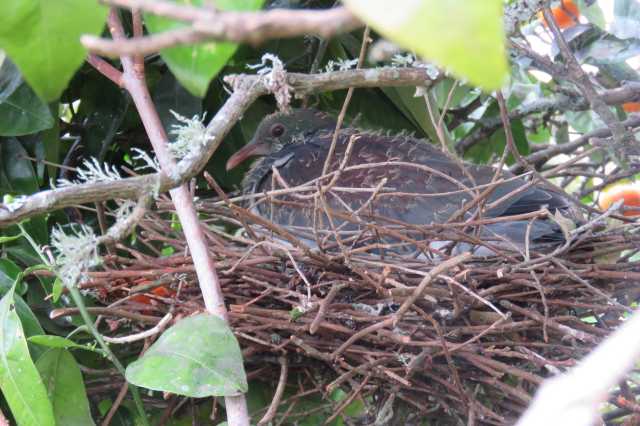
Here is one I prepared earlier, as they say on cooking shows. A fledgling kereru nesting in the tangerine tree.

I have shown the photo below before. In front of our picture window, we have a bamboo grid suspended to stop bird strike. Our double glazed windows reflect trees and sky and too many birds thought they could fly through, killing themselves on the glass. Window decals did not work. A kereru died before our eyes just centimetres from the decals. I didn’t want net curtains in this room so Mark constructed the bamboo grid. It works. We have not had birds die from striking this window since we hung the grid.
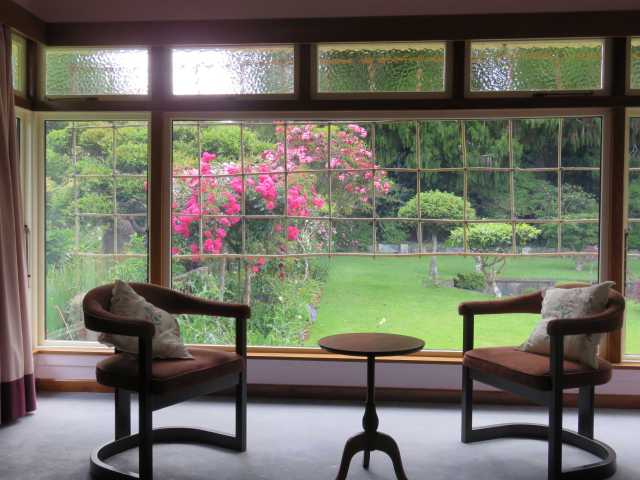
It is the bamboo grid you are looking at – not interfering with the view or the light but proven down many years to be enough to stop birds hitting the window.

It felt like a tragedy every time we found a dead bird, especially as they were often young ones learning to fly. All that time and two parents to raise just one chick a year only for it to die soon after on our windows. For the same reason, we would never have a mirror in the garden and we deplore that modern architectural trend of putting all windowed pavilions set amongst forest trees. Somebody must pick up the bird kill but it is rarely mentioned.
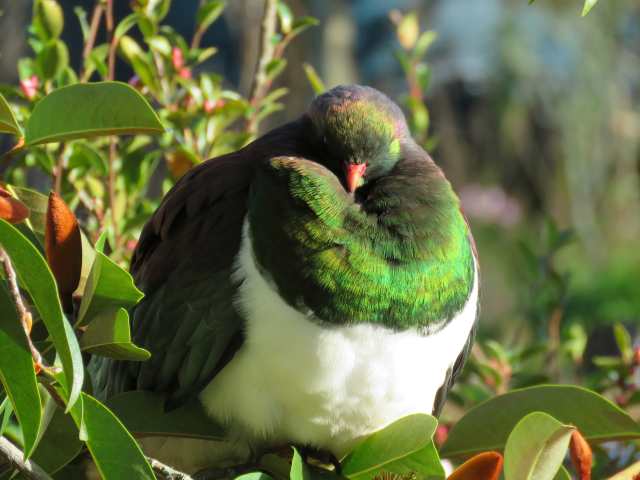
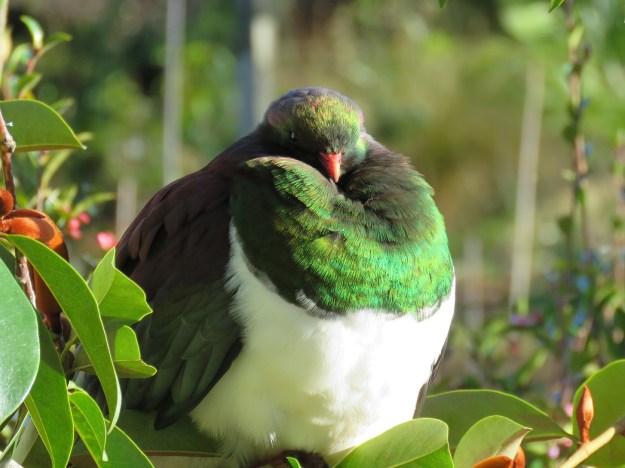
Still one of my favourite photos of this round chonk of a bird, in this case perched in Fairy Magnolia White.

Thanks to Zach for the three photos of our baby soon after hatching.
Feathered friends

Would you mess with this cat? Few people ever tried a second time.

Would you mess with this cat? Few people ever tried a second time.

The decision not to replace our last cat – when she shuffled off the mortal coils after 16 long years of cantankerous and unpredictable behaviour – was not taken lightly. Both Mark and I had lived with cats all our lives and were fond of the furry, purry things. But they are killers and we prefer the birds. That decision has certainly had a huge impact on our bird population here. It helps that none of our neighbours have cats and that there has been some control exercised over feral felines. This spring, we are particularly aware of the huge number and variety of birds in residence and feeling that we may have achieved something of a sustainable ecosystem which maintains an all year-round population. Mark’s ongoing efforts to reduce rat numbers by trapping may also have helped.

Our kaka!

Our kaka!

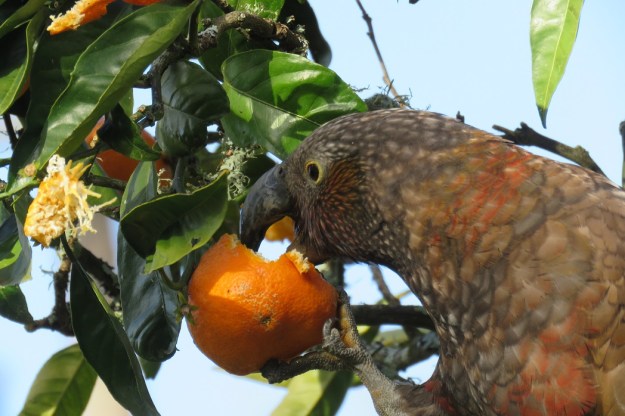
Not even the late Buffy cat could have had an impact on the most exciting arrival this year. It was a kaka – one of our native parrots which is limited to small, defined areas of the country these days, nowhere near here. We had never seen one before. A loud, noisy larrikin it was too, one which enjoyed rarking up the tui, swooping around the place feeding from a variety of sources including the mandarin trees. We were not so impressed at it pulling off fat magnolia buds just to throw around for no clear reason (we did wonder if it was aiming at the tui). After about two months it moved on, perhaps looking for a mate and it has seemed a little quiet here since.

The kereru nest scores about 1/10 for skill are care.

The kereru nest scores about 1/10 for skill and care. Viewed from below. 

Baby kereru in residence

Baby kereru in residence

The kereru – our great, lumbering native wood pigeon of small brain –  are a constant garden presence. They also sit about look decorative, posing almost, as they eat the magnolia and michelia flowers and anything else that takes their fancy. Fortunately we have plenty to share. But I thought that few readers are likely to have seen their nests. These are not creations of great skill and care – more a case of throwing a few twigs together and hoping it lasts long enough for the single baby to mature to flying stage. Sometimes the nests do not last the distance, alas. Mark manoeuvred the ladder into position with some difficulty so I could photograph the rather large baby in residence. I will keep an eye on it to see if I can catch the parents coming in to feed it.

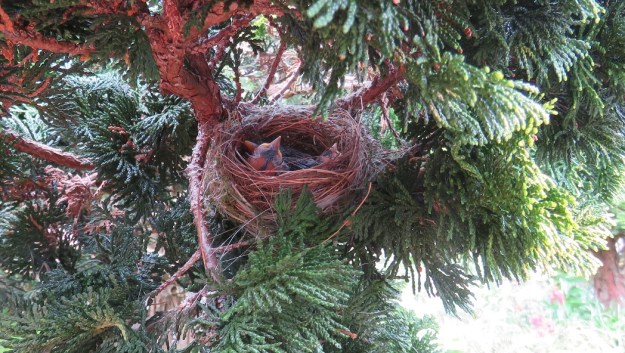
Wax-eyes craft exquisite tiny nests

Wax-eyes craft exquisite tiny nests

What the kereru lack in nest-building skills, the wax-eyes more than make up with their exquisite little creations mere centimetres across. I found this one two days ago in a conifer I was cleaning out (removing the clutter of dead needles improves the look and air circulation enormously). The hatchlings were so tiny that at first I thought they were berries that had fallen into an old nest and my eyes had difficulty focusing on the minute movements that showed they were living. I backed off immediately. Finishing the grooming of the conifer will have to wait. Two days later, today, I checked again and the babies are now looking up with their mouths open, waiting to be fed.

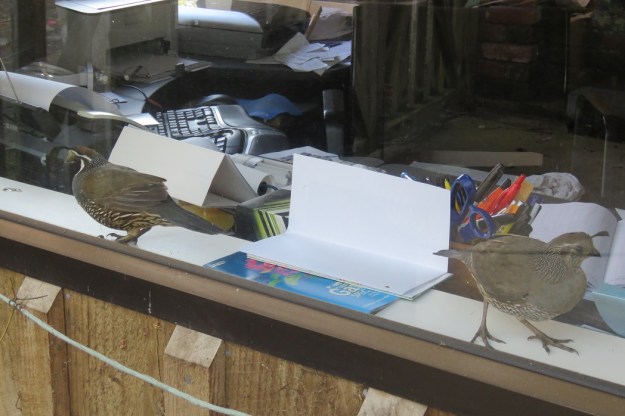
Trapped on the inside - Californian quail

Trapped on the inside – Californian quail

We would not have the mob of quail that have built up, had we kept a cat. They spend most of their time on the ground and they usually nest at ground level, then lead their babies around from the earliest stage when they still look like little feathered bumblebees, long before they are big enough to fly. I could, however, have done without the two who wandered into my office one night when the door had been left open by mistake and who then could not work out how to exit.

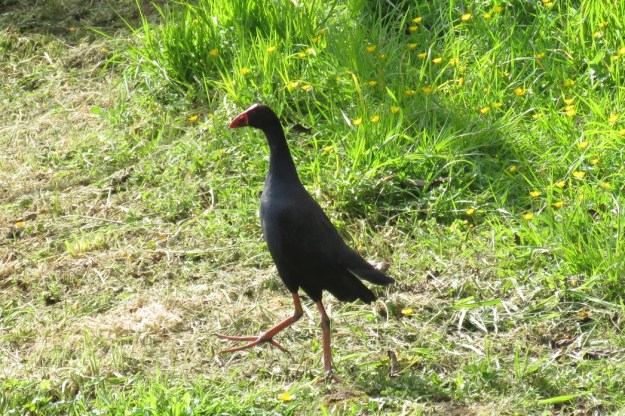
Agitated young pukeko

Agitated young pukeko

I haven’t even mentioned the pair of white-faced herons currently nesting in the Pinus muricata yet but neither have I been around with my camera at the right time to photograph them entering or leaving the nest which is maybe 30 metres up.  We are hoping that the cretinous man who shot two white-faced herons in the area because they were stealing his goldfish (!!!!) is now too old to still be wielding a gun. I can, however, give you the young pukeko separated from its parents down in the North Garden – and very agitated they all were by my presence there with the dog. These native swamp hens that rarely fly far are wonderful exemplars of survival and adaptability and therefore so common that they are taken for granted and never given the status of their highly endangered cousins, the takahe.

One of the bonuses of having a garden filled with birdlife is that we do not have much of a problem with slugs and snails. As far as we are concerned, good gardening is about establishing good eco-systems as much as it is about pretty flowers.

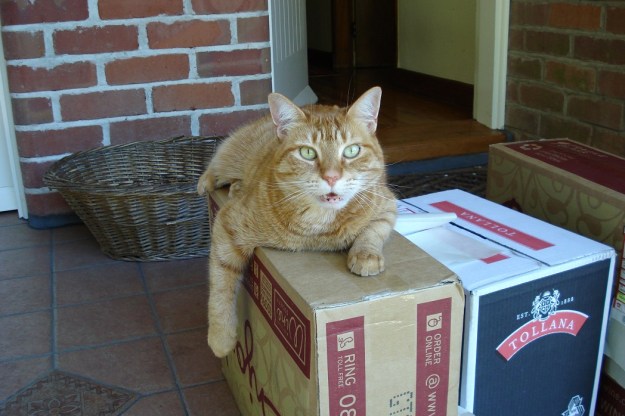
We once had a much-loved ginger cat called Moomintroll (or ‘The Troll’ for short). He lived to a ripe old aged despite two broken legs in kittenhood, the second requiring amputation. From this misfortune, I learned that three legged cats are good rodent catchers but can’t get the elevation to catch birds. I did wonder about putting a standing order with the local SPCA for a three-legged cat but there is a problem. All our cats have always been ginger, male or female. As far as I am concerned, all cats should therefore be ginger and a standing order for a three-legged ginger moggy who is confident living with dogs might be altogether too specific. We will stick with the birds.

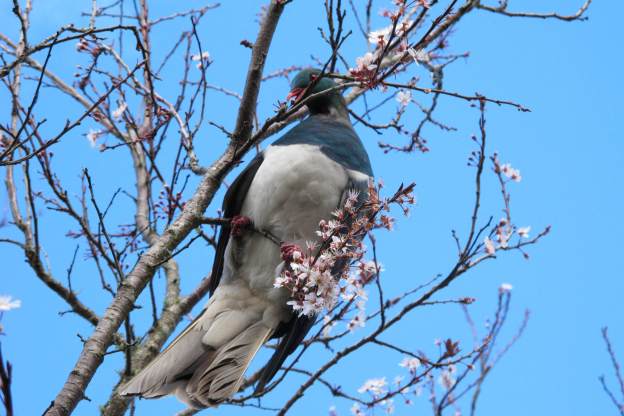
The handsome kereru, our native wood pigeon

The handsome kereru, our native wood pigeon