Tag Archives: Christmas trees

“O Christmas tree O Christmas tree you stand in splendid beauty!” Or maybe not quite so splendid.

The need for a Christmas tree became pressing. I admit that when none of the children get home for Christmas, I tend to skip that festive accoutrement. Our three all live overseas these days. But with two of them making it back this year, one with partner and daughter who was a baby last time I saw her in May but is now very much a small child, there was clearly a need for a decorated tree.

Family tradition decrees that said Christmas tree can not be a) purchased or b) a fake tinsel affair. It must be harvested or repurposed from home. This has led to considerable variation in size and type down the years.

We know it as a pohutukawa – the New Zealand Christmas tree but really only in the landscape

In the warmer parts of Aotearoa New Zealand, the pohutukawa (Metrosideros excelsa) is firmly established as the iconic ‘New Zealand Christmas tree’ but it does not lend itself to cutting to bring indoors. It is an outdoor tree. Being one of the few trees that will grow right on the coast, even on crumbling, eroding land, tolerating both wind and salt spray, it is widely grown as a street tree, on golf courses, as shelter belts and generally all round the place. Its flowering season may be short but it always comes in the lead-up to Christmas.

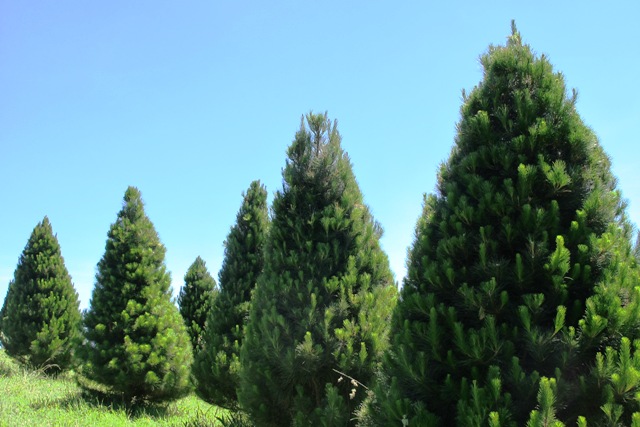
Pinus radiata is the main choice for Christmas trees here – quick-growing, expendable, suitable foliage and the Christmas pine scent. Christmas tree farms supply them as dense, clipped pyramids but wild collected specimens or just branches are generally more sparse. Mark has been known to wire in extra pieces to fill out bare spaces. It used to be a time-honoured tradition that families would head out to the country to harvest a tree or branch from the roadside but I am not sure that still goes on since tree farms made better specimens easily available, albeit at a price. That practice of wild collection had the potential to go wrong, of course.
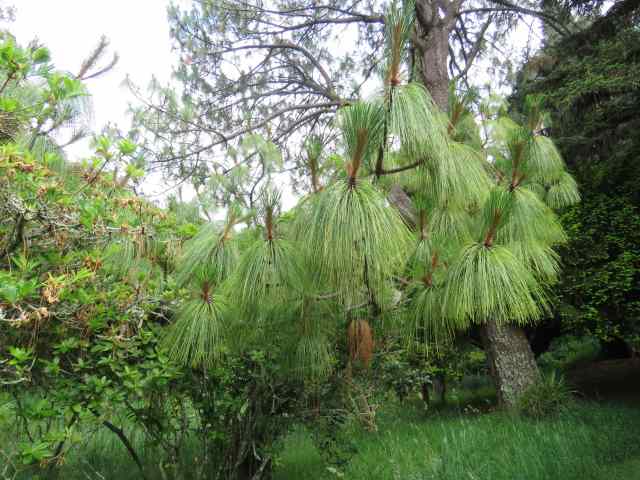
The falling branch of the rather large Pinus montezumae

We lacked even a wilding pine to harvest this year. What could we use? The first plan was to retrieve some of the huge branch of Pinus montezumae which has split but not yet fully snapped off the tree in our park. I could see it would be messy and we would have to be creative in wiring in extra pieces because it is sparse when viewed close-up. But I felt sure a collective effort would see us equal to the task.
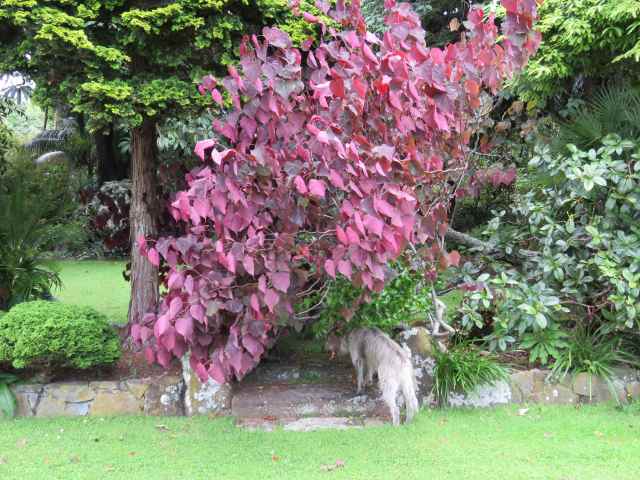
Ralph accompanied me on an inspection of the fallen Cercis ‘Forest Pansy’

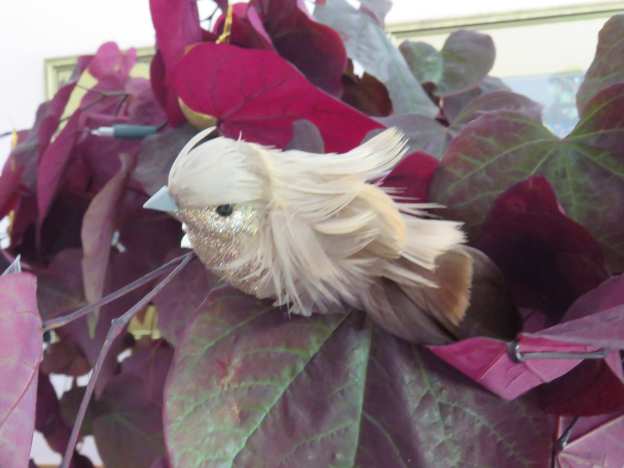
Then the Cercis ‘Forest Pansy’ fell over. It seems to have root problems and it hadn’t even been windy when we noticed it down. It seemed more manageable than the Montezuma Pine although Mark doubted its capacity to take up enough water to keep it alive when cut off. So far, so good. It only has to last another three days so I think it will make it. It is nicely colour-toned to our pink sitting room; it cost nothing either in dollar terms or in environmental impact. It is just not your traditional Christmas tree. I had to bypass all the small decorations because of the big foliage so the decorative aspects are… restrained, shall I say? Golden balls, feather birds and my glass decorations I made back in the days when I was a moderately competent leadlighter and copper foiler and the remaining Christmas lights.
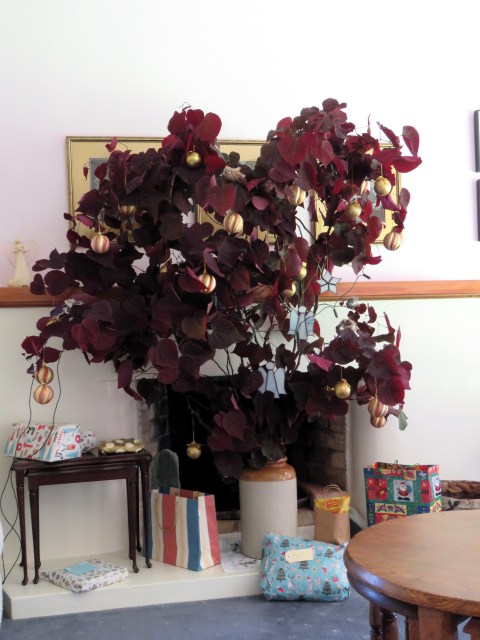
It matches the colour scheme of the sitting room – or, as daughter described it, the marshmallow lounge. On account of it being pink and white, you understand.
The long term prognosis of the propped up cercis is unknown

Lloyd and Zach took 90% of the foliage and branches off the remaining cercis and propped it back up. Only time will tell if it can recover.
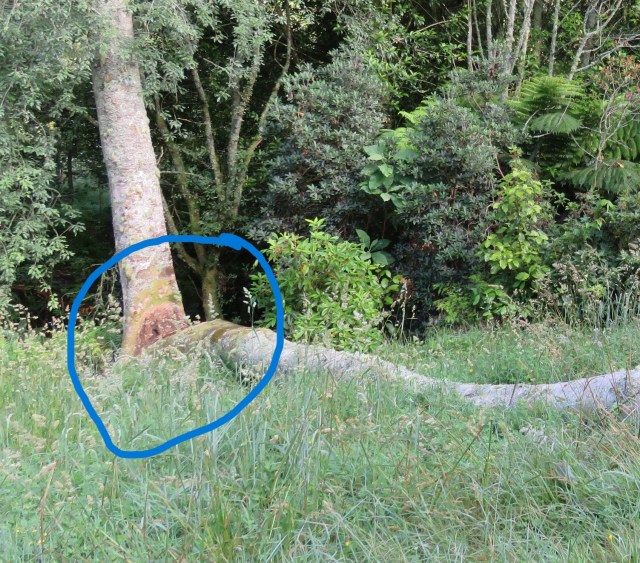
Poor management, allowing the ailanthus to have two leaders at the start

Despite the fact that we have had settled, calm weather recently, we have had more than the cercis and the Montezuma branch fall. I include the tree of heaven (Ailanthus altissima) which lost a trunk last weekend. It is a quick growing tree and something of a weed so it is no loss. But you can see how a trunk split out at the base and it is a good example of why trees should be kept to a single leader from the very start.
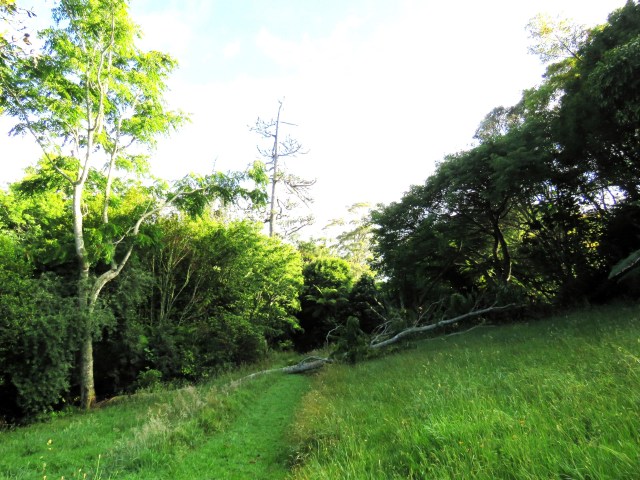
That is quite a long straight trunk whn seen lying on the ground, but low grade wood

The wood is too soft and light to be of any use. Lloyd has cut it into manageable lengths and at some stage soon, Zach will create one of his natural compositions in a wooded areas where they can stand as random uprights and start the process of rotting down to return to the soil.

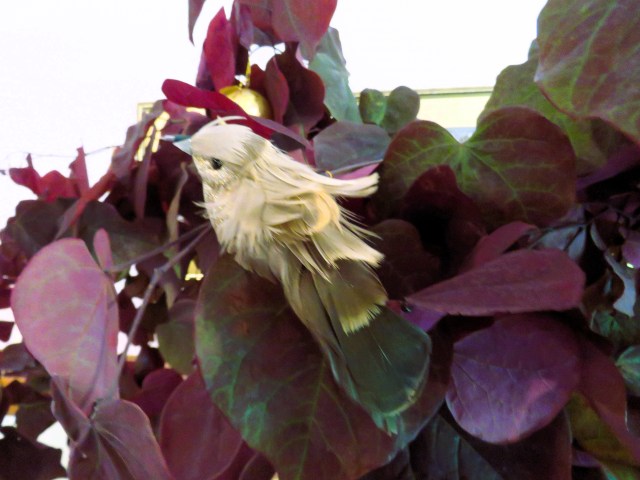
This bird looks as though it may have come off second best in an encounter with a cat but we do not have a cat. Maybe it just had a hard life in the box of Christmas decorations.

May you and those close to you find happiness and congeniality in the festive season. Here, in Aotearoa with our summer Christmas, the country has already started the big shut down when some people at least can breathe out, indulge too much, relax and take time out as much of the country closes down for the next few weeks.
The bakelite Holy Family for an antipodean Christmas

I love Christmas. I love even more the lifetime of memories that come out once a year with the Christmas bric a brac stored in the Harry Potter cupboard beneath the stairs. Our little nativity scene may even pre-date Mark’s birth. It certainly pre-dates mass plastic because it is made from its precursor  – bakelite which was not much used after the 1940s. I have to admit that Joseph used to have a teeny tiny lantern that hung from his hand and I can still recall my dismay as I vacuumed it up many years ago and then failed to find it in the cleaner bag.
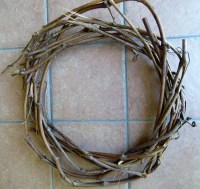
I enjoyed the wreath I made last Christmas in order to display the bakelite holy family. I know you can buy wreathes at shops like Spotlight but we live in the country so I improvise. In this case I retrieved a few grape vine prunings from where they had been thrown to decompose under a hedge. Because I use fresh flowers, my seasonal wreathes are but temporary affairs when compared to the tinsel numbers I see elsewhere, but their carbon footprint is minimal.
In this example, I just gathered an assortment of flowers in red, yellow and white from around the garden and wove them in to the vine circle. The cup shaped blooms in yellow and red are abutilons and the red berries are from Nandina domestica ‘Richmond’ (often referred to as the heavenly or sacred bamboo though it is neither sacred nor a bamboo). The nandina berries hang on for much of the year and it is worth having a plant if you like some for picking. The white flowers are star jasmine for fragrance (Trachelospermum jasminoides), a variation on a climbing hydrangea (Schizophragma hydrangeoides), our native Jovellana sinclairii and the green and white bells of one of the ornithogalum family. Or they may be an albuca.

Abies procera in our garden at Tikorangi

Ours is a household that tries hard to bypass plastic and other non-biodegradable options that tend to flood our lives every day but even more so at Christmas. I have always shunned the idea of a fake tree though at least the tinsel option is commonly stored away for future reuse. I also have a few ethical issues with the felling of trees to die indoors for twelve days at Christmas. Though not so much the Pinus radiata that is the common Christmas tree in New Zealand; they are quick growing and generally seen as disposable. It only takes three and a half years from seed to get your average sized tree. But the northern hemisphere uses a variety of slow growing conifers. In London one early December, I was somewhat aghast at the severed offerings in all the markets of beautiful Abies of Nordmanniana and Abies procera. Neither are rapid growers and even if they are plantation grown (mostly in Scotland and Norway to serve the London market, if my memory serves me right) it seems a bit, well, a bit like an act of consumer-driven vandalism to sever such slow-growing and potentially handsome long-term specimens merely to hold the Christmas fairy aloft in the front lounge.

These days we mostly reuse our version of the everlasting tree but the grapevines that I wove around the metal frame are due for replacement and this is a job that I need to do in winter when the vines are pruned. I have failed to get my timing right the last few winters so I am not sure what we will do this year as it really is too tatty now.

A flat pack designer tree and an Australian version of the outdoor tree

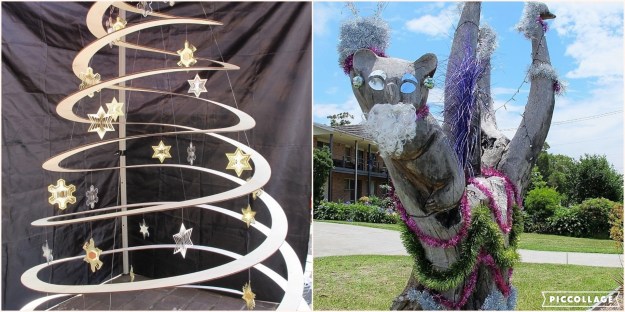
Over the years I have collected photos of various trees ranging from the ingenious to designer style for upmarket apartments. These last options usually fold flat for easy packing away after the event and there really is no place for a lifetime of memorabilia such as are contained in the family Christmas decoration box. But they are at least reusable and if you have a designer style of Christmas, maybe the designer tree is a good fit.

The tinsel adorned tree stump I photographed in Vincentia, a lesser known beach area south of Sydney. Of course it is wonderfully tacky and no substitute at all for the indoor tree that is the traditional centrepiece of the orgy of gift giving. But it made passers-by smile. It seemed a wonderfully Australian take on a time of year that we still celebrate in a southern hemisphere early summer season with traditions straight from a northern hemisphere winter.

First published in the December issue of NZ Gardener – my final column for that publication. Such are the demands of advance deadlines that I had already submitted this copy before I resigned towards the end of September over this column

December in the garden

Kevin and Sharon - the reindeer - at the base of the toetoe Christmas tree

Kevin and Sharon – the reindeer – at the base of the toetoe Christmas tree

December is the month of rituals for us. It is all about countdown and preparation. Will there be new potatoes, fresh peas, strawberries and raspberries ready for Christmas Day? I think we have only ever missed one set of homegrown new potatoes. If my memory serves me right, it was an advanced season and we had eaten all the first crops and hit a lull.

???????????????????????????????

Peas are more problematic and require some precision of timing and management. I adore fresh peas though I lose interest when they are podded and boiled. Browsing from the plant is my preference, followed by raw in salads. Peas generally do better in cooler climates. I admit the ones in the photograph are English. Ours never crop that heavily. In fact they take up quite a bit of space for a meagre to moderate crop here. There are more productive options where space is limited, not the least being beans. But nothing can replace the taste delight of fresh peas. We never have a Christmas turkey here, but we do peas if we can.

???????????????????????????????

Some years, the raspberrries will ripen in time for Christmas Day. The week or two after Christmas they come on stream at an alarming rate, needing to be picked every day but whether those early ones make the deadline for dessert is entirely beyond our control. Even with our raspberry cage, it is an ongoing battle between humans and birds, mostly blackbirds. The pie seems a fairly good option for the birds, in my opinion. They will scout out the slightest weakness in the cage, squeezing through tiny gaps in their determination to help themselves. The wretches will also breach the cloche defences to take out the strawberries we guard for Christmas breakfast. It is a war out there as Christmas approaches.

Christmas trees, we’ve had a few. The DIY ethos rules unchallenged. We have never bought a tree and never had a tinsel one. Generally we have wildling pines harvested from the property. If we are lucky, Mark has preselected the wildling pine and actually given it a couple of trims to get the growth denser than usual. More often, he resorts to wiring in additional branches in a vain attempt to create something akin to the commercially trimmed pines, or the Northern European abies with their wonderful conical shapes. The thought is there even if the reality is a little different.

By far our most creative tree was the one our second daughter made out of toetoe a few years ago. Home from London, she was inspired by an illustration she had seen of one created from the plumes of pampas grass. No pampas here. It is on the absolutely banned list as a noxious weed. But toe toe (which used to be a cortaderia but has now been reclassified as an austroderia) is our native substitute.

Should you wish to try this at home, be warned. It takes many more toe toe plumes than you think. Many, many more. They will moult through your car boot, even more in the construction area and they will then gently shed in the house all Christmas. But then so do pine needles and they are a more difficult to vacuum up. The toe toe tree was a tour de force. It had a certain Pacifica vibe going, combined with European style. If you want to try it yourself, there are step by step instructions on my website. https://jury.co.nz/2010/12/24/construct-your-own-christmas-tree-with-abbie-camilla-jury/

???????????????????????????????

All this is entirely academic for us this year. After more than three decades of building our own family traditions and keeping them the same as assorted offspring migrated home for Christmas, this is the first time we will not be celebrating at home. We are heading over to join the Australian-domiciled daughters and their families this year. I guess it may even be prawns on the barbie. It will be different as the next generation build their traditions for the festive and family season.

First published in The New Zealand Gardener and reprinted here with their permission.

Saturday morning at the Christmas tree farm

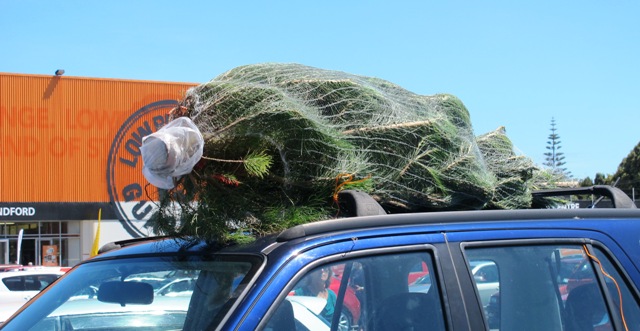
A southern Christmas – the pine tree on the SUV roof against a background of blue summer skies and orange Mitre 10.

A southern Christmas – the pine tree on the SUV roof against a background of blue summer skies and orange Mitre 10.

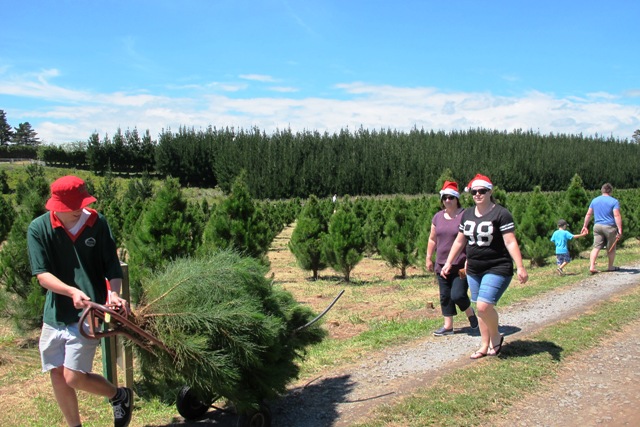
A visit to a Christmas tree farm was a new experience for me. In fact, I was amazed when I called in on Saturday morning. The whole place was buzzing. Cars, trailers, families, staff, a tree wrapping machine – even a sausage sizzle. It was like a single focus gala day. This was a set-up where you chose your own tree and it was cut to order on the spot.

My interest had been whetted when I saw a vehicle outside the supermarket with a wrapped tree tied to the roof. Clearly this was not one purchased from a trailer beside the road. Christmas trees were already on my mind because there is something about the disposable nature of them that was nagging at me and I had been gently looking for alternative ideas. Ours is a household where we have a tree every year – but not a tinsel one in sight – but we have never paid money for one. I can remember our second daughter once wistfully suggesting that maybe we could buy a perfectly shaped specimen but the DIY ethos rules supreme and this was dismissed on the spot. Of course we live in the country with self-gathered options available. It is different for urban dwellers.

Choosing exactly the right tree was a family affair although the choice is Pinus radiata or Pinus radiata

Choosing exactly the right tree was a family affair although the choice is Pinus radiata or Pinus radiata

I was so impressed by this Christmas tree farm. Our main local one is Cedar Lodge Nursery. Outside this period, they continue to produce and sell a range of interesting conifers which are not widely available on the market. With a proud tradition over the decades, they are one of the few remaining tree nurseries in this country to still offer a mail order service. But come December, it is all about pine trees for Christmas.

The use of Pinus radiata as the main Christmas tree is largely a New Zealand tradition. The Europeans and North Americans lean more to members of the abies and picea families – the spruces and the firs. These are much slower growing, even more so when you factor in naturally slower growth rates in less hospitable climates than we have here.

Max the Dalmatian posed amongst the pine trees destined to the 2015 crop for harvesting. These have yet to be trimmed to get the denser habit which is desirable.

Max the Dalmatian posed amongst the pine trees destined to the 2015 crop for harvesting. These have yet to be trimmed to get the denser habit which is desirable.

The clipped and shaped Pinus radiata that I was looking at last Saturday were three and a half years old. That will be from the time they were sown as seed and they had made handsome trees around the two metre mark. It will take longer than that to get the Northern hemisphere abies and picea Christmas trees to saleable size. In the hierarchy of splendid, long term trees, the abies and piceas rank much higher than the utility pine.

I hesitated over severing probably hundreds of thousands of them in their youth to hold the tinsel and a Christmas fairy for a few short weeks when in London in early December a decade ago. There were hundreds of Nordman firs (Abies of Nordmanniana) being sold cheaply in the Portobello Road street markets. Mark allayed my fears by pointing out that many of these will be thinnings from forestry plantings and the ability to sell them as Christmas trees is no doubt a welcome addition to income.

It was a hive of cheerful activity at the Christmas tree farm

It was a hive of cheerful activity at the Christmas tree farm

Our pine trees are grown as a crop, as are many other plants. Yes they are a disposable, consumer commodity. So are poinsettia and most pot chyrsanthemums. The trees are starting to die the moment they are cut off to your request but so are all cut flowers. It is not as if we are stripping out our forests. If you are worried about environmental issues, I am sure you can forgo the synthetic wrapping to hold the tree in a more compact form until you get it home.

Some suppliers offer a recycling service where you can return the poor dried out thing to be mulched. Or if you can find a suitable spot to hide it, it will break down naturally over time and feed the soils – saving on the fuel to run the powerful mulcher.

The advice on care for cut Christmas trees is that the critical issue is to re-cut the main stem of the tree when you get it home and plunge it immediately into a bucket of cold water. This fresh cut enables the plant to keep sucking up water which is what extends its life. Keep topping up the level every few days but the advice to seal the cut with boiling water, or to add sugar or aspirins is unnecessary and unlikely to add to the longevity of your tree. A tablespoon of bleach should stop the water from going stagnant.

Enjoy your pine Christmas tree with a clear conscience. Our quick turn-around Christmas trees will have made more contribution to the environment in their short lives than any more permanent tinsel tree.

Last year’s leftover trees, kept trimmed, now 4 ½ years old for those who want a super duper grade of tree and have wide enough doors to fit one inside

Last year’s leftover trees, kept trimmed, now 4 ½ years old for those who want a super duper grade of tree and have wide enough doors to fit one inside

First published in the Waikato Times and reprinted here with their permission.

Oh Christmas tree, oh Christmas tree…

The pohutukawa - often called the NZ Christmas tree

The pohutukawa - often called the NZ Christmas tree

Ah, the Christmas tree. I was a little amused by a comment on Twitter from somebody that their potted pohutukawa had arrived but was considerably smaller than they had expected so their decorations were now placed beside it. Somebody else posted a photo of their potted karaka tree festooned in gold tinsel, Christmas balls and lights. It looked odd, but logic says it is no odder than adorning a pine tree in similar fashion.

Some brand the pohutukawa as the New Zealand Christmas tree. Living near the coast as I do, pohutukawa feature very strongly in the landscape. They obligingly flower at Christmas, lighting up the landscape. But of course there are large parts of New Zealand where they don’t grow or aren’t needed and residents there may well question the seasonal accolades bestowed upon it. When I say they don’t grow, the problem is that this special tree is not overly hardy. Indeed it is distinctly frost tender when juvenile. If you look at the distribution, it is largely coastal because disturbed air flows from the sea prevent frosts. Head just five or more kilometres inland and it can be too cold for them.

The other aspect of pohutukawa is that they are a wonderfully obliging and resilient coastal tree, putting up with salt laden wind and making enormous buttress roots to hold back the ravages of coastal erosion. They will grow where most other trees struggle badly, defoliate and die. Our coastal areas would be barren wastelands without them. Once you move to more sheltered areas inland, you have a much larger palette of trees to choose from so the tough pohutukawa might not be the tree of first choice. So for those of us who live in coastal areas from about the lower middle of the North Island upwards, the pohutukawa is our New Zealand Christmas tree but there will be New Zealanders who have never seen one in flower.

Did some not make the grade in years past? A commercial grower's roadside field. Spot the two that have never been clipped

Did some not make the grade in years past? A commercial grower's roadside field. Spot the two that have never been clipped

For others, it has to be said the common old pine tree is more likely to deserve the award. Many people do not realise it is in fact native to California – it grows wild in a limited area of the Monterey Peninsula. But I think we could probably crown this country as the Pinus radiata capital of the world and certainly other countries don’t tend to use the humble pine as a Christmas tree. The handsome abies family are the favoured tree in Europe, particularly A. procera and A. nordmanniana, and these are so much slower growing that there are good grounds for raising eyebrows at the environmental vandalism of severing them to become temporary frames for Christmas lights. At least Pinus radiata grows so quickly in this country that it is more or less disposable. It also clips very well and if you buy a cut tree from a commercial grower, you should get a well shaped specimen with shorter needles. We were always into gathering wildlings, though the children would have liked better shaped specimens when they were young. They used to bewail the unbalanced shapes, the scruffy branches and the extra bits tied in to pad out particularly sparse areas.

Should you contemplate a growing Christmas tree in a pot as a last minute green alternative, you need to factor in three aspects. A large tree has a correspondingly large root system and is damned heavy. Don’t expect a living tree of two metres plus unless you have a small fork lift. It then takes a fair amount of skill to keep large plants healthy for an entire year so thinking you can keep your living Christmas tree and reuse it in future years may not be entirely practical. You are far more likely to have a moth eaten looking specimen with dead patches, badly root bound and hungry come next December. Thirdly, should you have purchased a living tree with a view to planting it out in the New Year, make sure you harden it off slowly to the bright sunlight when you bring it outdoors, saturate the root ball before planting and keep watering the poor thing all summer. But above all, choose the site carefully. Most living Christmas trees are forest giants in their infancy. They are not generally suitable candidates for suburban gardens, even less so if you are planting one a year.

The grapevine version

The grapevine version

If you are still determined to try a live option for the future, take a look at our native matai and start clipping and training it early.

If the live Christmas tree is an ethical option based on concerns about the abject waste of severing a tree in its prime to adorn your house for two short weeks, it would probably be kinder to the environment to stick to the disposable pine tree or go for the reusable option. As a family which shuns the horrors of the tinsel Christmas tree, I am hoping my efforts with the woven grapevine pyramid will be greeted by the returning adult children today as an acceptable alternative.

Merry Christmas everyone and best wishes for a safe and happy festive season.

First published in the Waikato Times and reproduced here with their permission.