Tag Archives: Garden book reviews

Abbie’s book reviews

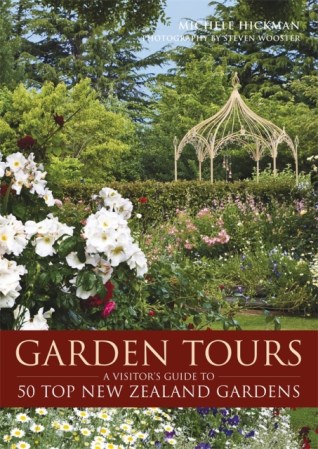
Garden Tours. A Visitor’s Guide to 50 Top New Zealand Gardens

The first thing I did on receiving what claims to be a garden visitor guide was to look at the contents to see who was included. There were some… ‘interesting’ inclusions and indeed exclusions. The entire east coast from Hawkes Bay to Poverty Bay has been bypassed.

The second thing I noticed is that a number of the public gardens got to write their own text which seemed an interesting authorial and editorial decision in what purports to be a guidebook – ergo independent.

Five minutes. It took just five minutes of dipping in to the book to realise that at times the author was writing about places she had not visited. I phoned a few friends whose gardens are included and they confirmed that she had never been there, a point not disputed by the publisher when queried. She carried out interviews by long distance phone calls and email from her UK base. No matter how hard you try (and the author has worked hard on this book) you can only tell so much from photographs and it was her failure to get to grips with matters of scale and proportion that alerted me to the fact she had only ever seen photos of some of the gardens at least.

In fact if you read the intro, the starting point for the book was the photo library of UK photographer, Steven Wooster. The author also makes the telling comment: “…each (garden owner) has approved the text written about their garden”. So much for independent commentary, then. It is still a mystery to me how she can write over 2000 words (10 pages including photos) on some gardens which I suspect she may never have seen in person. Others are much briefer – presumably the owners were less forthcoming on the phone.

So, had we been approached to have our garden included in this book, how would we have responded, knowing that the author had never visited? We would probably have agreed. What is not to like about free publicity written with the appearance of great authority when you even get to approve the text before publication?

The photographs are patchy. Some are lovely. Too many are not, where the light and shade are all wrong and the shadows too deep. Some of the selections fail to give a full picture of the garden and some fail to connect with the text – a problem which results from using existing photos as the starting point. I recognised some photos from earlier use in other publications.

The bottom line is that this book should have been called: “Fifty NZ Gardens I Have Visited” by Steven Wooster (he at least did visit all of them) with Michele Hickman. To publish it as a visitor guide is outrageous. Would you expect to buy a guide to 50 top restaurants where the author had not visited them all but had written the text and had it approved by the restaurant proprietors? Of course you wouldn’t. The same goes for 50 Top Wines or 50 Top B&Bs. So why would you want to pay $49.99 for this one on gardens?

Does it matter? Well, yes it does if I can pick it up within five minutes of starting to look at the book. And saddest of all, was the resigned acceptance I heard from some other garden owners. “It shouldn’t happen, but I guess it does.” Why do we settle for so much less when it comes to garden writing?

Postscript:

The author writes of one garden that it “… stands as a welcome rest from the sometimes anxious quest to make the definitive New Zealand garden, spurning the temptation (italics mine) to realise its European formal outline in native plants and minimising the contrast (or compromise) of English garden style which marries informality with formality.”

That passage is certainly packed with judgements. I have yet to find myself surrounded by angst-ridden gardeners frantically clipping, shaping and pleaching native plants. Cos, like, that’s just such a cliché these days, innit? Can there really ever be such a thing as a definitive New Zealand garden? Many might think that softening the austerity of a stark formal garden is a considerable enhancement, not a compromise. And is the only English style that is to be acknowledged the Arts and Crafts genre? English gardening embraces so much more. How about Capability Brown and landscape gardening on a grand scale? Woodland gardening? Naturalistic gardening?

Of another: “… a garden which showcases the genre with brio. The entranceway… announces the dramatic change of register to full-on subtropicalia.” Subtropicalia? Really? I admit I thought brio was a typo until I googled it – a musical term denoting vibrancy. Or something.

I have been to both these gardens. I wonder if the author has.

Garden Tours. A Visitor’s Guide to 50 Top New Zealand Gardens by Michele Hickman, photography by Steven Wooster. (Random House; ISBN: 978 1 86979 992 2) Reviewed by Abbie Jury

The Bad Tempered Gardener from the Welsh borderlands

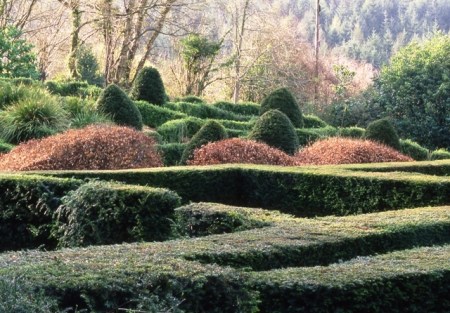
Veddw, the garden of Anne Wareham and Charles Hawes (photo copyright Charles Hawes)

Veddw, the garden of Anne Wareham and Charles Hawes (photo copyright Charles Hawes)

Anne Wareham (photo credit Charles Hawes)

Anne Wareham (photo credit Charles Hawes)

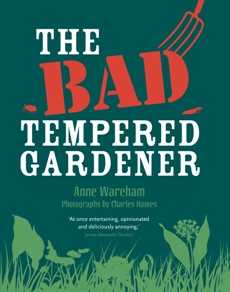
Anne Wareham had my attention from the first page of her book, bravely titled “The Bad Tempered Gardener”. Her second sentence opens:

I have to make my way in a world which is totally alien to me. A world where people are inevitably passionate, always ‘green’ and always terribly concerned about the little furry things….

She continues:

I began to get tired of hearing every garden described as ‘lovely’. I visited many of them and often found them to be banal and uninspired. I began to wish for writers who would tell the truth about the gardens and gardening and found only ‘garden stories’ and discussions of gardening techniques…. The problem is the fond idea that gardening is inevitably nice but dull…. ”

What is interesting about Anne Wareham’s work is that this is contemporary thinking about gardening from a hands-on perspective. I have also been reading Vita Sackville West’s collated newspaper columns from the early 1950s. She is renowned for creating the garden at Sissinghurst. There has been a proud tradition of garden writing by gardeners – Russell Page, Beth Chatto, Penelope Hobhouse and other great names, particularly in the world of English gardening. Not to put too fine a point on it, they are all either elderly or dead. Where is the current thinking?

Garden writing at this time seems to fall into three categories. There are academic treatises out of institutions where gardening has been hijacked by higher status landscape design. Then there are all the novice wannabe books which are of no interest at all to the serious gardener. All that breathless naivety and ingenuous enthusiasm wears very thin if you are not in the target demographic. The rest tends to be either prosaic description or praise in purple prose. There is no attempt at critique and very little in the way of ideas.

Apparently it is the same in the UK though I did think that the writer of the BBC Gardening Blog was guilty of gross hyperbole when he or she babbled of this book that: “Everyone, but everyone has been talking about possibly the most controversial book ever written about gardening.” It is not that radical and actually slots quite nicely into the tradition of garden writing. It is thought provoking and a breath of fresh air.

That said, it is not highly polished and the forty five chapters stand independently, almost as if they are a collation of pieces published previously, though there is no reference to this being the case. So there is not a cohesive argument but more a case of recurring themes. What I can tell about this book is that there is a great deal of thinking time that has gone into formulating the ideas and opinions. The author has two acres of intensive garden which she started from scratch and two acres of woodland which she maintains with her husband. Much of gardening is repetitive and takes little concentration so there is a lot of solitary thinking time. It takes one to know one. It is how I operate so I recognise it in someone else. And I have never before read a book where I have so often felt as if I was in conversation with the author. I kept wanting to say: “Exactly. I wrote about this very thing here.” Whether it is water maintenance, show gardens, rose gardens, scented plants, the impact of devaluing the garden visit experience by bringing it under the amateur and charitable banner, the hyperbole of garden descriptions – this is all familiar territory.

The Bad Tempered Gardener by Anne Wareham

The Bad Tempered Gardener by Anne Wareham

Thought provoking chapters are interspersed with short pieces on plants. These have little relevance in New Zealand. Erigeron is that highly invasive daisy that is actually on the banned list here. Tulip mania has never struck this country in the European manner (to buy fresh bulbs every season seems profligate). Alchemilla mollis is not the easy, frothy plant here that it is in the UK. These are just little interludes, breathing spaces, between the more opinionated pieces. Of interest are the chapters on the creation of her own garden, Veddw, on the Welsh border and the principles which drove her in design and plant selection. We are not in agreement on plants, but that is fine. To disagree with a well thought out and strongly held position challenges one’s own thinking.

Best guess is that the author has cultivated a certain prickly persona. I doubt very much that she is inherently any more bad tempered than the rest of us. The title of her book is probably as much a nod to the late Christoper Lloyd (he of Great Dixter fame) with his book titled “The Well-Tempered Garden” and maybe to Germaine Greer. Readers here may not be aware of the latter’s enthusiasm for gardening. She wrote a newspaper column under the pseudonym of Rose Blight and a collation of these were released in book form under the title of “The Revolting Gardener”.
Indeed, I am wondering about extending the theme with my own book – “The Opinionated Gardener”. Don’t hold your breath, however. I am unlikely to find a publisher any time soon.

I sourced my copy through Amazon though Touchwood Books or good bookshops will be able to order it in. As far as I know it is not on the shelves in this country.

The Bad Tempered Gardener by Anne Wareham. Photographs by Charles Hawes. (Frances Lincoln Ltd; ISBN: 978 0 7112 3150 4).

The reflecting pool at Veddw (instructions are in the book). Photo credit: copyright Charles Hawes

The reflecting pool at Veddw (instructions are in the book). Photo credit: copyright Charles Hawes

First published in the Waikato Times and reproduced here with their permission.

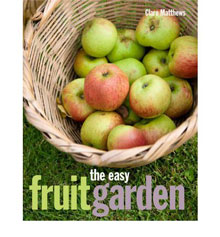
The Easy Fruit Garden by Clare Matthews

The Easy Fruit GardenI do not understand why New Holland wanted to release this book in New Zealand. It is a nice enough book but of precious little relevance to New Zealand growing conditions. It is just so very English – in fact so English that it refers to John Innes number two and John Innes number three with the assumption that the reader will know that these pertain to potting mixes. Jostaberries, sloes, hoverflies and hazels – it is just so redolent of English gardening.

There is little of relevance for New Zealand gardeners. The cultivars they grow are different. Pests and diseases are often different. There is no information to guide NZ gardeners on the climatic ranges of plants. I don’t think citrus are even mentioned, yet they are one of the mainstays for many of us. Yes some of the techniques are transferable but in a colder climate with slower rates of growth, they just garden differently from us.

You would probably only want this book if you are a nostalgic Brit or you are planning on moving to rural Britain.

The Easy Fruit Garden by Clare Matthews (New Holland; ISBN: 978 1 84773 858 5) reviewed by Abbie Jury.

First published in the Waikato Times and reprinted here with their permission.

More bad Penguin

Stop Press
Penguin NZ have issued an immediate recall of all copies of this book.

Slight sense of deja vu here - side by side

Slight sense of deja vu here - side by side

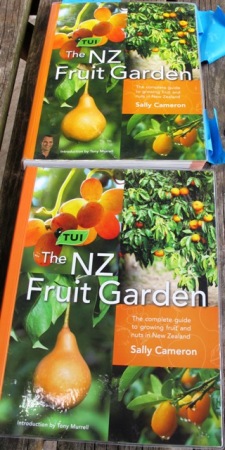
There was a bit of a problem with the first version of the Tui NZ FRUIT Garden by Sally Cameron, published by Penguin NZ. In fact it was clearly quite a large problem, given that Penguin ordered an immediate recall within a few days of its release. It’s usually called plagiarism – rather too much cut and paste from copyrighted sources without acknowledgment. It was the third such embarrassing incident in quick succession for this publisher, the highest profile being Witi Ihimaera’s work, The Trowenna Sea. No matter. Publishers closed ranks and I was on a National Radio panel where other professionals explained that it was all the author’s fault and none of this could possibly be blamed on the maligned publisher.

To my astonishment, Penguin NZ, with the backing of their sponsor Tui Garden, ploughed ahead using the same author to rewrite the book and a year later they issued a second edition which was substantially different. No better, mind, but different and minus the sections which appeared to have been plagiarised.

Would you not think that both Penguin NZ and Tui Garden would have put the first book by the same author in the same series – The Tui NZ VEGETABLE Garden – under the microscope at the same time? I reviewed it when it came out in 2009 and I was far too kind. In my defence, all I can say is that it seemed markedly better than the other book which I was reviewing alongside it. When faced with the FRUIT book a year later, I questioned whether the earlier VEG book might suffer from similar problems related to cutting and pasting other people’s work. I even cited the garlic entry and gave its source as a copyright website belonging to somebody else.

Given the obvious inexperience of the author, did nobody involved think it warranted a closer look? We are talking the same book series, same author (Sally Cameron), same sponsor (Tui), same publisher (Alison Brook for Penguin), same editor (Catherine O’Loughlin). When the author is already under scrutiny, in the dock so to speak, it is difficult to believe that others involved can dump all the blame on her a second time.

It was only ever going to be a matter of time before somebody noticed. And two weeks ago, somebody identified a primary source for the Tui NZ VEGETABLE Garden and posted the following comment on my website:
“Not only has Dr D G Hessayon ripped off Sally Cameron’s Tui NZ Vegetable Garden, chapter and verse, but, he also had the temerity to do it four years prior to Sally being published.
Is it OK to lift entire chapters of books if you include a reference to that book at the end? Hope so, ‘cos I’m just finishing my book “Great Expectations” with a small reference at the back to Mr C Dickens.”

Dr Hessayon's book may look a little old fashioned but is packed full of information and is a best seller - for British gardners

Dr Hessayon's book may look a little old fashioned but is packed full of information and is a best seller - for British gardners

My informant was working from a more recent copy of a source publication, “The New Vegetable and Herb Expert”. English horticulturist and bestselling author, Dr Hessayon actually published his book a good ten years before Sally Cameron produced hers. It took me mere minutes to track down a copy on Trade Me. I think I paid $12 for it plus P&P and it arrived in the mail this week.

Well. Oopsy. How many examples are sufficient?

1) On turnips: Hessayon: Round is not the only shape for these Early turnips – there are also flat and cylindrical ones. There is not much variation in the globular Maincrop types sown in summer, but you can choose the yellow-fleshed Golden Ball. (page 105)
Cameron: Round is not the only shape for these early turnips – there are also flat and cylindrical ones – but there is not much variation in the globular maincrop types sown in summer. (page 174 and one can do a side by side match for much of pages 174 and 175).

2) On Brussels sprouts: Hessayon: Birds are a problem – protect the seedlings from sparrows and the mature crop from pigeons. Hoe regularly and water the young plants in dry weather. The mature crop rarely needs watering if the soil has been properly prepared…. (pages 34-5)
Cameron: Birds are a problem. Protect the seedlings from sparrows and pigeons that will eat the mature crops. (Which type of pigeons, Sally?) If scarecrows don’t work, hang cutlery from a clothes hanger. (That suggestion does appear to be a Cameron original). … Hoe around the plants regularly and water the young plants in dry weather. The mature crop rarely needs watering if the soil has been properly prepared….( page 70 -71)

Even the instructions for picking are eerily identical.
Hessayon: Begin picking when the sprouts (‘buttons’) at the base of the stem have reached the size of a walnut and are still tightly closed. Snap them off with a sharp downward tug or cut them off with a sharp knife.
Cameron: Begin picking the sprouts at the base of the stem when they have reached the size of a walnut and are still closed. Snap them off with a sharp downward tug or cut them off with a sharp knife.

Similar problems exist with broccoli, celeriac, Jerusalem artichoke, the aforementioned garlic and more and I cannot claim to have done anything near a complete analysis. Given that the problems appear to be of a similar magnitude to the first version of the FRUIT book which was recalled, will we be looking at a recall of the VEG book? Maybe Tui Garden might consider whether it is a good look being affiliated to a book which claims to give good advice to New Zealand gardeners when a fair swag of it seems to have come from a book for British gardeners.

Lightning, it appears, can strike twice in the same place. It just beggars belief that editor, publisher and sponsor all appear to have failed to factor that in to their considerations.

First published in the Waikato Times and reproduced here with their permission.

Version 1 at the top, version 2 at the bottom. Just Tony Murrell's photo has disappeared from the cover though the content was substantially rewritten

Version 1 at the top, version 2 at the bottom. Just Tony Murrell's photo has disappeared from the cover though the content was substantially rewritten

The ongoing saga (and it is developing into a saga):

1) The review of the second edition of the fruit book: The Sequel – a second coming for the Tui NZ Fruit Garden

2) Does credibility and reputation count for nothing these days, or does Penguin just think we have short memories? (written upon hearing that Penguin and Tui were using the same author to rewrite the fruit book)

3) The story that started it all and that is currently the second most read article on my website, still receiving hits every day: The Tui NZ Fruit Garden – dear oh dear

4) The lead story on the Taranaki Daily News which broke the first plagiarism story. Since then I have parted company from the Daily News and moved to the Waikato Times.

5) The original review of the Tui NZ Vegetable Garden, which was far too kind and is now embarrassing to me as a reviewer. But I leave it in place because it is a good reminder – and I am considerably more thorough at reviewing garden books in NZ than many others. The Tui book did look better than the other one I was reviewing at the same time – but it, at least, was actually written by the author, based on her experience (however limited it was). Separating the genuine enthusiasts from candyfloss fashion gardening

6) The Tui NZ Flower Garden I merely add this one to complete the set. I declined to review the companion volume on kid’s gardening but I did review the flower book (same series but different author). I would not for one minute suggest that this volume suffers from plagiarism, not at all. It could only be original, for reasons which may be obvious if you read the review.

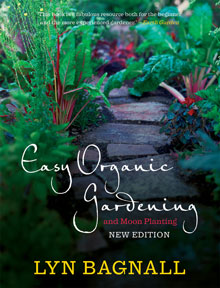
"Easy Organic Gardening and Moon Planting" by Lyn Bagnall

Easy Organic Garden

Easy Organic Garden

This is organic gardening as carried out by a dedicated moon planter but easy it is not. The author subscribes to the why-use-one-sentence-when-you-can-use-ten school of writing. It is very long and wordy, filled with so much detail that even the experienced and knowledgeable gardener can end up seriously baffled. You need to be a believer to want this book. As it is in its second edition, there are either a fair number of believers out there or there is a thirst for knowledge on the topic of organic gardening. I suspect the latter but I am not convinced this book will give the answers.

I am very keen to see books which will separate the organic gardening concepts from faith and mystique. Psuedo science does not do it. Nor do sweeping statements. When I read statements like: “I must confess to not fully understanding the science behind this particular portion of moon-planting principles, but I do know it works in practice,” I start to worry. The author is referring to the changed polarities of yin and yang in Virgo and Libra. I get irritated by the careless use of the word chemical as a synonym for all that is bad and destructive in gardening. A chemical is simply a substance or a compound. In itself it is neither good nor bad. I raised my eyebrows at the claim that synthetic fertilisers lock up essential nutrients in New Zealand soils. Really?

I am all for sustainable gardening practice and I think it is all to the good that we are questioning some pretty dodgy habits. If you are willing to drill down into this book, it promotes good environmental practice, aimed at the author’s homeland of Australia. It covers both ornamental and productive gardening and even has a helpful section on bushfire season. There is just an awful lot of smoke and mirrors to get through first and the husband still doubts that it is possible to get a tomato crop through in our climate without a little non-organic intervention.

(Scribe; ISBN: 9781921372605)

First published in the Waikato Times and reprinted here with their permission.