Tag Archives: garden edging

Seamless transitions – doing away with garden edgings

Beth Chatto’s dry garden in the UK was a revelation for us and, to this day, we see it as a major influence in the whole shift of direction with the New Perennials or New Naturalism movement that is more commonly attributed to Piet Oudolf.

Beth Chatto’s dry garden

Beth Chatto was planting on an old riverbed in an extremely low rainfall area and she wanted a garden that did not rely on any irrigation at all. Clearly this bears no relationship to our conditions. We never irrigate because we don’t have to; we never suffer from low rainfall. But it is the absence of garden edgings I want to draw attention to.
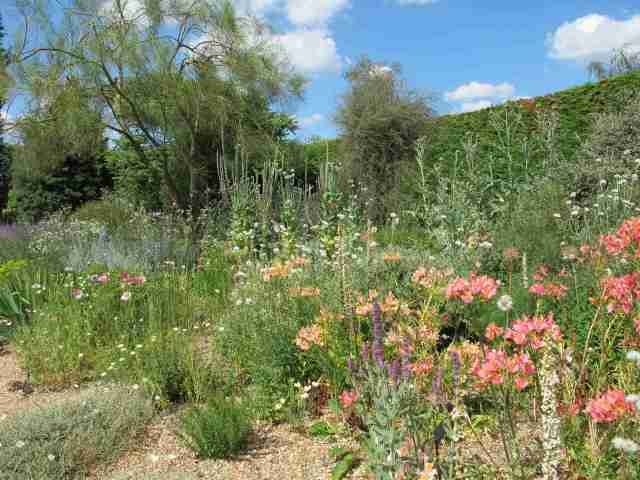
I don’t for one minute think that they have to do as much maintenance on their perennials in these testing conditions in Beth Chatto’s garden. We would be digging through that mulch and bringing up the soil from below all year round.

Garden edgings are basically about containing the garden and giving definition. To do away with them altogether completely changes the look and makes it far more natural in appearance – albeit while not being natural at all. I really like the look and debated about it when we were putting in the Court Garden but decided not to for practical reasons.
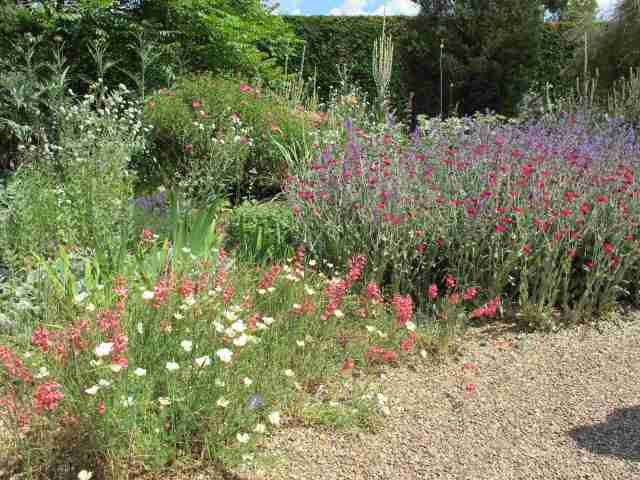
The Chatto garden again

It came back to mind recently, firstly with the visit of Australian, Michael McCoy and then looking at some of Penny Zino’s photographs of her summer gardens in North Canterbury. I don’t have permission to use their photos here  but you can find them both on Facebook where they post photos able to be viewed by anyone or go to their own sites – https://www.flaxmeregarden.co.nz/gallery for Penny Zino and https://thegardenist.com.au/ for Michael McCoy. I am not an Instagram user but Michael is active on that forum too as @michaelmccoyongardens. If you browse their photos, you will find examples of these seamless transitions – paths meandering through plantings in the Chatto style and very charming it is, to my eyes at least.
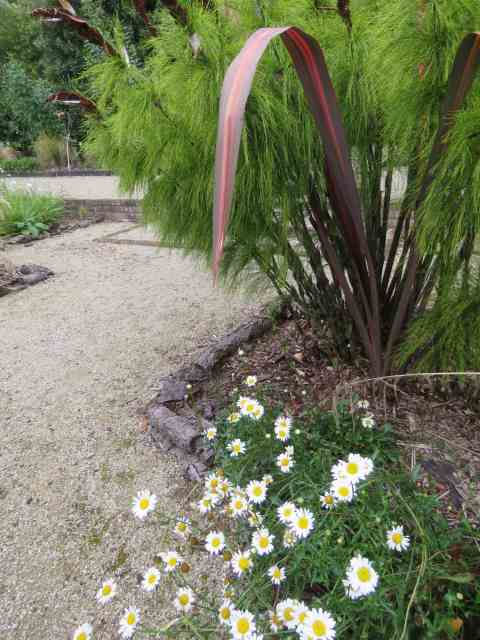
We used a fine, cream coloured grit that compacts well throughout the summer gardens

All of us appear to have chosen the same path surface in fine, cream grit and that, in itself, gives definition and lightness. Our grit is 50% crushed limestone and 50% crushed shell, bought from a local supplier of gravels and rocks. Beth Chatto used a mulch around the plants that is the same colour as the path grit but pebble-sized so it looks the same at first glance but it is in fact easier to rake to the side when digging is required. I didn’t notice that at the time but it is clear in my photo records. Not having seen their gardens except in photos, I don’t know whether Zino and McCoy have also carpeted their entire area in the same as mulch or whether they just allow the paths to peter out into leaf litter and soil as it goes further into the plantings.
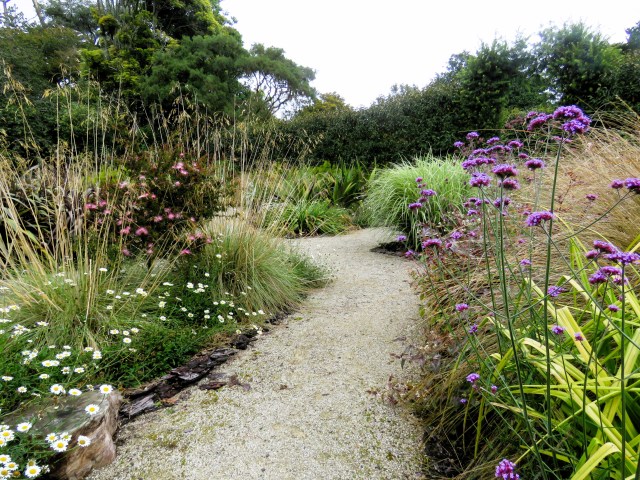
I chose to go with an edging in the Court Garden for reasons that were entirely related to ease of maintenance but we chose an informal edge in lengths of pine bark from on site

It made me reflect on why it is not a practical option for us and why I decided against it. There are several reasons – climate, the presence of large trees, plant selection and maintenance. I think it is a dry garden technique and we are anything but. If the path surface extends through the garden as mulch, it looks best if there isn’t a whole lot of leaf litter and debris on the surface. With the number of large trees we have and being in a windy climate, we have falling leaves and debris all year round. Keeping the cream-coloured paths clear is a big enough job for us, without having to leaf rake or blow all the garden surface too.
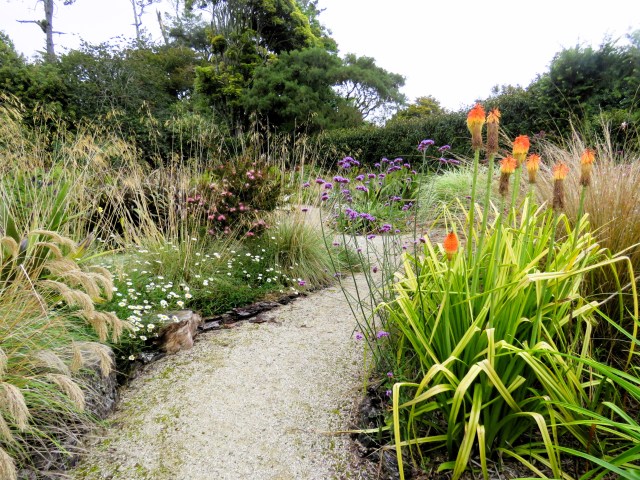
Added to that, in our soft climate, we have rampant growth and managing perennials means constant cutting back, digging and dividing, restricting and deadheading to prevent too many self-sown seedlings. Plant selection becomes critical if you want that seamless look because every time you dig a plant, you disturb the mulch and make a mess. When set in cream grit mulch, it would be easier from the start to choose plants that grow from a central stem – lavender, euphorbias, roses, and salvias come to mind. Plants that form rosettes or spread beneath the ground – like perennial lobelias, alstromerias, asters, echinaceas, rudbeckias – all need regular attention to restrict spread or to keep healthy by dividing. I want to grow all these, too.

It is why we favour composted wood chip mulch. It is easy to top up at the end, cheap to use and, when weathered and composted, it just adds natural humus to the soil. It is best to source a woodchip that isn’t too coarse. Some mulching machines make a big chunky chip which takes much longer to weather and is not attractive to my eyes. Our friendly, local arborist (he lives up our road) provides a good grade of chip which soon becomes anonymous in appearance.  When I cut back or deadhead, I often snip the pieces to smaller sizes and leave them in situ to break down naturally. If I had decorative mulch, I couldn’t do that. 
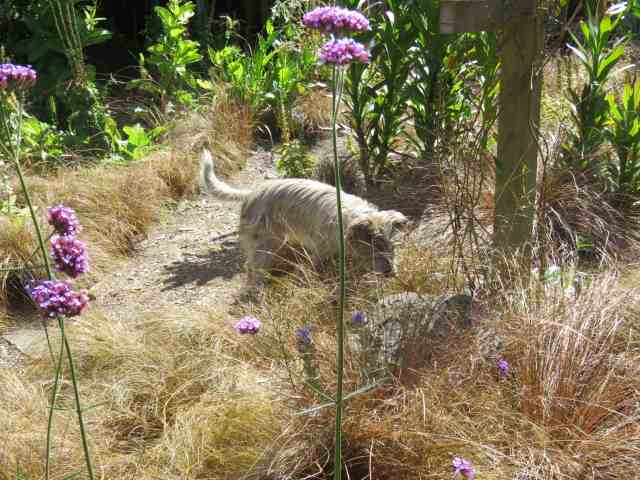
Ralph tones in particularly well with the grassland

Our compromise was to go for that seamless look and meandering paths in the area we now loosely refer to as ‘the grassland’. It is a transitional filler space, primarily using just two native brown grasses, Carex buchananii and Carex coman’s ‘Bronze’ along with a fair swag of interlopers (‘volunteers’ as we call plants that just arrive of their own accord), residual survivors from its earlier uses and bulbs I have added for seasonal interest. So, a limited plant palette overall and most of the maintenance is pulling out seedlings (particularly of the carex) and a bit of occasional grooming of the grasses. It is not carpeted in cream grit but in woodchip – paths and mulch. It is a lower-key look that lacks the contrast and lightness given by the cream grit but it is a long-term, sustainable option in our conditions.
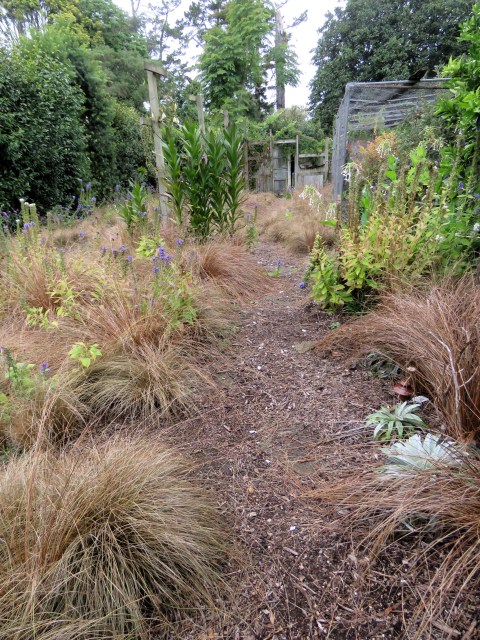

Seamless in woodchip

It is August – time for magnolias, laying paths and killing moss

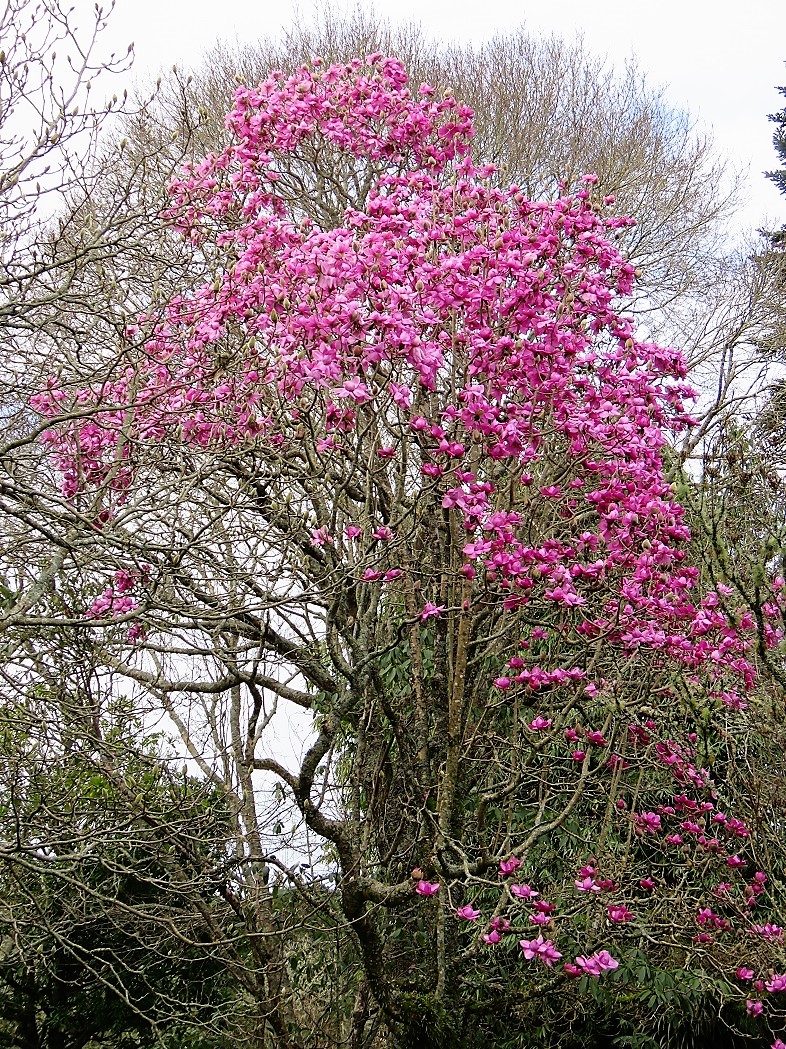
Magnolia campbellii ssp mollicomata ‘Lanarth’

Lanarth down by the water in our park

As August arrives, there is so much happening in the garden. Every day sees something else in bloom and now I get anxious that if I forget to look for a few days, I might miss something. I tell you, spring can be stressful.

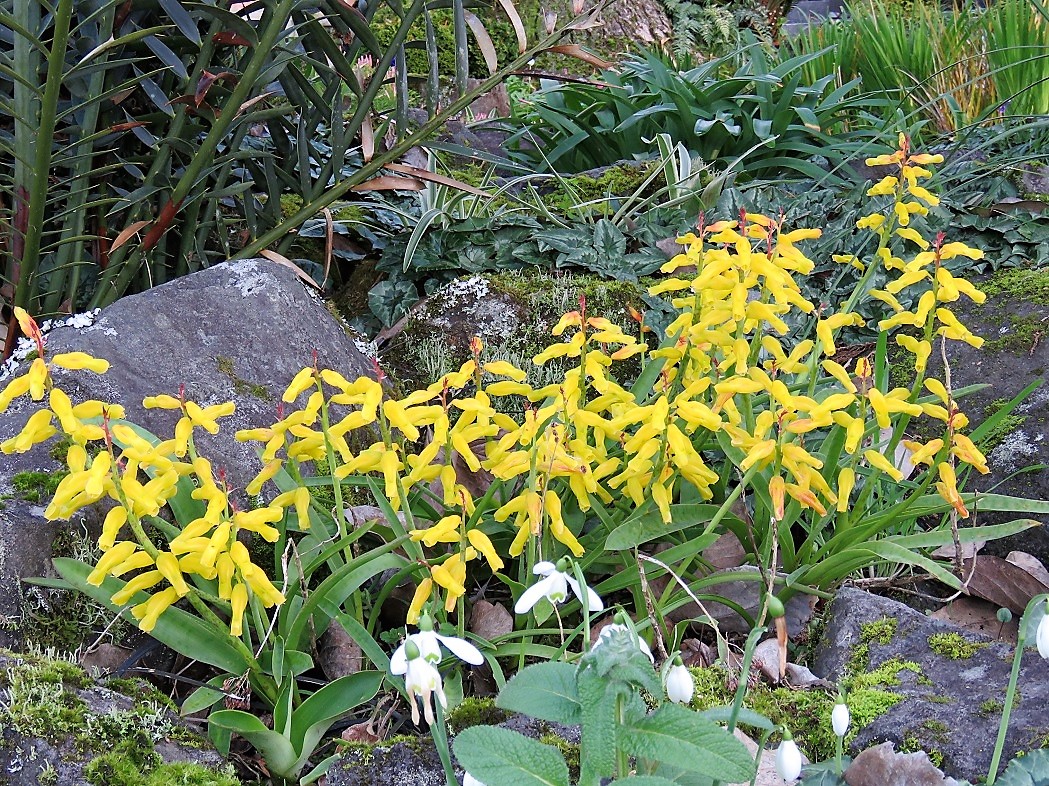
Mark’s yellow Lachenalia reflexa hybrid

But our thoughts go out to overseas readers whose lives continue to be disrupted, discombobulated and sometimes turned upside down by Covid-19. Never has New Zealand felt so comfortably remote and self-contained, a small cluster of islands holding the unpredictable forces of chaos at bay, so far. May you stay safe and well, wherever in the world you are.

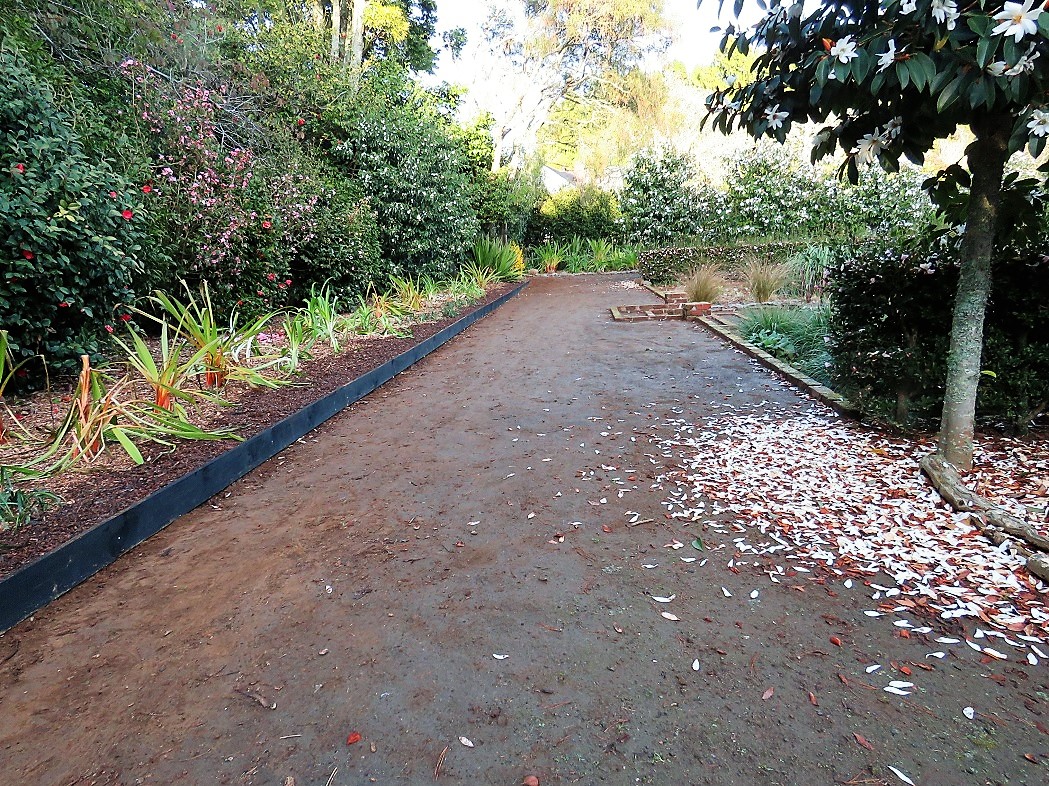
We are inching ever closer to finishing the new summer gardens, or at least to completing this stage of development. There are just the path surfaces to be laid and that has to wait until the man I hope can deliver the materials and arrange a bob-cat returns from holiday next week. We solved the problem at one end where the steps down to the garden were at a lower level than the camellia and michelia hedge that forms the backdrop. It was always going to involve some means of separating the levels. We priced steel edging because I really like that au naturelle, unobtrusive, thin look of gently rusted steel. Buying the branded product specifically designed for garden edging was very expensive indeed and that was without factoring in freight. Ever-handy Lloyd priced buying the steel locally, cut to suitable size, and it came in at about a third of the price but still somewhere over $1000. It was not going to bring me enough pleasure to warrant spending that amount of money.

Compromising with a stained timber edging

Much and all as I dislike tanalised timber in the garden, I compromised and said that would be okay as long as we stained all bits that will be visible to charcoal black. It was a solution that cost $103 (to buy six metre lengths of timber) and once the paths are laid, I do not think it will be obvious at all. The paths will be built up by about eight centimetres so there will not be a whole lot left visible.

A handy bobcat back when we started work on these gardens

Because it is going to take up to 30 cubic metres to lay all the paths, our plan – subject to the advice from the man currently on holiday – is to lay a base core of pit metal compacted to about 3 or 4cm deep and then lay the crushed, creamy yellow limestone on top of that to another 4cm. We think the pit metal will be much cheaper than limestone. We need to hire a bobcat and operator because none of us want to be carting 30 cubic metres of anything and the bobcat will be able to do a lot of the compacting that is necessary. If you have never seen a bobcat operating, believe me they are fast, manoeuvrable and quite mesmerising to watch.

On another practical level, a packet of Cold Water Surf washing powder entered my life. I had forgotten about its existence. It is vile, over-scented stuff that I would never use in the laundry but others may not mind that overpowering scent of chemical fragrance. We use unscented washing powder in this household of sensitive skins. But damn, that Cold Water Surf is a whizz on killing moss.

People in drier climates will not relate to the issues of excessive moss and lichen growth that we get here. There is nothing wrong with some, but we can get way too much. Sometimes we water blast (jet wash) the paths but that also takes off the surface of the concrete and flushes out any filling between pavers. It is just as fast for me to scrape off the top layer of moss, sprinkle Cold Water Surf to kill what remains and then use a stiff broom to sweep the residue off.

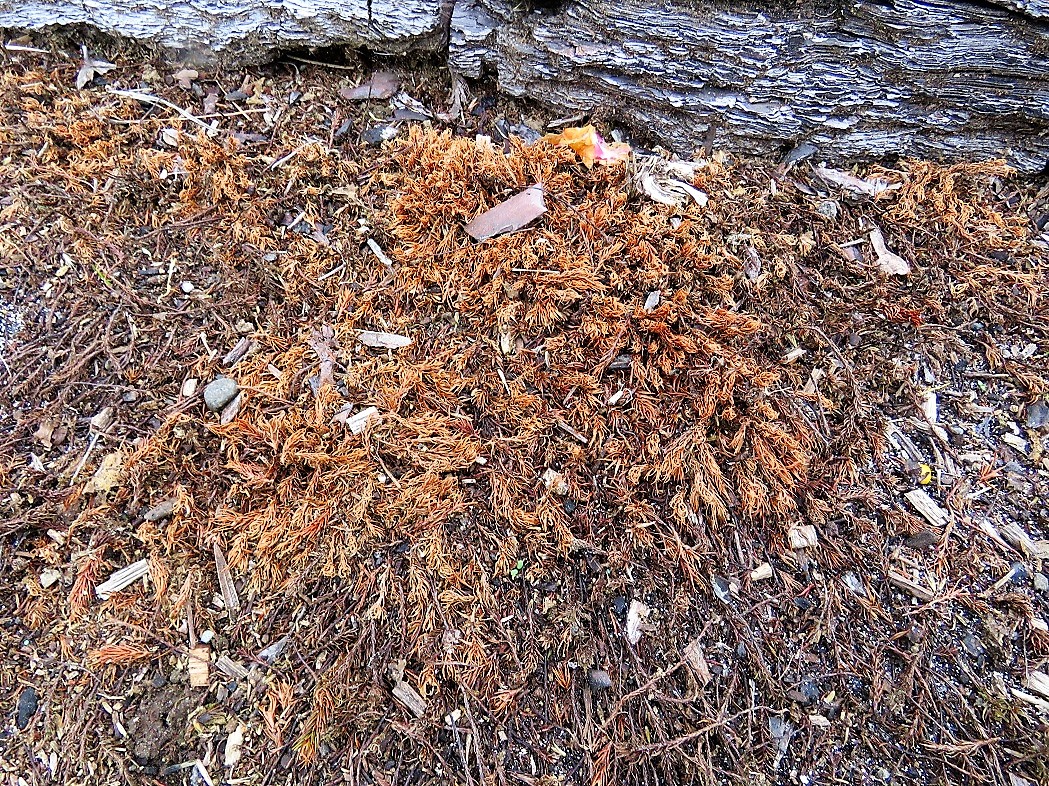
And it can kill very fast. This rather deep-rooted moss browned off within hours and died soon after.

I am no chemist so I struggle to get a grip on the difference between carbonate, bicarbonate and percarbonate. But as far as I can see, the active ingredients in many of the expensive, branded moss killers are often sodium carbonate (washing soda or soda ash), or sometimes sodium percarbonate (which is washing soda and hydrogen peroxide – a common ingredient in eco-friendly bleaches and other cleaning products).

You can buy both sodium carbonate and sodium percarbonate in powder form and I have done so but it worked out relatively expensive to use in the garden when cheap Cold Water Surf works just as well. Logically, this must mean that I was spreading the pure product too thickly when it can be extended by adding some sort of neutral carrier (Mark suggested sand). At a practical level, the products were fine powder and the coarser texture of the laundry powder makes it easier to spread evenly. Also, logically, any proprietary laundry powder should work unless some have a higher percentage of washing soda than others and that I do not know.

I am wondering whether it will work on our sandy coloured pavers in our front entrance courtyard. I water blasted these a few years ago. It was my first ever go on the water blaster and it took a lot longer than I thought it would. It was also wet and messy and blew out the sand between the pavers which Lloyd than had to refill. But they looked like new when done. Now they are blackened and discoloured again. I know there are branded products that attach to the hose that will also work and are quicker to use, albeit expensive. If laundry powder will do it, that appeals to my economical nature and avoids buying another product sold in a hard plastic container. I shall experiment and report further.

Narcissus Peeping Tom

Tikorangi notes: narcissi, garden edgings and a happy plant breeder

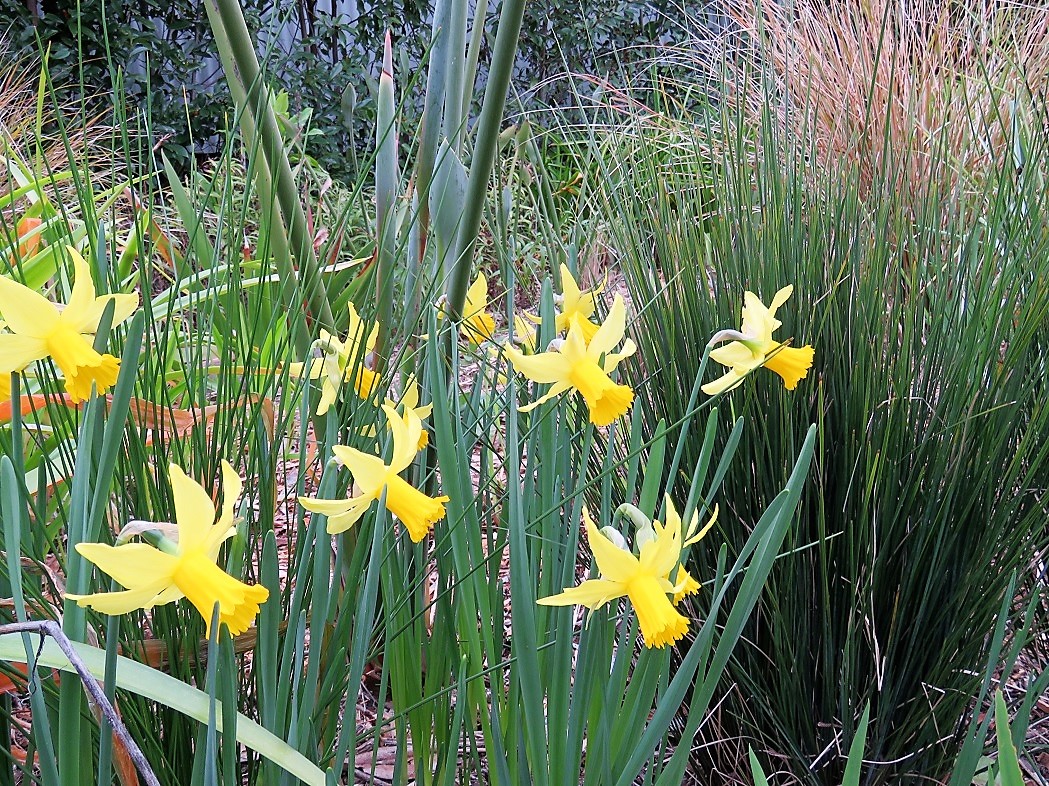
The snowdrop season is all but over already. It is charming but brief. The narcissi, however, have a longer season, at least in part because we can grow a much wider range of species and hybrids. Yesterday felt like a winter’s day – the last gasp of winter, I hope – so I headed out to pick one each of the many different varieties in flower. We don’t grow many of the larger ones at all, preferring the charm of the littlies, the dwarf ones. Bigger may be better when it comes to magnolias – at least in our eyes – but daintiness wins with the narcissi. Most of these are named varieties though Mark is also raising cyclamineus seedlings to build up numbers for planting out and to get some seedling variation within them. The cyclamineus are the ones where the petal skirt sweeps back, sometimes completely reflexed, giving them a slightly startled appearance. He was intending to plant many of these down in the park but hadn’t got around to it so offered them to me for the new grass garden.
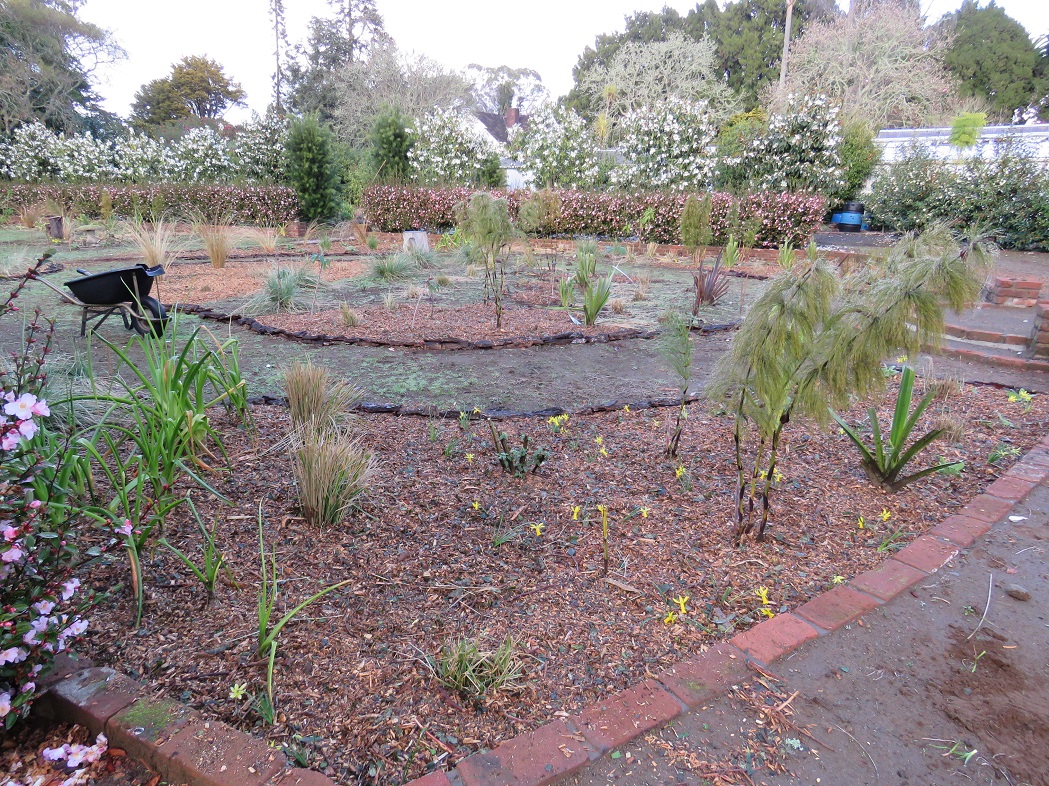
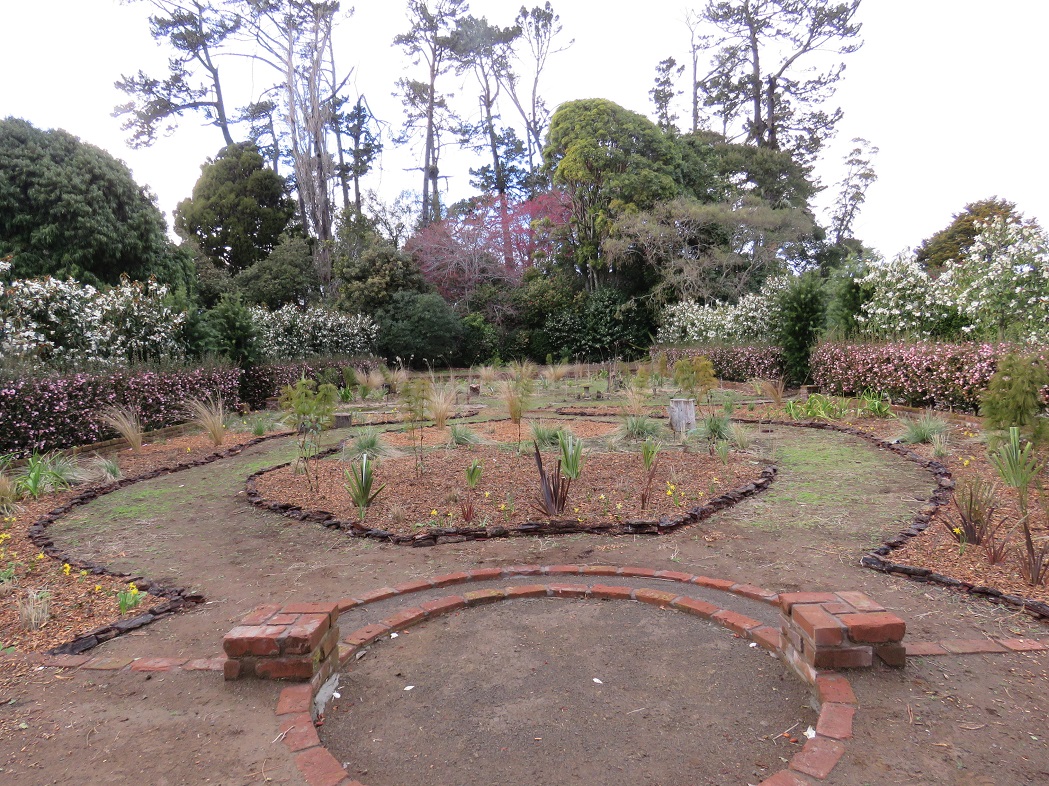
Drifting dwarf narcissi through the new grass garden. Camellia Fairy Blush hedge and Fairy Magnolia White edge the garden on both long sides. 

I have now compromised the big, bold, chunky planting in waves that is the hallmark of the new grass gardens by drifting hundreds of dainty, dwarf narcissi through them – though far enough out to escape being swamped by the large plants, for several years at least. It adds seasonal interest to an area that will not come alive again until later in spring.

Informal bark edging and bark and leaf mulch define the garden area

After much consideration as to how we wanted to complete the grass garden with regard to edging, mulch and path surfaces, we have gone for the casual, organic and local options. As soon as I started to load in the wood and leaf mulch that a local arborist delivered, I realised that the beds would need an edging to hold the mulch from spilling over. My idea of a seamless transition between bed and path was not going to work. We have pine bark to hand – left over from getting the firewood out from a fallen pine tree so I am constructing small edges out of that. It lasts for many years. The paths are still bare earth (we will probably use granulated bark on those) but as soon as I made the edgings and laid the mulch, it took on the appearance of a garden. It is a casual look but one that sits easily with us with the benefit of being low cost and, as Mark keeps saying, the use of organic materials adds carbon to the soils.

I am laying the mulch on fairly thickly – around a forefinger in depth which I measured to be about 7cm. Because it is fluffy, it will compact to less than that but if I see any weeds coming through, I can top it up.

Fairy Magnolia White – not only a beautiful flower form but a very long flowering season, beautiful velvety buds, good foliage and perfume

Mark is a quiet man, not given to blowing his own trumpet, but sometimes I hear him murmur a comment of deep contentment at a plant he has bred and named. So it was this week as we looked at the avenue of Fairy Magnolia White and Camellia Fairy Blush. “I picked White because it had a pretty flower,” he said. And it does. In a world of floppy white and cream M. doltsopa flowers, Fairy Magnolia White stands out with its beautiful star form. There were a lot of very similar sister seedlings to choose from in that cross and as a breeder, he always worries whether he picked the best one. I think he finally decided that he had indeed chosen the best which is just as well, when you think about it, because he will only ever name and release one of that cross

Camellia Fairy Blush also has a long flowering season, drops its spent flowers cleanly and clips well

Camellia Fairy Blush, planted as a hedge beneath the two avenues of Fairy Magnolia White, is also a continuing source of satisfaction and delight to us, even if it is a constant reminder of a missed commercial opportunity. It was the first camellia he ever named and sold. Back in those days, protecting a plant as our intellectual property was not even on the radar and now Fairy Blush is sold widely throughout the world and few know that it originated here and was Mark’s selection. We have even seen it branded overseas with other nursery names but we know it is ours. That is life and it is a very good camellia and continues to be a source of pride and pleasure to the breeder.

Fairy Magnolia White and a very blue spring sky