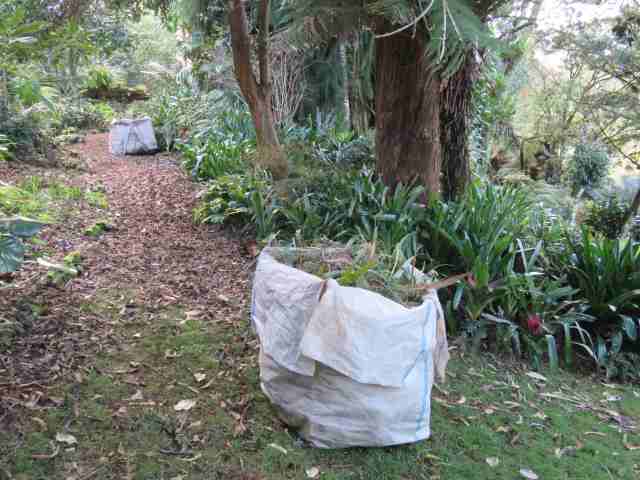
Green waste is removed by the wool bale full – too much for my wheelbarrow .
I coined the description of ‘invisible gardening’ in recent times. It describes when I spend many hours, often days, working through every square metre of a section of garden with meticulous care, removing huge amounts of foliage and debris. All the while, I know that the only people who will notice are the four of us here because, after all that, it just looks tidier. No dramatic changes.
I didn’t think to take a before photo of this stretch but this is the after shot. It doesn’t look as though it has had two wool bales of green waste removed.
I am invisible gardening my way along the lower borders of the Avenue Gardens where it meets the park and the waste is coming out in packed wool bales to be composted elsewhere. So far, I am up to five full bales. I figured it is a reasonably high level gardening skill to pick over an area and remove that volume without making the place look denuded.
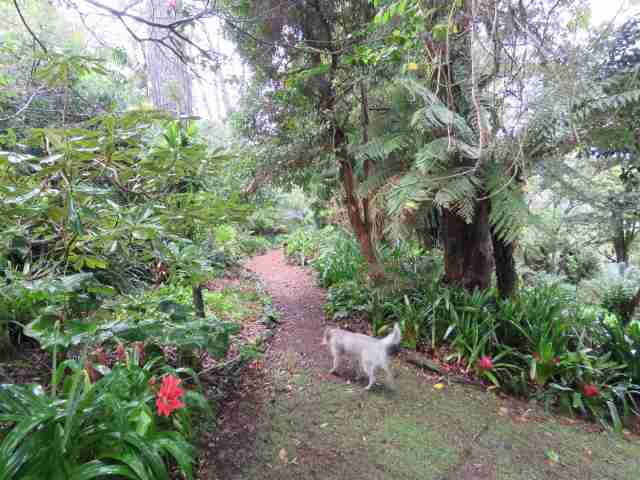
By the time I was onto the next path, Ralph and I remember the camera. This is BEFORE ….
… and AFTER another very full two bales of green waste was removed
I was trying to remember when I last gave this area the same level of close attention. It will be three to four years ago. In the interim, it has had the once over lightly treatment once or twice a year- a bit of weeding and removal of fallen debris and spent foliage, but nothing detailed. We don’t apply fertiliser; natural mulch provides nutrition. And we will only spot-spray if there is a problem that has got away on us. We never need to water.
BEFORE…
and AFTER. Spot the difference. It is a bit subtle, but believe me, a lot has been removed in the clean-up.
It started me thinking how long a garden lasts if you ignore it or just give it the occasional once-over-lightly attention. These are woodland gardens under a canopy that is largely evergreen, which slows growth and restricts weed germination. I came to the conclusion that after about three years, the area loses its definition. This is because plants are no longer standing in their own spaces but have melded together, enmeshed, so to speak. After about four years, the detail starts to go. We like highly detailed gardens – many different plants in varying combinations and a good representation of treasures. By four years, the thugs are taking over (I have removed A LOT of clivia seedlings) and the daintier plants have been squeezed out or swamped. From there, it is all downhill.
Halve the time estimates for sunny gardens. In those conditions, plants grow faster and the weed explosion can be exponential.
I am of the opinion that low maintenance and good gardening are mutually exclusive concepts. You can have one but probably not the other. If you want a lower maintenance garden, stick to shrubs and swathes of the same plant. We want detail and complexity and we live with the resulting maintenance demands. Besides, a couple of weeks every three years or so doesn’t seem oppressively high maintenance.
The meadow in late spring
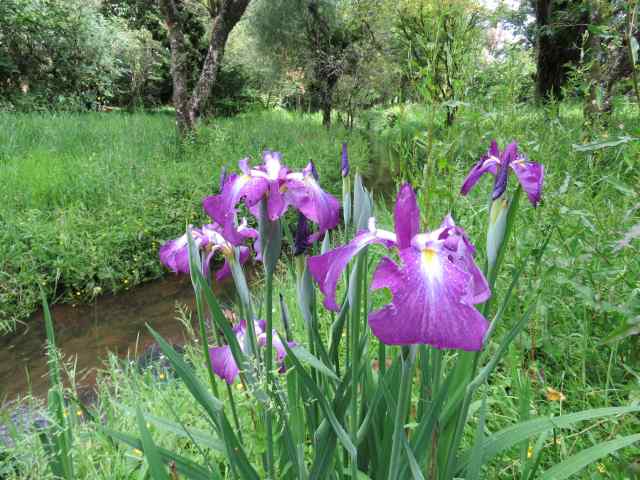
For readers who have followed our experiments in sustainably managing the park as a meadow, Lloyd mowed it all down this last week in June. The areas too steep to mow, he cuts with the weed-eater or strimmer. The timing is important because the bluebells and narcissi are all coming through. We will mow again in late January. With our high fertility and rainfall, we have to cut it right down twice a year. Grass grows every week of the year here, just a bit slower in winter. If we didn’t mow as we do, we would soon lose all the bulbs, the irises and other perennial meadow plants.
I made that term up. It is when I spend a fair amount of time working through an area, removing a large amount of plant material and at the end of it, most people wouldn’t even see the difference because it all looks pretty much the same. Just a bit tidier.
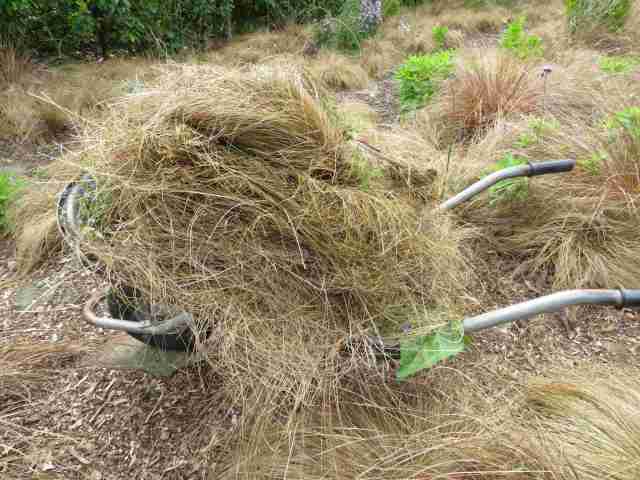
This times ten is a lot of waste to remove from an area that is not large
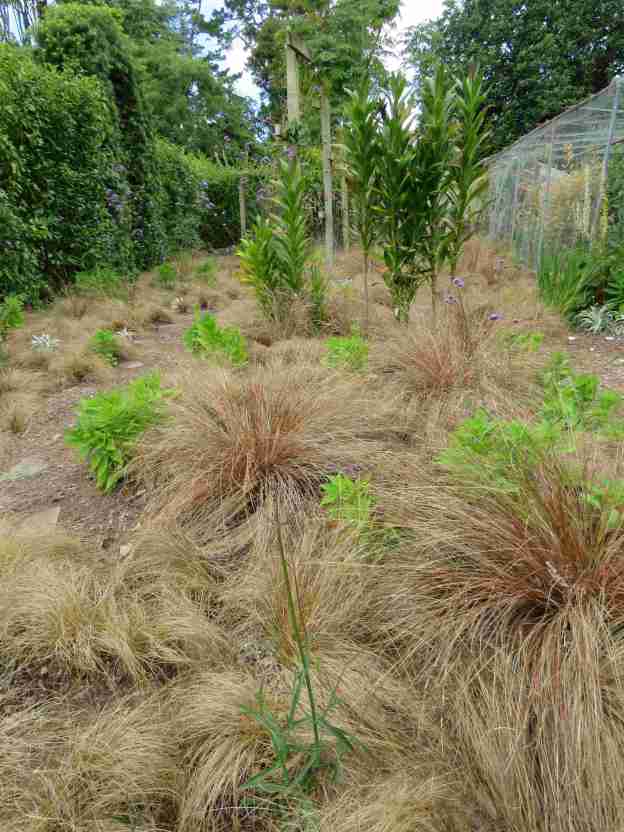
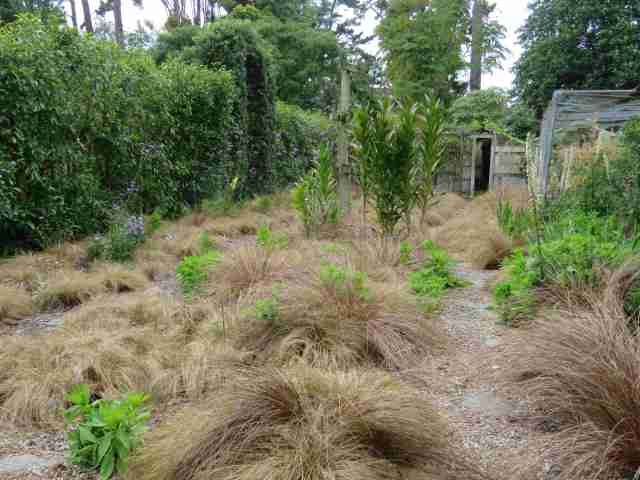
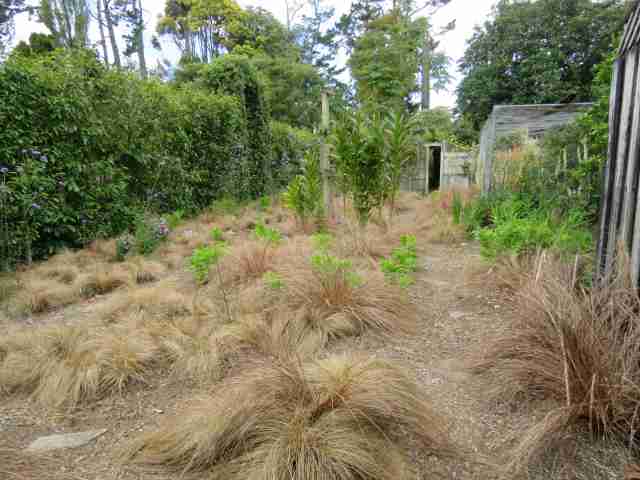
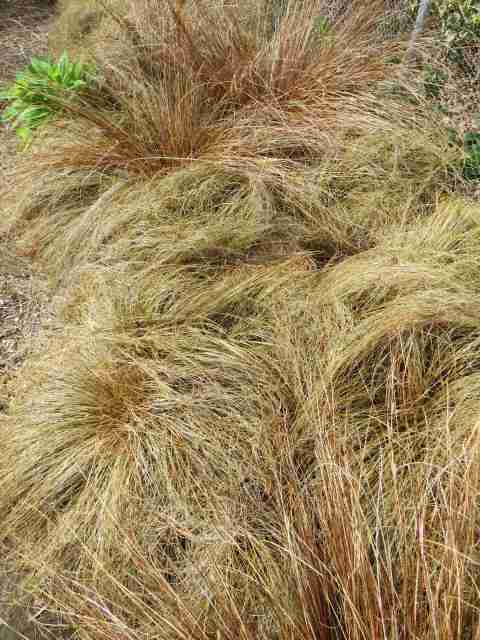
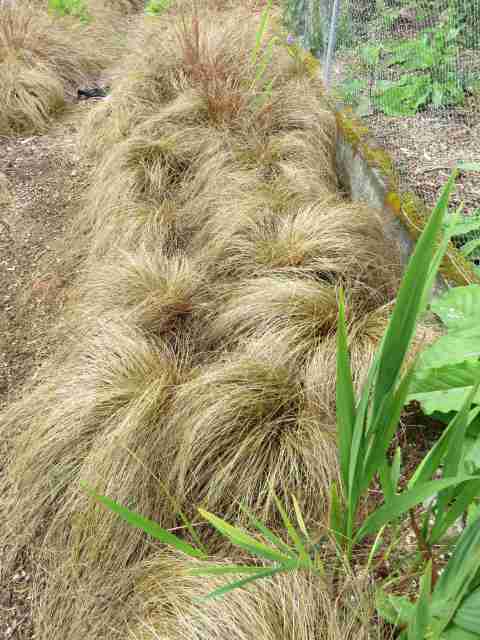
In the past week, I have spent five days meticulously going through the area we refer to as ‘the grasslands’. It is a very simple planting, mostly our native Carex buchananii and Carex comans ‘Bronze’. In the process, I have removed about ten overloaded wheelbarrows full of vegetation but honestly, nobody else is likely to notice the difference. That is fine. In fact, I regard it as something of a triumph because I know it is a lot better.
The ‘before’ scene
And the ‘after’ scene looks very similar
Most of the grasses we grow are evergreen and it seems that taking the time to work them over once a year, removing spent foliage, dead patches and debris buildup in the crown of the plant keeps them looking healthy and attractive as garden plants. That is the big difference between how they grow in the wild and keeping them in the garden – the human hand making an intervention now and then. While they will seed down and establish as a colony in the wild where some dead plants and strugglers are just part of the natural cycle, a garden situation only looks natural. My intervention makes sure that each plant is standing in its own space with limited competition, either from its seedlings or indeed weeds. I also comb out the foliage on each plant to remove the buildup and to keep the festooning form rather than it becoming a tangle.
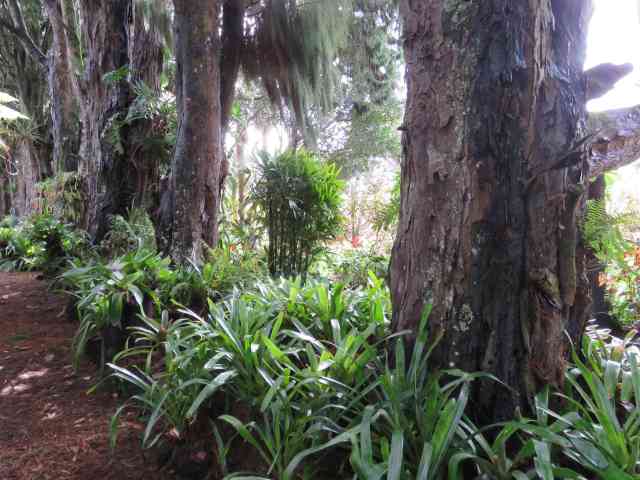
The Rimu Walk is maintained with one major, annual blitz and just the occasional tidy-up of fallen debris inbetween
We have a few other areas that also thrive and look good all year round with just one concentrated, annual blitz on maintenance. The Rimu Walk is notable. Every year, I spend a couple of weeks working my way over every plant from one end to the other and the garden waste is shipped out by the wool bale load to compost in a patch of bush elsewhere on the property. I work on rotating two wool bales and, at a rough guess, we probably move out over fifteen bales full. That is to say, I fill them and Lloyd or Zach remove them for me. At the end of it, there are no gaps in the garden, no bare areas and no indication of the time and care that has been spent but it just looks tidy, cared-for, healthy and loved. My efforts are largely invisible and I like it that way.
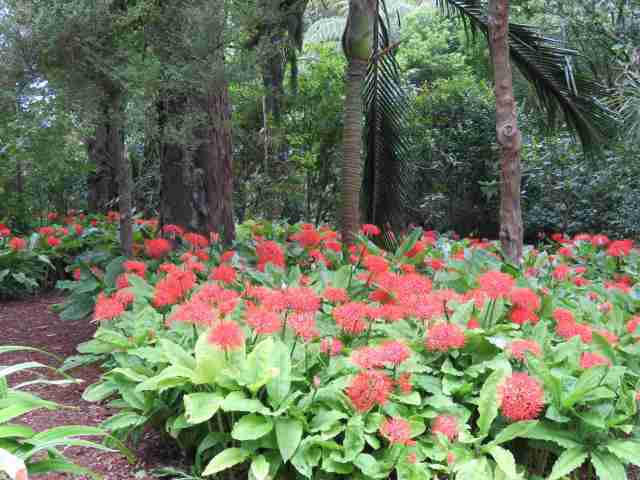
The spectacular Scadoxus multiflorus ssp katherinae is also managed with one major clean-up a year and very little inbetween
I refer to areas like these as ‘low maintenance’. With one thorough, detailed effort a year, there is little that needs to be done between those big clean-outs. We did one weeding round on the grasslands area in spring but nothing else. The scadoxus area will remain largely untouched until late winter again. Beneath the rimus, we will pick up fallen branches and sticks brought down by the wind and pull out the odd weed that has sneaked in but that is about it. They feel as though they are low maintenance, but if you averaged out the hours spent on that annual blitz, they are possibly not that low. It is just different maintenance, albeit that it only works in areas that are largely weed-free to start with, filled with plants that do not require ongoing staking, deadheading, cutting back, dividing, restricting or training and where a thick layer of natural mulch has built up over the years. Nor do they have edgings that need to be maintained, grass that needs to be cut or paths that need to be swept.
It is perhaps easier to see in close-up. Before…
… and after
Garden maintenance can be a bore as well as a chore. There are areas I don’t enjoy working in. But it is oddly satisfying to focus entirely on just one block, working over it in minute detail and wrapping up after a few days, a week or even more and having the area look its well-furnished best at the end of it all, despite the removal of prodigious amounts of green waste. Even better is knowing that it will remain looking fine for the better part of the next year.
Maybe it is more discreet gardening than invisible. it is also a sign of somebody who has the time and inclination to spend on such fine tuning. I am aware that for many people, garden maintenance sits somewhere closer to crisis management and that is a very different scenario.
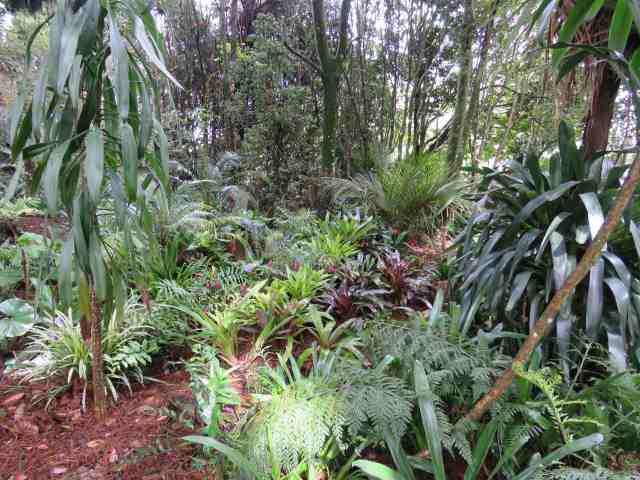
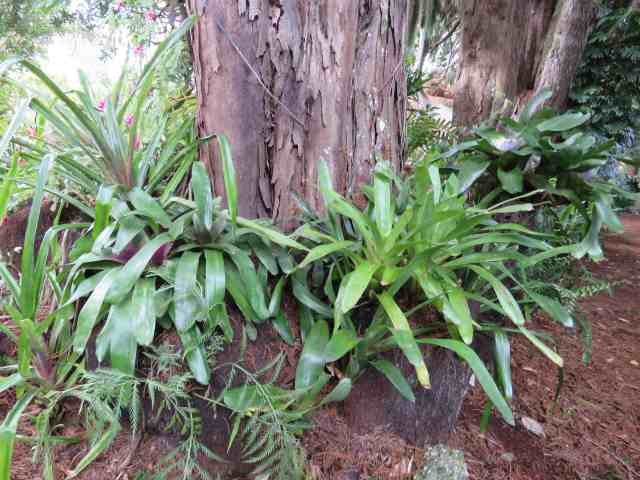
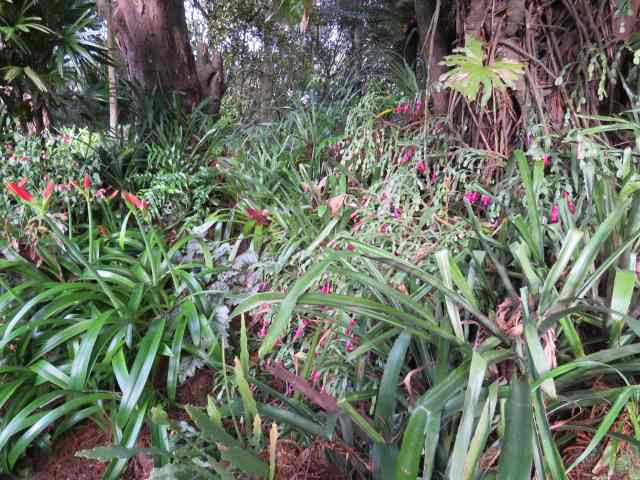
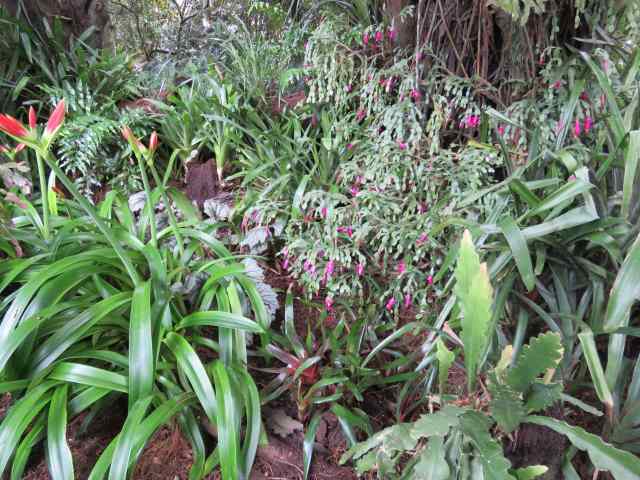
I have been ‘doing the broms’, as we say here. That is the once-a-year thorough workover in the Rimu Avenue. We have complex subtropical woodland planting throughout this area, but in square metreage terms, bromeliads are the dominant plant. This always brings back the memory of the rude old biddy who got into the garden for free on account of being brought here by a neighbour up the road. “I loathe bromeliads,” she declared as she stood in the middle of the Rimu Avenue. “Well you won’t like this part of the garden then,” I replied crisply, getting out of their company as fast as I could. When it comes to insults, I am like an elephant – I never forget.
More a symphony of texture and form than bright colour for much of the year
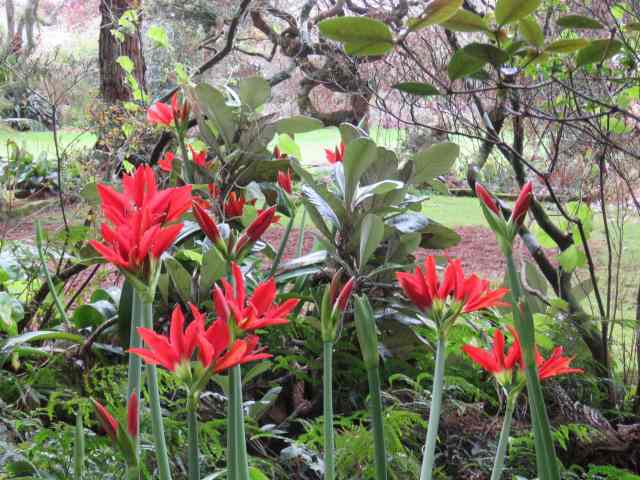
It is not entirely bereft of bright colour. The Hippeastum aulicum are glorious at this time of year and clivias in yellow, orange and red will follow
This avenue has long been one of our most admired areas. First started in the late 1950s, by Mark’s dad, Felix and then doubled in length 40 years later by Mark, it is probably unique in terms of an interesting, remarkably sustainable and low maintenance woodland garden adapted to our climate. Because it is completely frost-free, we can grow true subtropicals beneath the towering canopy of rimu trees (Dacrydium cupressinum) which are now over 150 years old. All up, it is an area somewhere over 2500 square metres, maybe even near 3000.
The Rimu Avenue is roughly 100 metres in length and variable in width
It is undemanding in terms of maintenance. During the year, we will remove dead branches and larger debris that falls from above. It is largely free of weeds, being in shade and having been gardened for so many years, although we are forever removing seedling prunus, nikau palms and wretched bangalow palms. Since we cut down the seeding bangalow (Archontophoenix cunninghamiana), the incidence of those seedlings will phase out in a few years.
We like a highly detailed garden and, while this area may be low maintenance by our standards, it remains diverse and detailed.
Once a year, I start at one end and work my way to the other end, picking over every plant. Yes, it is a big job and it takes about two weeks of intense labour but the difference is rewarding and it is not heavy work. When I say two weeks, it is probably 60 hours which represents just over an hour a week across the year to maintain a major area of garden. I admit that does not include Zachs’s time as he works along the margins or Lloyd’s time removing my mountains of debris. So maybe this annual exercise equates to an average of two hours a week, except we do it in one hit.
Lloyd must have dealt with about 20 times this volume so far. it is a prodigious amount.
When I say mountains of debris, I mean that Lloyd is removing about two packed wool bales a day of my prunings. We used to dump it in our bush across the road to rot down in its own time but this year, Lloyd has been putting it through the mulcher and then using it in compost which is more labour intensive, but we get to use the end result. You can never have too much weed-free compost.
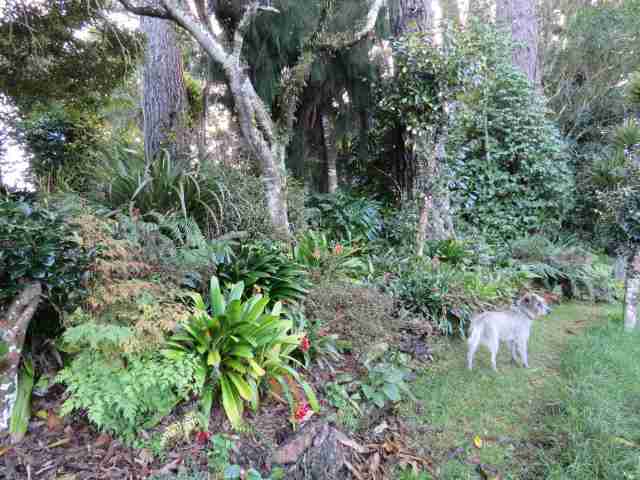
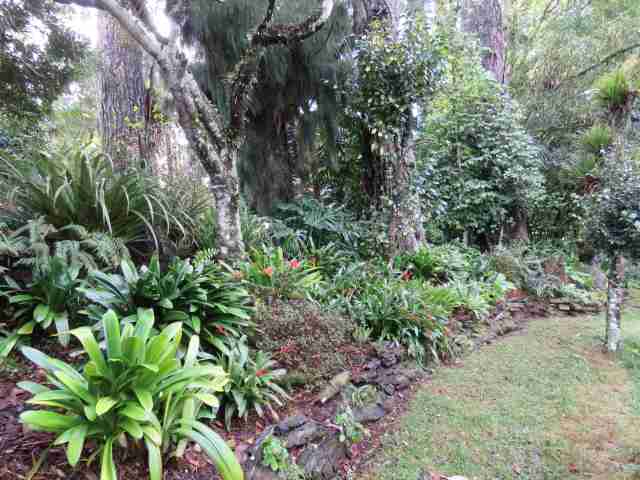
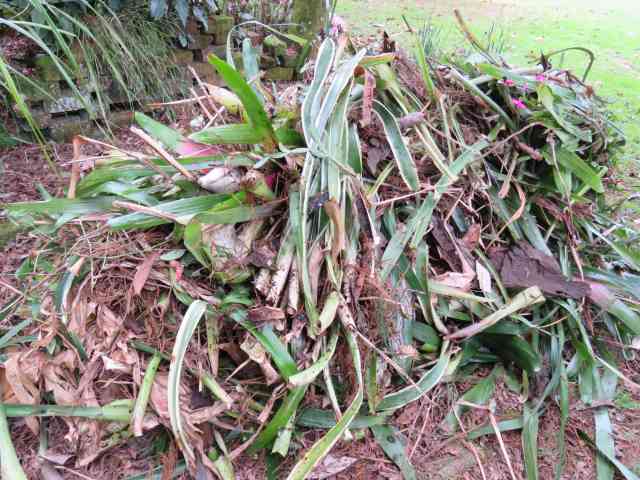
Before
and after
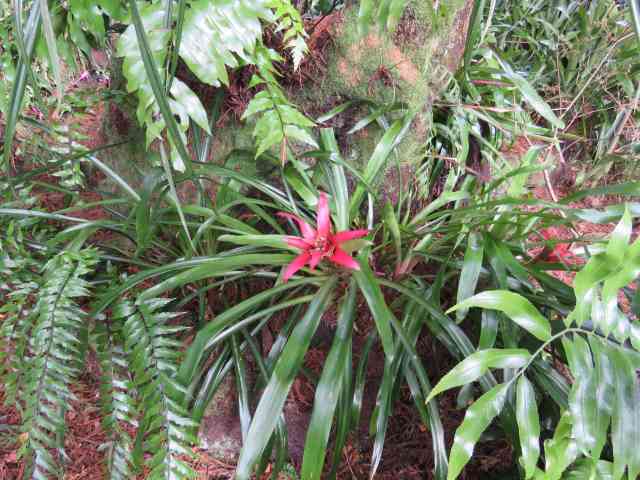
It is the bromeliads that generate most of the waste. Almost every bromeliad only flowers once and then the centre dies off – although the dying process can take more than a year or even three. While this is happening, the plant puts new shoots or pups out from the base of the old crown, or adjacent to it, and it is those new growths that will flower in the future. You can leave them to their own devices and the oldest parts will eventually die, dry and become dislodged but the clumps can get very congested and messy. I go through and remove the crowns that flowered last year.
Before
and after
The strategy to removing them is to take the time to look at each variety to see where the new shoots are coming from. Some appear from inside the bottom layer of leaves so if you just cut through the base of the rosette, you are cutting off all the replacement young growths. Every variety is a bit different but that is also what keeps the task interesting. They will all be shooting from somewhere near the base if the time is right to remove the old crown.
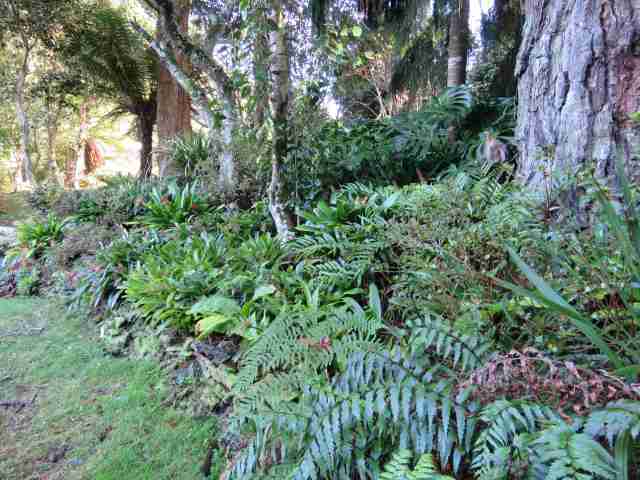
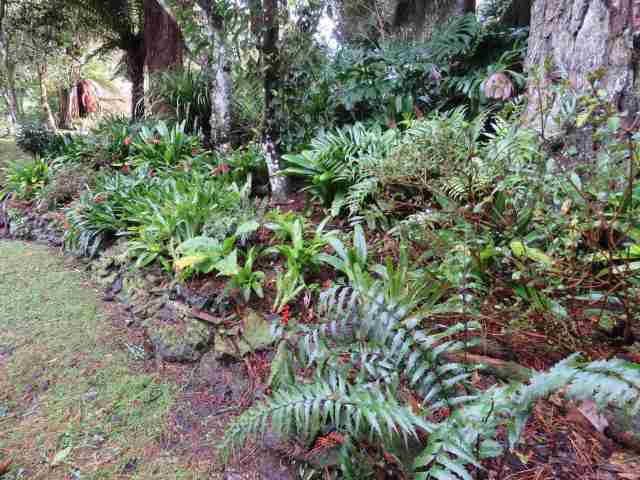
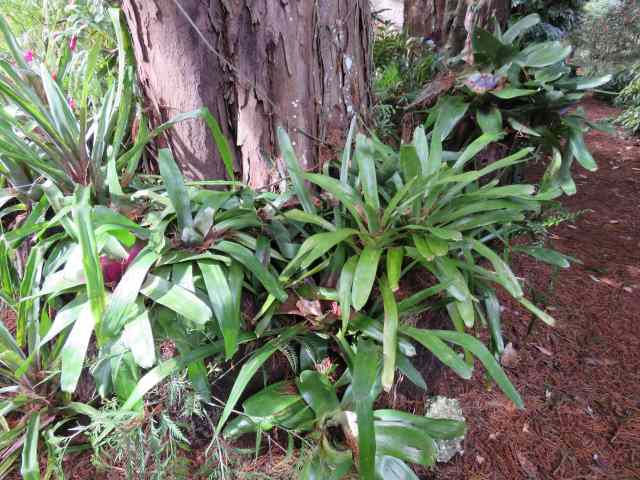
And the last before
and after.
Even though we have been doing this for years, it never fails to amaze us just how much volume is removed and yet the remaining planting never looks bare. It just looks fresh. It is one of the more rewarding garden maintenance tasks on our gardening calendar.
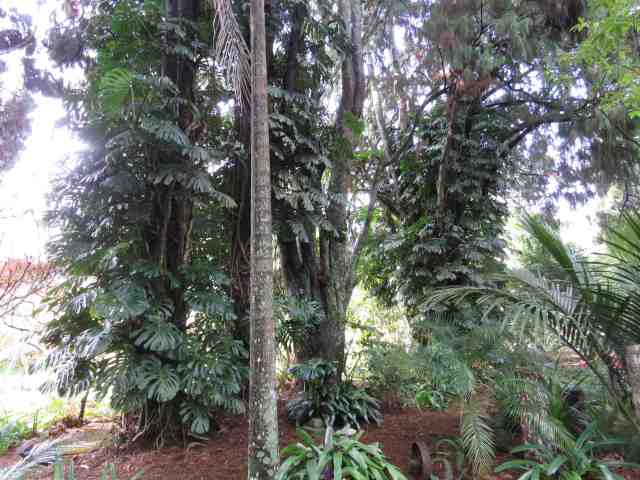
Those are monstera – the fruit salad plant – climbing up the trees. A long way up.
It wasn’t just the bromeliads. Zach and I removed huge amounts of Monstera deliciosa which had become monstrous indeed. We are fine with them climbing up; they add to the tropical look. Spreading outwards was another issue and removing most of the stems from the lower two metres opens up the views through which gives the feeling of more depth and distance in the garden. As he hauled out large amounts for mulching, many with aerial roots, Zach was musing how appalled plant sellers on Trade Me would be to see the wanton destruction of plant material they could sell at exorbitant prices!
“What do you think is the lowest maintenance form of gardening?” I asked Mark.
His response was immediate: “Plant shrubs and spray the ground beneath with RoundUp.”
He is right. All outdoor space needs some maintenance just as we routinely maintain indoors. Even if you concrete or deck most of your area, it still needs some attention. The concrete will need sweeping and probably some attention to moss growth with weeds finding purchase in any cracks or natural build-up of litter. Using pavers or cobbles requires quite a bit more attention as there are many more opportunities for weeds to get established. And lawns – or mown grass if that better describes your green sward – needs regular mowing even if you ignore all the other interventions and care that many lavish on their lawn.
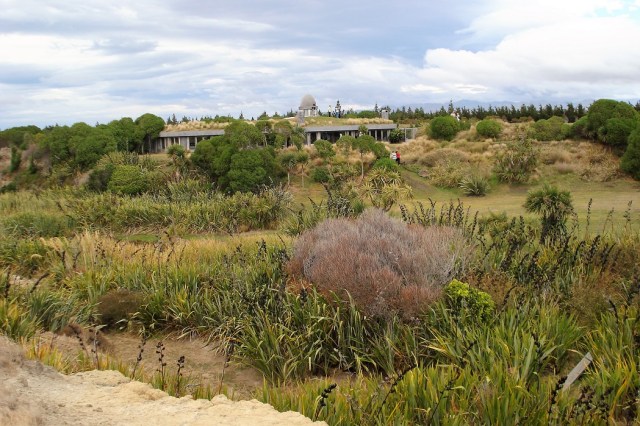
Probably the most memorable wild garden I have seen but it was in harsh conditions which would restrict growth, on a big scale, created with skill and while lower in maintenance requirements, it was not free of any need for some gardening interventions.
How about wild gardens? Yes, that is a lower maintenance style of garden but it also takes a much higher level of skill to find the right balance. There is a fine line between a wild garden and an unkempt wilderness. The same goes for cottage gardening. It is a fine line and quite a bit of skill that differentiates a cottage garden from a wild garden. The wild look will not appeal to many (most?) people who just want a tidy back yard. Wild gardens are an acquired and thoughtful taste.
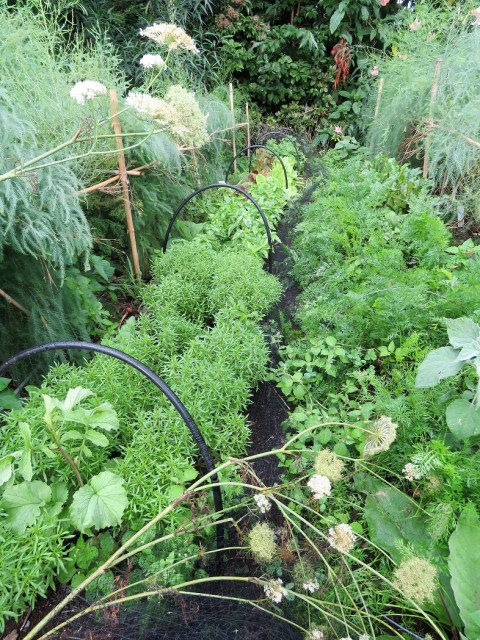
I don’t take many photos of Mark’s vegetable garden because it leans to the wild side but he can tell you after growing vegetables all our married life that it is anything but low maintenance.
Vegetable gardening is anything but low maintenance. Don’t believe any of the trite commentary that you can have a productive vegetable garden with very little effort. You can’t. Getting a decent crop and some continuity in supply takes a whole lot more work on an ongoing basis. What about trendy food forests? It takes an even higher level of skill to manage a productive food forest. You actually need to know what you are doing if you want regular harvests. In less skilled hands, a food forest will soon morph into a wild garden on track to becoming a wilderness with very little food produced for humans, although the birds, insects, rats, mice and rabbits may thank you.
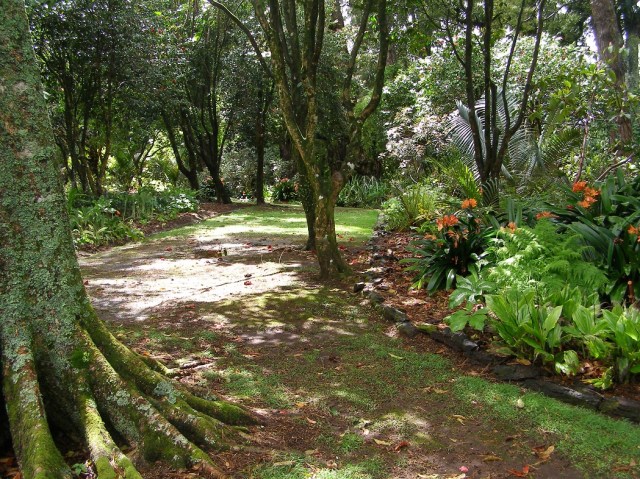
By our standards, our shade gardens are on the much lower maintenance side
Shade gardens tend to be lower maintenance because plant growth is much slower in areas without sun and the soil is not cultivated to the same extent. The shade and woodland areas here are the lowest maintenance areas we have and I can say that confidently with decades of experience. They are less demanding even, than the sunny meadow. But they are not no-maintenance, just lower maintenance and that is all dependent on tree cover. New Zealanders are not known for a love of trees in domestic gardens – maybe because our housing stock is not generally of high quality and we want all the solar warmth and light we can get.
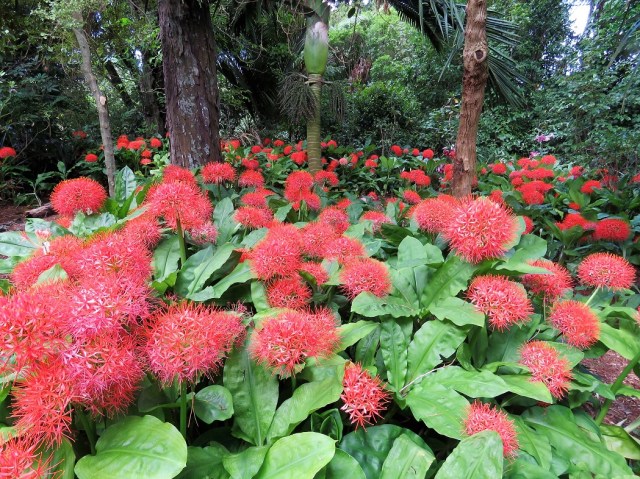
No, truly, this lovely summer scene of Scadoxus katherinae really is very low maintenance in the shade
The risk with trees is greater if you get the selection wrong in the first place, or the placement wrong and then fail to carry out maintenance as required to ensure that it is a good shape and in good health. The cost of remedial work or removal of an established tree is a whole lot higher than a shrub. That is why Mark recommends keeping to shrubs if you want low maintenance.
If money is no object, you can have what you want. You can pay a good designer and then pay a skilled maintenance crew to come in and do the work but it will be an ongoing commitment. Just as houses need cleaning, attractive outdoor spaces and gardens need attention too.
This particular formal garden was not low budget but I lack photos of the DIY low budget/low maintenance option that I consider is much less demanding of both skill and maintenance.
If you are operating on a lower budget, my advice given in earlier posts stands: plant a formal garden with a very limited range of plants. It is all about the look, the photograph. In practical terms, it takes regular attention to maintain the pristine level of care a formal garden requires but there is no great skill in carrying that out. You don’t need a competent gardener to maintain that, just somebody with a penchant for tidiness.
Apartment living avoids the expectation to maintain the outdoors area
If you can’t afford to pay somebody to come in and do your outside maintenance that you don’t wish to do yourself, and you live in a city, then buy an upper floor apartment. The body corporate will take responsibility for all the shared outdoor space. If you buy an apartment that looks out over green space and trees, the view may be all you need.
Or plant shrubs and buy a sprayer and a good supply of glyphosate. Not that I am recommending this as desirable, but it is a lower maintenance option. Shun detail and shun underplanting.
Our Wild North Garden will remain wild but not a wilderness
This train of thought came about because I am much absorbed by our perennial gardens – the new summer gardens, the semi-wild Iolanthe cottage garden and the Wild North Garden. We have a new part-time gardener. This is very exciting for us – a strong, young person with some skills is like a breath of fresh air in our ageing establishment. His first project is working in the Wild North Garden to get it to a standard that we think necessary before we open it to garden visitors. Meantime, I am taking apart and completely replanting the perennials in a little-noticed shrub and perennial border that edges the sunken garden area. It was anonymous because it wasn’t working very well and I want more visual oomph.
An anonymous sort of border that I felt needed some major tarting up but only of the underplanted perennials
I came to the conclusion that the highest maintenance form of gardening that I can think of is in fact gardening with sunny perennials. It is taking a lot more work than I thought it would. Fortunately, we are of the Christopher Lloyd (he of Great Dixter) school of thought. To paraphrase him in a comment we once saw on TV, “I think you will find that the higher maintenance your garden is, the more interesting it is.” In high maintenance gardening, you notice the detail and the changes, not just the single snap-shot big picture. That is what keeps us absorbed here, even if as it keeps us busy.
Gardening with sunny perennials here has the highest maintenance requirements but we find the rewards outweigh the efforts required. Less enthusiastic gardeners may not.
I just issue the general warning that if you want a low maintenance garden, don’t go down the track of gardening with sunny perennials. At least not in our climate with its benign growing conditions and rampant growth.
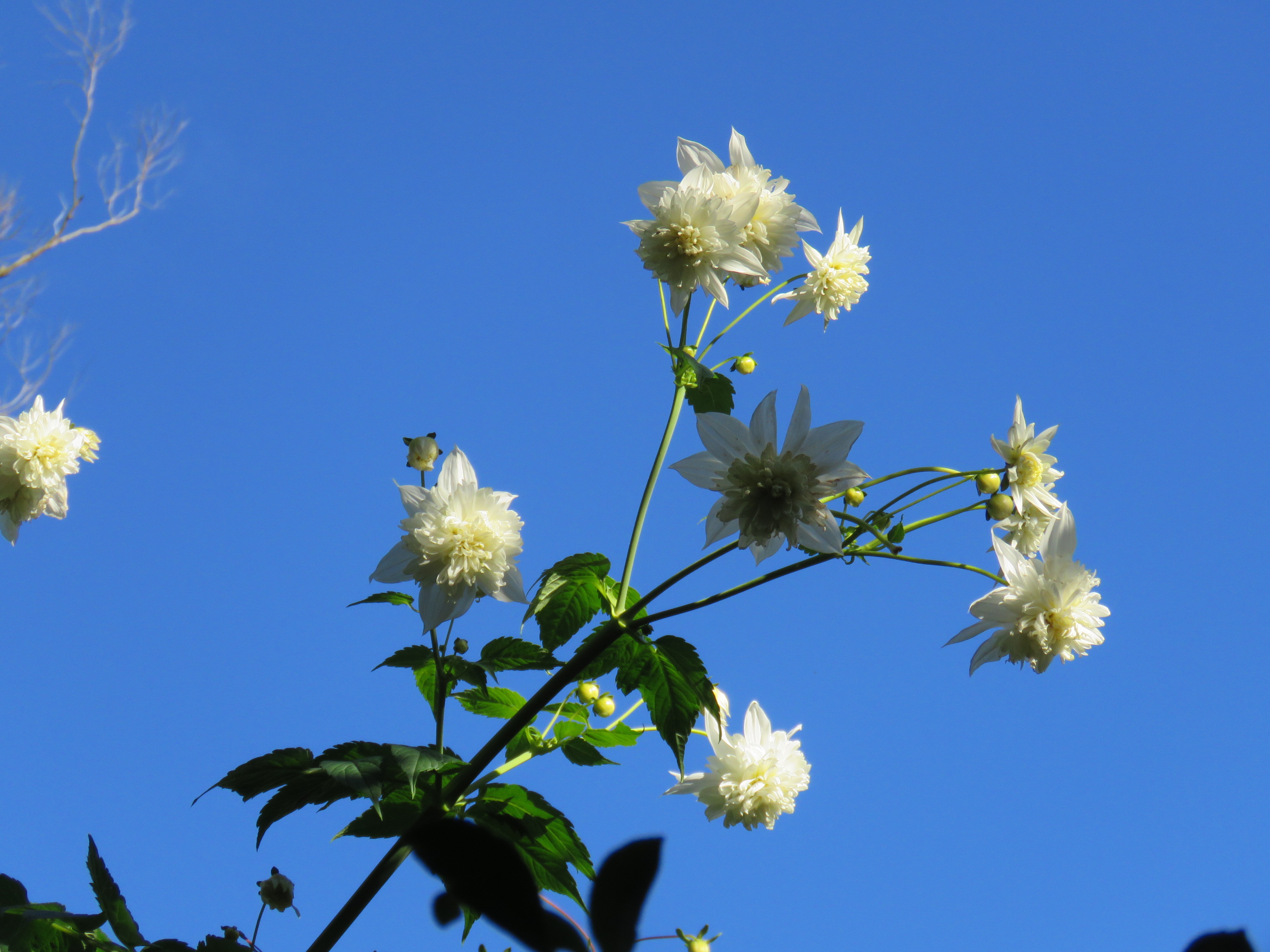
The last tree dahlia of the season is in bloom. Dahlia imperialis alba plena is the towering giant of them all, way up in the sky, not blooming until well into winter so particularly vulnerable to frosts and winter gales. I took this photo yesterday to show those in other climates the intensity of winter light that we get here on sunny days. It is different to those who garden where the winter sun hangs lower in the sky. We are not tropical; I don’t want to mislead. It is almost mid-winter and can be quite chilly. However, it is a lot less depressing to the spirits when you live somewhere with this clarity of bright light, even on the shortest days of the year.
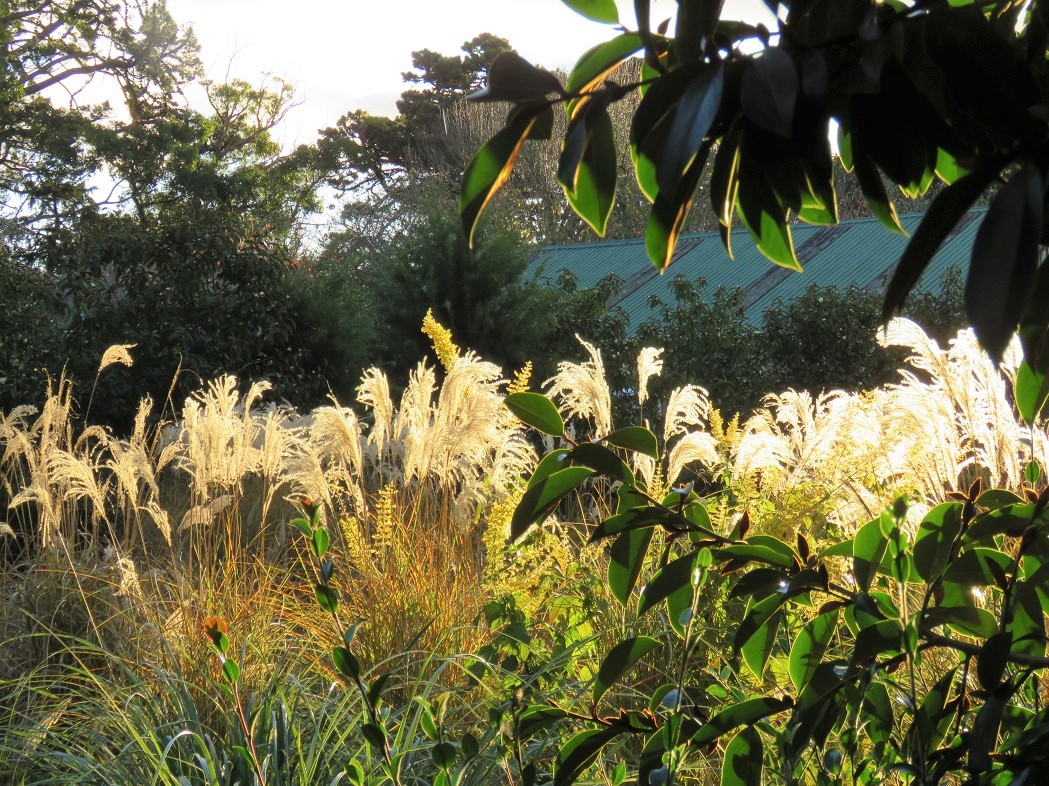
Miscanthus ‘Morning Light’ shimmering in the late afternoon light
We are now well into what Piet Oudolf refers to as the ‘fifth season’ and the new Court Garden brings me much pleasure, especially in the late afternoon when the sun is dropping lower and shines through the miscanthus grasses. I have used a lot of miscanthus running through the garden in waves and the plumes shine in the light and wave gently in any breeze.
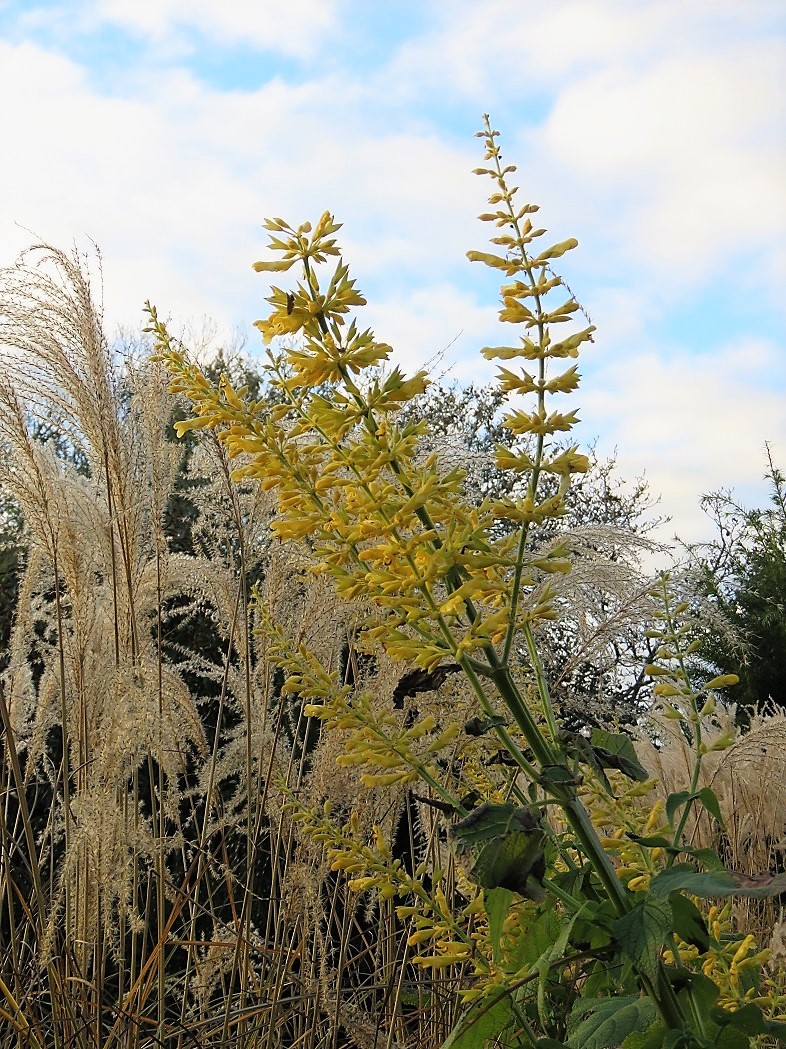
I have finally found a place where this large yellow salvia can grow with sufficient space and it is a late autumn – early winter highlight. We have never had a name on this variety so if any readers can identify it for me, I would be grateful. It stands a good two metres tall so it is a large plant to accommodate. *** Now identified as Salvia madrensis, thanks readers.
Tips and techniques for the week:
Stipa gigantea after a major thinning exercise
I took a before photo of this block of Stipa gigantea in the new Court Garden but I appear to have deleted it when I was filing photos. It looked fine at the end of its first year but I knew it wouldn’t stay looking fine and it was already too congested to allow the plants to fountain out and show their natural form. Last week, I took out well over half the plants and gave them away. I did have to lift some of the remaining plants to centre them to their own space but I am much happier with it now so it was worth the effort. I haven’t grown this stipa before and hadn’t realised how much space each plant needs. I am hoping this can now be left alone for a few years at least. It has a white field daisy growing between which I have learned I can get two, maybe three successive flowerings from spring to autumn if I cut it back to the base rosette at the right time.
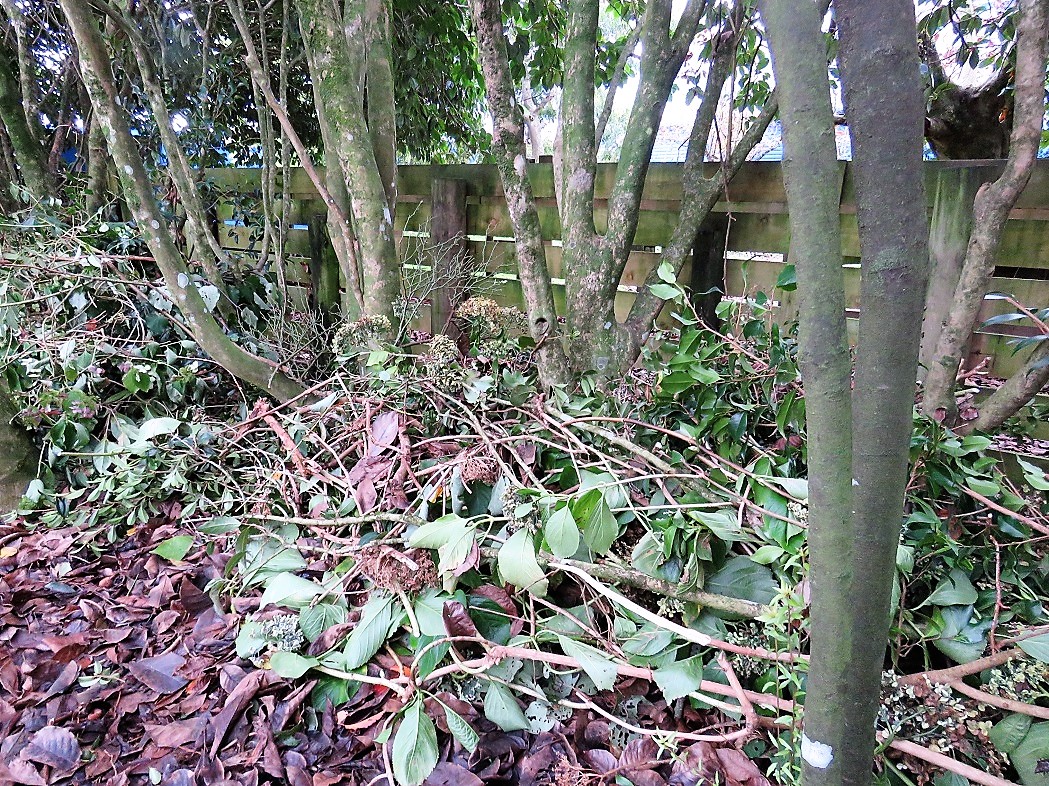
Layering up the prunings at the back, more or less out of sight
Out of the ‘I thought it would be a straightforward job that would only take a day and a half at the most but actually took four full days and still isn’t quite finished’ school of thought, I spent this week clearing the wilderness of boundary plantings that separate the caterpillar garden from the boundary with the neighbours’ wool shed and yards. People with big gardens will understand that you have areas which get planted and then mostly left to their own devices. It is one of those jobs you finally tackle when preparing to open the garden to the public again. Nobody will notice I have done it, but they may well have noticed had I not. Over the years, it had become largely impenetrable with self-sown camellias, layered hydrangeas, native seedlings, especially kawakawa and various mounds of vegetation where I had emptied the wheelbarrow of prunings that I didn’t want in the compost heap. It amazes me how far I can get with a sharp pruning saw. Because there was so much of it, I dragged all the debris to the back and layered it by the boundary fence. At some points, it is quite a bit higher than in this photo. It can gently rot down there, adding humus and carbon to the soil and is a lot lighter on labour than carting it all away to compost and mulch. It is a technique we are using quite extensively now and is a tidy, unobtrusive way of dealing with excessive amounts of garden waste. That said, it is a big garden technique, rather than one for small town gardens.
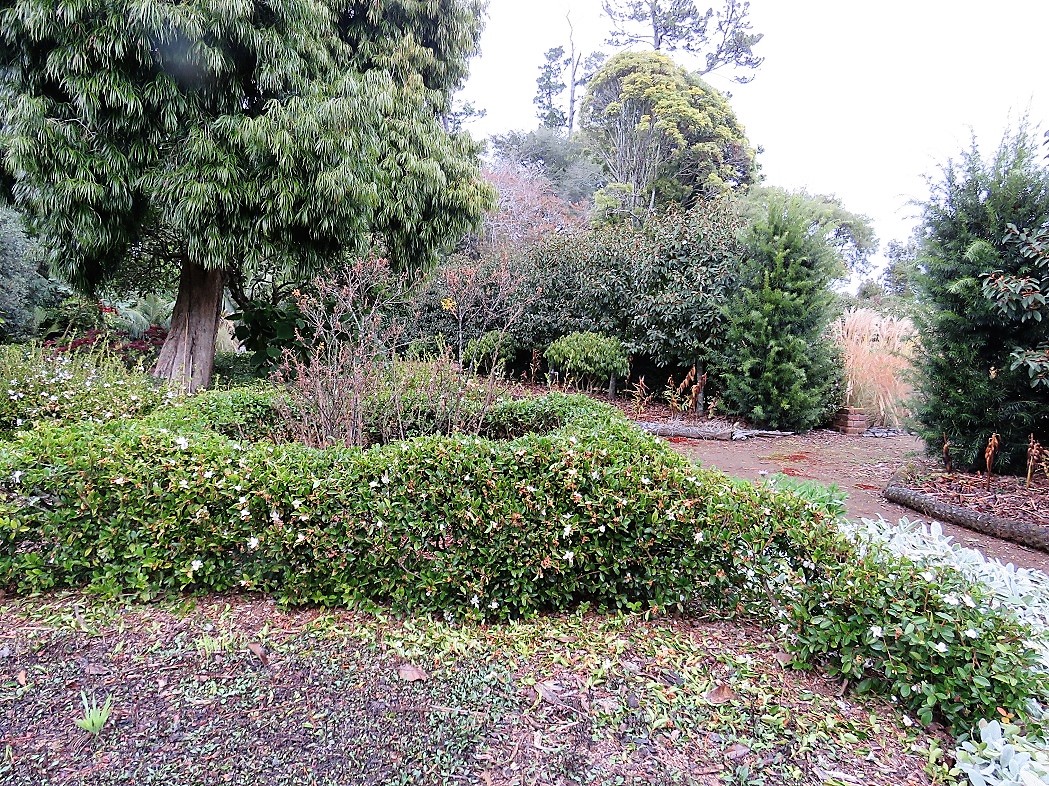
On track to be an undulating, curvy hedge like a moving caterpillar
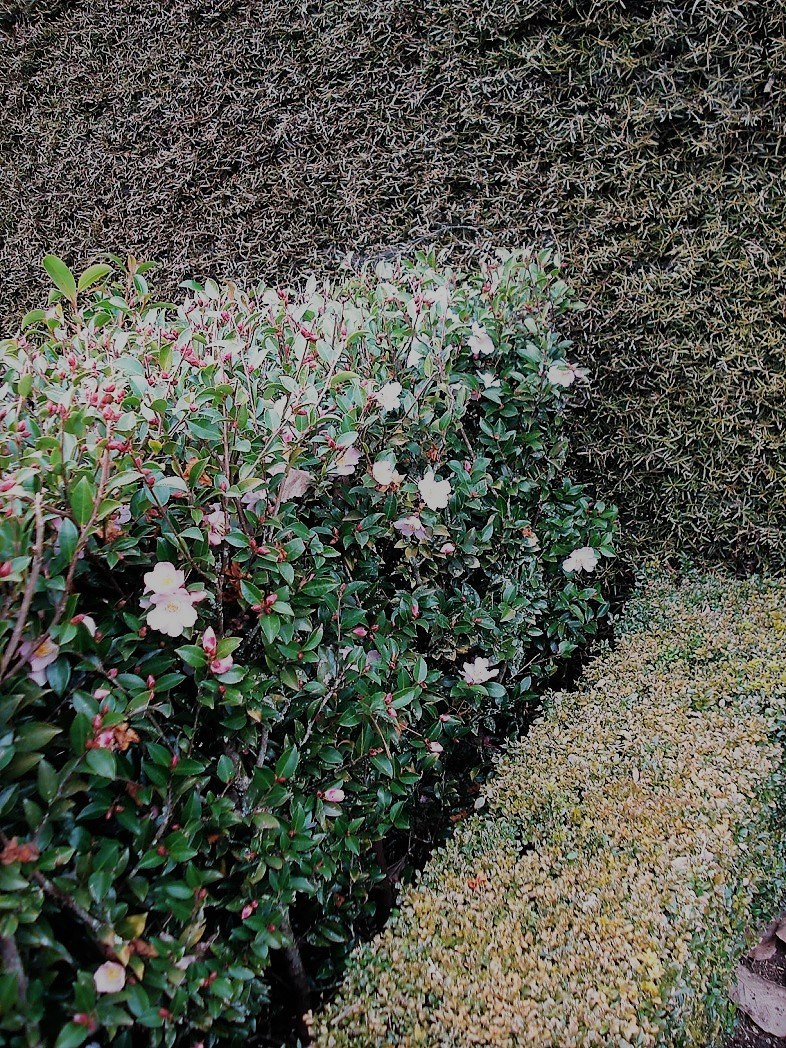
I have started a major clipping round on the hedges in what we call the Caterpillar Garden. The hedge is Camellia microphylla, already nearing the end of its flowering season. The plants were pretty neglected -raised from seed and cuttings many years ago and then left to kick around the old nursery until we were ready to use them. We planted them two years ago and the hedges, laid out in the shape of the basket fungus, are still a bit patchy. Mark’s plan is to clip these hedges into mounded, free-form shapes like an undulating caterpillar in the style we associate strongly with UK designer, Tom Stuart Smith. I am doing the first clip this season and have told Mark it is his job to come through and do the final clip of the top to get the mounding shapes he wants.
The straight-edged, hard clipped approach
Most of our clipped hedges here are very straight sided with the top meeting at right angles. Lloyd does them with a string line to keep the lines straight and the hedges a uniform width. He has a good eye for these things. But after spending a fair number of hours clipping and shaping the caterpillar hedge, I can tell you that it is a great deal easier and more pleasurable to work with a more organic shape and form than that military regimentation of the sharper-edged hedges. Informality is much more forgiving than formality.





 We are now well into what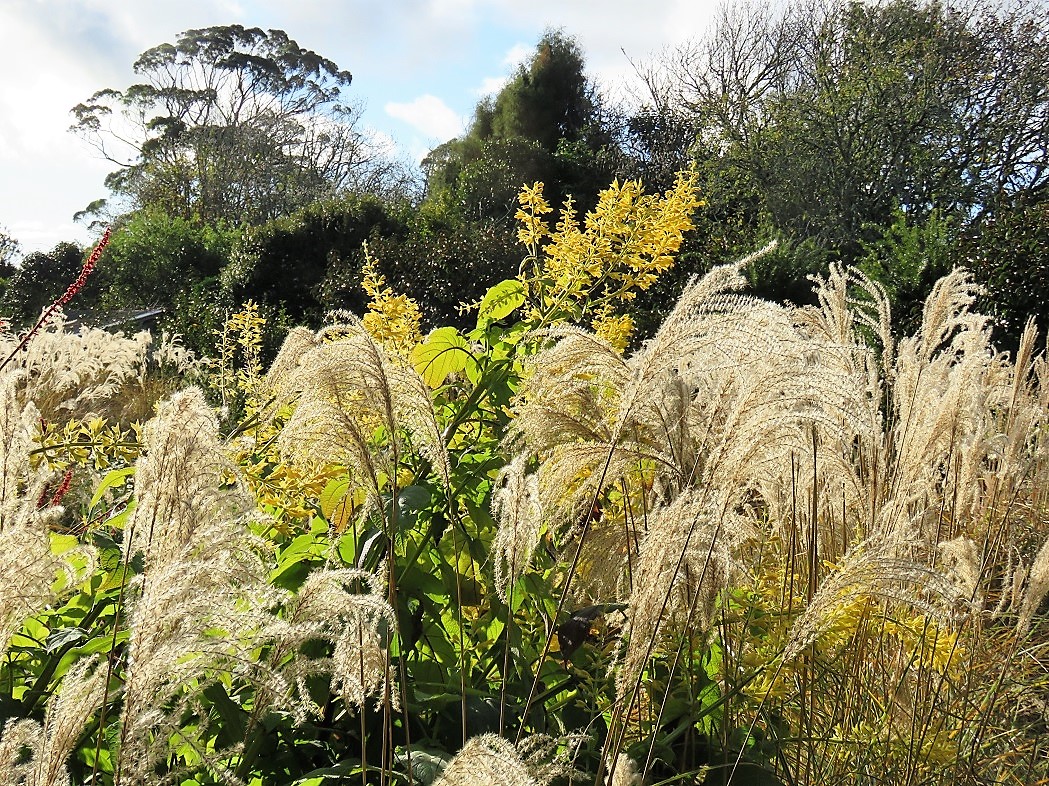
 I have finally found a place where this large yellow salvia can grow with sufficient space and it is a late autumn – early winter highlight. We have never had a name on this variety so if any readers can identify it for me, I would be grateful. It stands a good two metres tall so it is a large plant to accommodate. *** Now identified as Salvia madrensis, thanks readers.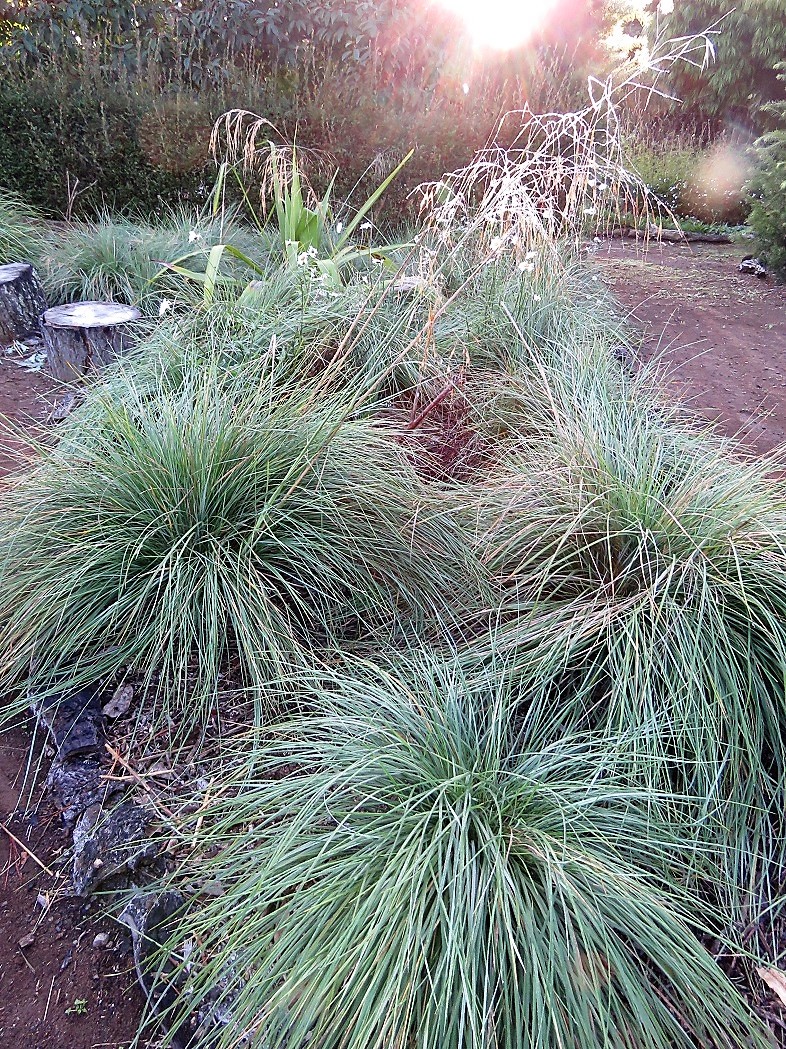
 Tikorangi The Jury Garden