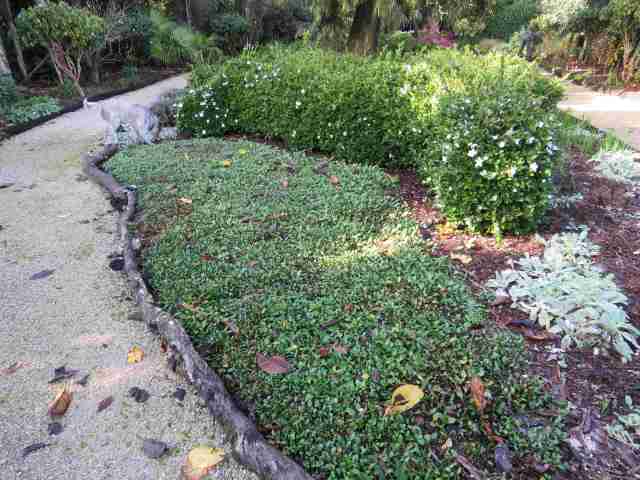
I photographed this patch of asters trimmed to the ground because I thought it was a good example of when not to let sleeping asters lie. Digital photography is very handy for dating things and I see it is only three years since these were last dug and divided. It had become a seamless carpet of aster in the time since. Both Zach and I noted that it did not look as good as it should have last summer. They weren’t helped by getting hit by mildew which has not happened before, but there was no mass flowering.
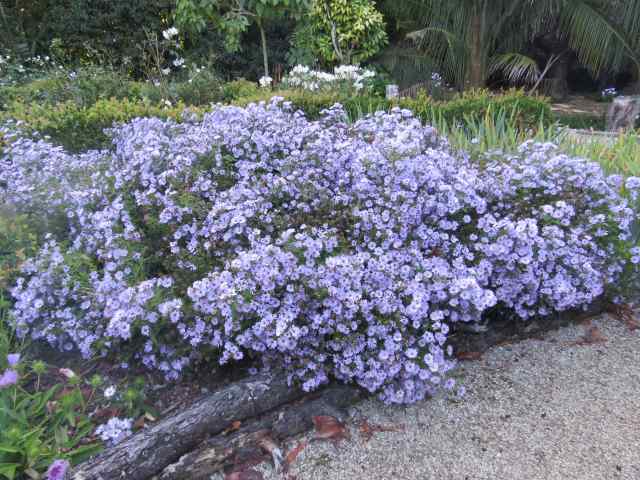
It should have looked like this last summer, but it didn’t. This is from summer 2024.
Time for a dig and divide, which Zach did this week. A perennial that has to be lifted and split every two to three years is on the high maintenance side and we don’t have many in that category. My friend, Sue, who leads the team of volunteers at the pretty Te Henui cemetery, told me she is culling plants that are too high in maintenance for their labour resources and this aster might fit that category. I must ask her for her latest list of culls. Fortunately I have Zach to carry out such tasks or I might be casting around for a less demanding plant option.
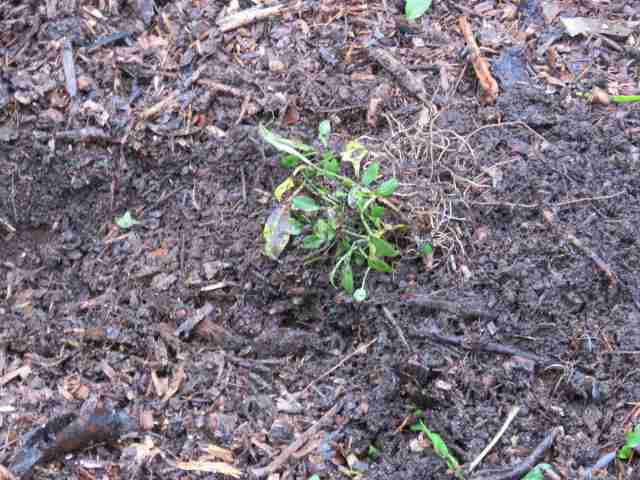
Enter the rabbits. After a quiet few months on the rabbit front, they are back and there is nothing they like more than an area of soft, freshly dug garden and mulch to dig. I sent Zach a text yesterday telling him that the rabbits were undoing his work. He was equally unimpressed but at least the photo shows you the size of division he split off from the previous carpet to replant.
I have just replanted the casualties, filled in the holes and spread blood and bone. The rabbits don’t like blood and bone and will stay away from that area but it does need to be replenished after rain and we have had plenty of that this week.
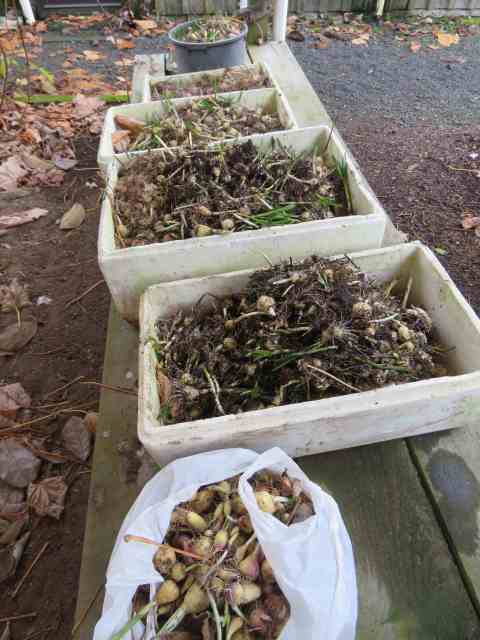
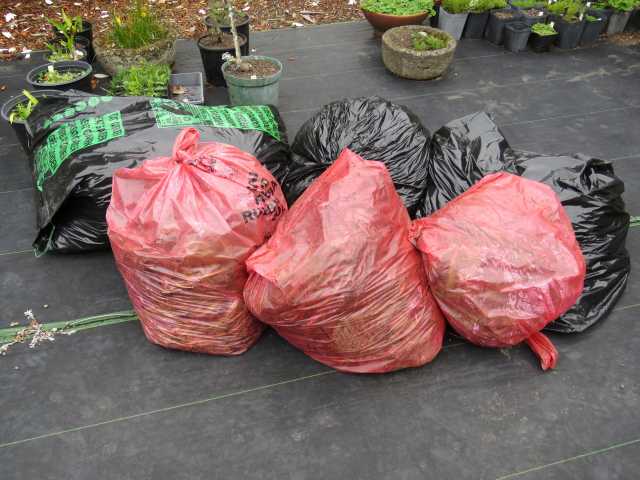
A whole lot of bluebell bulbs, just from the Iolanthe garden. There were more. I have already disposed of some.
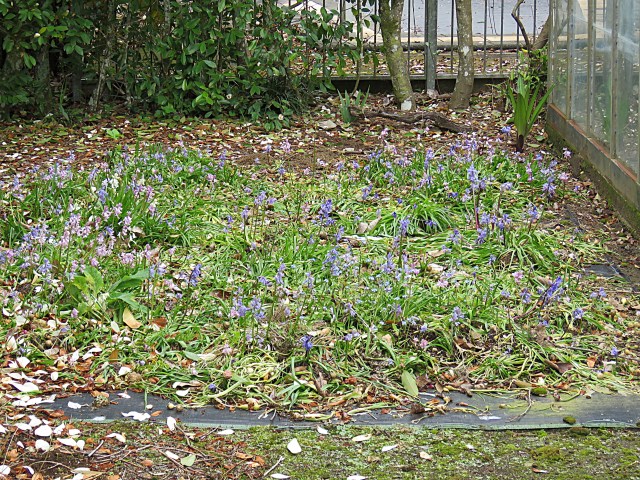
The war on bluebells continues and I am at an advanced stage of boredom. I took this photograph as proof that I am not exaggerating. This is by no means all of the bulbs I have dug out of just the Iolanthe garden. Most were never planted there but I will have spread a few when I planted that area in 2019. Some have already been disposed of and still there are more to be dug.
They did not dehydrate in the summer sun. They grew instead.
Bluebells have no place in the cultivated garden. I found a couple of photos from last year, recording our attempts to deal with some culled from the Avenue Gardens. I worried about how many we were dumping on our wild margins and they don’t rot down in the compost. I had the idea that if we spread them thinly on weedmat, they would dehydrate and die in the summer sun. They didn’t. They kept growing. I then thought they might compost in plastic bags in the sun, as wandering tradescantia does. Some did over the summer months but others in those bags were still firm and viable. Responsible disposal is quite a big problem.
Nor did they rot down in the plastic bags, as I hoped.
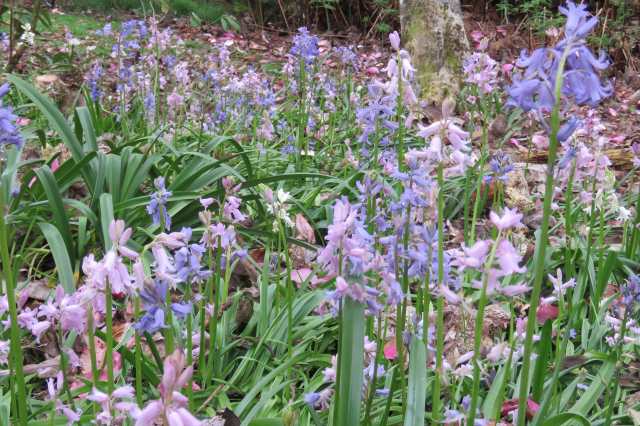
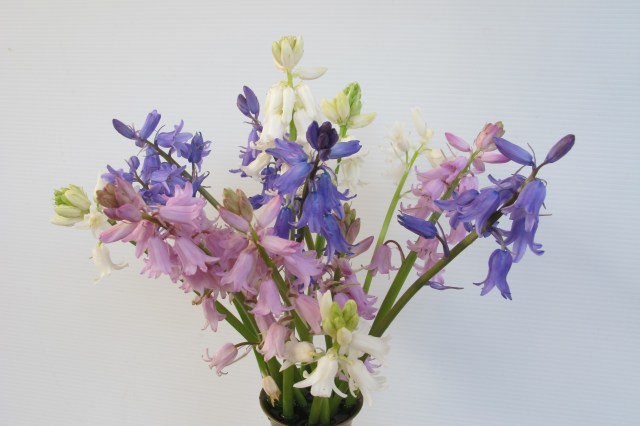
We have a lot of bluebells in the park and the Wild North Garden and they can stay there. To get rid of them, we would have to go for repeated use of some heavy-duty sprays and we try and avoid that. Besides, they are very pretty in spring. Ours are all Spanish bluebells or hybrids; the more desirable English bluebells are extremely scarce in this country. I don’t think I have ever seen them.
“If they stank like onion weed, they would be seen as a weed,” said Mark. “They are a weed,” I replied.
If we had our time over again, we would think twice about introducing them to our property. Mark put a bit of work into building up numbers in the first place. A decade or so on, I am putting a great deal more work into digging them out from some areas, all but sifting the soil to get the baby bulbs. You have been warned.
In a world that seems to be growing more chaotic, unstable, downright dangerous and even vicious by the day, let there be flowers.
I know I am not alone in limiting my time following the news and on social media. Never in my life did I think I would be taking life guidance from RuPaul but his advice to ‘look at the darkness but don’t stare’ are words that I repeat to myself every day. It is one thing to be aware of what is happening but it can be overwhelming if I spend too much time following it closely.
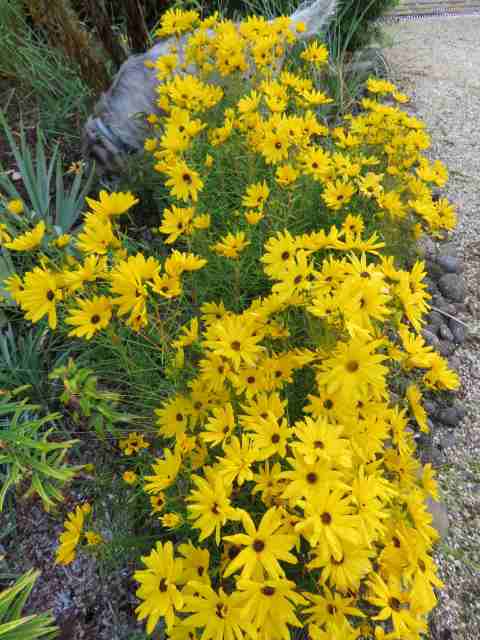
The bright cheer of the dwarf helianthus makes me smile. This is a named cultivar but I have forgotten where I recorded the name.
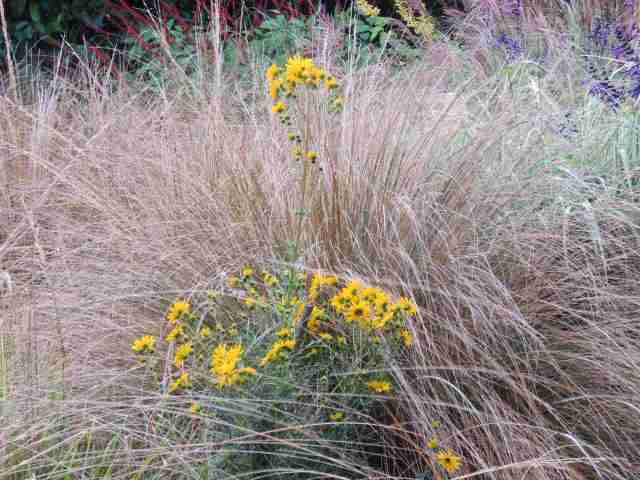
Instead, I give you the gentle predictability of the change of season from summer to autumn here with photos from yesterday. I have used the shorter version of the helianthus in the borders but the tall leggy form – likely closer to the species or as it is found in the wild – seemed to fit better in the controlled abandon of the Court Garden. No more. We are in danger of losing it because it is not as capable of coping with competition as I thought. As soon as this remaining clump has finished flowering, I will relocate it to the more cultivated environment of the borders where it will be given its own space to thrive.
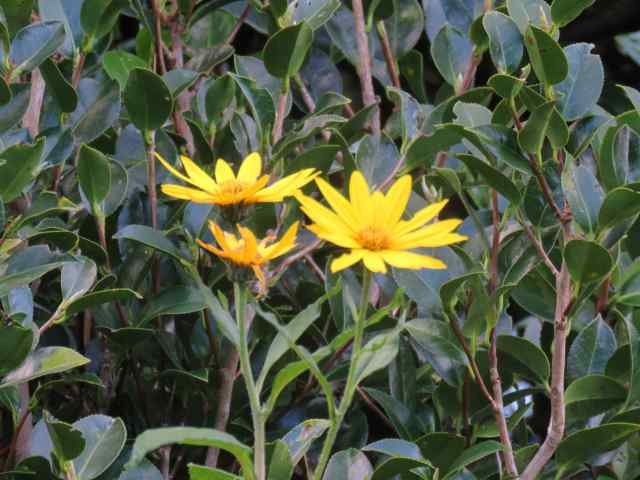
The Jerusalem artichoke is also a member of the helianthus family but it does not justify its place as an ornamental plant. Not enough flowers, I am afraid, but an abundance of tubers which I dare not eat. While tasty, no matter how hard I try, I can not find ways to prepare it that improve its digestibility without the unfortunate side effects. Its name as fartichoke is fully justified.
The heleniums are in the twilight of their season but remain eyecatching. These have one of the longer flowering seasons of the summer perennials and fully justify their prime position in the borders.
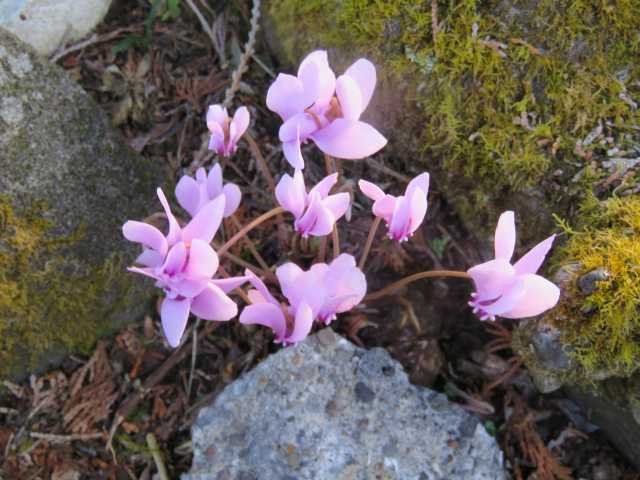
Cyclamen hederafolium are coming into their autumn peak and what a delight they are. We have many of them, many many in fact because we encourage them to seed down in their pretty pink and white charm. I am not a fan of the bigger cyclamen hybrids but the species are a source of great delight throughout the garden.
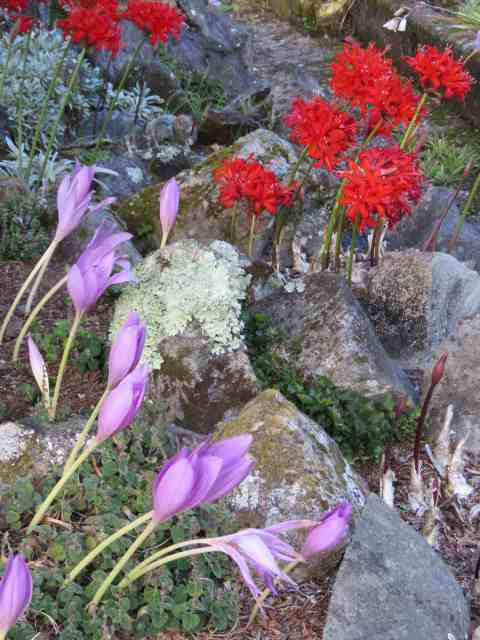
The rockery is hitting its stride with its autumn display. The colchicums are a fleeting delight but one we would not be without. The nerines are just starting, mostly red so far but plenty about to open in other colours. I live in hope that the Lycoris aurea will stage a reappearance. I planted a pot of flowering bulbs out in the rockery years ago but I can’t remember where and it has never flowered since. It may have gently withered away to nothing or it may still be masquerading as a random clump of nerines which I just haven’t noticed aren’t flowering. Perhaps our hot, dry summer will have triggered it to flower. Or maybe not.
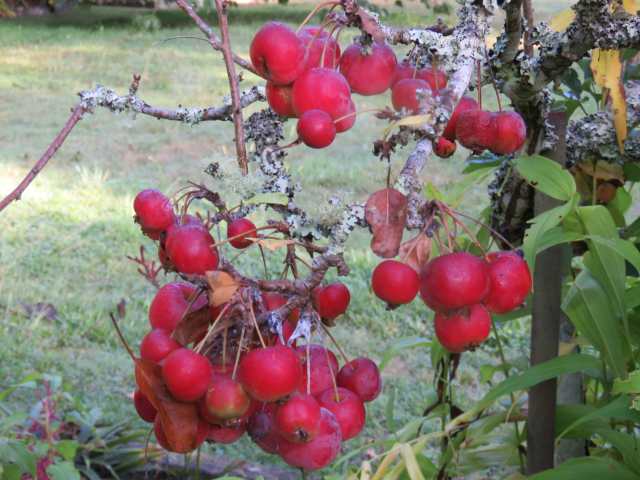
We have two dwarf crabapples in the rockery, standing little more than 1.2metres high after about 50 years. Their flowering is insignificant and their form and foliage unremarkable but they justify their place with their ornamental fruit in autumn.
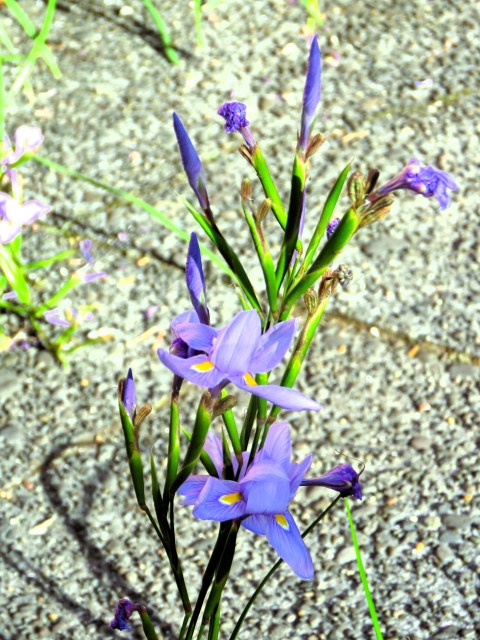
Moraea polystachya, an autumn form of the peacock iris, seeds around enthusiastically but harmlessly and rewards us by popping up randomly – on the edge of the drive in this photo – and having one of the longest seasons in flower of any of the autumn bulbs because it keeps opening a generous succession of buds.
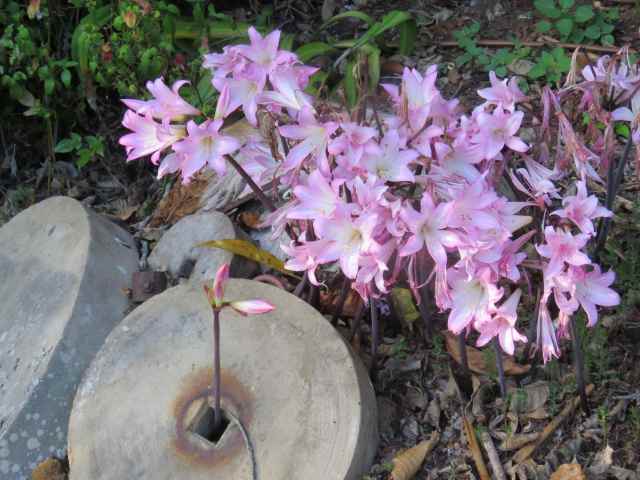
The belladonnas are bold, a bit scruffy and have bulbs and foliage that are too large to make them obliging garden plants. But they are a welcome addition in wilder areas, in this case on the site of the old woodshed we removed this summer before it fell over of its own own accord. We don’t know anything about the grinding wheels except that Felix must have gathered them up fifty years ago and there are three in graduated sizes.
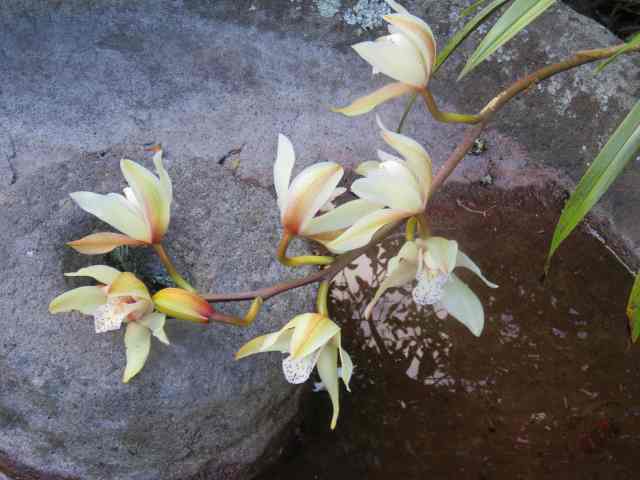
The first cymdidium orchid is opening. This somewhat understated one is always the first of the season and is a top performer in its spot, arching over the old stone millwheel which has been repurposed a bird bath.
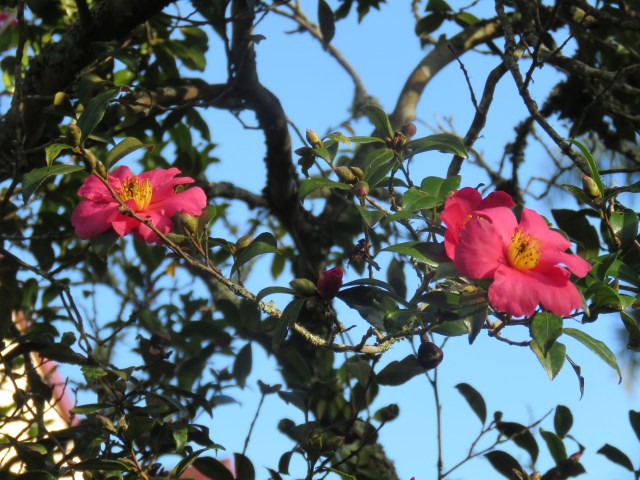
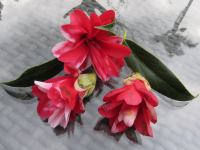
Finally, camellia season has started. Camellia sasanqua ‘Crimson King’ is always one of the first to open. Even with climate change, there is a reassuring predictability in the cyclic nature of the seasons.
May there always be flowers. I can stare at them as long as I like without fear of being overwhelmed by a sense of despair, anxiety and helplessness. In the flowers and the seasons lie promise and joy and we need a whole lot more of that at this time.
It is an experience shared by most gardeners. I will just get this (smallish) job done and then go on to something else. And that smallish job expands from a few hours to days or even weeks. So it is with trimming camellias, about which I wrote last week. I am still doing it.
A rare sight these days – good flowers on Jury’s Pearl.
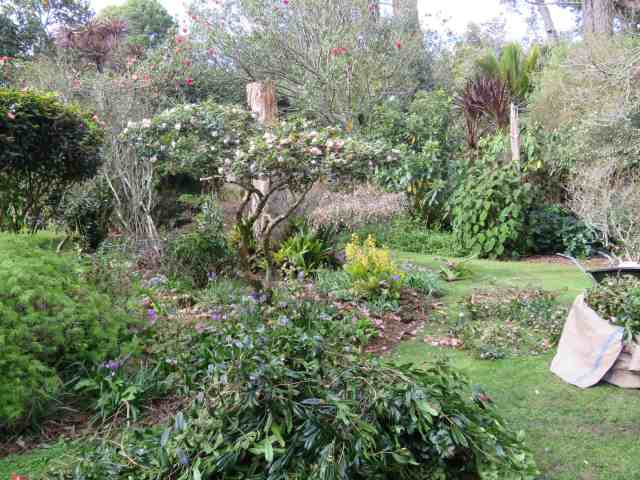
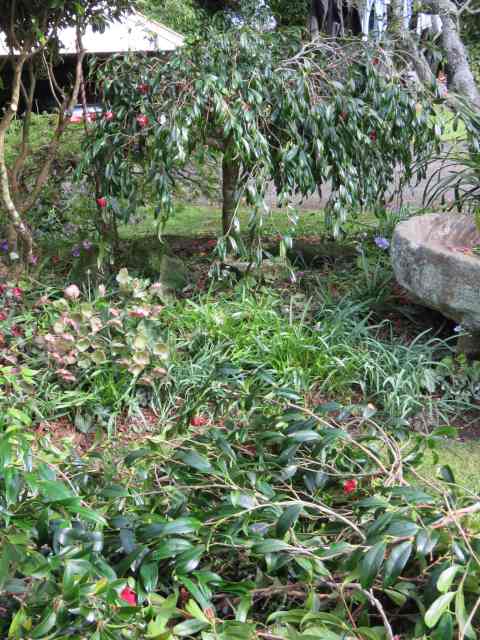
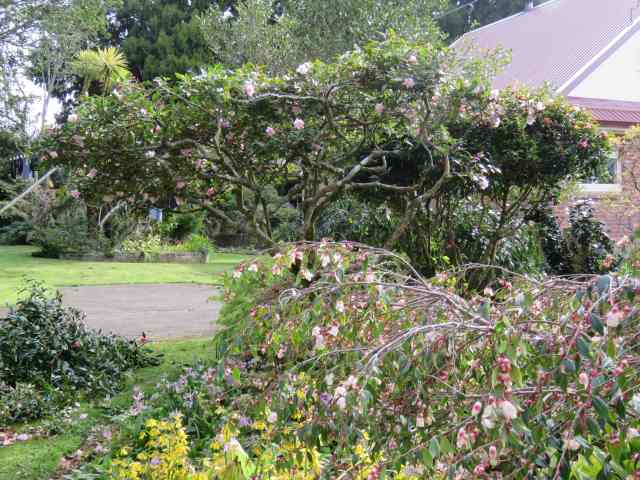
We don’t trim a lot of camellias, I thought to myself. And then I added them up. Excluding the camellia hedges – and there is a fair distance of those – I reached about 40 that get individual attention every year. That is not a lot compared to the number of camellias we have which must be several hundred, but it is still quite time consuming. Some we trim to be feature plants; some we trim to freeze them in size.
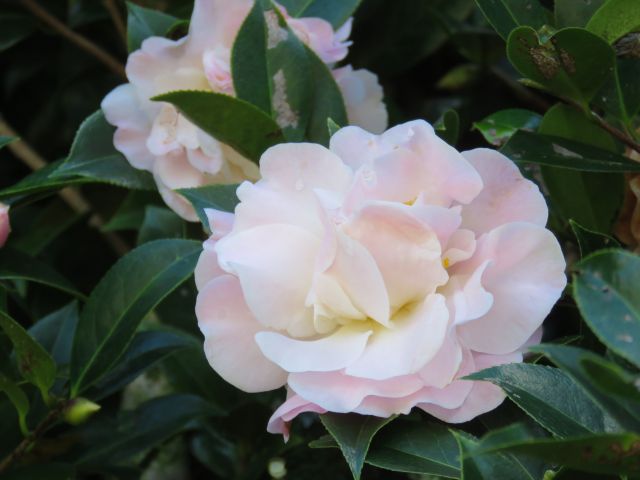
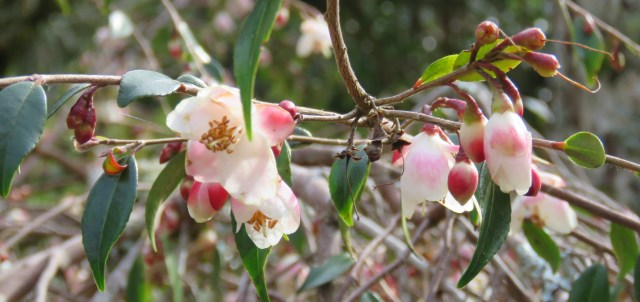
A relatively dry winter has meant we have had a better show this year. It doesn’t resemble the mass displays we used to get before the devastation wrought by camellia petal blight but there have been some pretty blooms. Most of our larger flowered camellias are retained as shelter, screening, wind breaks or their attractive form, certainly not for floral display because that is but a memory and the larger flowered types get hammered by petal blight. It means more work to ensure that in key spots in the garden, we have to make that attractive green form visually effective in order to justify keeping them. We have a strong preference for the small flowered varieties which do still put on a good show. And autumn flowering sasanquas, of course but they are long finished.
Fairy Wand has been reduced to a skeleton and we may drop it lower yet. We try and keep a good framework when we are cutting camellias very hard, not cutting off at ground level.
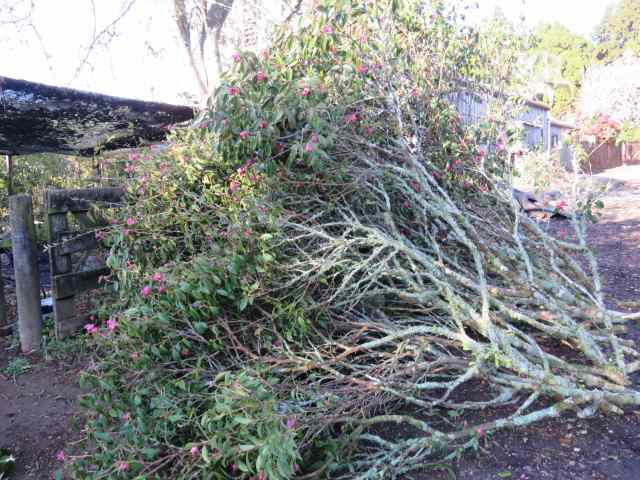
That is A LOT of Fairy Wand piled up to be mulched
Camellia ‘Fairy Wand’ started life as a miniature back in the days when miniature only applied to the flower size and not, as most people assumed, growth habit. Bred by Os Blumhardt in Whangarei, Mark planted it, ‘Gay Baby’ and ‘Tiny Star’, also from the same breeder, beside our driveway. After about 40 years, they were all about six metres tall and in a decidedly leggy state, with wayward branches being cut off to keep the driveway clear. We stagger our extreme pruning here. ‘Tiny Star’ was cut back two years and is now a bushy little column shape about two metres tall. This week was ‘Fairy Wand’s’ turn for drastic treatment. ‘Gay Baby’ will be done at some stage in the next two years, when ‘Fairy Wand’ has rejuvenated. We don’t want a row of three massacred plants. It took Zach all of an hour to cut back the Fairy and about the same length of time for Lloyd to mulch it up for wood chip.
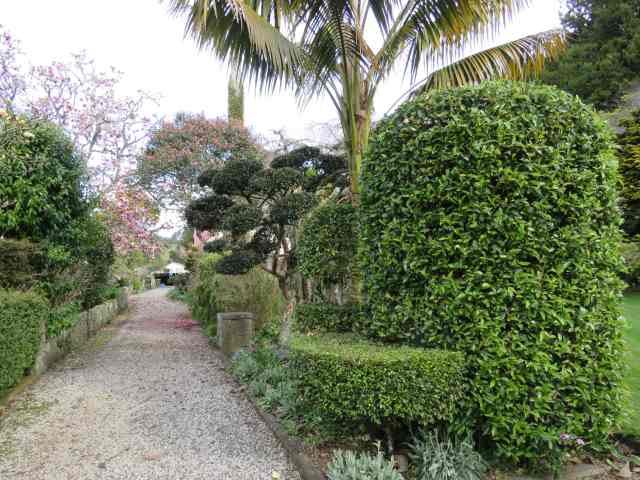
Taking Fairy Wand down behind gives this tableau of clipped camellias a whole lot more impact, especially the cloud-pruned sasanqua Elfin Rose. We are now thinking of dropping Fairy Wand behind even lower so it stays below the cloud pruning.
As an aside, it is possible to rejuvenate most michelias in the same manner. You do need to start with plants that are growing strongly because if they aren’t, the shock may kill them but we have, upon occasion, cut michelias as ruthlessly to promote bushy fresh growth.
Itty Bit in the centre after being reduced in size by about 40%
While Zach may only have taken an hour on ‘Fairy Wand’, I have spent many hours on others and that is because we want the form and shape on a healthy plant. I probably removed about 40% of ‘Itty Bit’ to reach this stage.
Camellia Hakuhan-kujaku – a shadow of its former self
It took me ages to get ‘Hakuhan-kujaku’, the peacock camellia, to this state. I took out at least 60% of it and it looks a whole lot better for the time spent. Shapely, not hacked or massacred.
Camellia minutiflora front right, Itty Bit behind
Little C. minutiflora is one of my absolute favourites, though hard to get photographs that do it justice so you will just have to take my word that it is a little charmer. It is a more recent planting so I probably only took 25% off it. At least it will only be a tidy-up trim for the next few years until there is so much congested growth and crossed branches that it is time to spend hours laboriously picking over every branch again.
My secateurs and pruning saw are my best friends at the moment. If you are wondering where to start on this type of pruning, I start by looking at the plant from every angle. Because we are trying to keep the plants from getting tall and leggy, I first take out growths on top that are going straight up instead of bushing out sideways. Then I work around the perimeter, reducing the spread, always trimming growth flush to the branch or trunk. Then I get into the middle and take out crossing branches. Finally, I get underneath and trim from below, making sure there is cover across the top while taking out surplus growths and branches below. I spend a lot of time looking and tracing where main branches go. This is why it takes time.
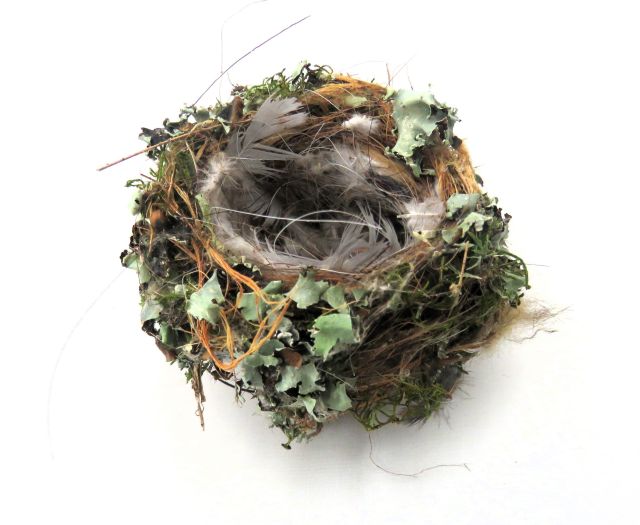
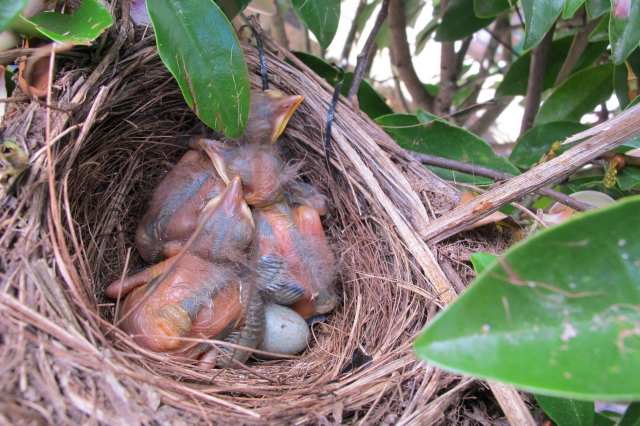
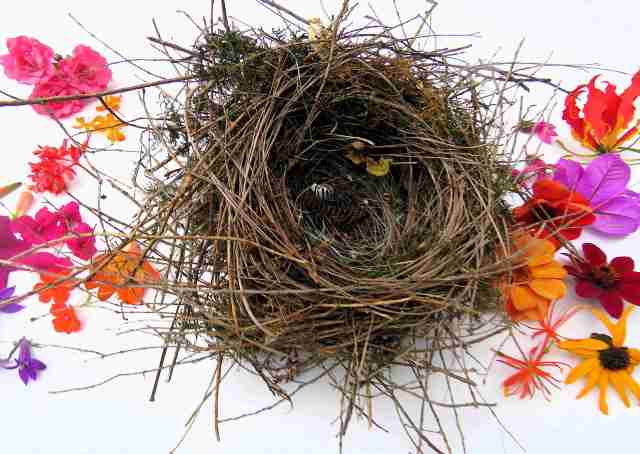
Look! Just look at this exquisite little chaffinch nest lined in soft feathers. Must the chaffinches start all over again because we humans destroyed their nest? Disclaimer – this one was blown down in a storm.
At this time of the year, I remember the warning from friend and colleague, Glyn Church. Pruning needs to be finished very soon on taller trees and shrubs. The birds are nest building and will be laying eggs. Unless you are okay with destroying days of hard work by individual birds and killing off their young, time is of the essence.
They are just common, pesky blackbirds but it still does not feel right to kill them for human convenience or by human carelessness. A tui nest.
The bright pink Prunus campanulata are controversial in this country because of their seeding ways but this enormous specimen is sterile and doesn’t set seed. The greatest danger is being hit by low flying birds as scores of tui move around the garden.
We are very sensitive about criticism of the climate in our neck of the woods. It is true that other places warm up more quickly in spring, some of us would like another degree or two of heat in summer and spring can be wet and windy. For many years we would cringe as garden and nursery visitors from further north or east would come in, hopping out of their heated cars and shivering, saying how cold and miserable it was here and asking if it was always like this. Or worse, asking “How can you grow such tender material in your cold climate?” One person clearly pushed Mark too far because I heard him reply with a dead pan face that we get out at night with little woolly jumpers and blankets to cover them up.
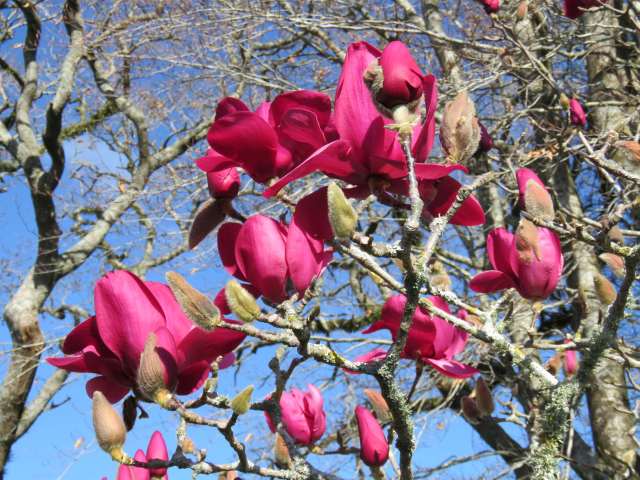
First blooms opening on Magnolia Vulcan, one of our early flagship Jury magnolias
We may not have higher temperatures in summer but we have high sunshine hours and high light levels and that makes a big difference in winter. Of course, it can get cold and we have winter storms as cold fronts move over bringing wind, rain and gloomy skies. But in between, we can get bright blue skies and sunshine for days on end. Right now, in what we deem midwinter and our bleakest month, we still get 10 hours of daylight.
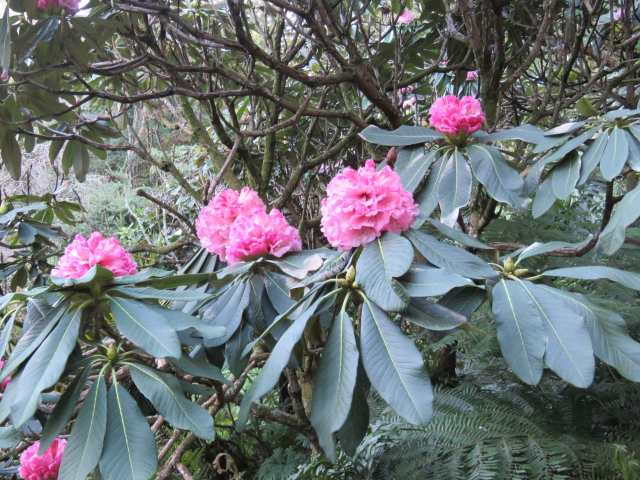
Rhododendron protistum var. giganteum ‘Pukeiti – one of the big leafed varieties that flower early. We also have subtropical vireya rhododendrons in bloom.
This train of thought was started by reading a blog post by Christchurch gardening colleague and friend, Robyn Kilty. Headed ‘It’s winter drear, my dear’, it vividly conveys her experience of mid winter, where low light levels and grey skies suck the colour out of both garden and landscape.
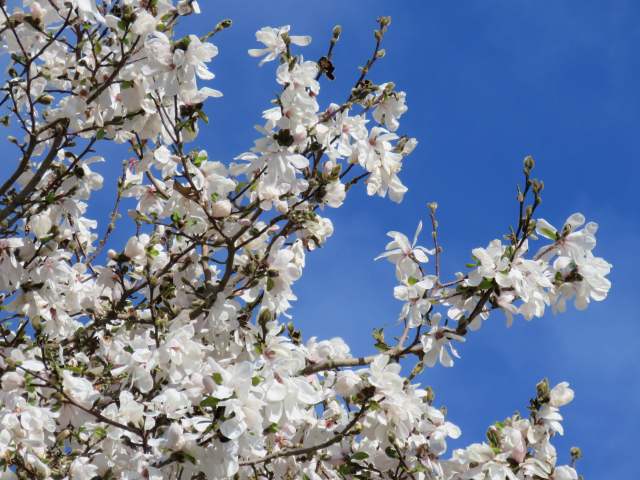
Blue skies a-plenty. With a white magnolia – likely kobus, flowering in a garden down the road.
I have not been to Christchurch in midwinter so I have no opinion on their winter conditions. For overseas readers, we are in the middle of the west coast of the North Island. Christchurch is in the middle of the east coast of the South Island. Clearly our winter experiences are totally different and that is what happens when you live in a country of long thin islands that run north to south, surrounded by vast oceans with no major land masses nearby. There are big variations in climate.
Luculia ‘Fragrant Cloud’ flowers on, undeterred by winter.
Nobody is going to suffer from seasonal affective disorder here in Taranaki. We are at latitude 39° south. If you match that to the 39th parallel north, we correspond to places like Ibiza, Sardinia and a line through California. Not that this means in any way that our climates are similar but it does mean our winter daylight hours are greater, as is the height the sun rises in the winter sky.
Camellias in bloom – this is Camellia yuhsienensis (syn C. grijsii var grijsii)
We garden all year round. If it is wet and windy or bleak, I will stay inside. I wait until the mornings have warmed up a bit before heading out, retiring indoors when it starts to cool off at 4.30pm. But most days, we are out and about for most of the day. I have a penchant for photographing flowers against blue skies but I don’t colour enhance my photos so what I show is colour as my camera captures it.
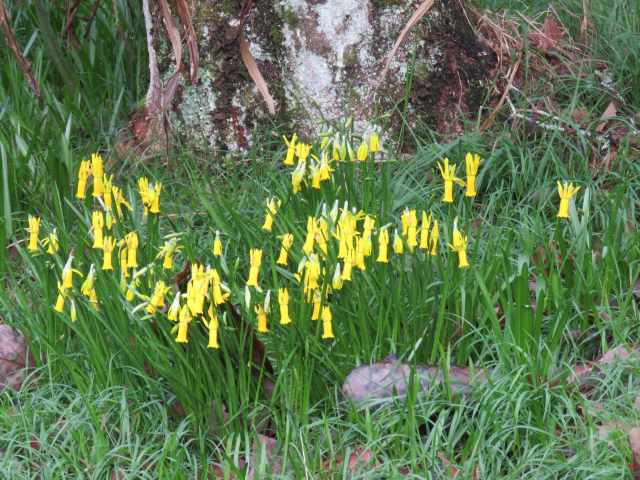
Loads of narcissi in bloom. We mostly grow the early flowering dwarf varieties because they are over before the nasty narcissi fly is on the wing.
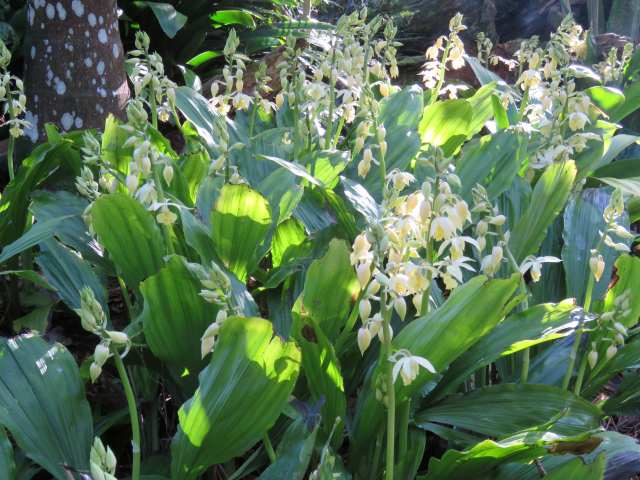
Everybody grows narcissi but not everybody grows orchids in the garden. These are calanthes opening and most of our cymbidiums are already in flower.
Our winters are still filled with colour and flowers. As the snowdrops pass over – their season is but brief in our mild conditions – so much else is coming into flower that I feel that slight sense of panic that I may miss something altogether if I don’t get right around the garden every few days. At least we no longer suffer from anxious pressure at the need to get many tasks done before the garden visiting season starts – on account of us no longer opening the garden, you understand.
There are many worse places to spend winter than here in North Taranaki.
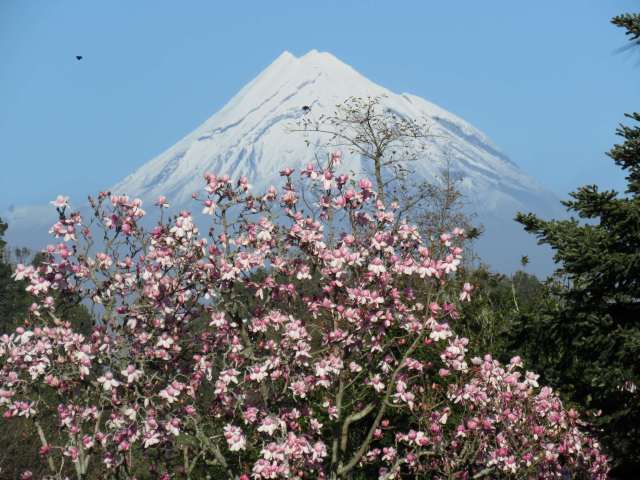
Magnolia campbellii var campbellii in our park. The snow line on Mount Taranaki is high this year, indicating a milder winter than some other years.
From the Ephrussi de Rothschild garden, it was on to the village of Èze and its famed Jardin Exotique. Èze is pronounced somewhere between ‘ezz’ and ‘airz’, not to be confused with the modern, novelty spelling of ‘easy’ – as in the Eze Wash carwash franchise I drive past as I go to town. I feel the village of Èze deserves more respect than that.
A few km north of Nice, Èze is recorded as having been occupied since 200BC. Its long history involves the Romans, Moors, Italians, French, Spanish and Turks. Surprisingly, it has only been formally French since the 1860s. It has attracted so much interest because the fortified village is on an elevated promontory with cliffs on the seaward side and views right around, making it both strategic and defendable. The fortifications tell quite a story.
I assume the brick path through the centre of the cobbled lanes has been laid in modern times to make the terrain a little easier for visitors but the rest of it seems to be largely original. Maybe they laid the modern services of water, drains and wiring beneath the bricks?
The village layout and buildings date back to the early 14th century, although fragments of walls from those BC times, 14 or 15 centuries earlier, still exist. Significantly, there is no vehicle access into the village. Everything comes in and out by hand and manual trolley. Well, almost everything but more on that later. It seems the two hotels in the old village use porters. I laughed when I looked up accommodation in Èze, just out of curiosity. There was a review, clearly of a place by the new town, not the medieval village, and written by an American. “We could walk to the grocery, quiche place, bus, and to the old city of Eze. All the other accommodations I saw were on hilly roads without sidewalks.”
Pretty much the whole of the French Riviera I saw is built on steep hills with uneven terrain, narrow, winding roads and certainly no footpaths outside of urban centres. Every road was a foot path for centuries of occupants here, long before the car was even thought of. This is not a place for people with restricted mobility.
Just a ruin from three centuries ago of a fort that may have been built six centuries ago
Above the village, at the highest point, stand the ruins of a fortified castle, sacked in 1706 by the soldiers of French King Louis XIV. At that point Èze was still under the control of the House of Savoy, so Italian, but largely inhabited by people known as Ezasques. Interestingly, the native dialect of Èze – rarely used nowadays – is most closely related to the Monegasque language of nearby Monaco. I find Europe’s fluid land borders fascinating.
My eye is drawn to all those conspicuous white labels but there is an educational role to play in naming plants for easy visibility.
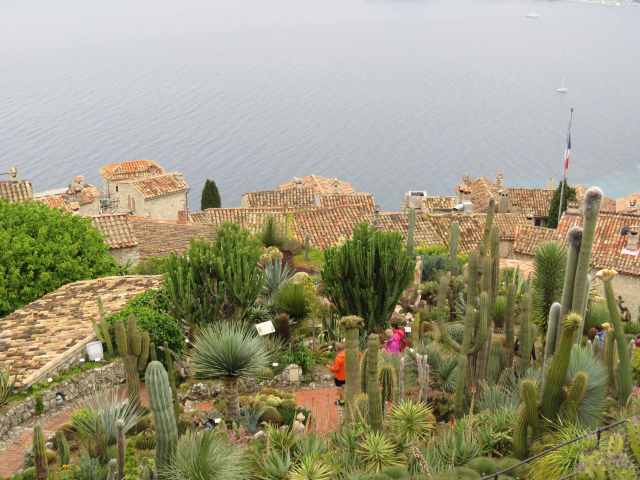
The ExotIc Garden is positively modern because it only dates back to 1949. Just down the road, so to speak, Jean Gaustad had already played a major role in creating the Jardin Exotique de Monaco. The mayor of Èze apparently thought it would be a good idea for his area too, as he is credited with a role in creating the Èze garden. Conditions are tough – exposed, coastal, precipitous, rocky, windy, very dry and hot in summer. What grows in those conditions? Cacti and succulents. They grow very well. I see a note that in getting the garden established, crews of men carted soil up the hill in bags on their backs so clearly efforts were made to give the plants a good start.
I am not a fan of prickly plants in any way, shape or form but they look right at home in these exposed conditions and I was somewhat won over by their textures and colours. Being a designated botanic garden, plants are all labelled. The gardener in me finds my eyes zooming in on those white labels and the aesthetics worry me but labels are the way in public and botanic gardens; private gardens need to make their labelling very discreet or non-existent to avoid looking amenity or municipal, in my opinion.
I felt obliged to photograph the tree fern out of southern loyalty. Truth be told, it is probably the Australian Dicksonia antarctica rather than one of our NZ species. It seems to be more widely available in Europe and Australian plants were being widely grown in the area whereas NZ plants were rare. But you know, we claim all tree ferns as ours, in an inclusive sort of way.
When I say a long way down, you can see the coach park in the centre, below the church.
As I understand it, Bono’s French pad is somewhere down below at sea level. It is quite a bit further down than the coach park and new town in the previous photograph.
The setting is amazing with 360° views. It is a long way down, whether on the land side or even further down to the sea. Apparently the Irish rock star Bono (of U2 and social activism fame) has a house down by the sea and the story is that he and his good friend Barack Obama walked up the hill for a drink at the hotel in the old village, somewhat to the surprise of village and garden visitors. All I could think was that if they walked all the way up there from the sea, they deserved a long, cold drink in peace.
The aspect of this garden that did worry me was the answer I was given to how they got large plants and sculptures to the upper levels. I didn’t think they were being levered around the tight lanes and steep steps. Helicopter, I was told, with the additional information that garden waste is also lifted out by helicopter. Surely not? Colour me shocked. In 2024, I would expect garden waste to be dealt with on site in a sustainable way, not loaded into bags to be airlifted out. I hope the information I was given is wrong but I fear it may be accurate.
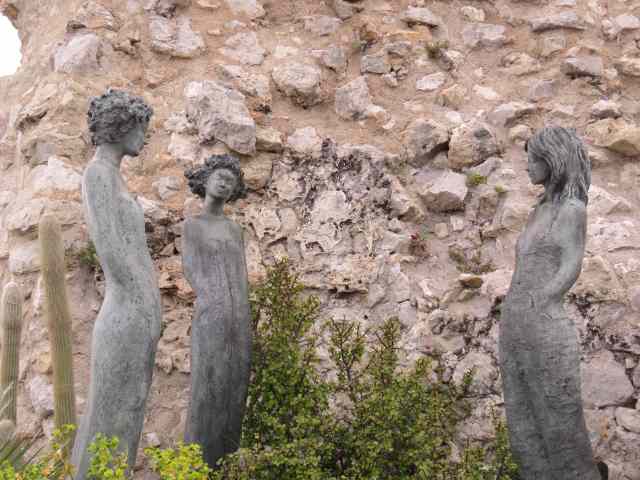
Each figure has a name and a somewhat obscure sign. That is Mélisande to the right above. Others seem to have somewhat eclectic names ranging from Justine or Isis, to Margot, Rose and Anais. I found a blog on line that referenced one named Barbara but I can not vouch for that and, if true, I want to know where the name Barbara came from for the artist.
More classical at La Mortola
The Earth Goddess sculptures were an interesting, contemporary touch. Jean-Philippe Richard started on his earth goddess works in the 1990s. Their elegant, elongated bodies stretch from chunky bases as though emerging from the earth and metamorphosing into stylised interpretations of classical, maybe stereotypical, feminine beauty. They were striking and after my reservations about the cliches of feminine beauty (I kept looking in hope that they may be either androgynous or maybe include some examples of young male beauty) I decided that they were indeed striking and entirely appropriate to the setting. And, in fact, no more cliched than the classical concepts of feminine beauty seen in La Mortola and the Ephrussi de Rothschild gardens.
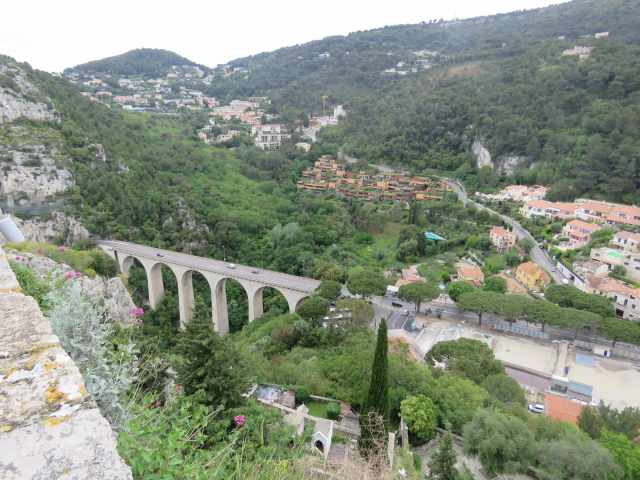
Looking across to a recent housing development
Privacy and green space is possible with good design
Finally, on a change of topic: looking out from the top of Eze, my eyes focused on an interesting example of green high density housing. I don’t for one moment imagine it is cheap – this is the Riviera after all – but it appears that good, modern design can give privacy and some outdoor green space while achieving housing density which blends harmoniously into the surrounding environment.
As seen in the middle of the photograph – blending into the wider landscape.









 Tikorangi The Jury Garden