Tag Archives: gardening

Garden lore

“Nature is the gardener’s opponent. The gardener who pretends he is love with her, has to destroy all her climaxes of vegetation and make… an alliance with her which she will be the first to break without warning, in the most treasonable way she can. She sneaks in, she inserts her weeds, her couch-grass, her ground elder, her plantain, her greenfly and her slugs behind his back. The bitch.”

Gardenage by Geoffrey Grigson (1952)

???????????????????????????????

Grooming conifers

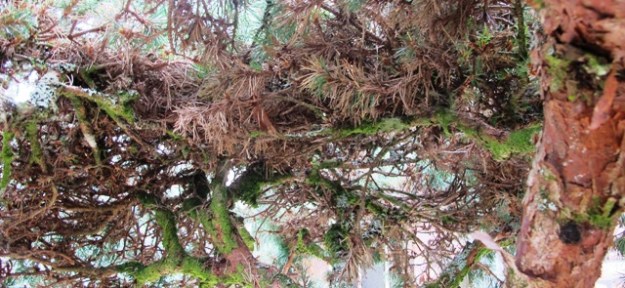
Conifers have had a bad rap in the NZ gardening world since their glory days of the 1970s. We regard this as entirely unfair. It is not the plants that are at fault, it is how we used them. If you are lucky enough to have some smaller growing conifers in your garden, getting in and cleaning them out improves the look, assists plant health by reducing problems with pests and diseases. They can build up an astonishing amount of decaying needles and debris which starts composting over time. What may look like a few brown tufts of foliage from the outside reveals a whole lot more if you part the branches to look within.

I just don gardening gloves and manually dislodge the debris, reminding myself I should start at the highest point I can reach and work my way down, rather than the temptation to do it the other way. I then follow up with secateurs to tidy up dead stems, trimming flush back to the branch. Snails like snoozing out the days in conifers, I notice. All plants benefit from some air movement and few appreciate composting material against their trunks.

First published in the Waikato Times and reprinted here with their permission.

Plant Collector: Hydrangea quercifolia “Snowflake”

Hydrangea quercifolia "Snowflake"

Hydrangea quercifolia “Snowflake”

That is a real flower, not a silk or paper one and it is a hydrangea. It is often called the oak leaf hydrangea – oaks are quercus, hence the quercifolia. It is native to south eastern USA.

This particular plant, which I photographed in my sister’s garden last week, is surviving on benign neglect. It has its roots in the open but the plant has spread so that the flowers are under the cover of a carport, conditions it clearly relishes. We have it planted in woodland areas here but this plant was more spectacular. Apparently it started flowering in November and has been looking really good ever since. The flower heads are in long cones and while “Snowflake” is described as a double form, in fact it forms multiple layers of petals down the stems ageing from white to antique pink shades. In autumn, the foliage colours up to deep burgundy red shades before falling.

H. quercifolia is not fussy about soil types but it needs to be rich, moist and well drained even through summer. It will grow in sun or shade although it is probably easier to keep those moist conditions in semi shade. There are a number of different named cultivars, but “Snowflake” is probably the most spectacular. If you can’t source it from your local garden centre, then mail order hydrangea specialists Woodleigh Nursery have it available on their website.

First published in the Waikato Times and reprinted here with their permission.

Gardening on a steep slope

Terracing allows for easier gardening after the initial cost and effort (but I think the steps are too steep to be comfortable)

Terracing allows for easier gardening after the initial cost and effort (but I think the steps are too steep to be comfortable)

I had a few days in Tauranga last week. It is always interesting for me, a country dweller, to stay in city suburbia. It reminds me that others garden in very different situations. In this case, I was staying with my sister who lives on a relatively steep hill and that certainly brings a whole new set of challenges for gardening.

If I was starting from scratch on a steep section, I would get wide steps in first and then start working around them in terms of the garden on the sides. Where space allows, wide steps look far more generous and remove much of the off-putting aspect of a steep slope.

Where space allows, wide steps look more generous and less onerous to climb

Where space allows, wide steps look more generous and less onerous to climb

There are rules for garden steps. The DIY home owner often makes the mistake of getting the tread width and riser depths wrong. The riser is the vertical piece and the general advice is that in a garden situation, it should not be more than about 15cm. To balance that, the tread (or flat part of the step) should be about 30cm. That is a gentler gradient than indoor house stairs. There is plenty of information around on this topic and it pays to take notice. The hand hewn steps in my sister’s garden were probably the other way around and very difficult they were to negotiate as a result.

If you decide to do a zigzag path crossing your section rather than steps, take the time to get the path almost level crossways. Most of us have two legs the same length. It is not at all comfortable to limp along a path that slopes sideways as well as wending its way up or down a bank. I say almost level. You want your path to shed water sideways rather than channelling it down the length so you need just a slight gradient across. Get the spirit level out.

Once the steps or paths are in, you can then decide what you are going to do with the sides. It is difficult on a steep slope. If you are a serious gardener, you will probably want to put in terraces. If you don’t, you are going to destabilise the slope every time you dig into it and the rain will wash the soil downhill. It is also physically uncomfortable to work perched on a steep angle.

Just remember that if you terrace and sow lawns, you need to make it easy to get the lawnmower down. If it is too difficult, you will keep putting off mowing the grass.
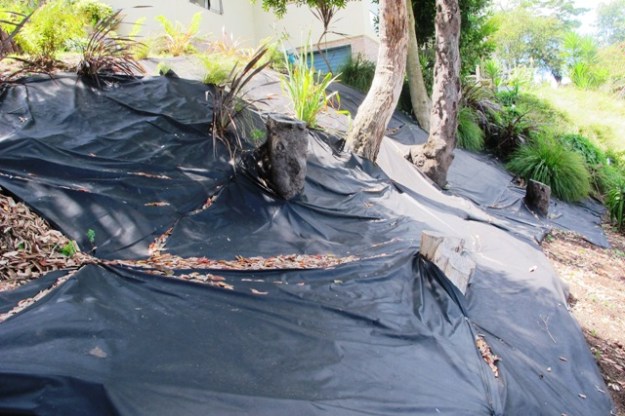
Weed mat is never a good look

Weed mat is never a good look

If you don’t want to tackle the effort and expense of terracing – the hard landscaping, retaining walls, finding topsoil to fill your terraced areas and the rest – you may choose to let nature take over your slope. One hopes not many of you will think it appropriate to clad your slope in ugly weedmat. That is a truly awful finish. In shaded areas, allowing ferns and mosses to colonise gives an attractive, natural look over time.

In sunny areas, you will need to give a helping hand. Whatever your opinion of agapanthus, it does a great job of retaining clay banks with the bonus of summer flowers. Alternatively, there are a range of sedums and sempervivens that you can plant and leave to smother a dry, sunny bank. Or you can establish our native iceplant (horokaka or Disphyma australe) which evolved to cope with these types of conditions. Renga renga lilies (arthropdium) prefer a little shade but will tolerate full sun and will grow in inhospitable soils.

A bare bank will erode so you need to stabilise it with something.
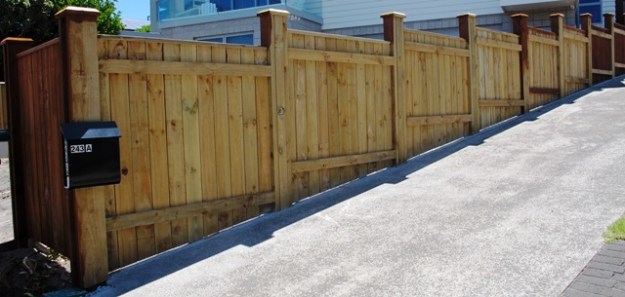
Professionals step fences to get them down slopes

Professionals step fences to get them down slopes

I would also observe that fences can define your station in life. A DIY fence often follows the lie of the land, undulating its way down the hill. A professional fence steps its way down. That is all on that matter.

The DIY fence is often obvious by its undulating line, following the contours

The DIY fence is often obvious by its undulating line, following the contours

I admit that I leaned on the decking railing at my sister’s house and looked at her steep section which runs down to a native bush reserve and then an estuary. I looked at my sister. Confine her gardening to the flatter, more accessible areas immediately by the house, I suggested, and let the lower slopes revert to bush. She will keep her lovely outlook without having to do major construction and continual garden maintenance on a difficult site. I think it likely she will heed my advice.

First published in the Waikato Times and reprinted here with their permission.

Garden lore

” I had never ‘taken a cutting’ before…. Do you not realise that the whole thing is miraculous? It is exactly as though you were to cut off your wife’s leg, stick it in the lawn, and be greeted on the following day by an entirely new woman, sprung from the leg, advancing across the lawn to meet you.”

Down the Garden Path by Beverley Nicholls (1932)

007 - Copy Leaf drop – evergreen, semi evergreen or deciduous
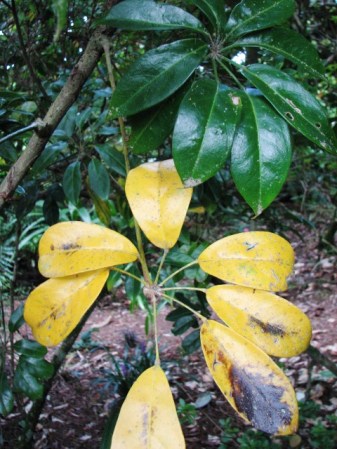
All plants lose a full set of leaves every year so the search engine terms I see like “a michelia that doesn’t drop leaves” shows a lamentable lack of understanding. What varies is how long the plants hold onto individual leaves and when they drop them. Deciduous plants drop them in one hit, triggered by declining day length in temperate and cool climates (ie autumn) or by the dry season in the tropics where day length stays constant. Semi deciduous plants usually drop all their leaves just as the new ones are coming through so the plant has a very short period without full foliage. Some plants will drop a lot of foliage around flowering time – Michelia Silver Clouds is an example of this.

Many evergreen plants gently drop old leaves all the time. It is just so gradual you don’t really notice it but you will see a build up of leaf litter below. The length of time an individual leaf stays on the plant can vary from a few months for bulbs to several years for bushy, dense evergreen plants but sooner or later, every leaf will either fall or wither away. A stressed plant will drop more leaves. It is the plant’s way of trying to reduce evapotranspiration (moisture loss).

If you want a plant which never drops leaves, you will have to keep to plastic or fabric. Living things have to renew themselves

First published in the Waikato Times and reprinted here with their permission.

Garden lore

” These are most anxious times on account of the slugs. Now every morning when I rise I go at once into the garden at four o’clock and make a business of slaughtering them till half past five, when I stop for breakfast.”

An Island Garden by Celia Thaxter (1894)

Snails – if you can’t beat ‘em, eat ‘em

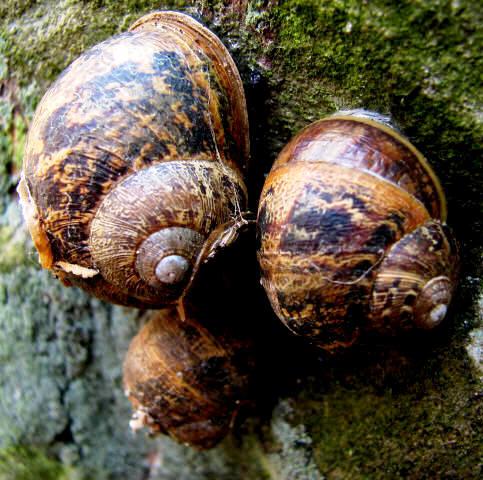
If you are inundated by snails, you could consider eating them. They do not have to be ooh la la francais escargots out of a tin. It appears that our common snail here is the internationally edible variety of Cantareus aspersa, formerly known as Helix aspersa. If you are keen to try, it is often recommended that you purge the snails for a couple of days. You can do this by starving them or by feeding them on bread. A genuine snail-eating Italian on Twitter told me that the technique is to bring them to the boil, wash them, boil them again and serve with lashings of garlic butter on a bed of lettuce. If you are squeamish about boiling live snails, the best way to euthanase them may be to put them in the freezer for a short while. The ever-useful internet tells me that each snail weighs about 10 grams and you need at least 6 per serving.

This advice is theoretical on my part. Our accord with the many birds in our garden means that we don’t have sufficient snails on hand to try it out.

First published in the Waikato Times and reprinted here with their permission.