Tag Archives: gardening

Garden lore

” I had never ‘taken a cutting’ before…. Do you not realise that the whole thing is miraculous? It is exactly as though you were to cut off your wife’s leg, stick it in the lawn, and be greeted on the following day by an entirely new woman, sprung from the leg, advancing across the lawn to meet you.”

Down the Garden Path by Beverley Nicholls (1932)

007 - Copy Leaf drop – evergreen, semi evergreen or deciduous
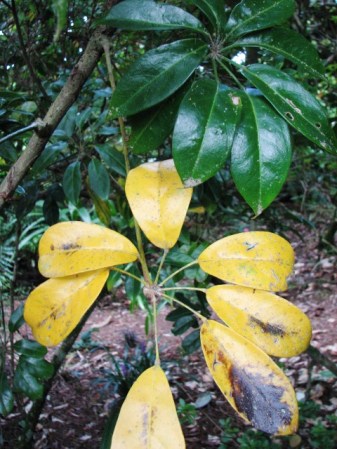
All plants lose a full set of leaves every year so the search engine terms I see like “a michelia that doesn’t drop leaves” shows a lamentable lack of understanding. What varies is how long the plants hold onto individual leaves and when they drop them. Deciduous plants drop them in one hit, triggered by declining day length in temperate and cool climates (ie autumn) or by the dry season in the tropics where day length stays constant. Semi deciduous plants usually drop all their leaves just as the new ones are coming through so the plant has a very short period without full foliage. Some plants will drop a lot of foliage around flowering time – Michelia Silver Clouds is an example of this.

Many evergreen plants gently drop old leaves all the time. It is just so gradual you don’t really notice it but you will see a build up of leaf litter below. The length of time an individual leaf stays on the plant can vary from a few months for bulbs to several years for bushy, dense evergreen plants but sooner or later, every leaf will either fall or wither away. A stressed plant will drop more leaves. It is the plant’s way of trying to reduce evapotranspiration (moisture loss).

If you want a plant which never drops leaves, you will have to keep to plastic or fabric. Living things have to renew themselves

First published in the Waikato Times and reprinted here with their permission.

Garden lore

” These are most anxious times on account of the slugs. Now every morning when I rise I go at once into the garden at four o’clock and make a business of slaughtering them till half past five, when I stop for breakfast.”

An Island Garden by Celia Thaxter (1894)

Snails – if you can’t beat ‘em, eat ‘em
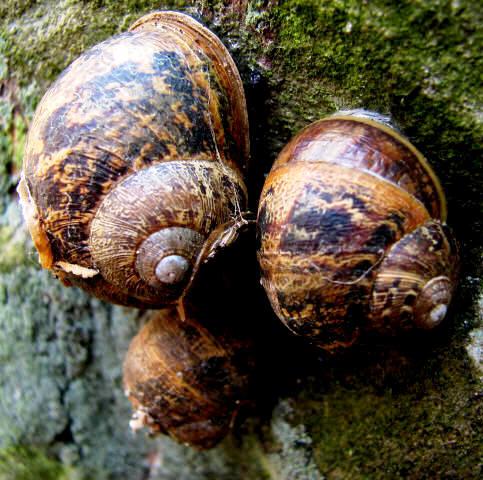
If you are inundated by snails, you could consider eating them. They do not have to be ooh la la francais escargots out of a tin. It appears that our common snail here is the internationally edible variety of Cantareus aspersa, formerly known as Helix aspersa. If you are keen to try, it is often recommended that you purge the snails for a couple of days. You can do this by starving them or by feeding them on bread. A genuine snail-eating Italian on Twitter told me that the technique is to bring them to the boil, wash them, boil them again and serve with lashings of garlic butter on a bed of lettuce. If you are squeamish about boiling live snails, the best way to euthanase them may be to put them in the freezer for a short while. The ever-useful internet tells me that each snail weighs about 10 grams and you need at least 6 per serving.

This advice is theoretical on my part. Our accord with the many birds in our garden means that we don’t have sufficient snails on hand to try it out.

First published in the Waikato Times and reprinted here with their permission.

Plant Collector: blandfordia (February bells here)

Blandfordia - Australia's Christmas bells

Blandfordia – Australia’s Christmas bells

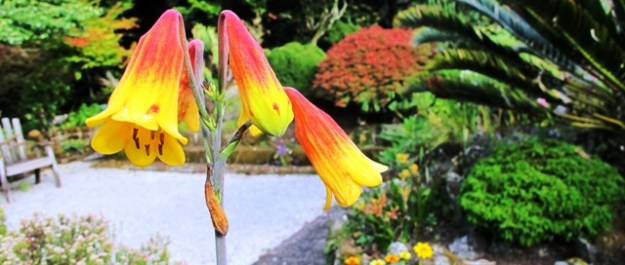
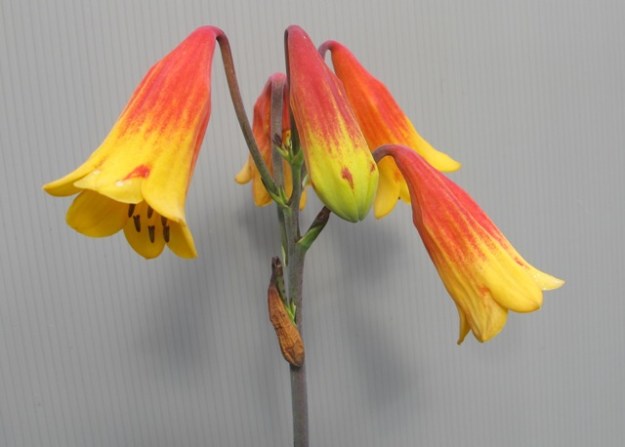
Christmas bells is the common name. Apparently in their homelands of Australia, these bulbs flower around Christmas. They are somewhat later here but the flowering lasts many weeks. It is not that there are large quantities of blooms, just that they come in succession and each trumpet lasts for a long time. These ones are on stems about 30cm high. The foliage is small, anonymous and grass-like at the base.

There are four different species of blandfordia and they have been given a family all of their own. They are hugely variable in colour and flower size, ranging from all red to all yellow, which makes identification difficult. We think this one is most likely to be Blandfordia grandiflora (so-named because it has the largest flowers) which is native to New South Wales and Queensland. There is a slight hesitation, however, between that and the Tasmanian form B. punicea. Unless an Australian botanist arrives at the right time, we may not get a definitive identification.

You don’t see blandfordias around often, or used in cut flower production, because they are slow to establish. Really slow, in fact. The references say up to 7 years to get to flowering size. In our case, maybe add another 7 before we started getting consistent flowering. Ours appears to be largely evergreen, keeping some foliage year round. Blandfordias need excellent drainage but not dry and baked in arid conditions.

blandfordia (2) - Copy

First published in the Waikato Times and reprinted here with their permission.

The Chelsea chop comes to New Zealand

Lobelia, phlox, campanula, aster, pensetemon and coreopsis - all candidates for the Chelsea chop here

Lobelia, phlox, campanula, aster, pensetemon and coreopsis – all candidates for the Chelsea chop here

We are fairly dedicated viewers of the long-running series BBC Gardener’s World. Of late it has been on free to air Choice TV (interspersed with huge quantities of advertising) and sometimes it turns up on the Living Channel. There was a programme that screened here last November which demonstrated the technique of the Chelsea chop. I tried it in a small way and will be doing a great deal more of it this coming year.

The Chelsea chop came by its name, apparently, because at the end of the annual Chelsea Flower Show, many surplus plants were returned to nurseries. These plants in full growth, nearing or at their peak, were often cut back hard. Presumably some were plants forced into early growth to peak for the show and that early growth can be leggy. Plants responded with greatly increased vigour and put on extended floral displays with much bushier and more compact shapes.

Thus did the term the Chelsea chop enter the lexicon of English gardening.

Right, I thought. Chelsea is towards the end of May which translates to November in our hemisphere. I headed out with the snips to experiment. It seemed extreme because I was cutting off flower stems which were already well advanced. In some cases, I cut half and left half. I can now report that it works and I will be doing a great deal more of it next spring.

Important points to note are that we are talking about perennials here, not shrubs or bulbs. You need to understand your perennials because it only works on varieties which repeat flower. If you snip the ones which only flower once, such as irises or aquilegias, you won’t get any flowers at all.

I tried it on perennial lobelias, sedums, penstemons and asters.

The unchopped lobelias have shot up their flower spikes to over 1.5 metres and they have promptly fallen over in the welcome rain this week. The plants I Chelsea chopped are only a few days behind in their stage of flowering but have tidy, sturdy stems about 50cm high. They are much better in the garden borders.

Sedum, left to its own devices and falling apart already

Sedum, left to its own devices and falling apart already

Many readers will understand when I complain about the sedums which grow brilliantly from such tidy rosettes at ground level but when they reach a certain point of being top heavy, they fall apart. The Chelsea chopped ones are a more compact and holding together at this stage.

I cut the asters because I didn’t want them to flower until late summer and they were threatening to do it too early. They are just opening now, on lovely bushy mounds of plant, and should take us into autumn.

I see the Telegraph website advice is to do it with Campanula lactiflora (which can get a bit too tall and fall over if you don’t stake it), rudbeckias, echinaceas and heleniums as well. Their writer advises to prune back by a third. Essentially it is a more extreme version of pinching out plants at their early stages to encourage bushier growth.

Perennial gardening is our current learning project here. We have been working on it for a few years now and the more we learn, the more we realise there is to learn. New Zealanders don’t have a great record in perennial or herbaceous gardening. We lean more to bunging them all in together in mixed borders, or working from a very limited palette in large swathes of the same plant.

Sedum, cut back last November and holding itself well. Flowering is unaffected

Sedum, cut back last November and holding itself well. Flowering is unaffected

The mix and match approach to perennials is very English. They just do it so much better than anywhere else we have seen. Underpinning it (at its best) is a wealth of experience in successional flowering and good combinations. It is not just flower colour combinations, it is also compatible growth habits. This may be growing a naturally leggy plant (such as Campanula lactiflora) through a plant that is sturdy enough to support its leaning companion. It is making sure that a big voluptuous plant can’t flop all over a low growing, more retiring specimen. It is getting variations within the foliage as well as the flowers. It is getting the plant shapes right.

And it is not just peak flowering looking its best for three weeks of the year. It is understanding which combinations will take the garden through the season from spring to autumn, so as one finishes, another star takes centre stage. Judicious use of the Chelsea chop can extend the display, staggering flowering through the season.

There is a lot to it. No wonder people opt for mass plantings of the same plant. It is much easier. So too with the cottage garden which does not require the same level of skill. This type of intensive gardening is not to everybody’s taste but we are finding it interesting to learn. To be honest, I had not appreciated the skill that goes into putting in a really good planting of herbaceous material.

I will be doing my best impersonation of a garden hairdresser come this November. I will be out there snip, snip, snippin’ away.

First published in the Waikato Times and reprinted here with their permission.

Plant collector: Jacaranda mimosifolia

The summer delight of the jacaranda

The summer delight of the jacaranda

South Africans could be forgiven for thinking that this tree is one of their indigenous species. Pretoria has so many planted that it is apparently a haze of blue in late spring to early summer. In fact it comes from Bolivia and Argentina but is a worldwide hit because blue flowered trees are not common at all when you think about it. Nearer to home, when we last visited Whakatane, they too had used this summer flowering delight as a street tree. But it is nowhere near as common where winters are wet or in inland areas because it is a subtropical plant. Our tree is growing in a protected position, surrounded by other trees, rather than standing in solitary splendour so its blue-as-blue floral display is best seen out of our upstairs windows.

Jacarandas are deciduous and make an airy, open tree. After many years ours has reached around nine metres high, though it will have been stretched up by the trees around it. The flowering season lasts many weeks but it does appear that cooler temperatures delay the season until mid summer. In less than ideal conditions, it will need a sheltered, favoured position with excellent drainage in the warmest possible situation. It is classified as a member of the Bignoniaceae family though most gardeners will just recognise it as a legume.