Tag Archives: gardening

Garden lore

“A well-watered lawn will look great for a week or two, but you will have created a rod for your own back because it will start to expect another dousing. Grass is a tough plant and can survive very long stretches without water. No matter how severe a summer drought, no one’s lawn in Britain has ever died from lack of water. It can survive up to eight months without rain.”

The Curious Gardener’s Almanac by Niall Edworthy (2006)

Summer watering

Readers who have gone for the raised vegetable garden beds should be discovering a major disadvantage around now. Raised beds need a whole lot more watering in dry conditions because they dry out much more quickly than the ground below. Container plants dry out even faster.

Ideally, evening watering is better than morning watering because the cooler night temperatures allow for better absorption. A spray of water is preferable to a jet. Making many slow passes over the surface rather than flooding it allows for better penetration by the water. A good deep watering every few days is much more effective than merely passing over the surface each day. Dig down a little to see how far the water has penetrated. If it is only the top few centimetres, that is where the plants’ roots will be concentrated, making the plants even more vulnerable to drying out.

If you allow your container plants to get too dry, watering becomes ineffective because the water just flows straight through and is not absorbed at all. If the container is too big to sit in a bucket of water for at least 20 minutes, then a small squirt of dishwashing detergent on the top before watering can help absorption without harming the plant.

First published in the Waikato Times and reprinted here with their permission.

Cover the ground

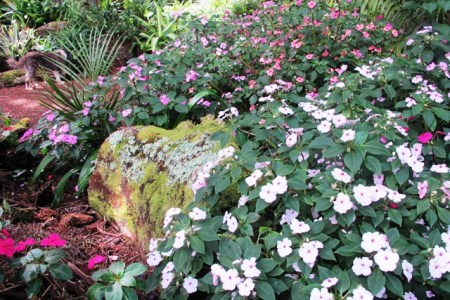
Happy and easy care perennial impatiens

Happy and easy care perennial impatiens

I mentioned last week about my mother’s gardening mantra being ground cover which focussed my mind on the case for ground cover plants. Surprisingly, this preoccupation is a relatively recent phenomenon.

Back in the 1950s and 1960s ground cover plants hardly featured. It was all about trees and shrubs with little under planting. Now it is often regarded as a hallmark of good gardening to have no dirt showing at all – except in the vegetable garden. Mostly it is about packing the garden with layers of plants, each lower layer masking the stems and trunks of the taller ones while down the bottom is some low but strong growing ground hugger.

There is good sense to not having exposed dirt in a garden. Keeping it covered stops dirt splash in the rain, wind blown top soil in the wind and erosion in torrential downpours. A good thick layer of something, be it plant or mulch, can cut down on the germination of weed seeds lurking in the soil because it reduces the amount of sunshine and light that most need. It is also a great deal more attractive than the liverwort that colonises uncultivated ground in shaded areas.

There are ground covers and there are G-R-O-U-N-D C-O-V-E-R-S. Some modest little ones never get ideas above their station and just gently colonise an area, spreading in a quiet and acceptable manner. In this class, I would put the unassuming but pretty little scuttelaria which we have in both white and blue or the obliging corylopis and a number of the ajugas.

Then there are the rampant ones which, given even a hint of an invitation, will spread at an alarming rate. I once bought a punnet of such a plant which looked promising. I have long since lost its name but it had pretty white cup flowers and good green, fine foliage. That punnet held six plugs, each measuring about 2.5cm across. Within one season, each of those plugs measured a metre across. I have never seen anything spread so alarmingly. It took me two years to get rid of it entirely, all the time muttering that the people who propagated that plant for sale should be lined up and shot. For the same reason, I have eradicated the Orangeberry plant (Rubus pentalobus) and rampant violets. I don’t want lemon balm either. It stages a takeover bid, choking everything in its way. And the ornamental tradescantia is pushing its luck.

Zephyr beside the Acanthus mollis

Zephyr beside the Acanthus mollis

We are extremely cautious about the triffids too. These are the large growing perennials which spread and choke out much in their path, seeding their way through the garden. Acanthus mollis or bears’ breeches springs to mind as a good example. One can be striking but don’t turn your back on it and allow for the fact that every one needs at least a metre and a half of space. Too many and your garden looks as if it is full of cheapie plants as bulk fillers. We call it the ABG syndrome after we heard somebody’s garden described as being a case of Another Bloody Gunnera. Those particular triffids are now on the banned list in this country, as far as I know – the enormous rhubarb plants.

Endless plant lists without photos make dull reading, but I will offer up a very short list of recommended, well behaved ground cover plants which have proven their worth here and should be readily available. In shade areas, it is hard to go past hostas, farfugiums and ligularias but also the francoas (sonchifolia and ramosa- the Chilean bridal wreath flowers) and phlomis. We have a wonderful swathe of old fashioned perennial impatiens (busy lizzies) which have kept on keeping on for decades in frost free woodland conditions. They flower for 10 months of the year and require next to no attention.

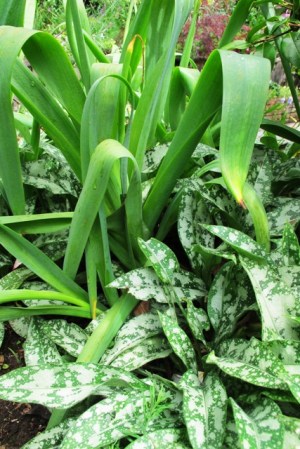
The mottled foliage of pulmonaria (with the unromantic common name of lungwort)

The mottled foliage of pulmonaria (with the unromantic common name of lungwort)

In sunnier conditions, the sedums work well, as do coreopsis, smaller growing campanulas, phlox, asters – there is an endless list of possibilities. I am less keen on the widely used catmint (nepeta) which I regard as too strong a grower and essentially boring. I much prefer the mottled foliage and pretty flowers of the pulmonaria which fill a similar niche.

For those who find using perennials offputting, the permanence of ground cover shrubs sometimes appeals, especially flowering shrubs. We used to sell pretty little weeping camellias (Sweet Emily Kate and Quintessence) which, if not trained upright, would become ground cover. And somebody has apparently released a “ground cover” michelia. I know this because I have been asked for it but have not seen it yet.

But, ground cover shrubs in a mixed planting? I don’t recommend them. We tried Sweet Emily Kate and very soon discovered the drawbacks. There is nowhere for the spent flowers to drop to so all that happens is that slushy blooms and other garden debris sits on top of the plant, needing frequent picking over by hand.

If you want ground cover, keep to perennials or seasonal bulbs and annuals is my advice. If you want to reduce maintenance, mulch with something anonymous like compost or bark chip instead and bypass the ground cover altogether.

First published in the Waikato Times and reprinted here with their permission.

Garden lore

” The nonagenarian President of Magdalen, Dr Routh, was once brought the news that the acacia tree outside his lodgings had been blown down by a storm. “Put it up again,” was all he said; and up, of course, it went.”

Oxford by James Morris (1965)

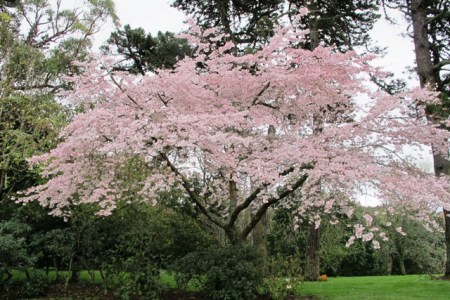
Prunus Awanui, flowering in spring here, has a tendency to develop witches' broom

Prunus Awanui, flowering in spring here, has a tendency to develop witches’ broom

Summer pruning

Now, at the height of summer, is the time to prune prunus, be they flowering cherries, fruiting cherries, plums, peaches, nectarines, apricots or almonds. Naturally you wait until they have finished fruiting for the season where possible. These plants are always pruned when in full growth to stop the dreaded silver leaf or silver blight getting in to the cut surfaces and taking hold. If your flowering cherry had large patches which didn’t bloom in spring and where the leafy growth is denser, then you have witches’ broom and it needs to be cut out now. If you leave it be, it will take over the whole tree and you won’t get any flowers at all in due course. It affects the Japanese type cherries but not the earlier flowering campanulata or Taiwanese varieties.

Make clean cuts with a sharp pruning saw and if you are moving on from an unhealthy tree specimen, then disinfect pruning implements between. Otherwise you can transfer disease. Wiping the cutting blades with meths or chlorine should work.

First published in the Waikato Times and reprinted here with their permission.

Cicely’s gardens

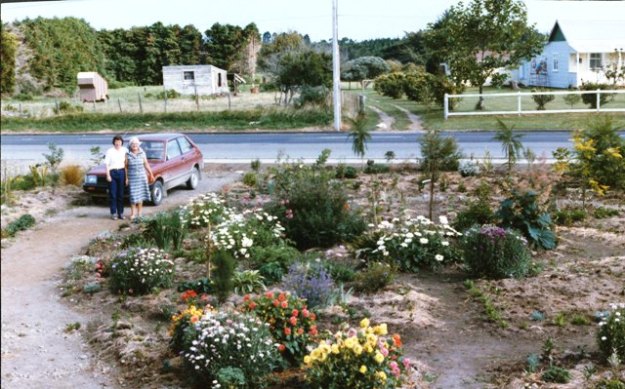
My mother and sister at the start of another of her gardens

My mother and sister at the start of another of her gardens

I have been thinking of my late mother, Cicely Denz, this week and realised I have never paid tribute to the fact that I, as well as Mark, grew up in lovely gardens. The difference is the plural – Mark grew up in the one garden that is now our home at Tikorangi. I grew up in multiple gardens, mostly around Dunedin.

She was a fine garden maker, my mother, though the gardens were distinctly clonal. She worked from the same plant list of favourites and she never stuck around long enough to see them mature. I am sure it would have been different had my father lived longer and she had her lifelong love next to her in body and not just memory. She would have put down roots and may well have earned a place in the modern garden history of this country.

Instead for a woman of her generation, intelligent but under educated with no recognised career, lacking a man at her side when solo parents were almost unknown, leading a distinctly precarious financial existence and lacking the usual anchors in life, my mother turned her gardening into her public face and her claim to status.

She was always a gardener. Her first was an acre in size. When my father was demobbed post WW2, he went to work at Porton Down in Salisbury. As that place was a military scientific research facility, this may well have contributed to his premature demise (think nerve gas research, organophosphates and other agricultural chemicals). With the shortage of housing in bombed Britain, they relocated two military huts and my mother built her first garden around them. Despite extensive reading of the major English garden writers, she never deviated from the romantic English country cottage style of gardening of that era.

By the time I was born, my parents decided to return to New Zealand with the four children in search of the traditional NZ family life and employment opportunities meant Dunedin. That English style of gardening translated well to Dunedin which may never get as cold as most of the UK but has similarly low sunshine hours, never gets hot and is characterised by a soft light unknown to most of us north of there.
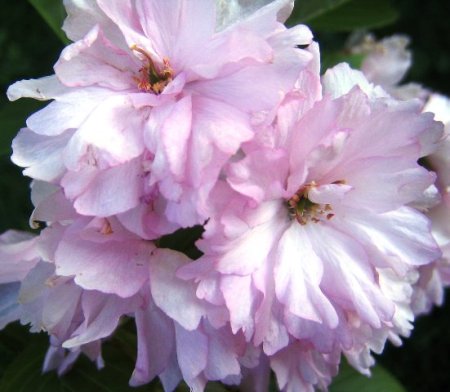
Every garden had Prunus Kanzan

Every garden had Prunus Kanzan

She was always renowned for her proper English primroses. They will grow here in more northerly climes but they hardly flower whereas my childhood was spent with vases of them in season. Along with violets, hellebores and London Pride. Roses were always of the old fashioned variety, not a vulgar hybrid tea in sight. And herbaceous paeonies, big clumps of these spring delights. We all grew up knowing the name of Paeonia mlokosewitschii – she was a demon for botanical names. Every garden had at least one Prunus Kanzan (in pink) and one Prunus Tai Haku (in white).
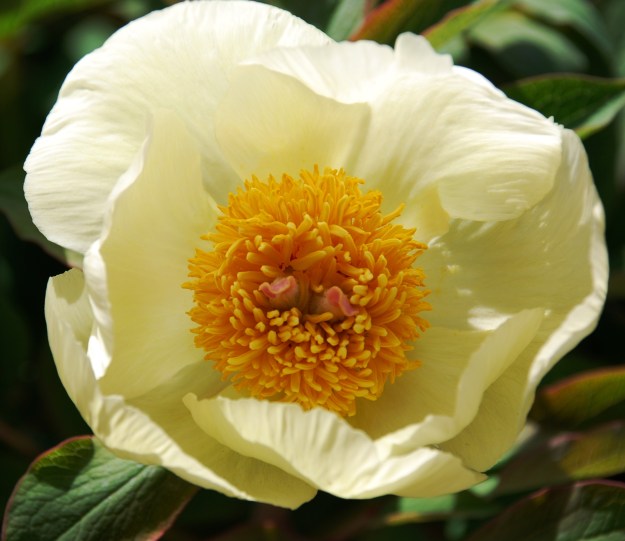
The paeony with the impossible name

The paeony with the impossible name

Lawnmowers were not her friend. She attempted to pressgang any passing young male into using the push mower on grass which tended to be overgrown. At one stage, she decided that a brand new motor mower might do the trick. This required site visits from the poor young salesman, whom she probably reduced to tears with her complete inability to start the engine and her tendency to blame the machine. The shop took the mower back.

In due course, Cicely gave up on all lawns. She figured that it cost money to maintain a lawn (it does) and she would rather have gravel paths and garden.

Not only did she not have lawns, there was a total lack of hard landscaping. Good gardener she may have been and certainly she had no fear of hard work, but she lacked any home handywoman skills and she rarely had sufficient money to pay for someone else to come and install anything like fencing or paving. Garden ornaments were completely absent. Mind you, this was in the days before it became fashionable to adorn your garden like an overstuffed display cabinet.

I quipped many years ago that all she needed to keep her happy were five plants, a spade and a wheelbarrow. She could then move the plants like chess, as she was wont to do. But she was a garden maker at heart. The joy for her lay in breaking in a piece of ground and planting it up, garnering much admiration from passersby and neighbours. She had little interest in maintaining the garden once established so soon became bored, finding some compelling reason to move. I kid you not. In my lifetime, I can recall about ten gardens she made. There may have been more.

Her mantra was ground cover. She firmly believed that if you plant ground cover densely, it suppresses the weeds. Well, no. She didn’t like weeding and ground cover plants mask the weed infestations, rather than suppressing them. It also makes weeding more difficult because the weeds and plants become deeply intertwined. Her style of gardening was hugely labour intensive and generally involved lifting all the ground cover perennials once a year and dividing them so the weeds did at least get dealt to annually. She spent pretty much every single day in her garden.

Cicely’s style of gardening was transient. These gardens lacked the bones to carry them through the decades. There was a lack of good long term trees and a lack of structure or form. I doubt that any survive now. She never went back to look. But for the few years of their glory, they were a delight and a fine example of that particular garden style.

First published in the Waikato Times and reprinted here with their permission.

Plant Collector: Cordyline stricta

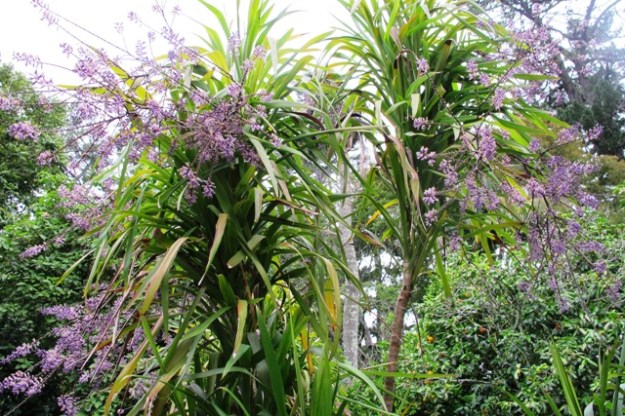
Cordyline stricta - blue flowers but no scent

Cordyline stricta – blue flowers but no scent

Cordylines are commonly known as cabbage trees in this country. Some wit branded them as Torbay Palms for the UK market and we know that most of them are ours, native to New Zealand. Not this one, however. The blue flowers and the unchewed foliage are a hint – C. stricta belongs across the Tasman, native to coastal New South Wales through to southern Queensland. It is a native moth – Epiphryne verriculata – that chews our cordylines but it does not fancy the foreign varieties so C. stricta doesn’t get the moth eaten look.

It is an excellent garden plant, being tolerant of a wide range of conditions and relatively hardy. It will take coastal winds, even dry conditions, grows in sun or shade and is okay with light to moderate frosts. We have never had it reach much over 3m tall and it clumps so if it is getting unwieldy, it is easy to chop out the longest stems. The leaves are a little fleshier than the stringiness of our native varieties so it is more amenable with the lawnmower. Then there are the lovely blue flowers in summer. But it doesn’t have everything – there is no scent and that is one of the hallmarks of our native ones.
Cord stricta - Copy

First published in the Waikato Times and reprinted here with their permission.