Tag Archives: gardening

Garden lore

The more one gardens, the more one learns; and the more one learns, the more one realises how little one knows. I suppose the whole of life is like that

by Vita Sackville-West.
(1892-1962)

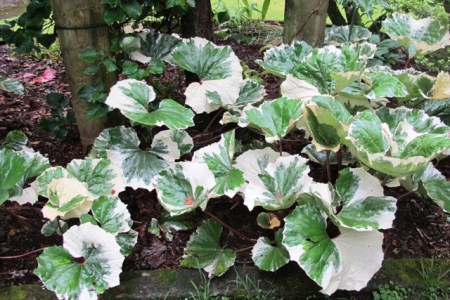
Farfugium tussilagineum argenteum - standing up well after being dug and divided last autumn

Farfugium tussilagineum argenteum – standing up well after being dug and divided last autumn

Digging and dividing

While the advice is freely given to dig and divide perennials, it is often the garden task that slips so far down that it falls off the to-do list because it is rarely urgent. If you have clumping, leafy plants which are either dying back in the centre or flopping all over the ground, that is a sign that they will benefit from being lifted, divided into smaller pieces which are then cleaned up and replanted into well dug and composted soil. This patch of Farfugium tussilagineum argenteum (some of you will know it as a ligularia) received this care and attention last autumn and now it is sitting up looking much more attractive, rather than falling apart with leaves lying on the ground.

In our comparatively mild climate, we can do this pretty much any time of the year though hot, dry summer is best avoided unless you water twice a day. In cold climates, plants can rot out if dug and divided when dormant, so times of growth in spring and summer are usually recommended.

First published in the Waikato Times and reprinted here with their permission.

The vexing issue of underplanting

A row of alternating annuals makes a statement, though it may not be the statement the gardener is aiming for

I had a day out and about looking at gardens recently and I was struck by the nature of under planting, though this preoccupation may have had more to do with my thoughts at the time. What I noticed about the under planting was how badly it was done in a couple of gardens. Bear with me, dear readers. You are going to have to imagine it because I know the garden owners so I was not going to whip out m’camera and take photos of the worst examples to embarrass them in the newspaper and on line.

Words like mishmash and hodgepodge came to mind as I looked at the bottom layer of plants in otherwise perfectly competent gardens. In other words, they had good upper layers of larger plants but when it came to the bottom layer of ground covers and under plantings, the selection criterion seemed solely that the plant should not reach more than 30cm in height. And there was one of this, one of that and one of the other, bunged in higgledy piggledy in most spaces.

Even worse, and I had to visit my local garden centre to set up a photo to demonstrate, is the horror of alternating annuals in a row along the edge. These certainly make a statement in the garden, though it may not be the statement that the gardener thinks when he or she plants them. I saw something similar (maybe with pansies and alyssum?) looking incongruous in a garden with otherwise high quality woody trees and shrubs and there were not any resident children to justify such a lapse in taste.

Nor am I a fan of edging plants, or indeed anything planted in rows other than proper hedges or vegetables, but that is a matter of style and personal taste. Fringes of mondo grass, liriope or anything else leave me cold but edging rows of matched annuals make me raise my eyebrows. Not even moderately tasteful white petunias cut the mustard when planted as an edging.

The contemporary look is to plant in blocks. The landscaper look is to plant in sharply defined geometric blocks each comprised of only one evergreen plant. Clivias are good, renga renga lilies are a bit untidy. Hellebores are probably acceptable, as is liriope or trachelospermum. Natives like prostrate muehlenbeckia are better.

Bergenia ciliata and Siberian irises – this gardener’s version of block planting

The middle ground is to gently block-plant but in more interesting combinations and in less rigidly defined grids. I am far more comfortable with that approach and it makes gardening interesting to play with different combinations. It also has advantages in making maintenance easier to group plants which require more frequent care – such as dead heading, staking, dividing, or grooming. Rectifying mistakes or bad decisions including eliminating invasive thugs is more localised if you are planting in blocks. I tend to blur the edges of my block plantings so that the overall look is softer and less delineated because that suits our style of gardening better. There is no doubt that if the upper layers of the garden are varied and mixed, some sort of unity in the bottom layer creates a more harmonious picture. I would argue that the flip side of the coin is also true: if your upper layers are rigidly conformist and consist of restrained plantings of only one or two different plants, ringing the changes with more complex and varied under plantings will make it a great deal more interesting.

Acceptable clivias

If you don’t want to go the block planting route, the old fashioned cottage garden genre may be an alternative. Essentially this is a jostle of perennials, annuals and bulbs in combination with small shrubs, often roses, where self seeding is encouraged. If you want a more modern look, you colour tone it rather than the traditional riot of random colour that nature achieves. If you like a tidy garden which is weed free, it is not an easy style to manage well. More often it is best viewed in passing, rather than looking at the detail.

Then, of course, you could ask yourself whether under planting is even necessary in some areas. The requirement that all garden beds and borders be layered with nary a glimpse of garden soil is relatively recent. In times past, it was fine to plant shrubs and trees without any bottom layer at all. It was called a shrubbery. Just don’t plant the shrubs too close together or you end up with a hedge. Each shrub needs to stand in its own space. As nature abhors a vacuum, mulch all the bare earth with something anonymous or you will grow a carpet of weeds. It is certainly easier to maintain than more complex plantings. It will probably look more attractive than the hodge podge assemblage of random plants I saw. It should look classier than the row of alternating annuals. Maybe it is time to start a movement called The Shrubbery Revival. Neo-shrubberies, maybe?

First published in the Waikato Times and reprinted here with their permission.

Garden lore

I am strongly of the opinion that a quantity of plants, however good the plants may be themselves and however ample their number, does not make a garden; it only makes a collection.

Colour in the Flower Garden by Gertrude Jekyll (1908).

Dead heading

Plants don’t flower to delight humans. That is merely a bonus for us. Plants are genetically programmed to reproduce themselves and flowering is part of that process. Dead heading plants is therefore akin to contraception – preventing them from setting seed. In many cases, the plant will try again and set more flowers. That is what happens with annuals, perennials and repeat flowering roses. Removing spent blooms will extend their flowering season considerably. It doesn’t work for plants where flowering is set the preceding year (bulbs, rhododendrons and many other woody plants) but interrupting the process of setting seed can make the plant concentrate its energies on fresh growth and setting more flower buds instead. Annuals and biennials die after setting seed. Some plants can set so much seed that they weaken themselves and may eventually die (some rhododendrons and pieris, for example). Plants which are sterile often flower extremely well because they never get past that optimistic first stage of procreation.

First published in the Waikato Times and reprinted here with their permission.

Plant Collector: Gesneria cardinalis

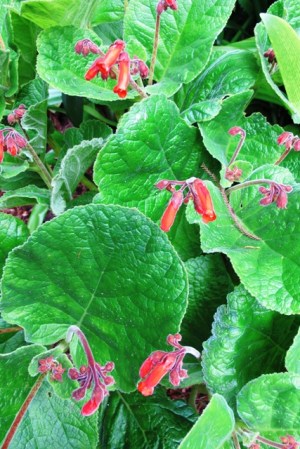
Gesneria cardinalis, or maybe Sinningia cardinalis

Gesneria cardinalis, or maybe Sinningia cardinalis

The tuber in growth. I have cut chunks from it to grow new plants.

The tuber in growth. I have cut chunks from it to grow new plants.

Gesneria or sinningia? We have always known it as a gesneria but it appears that Sinningia cardinalis is equally valid as a name. Whatever, this is a comparatively rare plant which comes from the same family as both African violets and gloxinias – the family having the near unpronounceable name of Gesneriaceae. Most hail from South America and cardinalis is from Brazil.

Unlike most members of the family (and there are somewhere over 40 of them), cardinalis grows from a tuber which pushes itself above the ground. We have described it in the past as developing a football-like tuber, but with the passage of time, ours are getting closer to exercise ball in size. The leaves are soft and somewhat hairy while the tubular red bells sit above the foliage and flower over a long season in late spring. Come autumn, all the leaves will fall off. This is a plant for dry shade but needs to be frost free.

First published in the Waikato Times and reprinted here with their permission.

Garden lore

Garden radishes are in wantoness by the gentry eaten as a sallad, but they breed but scurvy humours in the stomach, and corrupt the blood, and then send for a physician as fast as you can.

The Compleat Herbal by Nicholas Culpeper (1653).

Spring planting – NOW

If you have not planted out your summer garden, now is the time to panic. An unseasonably cool spring may have led many to delay, but delay no longer because the official start of summer is a mere two weeks away. Top priority needs to be given to the plants which require the longest growing season. This includes capsicums, aubergines, both rock and water melons, kumara and even tomatoes. Starting with plants now, rather than seed, is advisable to get a jump start this late in the season. Other techniques are to plant in black plastic (which heats up the soil faster) and to use a cloche for the early stages because this heats up the air around the plant to encourage growth.