Tag Archives: gardening

Orchids as garden plants

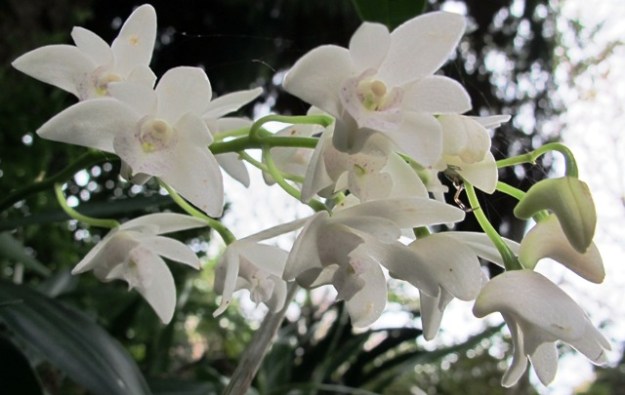
Referred to here as the Aussie dendrobes - dendrobiums

Referred to here as the Aussie dendrobes – dendrobiums

We are at the peak of orchid season in the garden. There can be few plants which carry the aura of luxury and exotica accorded to orchids. They belong to a huge and complex family, second only to the daisy family in number and go well beyond the common cymbidium. Yet they are not a plant that is common in New Zealand gardens.

Besotted by calanthes

Besotted by calanthes

The calanthe orchids are particularly rewarding as garden plants but you need to take the long view. We use them mainly as woodland plants. The blooms are a bit frost tender. Some we had on the margins were once hit by a memorable late frost but that was a one-off event. After about five decades of building them up, we have large swathes or drifts. In fact we have so many that a gardening ingénue who saw them recently drew the conclusion that they must be an unusual but easy bedding plant. Ah, no. But for those who have the time and inclination, they are a very rewarding branch of the family. Over time, they form a string of back bulbs below ground and can be increased from these.

For orchid enthusiasts who want the technical data, we understand that it is mostly forms of striata that are showiest for us. We have a pale lemon one which flowers in early spring and a much brighter yellow form that comes later. We used to have them under different species names but have come to the conclusion that they are more likely just different striata forms. Note: I have now been informed that the pale yellow calanthe shown is in fact Calanthe ‘Higo’ (C. sieboldii x C. aristulifera) which makes sense to us. We also use the white C. arisanensis but alas we failed with a lovely lilac species and appear to have lost it. All of these are evergreen varieties, though I understand there are deciduous species as well. The fresh spring leaves are large and could, at a pinch, be thought of as looking like pleated hosta leaves. A fair number of garden visitors over the years have asked us about the yellow flowered hostas. (Hint: hostas only flower in white or shades of lilac to purple.)

The Australian dendrobiums make compact, clumping plants with many smaller flowers and are pretty as a picture in the subtropical woodland areas. They combine very well with bromeliads and ferns and are an easy care garden plant. We have them in pinks, lilacs, white and yellow. We don’t know much about the hardiness of these. Ours are in positions where they never get frosted but they will get cold and they never turn a hair. They are probably similar to cymbidiums in hardiness.

Cymbidiums give long lived blooms, even outdoors
Cymbidiums give long lived blooms, even outdoors

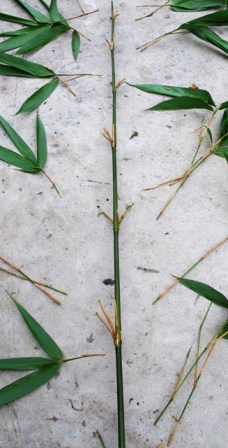
DIY bamboo stake

DIY bamboo stake

Cymbidiums are the usual florist’s choice and are surprisingly easy as garden plants, given the right conditions. All of ours are grown in the ground, not containers. We don’t get florist quality blooms but they last an amazingly long time in flower and put on a splendid show as long as I remember to stake the flower spikes at the right time. I see I started photographing the flower spikes a full two months ago and those same flowers are now a little weather beaten but still showy. These days I harvest stems of green bamboo which still have convenient leaf axils because I can gently engage the flower spikes in the leaf axils and don’t have to tie each one which makes staking much faster and more discreet. I admit this only works if you have a convenient stand of bamboo to harvest.

The jury is still out on whether we can get the disa orchids naturalised by the stream. They were fine for the first two seasons but the proof of the pudding is in the five to ten year cycle – whether they are still strong and flowering after that time. At this point it is not looking good. The native English field orchid, Dactylorhiza maculata, has gently ticked on here for decades but is romping away more enthusiastically now we are trying cooler, damper positions. We didn’t succeed with the masdevallias (though we probably didn’t try very hard) and the tropical orchids like phalaenopsis (moth orchids) won’t do as garden plants for us.
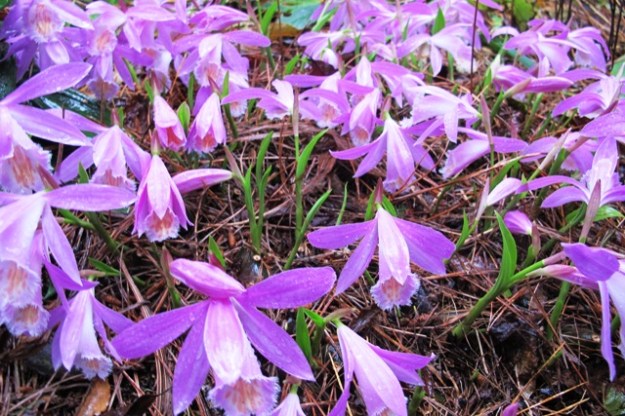
One of the easiest orchids to grow - pleiones

One of the easiest orchids to grow – pleiones

This week it is the pleiones which are the stars. Their flowering season is nowhere near as extended as some of the other orchids, but they form pretty carpets, are not at all tender and are dead easy to increase. Most bulbs will make one or two offsets a year. Along with the dactylorhiza, they are deciduous, becoming dormant in autumn. The yellow pleiones want more of a winter chill and have gradually died out for us but we have an abundance of purest white ones and an array of lilacs and purples.

These are not generally plants that you will find offered for sale at garden centres (which may be why they are not often seen in gardens). You probably need to find your nearest Orchid Society and enquire about sales tables. Orchid enthusiasts tend to be a different breed. At the risk of making sweeping generalisations, Orchid Society people are more often collectors than gardeners. More than any other horticultural group we have come across, orchid people have well above average technical knowledge and like to show off their treasures in bloom. They are also generous and encouraging to any novice who shows an interest. Much of our collection has come from Orchid Society people over the years. We cannot speak highly enough of them as a repository of knowledge about a very complex plant genus.

For details on how to multiply calanthe orchids, check out our earlier Outdoor Classroom on the topic.

First published by the Waikato Times and reprinted here with their permission.
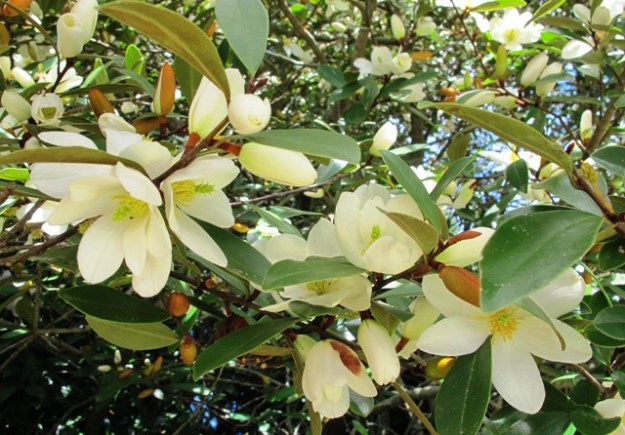
Plant Collector: Magnolia laevifolia “Velvet and Cream”

Now renamed Magnolia laevifolia

Now renamed Magnolia laevifolia

The naming of this plant is a complicated story. It was and still is widely sold as Michelia yunnanensis. It then had a fling with the name Magnolia dianica but is now Magnolia laevifolia. There are sound reasons for the changing name but it makes it confusing. In this country, it is almost a certainty that you will find it sold under its original name of M. yunnanesis. Michelias have now been reclassified as magnolias. Though evergreen, their foliage is much finer than the tough grandiflora types we normally associate with evergreen magnolias.

“Velvet and Cream” is a particularly good flowered form first released by former Cambridge nurseryman, Peter Cave. It has larger flowers in a beautiful cup form. M. laevifolia sets seed so prolifically that every man and their dog has raised seedlings and named them – some are better than others. Grown in open conditions with full sun, plants will stay bushier and more compact but generally these plants are a little slow to get established but eventually make small trees around the 3 metre mark if not trimmed. They are generally sold as fragrant, though I have yet to find one that has more than just a hint of perfume.

First published in the Waikato Times and reprinted here with their permission.

Reviewing accepted garden practice

Lawncare - one of the worst culprits in environmental vandalism

Lawncare – one of the worst culprits in environmental vandalism

I caught most of an extended interview with Fiona Eadie on National Radio last Monday. She is the head gardener at Larnach’s Castle just outside Dunedin. For me, the most interesting aspect was when she commented that much of our traditional gardening practice is bad. Just bad. Hear the clanging of bells, dear gardening readers. Change is coming.

It has been interesting to see the speed at which criticism of modern dairying practice has gathered momentum. It used to be that farmers held a pretty unassailable position, immune to criticism. Not any longer – environmental practices are coming under the microscope and the sure sign of pressure is the growing defensiveness in the sector.

Expect the same thing to happen in gardening. We have been talking about garden practices here for quite a long time and gently changing our ways. A trip to the UK a few years ago was a wake-up call. In the gardening sector, there was a lot more talk and action on beneficial gardening and sound environmental practice. It comes through most of the UK gardening programmes we get here (the main reason we subscribe to Sky) and also through their garden print media. It is a snowball that is gathering size and speed.

It may not be that long before a near perfect lawn is no longer a badge of honour but a sign that you are an environmental vandal. There is a direct correlation – the better your lawn, the worse your environmental score card. You cannot achieve that perfection without major intervention in the form of very frequent mowing (twice a week, I just read someone claim), removing all clippings which means you have to apply nitrogen based fertiliser frequently (once a month, the aforementioned lawn owner said) spraying, scarifying, summer watering and generally maintaining a complete monoculture. At its most extreme, even the worms are poisoned off. After all, worm casings spoil the green velvet. In fact none of this is good practice at all. While we appreciate the restful green interlude that lawns give, we have long since abandoned anything other than mowing with a mulcher mower and a bit of judicious hand weeding. Our lawns are less than perfect but at least they are non toxic. Greater purists abandon lawns altogether but that is a step too far for us.

Roses need considerable intervention to stay lush through summer

Roses need considerable intervention to stay lush through summer

Similarly, perfect luscious looking roses without a hint of disease in high summer and autumn may become an advertisement for your bad practice rather than a sign of care. You can’t achieve that state without regular spraying and heavy supplementary feeding and watering. The healthy buxus hedge in urban areas may be frowned upon in due course now that the dreaded blight has taken such firm hold. A healthy appearance is likely to be a sign of regular chemical intervention.

Gardeners have substantially reduced the use of sprays, in part because the Government has placed so many restrictions on the availability of many that were in routine use. That happened because many are either highly dangerous or downright environmentally bad. So the gardener who told me she drenched her alpines weekly with fungicide to keep them alive in lowland conditions may soon be accused of bad practice rather than cleverness in keeping such plants alive and healthy outside their natural habitat. At least we have moved on (I hope) from the Paraquat days when that highly toxic weekiller was used interchangeably with the much safer glyphosate. Mark remembers a neighbour in our Dunedin days whose Friday routine was to spray all edges, paths and any visible weeds with Paraquat. We have been frowning at brown sprayed edges for years – not a good look in a garden and not good practice.

I hope we will see a change from the rampant consumerism promoted by many garden centres sooner rather than later. Fertiliser use needs a good hard look. Frankly it is no more acceptable to routinely use chemical fertilisers in the garden than it is to saturate farmland in the quest for increased production. The very notion that the slow release bubble fertilisers, some of which are encased in a non biodegradable coating, are suitable for garden use is a shocker. They are developed for container growing (and are expensive) but I have seen garden centres promoting their use in garden situations.

My local garden centre has a major display at its entranceway of heavy duty plastic bags filled with all manner of mulches and mixes. It is one thing buying the occasional bag of seed raising mix or potting mix. It is quite another to load large numbers of these prepackaged consumable commodities onto your trailer so you can fill your new raised bed with a soil mix trucked halfway across the island and then mulch with peastraw shipped from a similar distance in the other direction.

It’s all about sustainability – making sure that our quest for beauty in our gardens does not come at the cost of degrading the environment. We have a long way to go with this debate in New Zealand but it was heartening to hear Fiona Eadie bringing a similar message. Maybe the time has come to review practices we have taken for granted and to take steps to ensure that our gardens actually enhance nature instead of wounding it.

First published in the Waikato Times and reprinted here with their permission.
Plant Collector: Erythronium revolutum

The transient delight of dogs tooth violets - Erythronium revolutum

The transient delight of dogs tooth violets – Erythronium revolutum

Of all the fleeting seasonal delights, the dogs tooth violets or erythroniums might take the award for ephemera. They are so pretty and dainty and they are here today and gone pretty soon after. We probably only get ten days out of them in flower and a bad bout of weather can knock the display for the year. But we still get a great deal of pleasure from them. The flowers are like nodding hats while the compact foliage is often gently mottled or marbled in green and maroon.

There are about 20 different species, all in the Liliaceae family, but some of them just won’t perform in our climate. Many prefer cooler conditions and dry summers. As far as we know, what we have are mainly seed raised E. revolutum which is native to the west coast of USA. They thrive in humus rich conditions on woodland margins where the soil stays moist and there are reasonable light levels. The corms are interesting, being long and narrow and alarmingly easy to snap in two when disturbed. They find their own depth, often burrowing down quite deep, out of harm’s way.

First published in the Waikato Times and reprinted here with their permission.

Garden lore

A partial quote this week, relevant to changeable spring weather, which I noted some years ago from none other than Billy Connelly: “There is no such thing as bad weather,” he boldly asserted on television. He went on to blame television weather presenters for continually referring to sunny days as “good” and rainy days as “bad”, causing depression in people who live in high rainfall areas.

“There is no such thing as bad weather. There are only the wrong clothes.”

Tikorangi The Jury Garden

The time to hard prune camellias and rhododendrons is running out so do it right now before spring advances further. That way, the plants will still be able to flush with new growth on what remains. If you leave pruning and shaping camellias too late, you end up cutting off most of next year’s flower buds. However, you do have to sacrifice this year’s rhododendron flowering if you are wanting to cut plants back hard. If you leave it until after blooming, you are more likely to kill the plant instead. Timing is of the essence. Birds are nesting so check before you murder their babies as collateral damage with your pruning efforts.

Published in the Waikato Times and reprinted here with their permission.