Tag Archives: gardening

Plant Collector: Rhodohypoxis

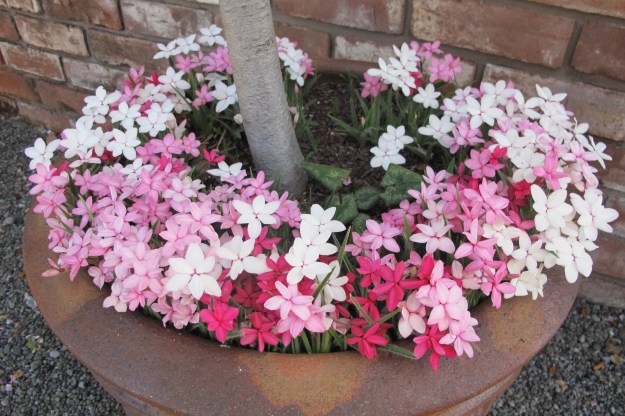
Pretty little rhodohypoxis - Ruth (white), Susan (pink), Albrighton (dark)

Pretty little rhodohypoxis – Ruth (white), Susan (pink), Albrighton (dark)

As the peak time for spring bulbs passes over, the South African rhodohypoxis come into their own. These are cracker little plants, forming a colourful carpet in well drained, sunny conditions. They are also great in wide, shallow bowls or underplanting shrubs in containers, as illustrated. Their fresh growth is triggered by autumn rains and they have a long flowering season from mid spring into early summer, as long as they don’t dry out. The foliage is short and grassy and hangs around unobtrusively until autumn when the plant goes dormant for a brief time.

There are a mass of different named rhodohypoxis, though most are just selections of R. baurii. Essentially they come in sugar pink, deep pink to red, white, bicoloured variations and occasional double forms. They are really easy to grow and multiply up most satisfyingly, with one proviso. The rhizomes are tiny and dark brown – sometimes not unlike the clawed ranunculus and other times just small, brown lumps. This means they are alarming anonymous when dormant and I am sure that is when most people forget where they are and either flay them round when weeding or plant something on top of them. If in doubt, plant them in a pot and sink the whole pot in the garden while you build up numbers.

With a rhodohypoxis expert staying here this week, we had a discussion on whether these bulbs are technically tubers, corms or rhizomes. The internet uses all terms interchangeably. The decision came down fair and square on rhizome status.

First published in the Waikato Times and reprinted here with their permission.

Garden lore

It surprised him to discover that gardening, for all its air of prelapsarian serenity, is furiously competitive, frequently indulged in by the envious, the deceitful, the quietly criminal.

The Pedant in the Kitchen by Julian Barnes (2003).

Onehunga weed or prickle weed in the lawn.

Onehunga Weed

Onehunga Weed

The greatest curse of the lawn is the prickly Onehunga weed. If you know you had it last year – prickles in the feet- now is the time to act. It will take several years to eradicate entirely, but it will get worse if you leave it. You want to break the cycle and stop it from setting seed in early summer. These weeds are annuals – usually they germinate in autumn, romp away in spring (right now, in fact), flower, set seed and prickles and die as lawns dry out over summer. If you only have a little, hand weed it. There are specific sprays developed for Onehunga weed (ask at your local garden centre). We prefer to let the grass grow considerably longer than usual and then follow up in two to three weeks time by cutting it very short – scalping it in fact. The growth stretches the Onehunga weed up and it does not survive being cut very short. Timing is of the essence – if you leave it too late, the prickles and seeds will be developing. Onehunga weed does best in poor conditions. It is not so good at competing in a lush, healthy lawn.

Plant Collector: Prunus x yedoensis ‘Ivensii’ with collospermum

Prunus x yedoensis 'Ivensii'

Prunus x yedoensis ‘Ivensii’

Trying to delve into the origins of flowering cherries of the Japanese types was far more complex than I expected so I will keep it simple and say that this is a hybrid, sometimes known as the ‘Yoshino Cherry’. This particular variety was named at the UK’s famed Hillier Nurseries because of its weeping habit and wonderful tortuous branches. Our mature specimen looks a bit like a rigid octopus and has a near flat top. Prunus do not have a long flowering season but while it is in full flight, it is a veritable froth of white single blossoms reputedly with a sweet almond scent but I wouldn’t buy this as a fragrant tree. Even when mature, it is only a small specimen – maybe four metres high and about the same in width.

The rather odd effect of the native epiphyte, Collospermum (probably hastatum) looks like tuft of hair poking out of the centre. These flax or astelia-like plants are sometimes referred to as the perching lily or, less romantically, widow-makers. That is because they can be large and heavy and have a habit of eventually falling out of the tree. Other than that, they do no harm.

First published in the Waikato Times and reproduced here with their permission.

Of slugs and snails but no puppy dogs’ tails

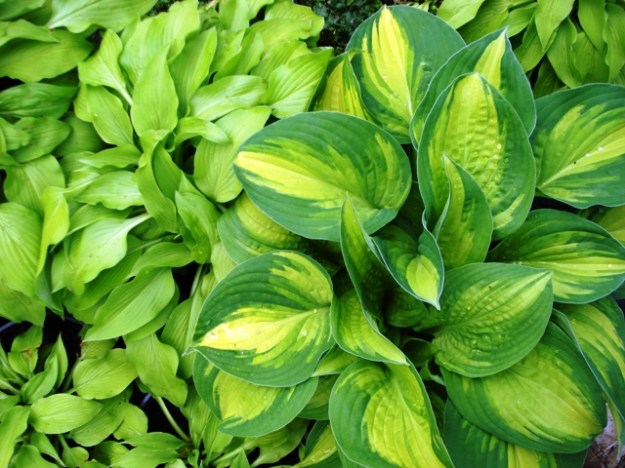
The hostas are all romping into growth. There is nothing quite like this for focussing the mind on slugs and snails.

We don’t have a big slug and snail problem here and we rarely resort to using bait. We can only conclude that we must have a struck a reasonable balance with the main natural predators – birds. We have a rich birdlife in our garden and think that eating slugs and snails which have been poisoned is not a good call for our feathered friends.
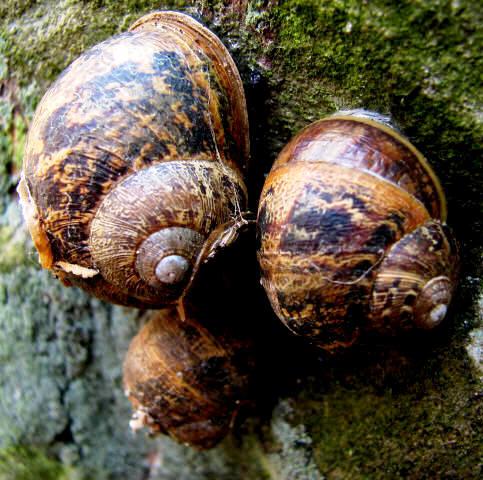
Where we see the slimy critters making inroads to something precious, we resort to discreet little bait stations – a bottle cap with two or three pellets beneath a paua shell. The roof keeps the bait dry so it lasts a lot longer. A small packet of bait lasts us for ages.

Mark has been railing for years against gardeners who broadcast slug bait as thickly as fertiliser. Baits have an attractant so you don’t need to layer them on so densely that you trip up passing targets. One bait placed at the base of a lettuce seedling is all that is required to kill the marauders.

The bait trap

The bait trap

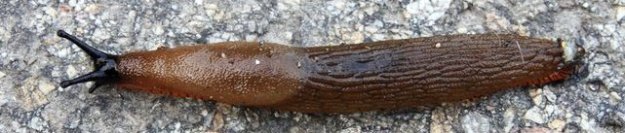
If, like us, you are reluctant to reach for the poisons as a routine solution, there are alternatives. The night time prowl with the torch can be effective though it may take a few forays to get the timing right. The snails don’t usually come out until a good hour or more after dark. The richest hunting nights are when there has been rain after a dry period. I squash all but the giant tiger slugs underfoot, which is a quick end for them. Others of more delicate dispositions drop them into a bucket of salted water where I imagine they die a slow and lingering death. Sentimentalists and, presumably, Buddhists release them in farther reaches or drop them over the fence to the neighbours so they live on causing damage. I am afraid that I think the only good garden slug or snail is a dead one (our native powelliphanta excluded).

As much of our problem slimy population was imported, it has always seemed a great pity to me that the early settlers who were so determined to bring food crops and plants to remind them of home, did not while away the hours of the long sea voyage ensuring that this vegetative material was free of the pests. It seems a missed opportunity and would have saved a lot of bother later. While we have a remarkable number of native slugs and snails, most of these feed on decaying material whereas the imported ones generally feed on fresh, green growth and do the damage.

I have not tried the beer can approach (I just don’t want cans of flat beer lying around my garden) but, as with the hollowed out orange half, these traps require you to do a morning round to dispose of any lurkers. There is nothing in the beer and the orange to kill them.

It is a myth that slimy critters will not crawl over rough and gritty surfaces. Insect expert Ruud Kleinpaste once showed a photo of a snail crawling over the sharp end of a razor blade. But they will take the line of least resistance so surrounding vulnerable plants in a thick enough ring of something less appealing can deflect them in another direction. However, you need a small mound rather than just a scattering of crushed egg shells, sawdust, rimu needles, sand, gravel or similar and you need it round each plant individually. It can certainly help with new plantings. Copper rings are reputed to work but it seems an awful lot of effort to go to, fashioning a copper bangle for each plant.

One eco friendly solution I have tried with success is generous amounts of cheap baker’s bran. Apparently slugs and snails find it irresistible. I don’t think the bran actually kills them, unless they gorge so much that it swells up inside and dehydrates them. I think it more likely they eat too much and then lie around in a comatose state making easy pickings for the early bird in the morn. All I can say is that it did work when I tried it on a patch of hostas that was getting slaughtered.

I have not tried the temptation approach suggested by BBC Gardeners’ World presenter, Monty Don. According to him, there is nothing slugs and snails like more than comfrey so he lays fresh comfrey leaves beside vulnerable plants. What he didn’t say is that you would have to replace the comfrey leaves every two days and you would need to follow up in the evening and deal to the revellers. I don’t think there is anything in the comfrey that kills them. It is merely an attractant (like the beer). I thought it seemed to be a case for not planting comfrey near vulnerable plants to reduce temptation.

In the end, we will never win the war on slugs and snails. It can only be managed and if you can get your garden to a balanced state of co-existence, you can target your efforts to areas of particular damage. If you are the type who carpets an area in slug bait (which then breaks down with moisture), just remember you are in fact carpeting your garden with a poison. It is better to try other ways of management if you can and save the slug bait as a last resort.
First published in the Waikato Times and reprinted here with their permission.

Garden lore

Labour Weekend is the time honoured occasion for getting the bulk of summer vegetables planted in this country, particularly those which require the soil to have warmed up a little. If you prepare the beds as soon as possible and leave them without planting, there should be time enough for the first crop of weed seeds to germinate. If you then push hoe these on a sunny day, you will save yourself quite a bit of weeding later. You want to catch them just as you get the haze of green showing. If you have enough time to allow for two flushes of weeds before planting, so much the better.

“These are most anxious times on account of the slugs. Now every morning when I rise I go at once to the garden at four o’clock and make a business of slaughtering them till half past five, when I stop for breakfast.”

An Island Garden by Celia Thaxter, 1894

Such dedication!