Tag Archives: gardening

Tikorangi Notes: Friday July 6, 2012

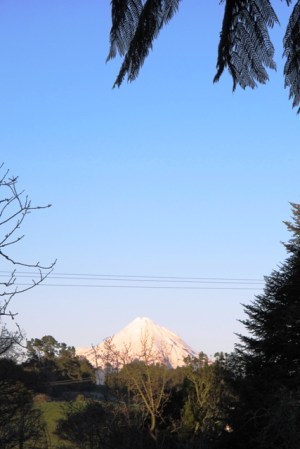
Our maunga, Mount Taranaki

Our maunga, Mount Taranaki

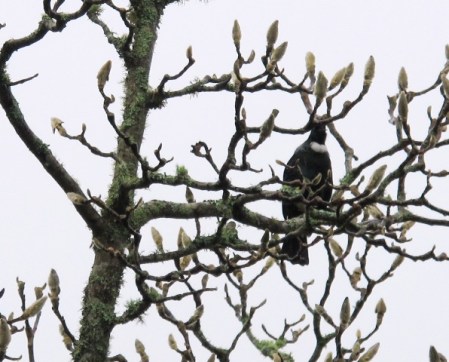
The tui are back

The tui are back

Latest posts: Friday July 6, 2012

1) Fragrant rhododendrons – the final feature article I have written for the Weekend Gardener. So you only want scented plants in the garden? There are fragrant rhododendrons to choose from.

2) The understated elegance of Helleborus orientalis in Plant Collector this week.

3) Reviewing the role of container plants. Do they add anything to the garden other than work?

4) Grow it yourself – celery. We don’t because Mark won’t, so I buy it but you can if you wish. The word from Mark is that it is not that easy to grow well and the one year he got it absolutely right, we only hate about two complete heads of celery and the rest went to waste.

5) In the Garden this fortnight. The final in this series I wrote for Weekend Gardener. It’s on gloriosas this week.

6) Outdoor Classroom revisited – sharpening garden tools. Everybody says do it but nobody says how.

Tikorangi Notes: Friday July 6, 2012

As you may gather from above, I have resigned as a contributor to the Weekend Gardener so the pieces first published there will cease after today. But do not let that stop you – please take the time to fill out their survey and let them know what you think of the changes they have made with their new management.

The three new posts a week from the Waikato Times will continue uninterrupted. Though if anyone has any ideas for replacing Grow Your Own, I would appreciate hearing. There are a finite number of vegetables and I am nearing the end of all available options, even allowing for extensions into some herbs and soft fruits.

In the meantime, great winter weather has seen plenty of sun, mild days (15 degrees yesterday) and very little wind. The mountain has a good covering of snow and is looking its most spectacular. More camellias are opening flowers and the tui and kereru are here in good numbers. It won’t be long before the magnolia season starts.

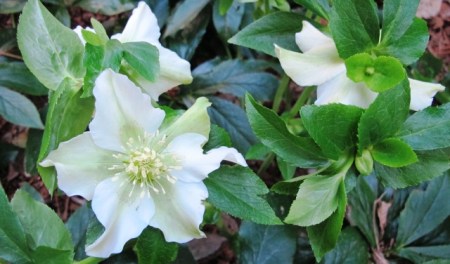
Plant Collector – Helleborus orientalis

Helleborus orientalis - quiet and undemanding stars of winter

Helleborus orientalis – quiet and undemanding stars of winter

Hellebores are quiet heroes in the winter garden. I have never seen a strident one. By far the most common hellebore is H. orientalis – though it is not from the Orient, being native to northern Turkey and Greece. It is a perennial which keeps its leaves all year round but in our experience it is not one that appreciates being dug and divided. Plants subjected to this routine can sulk for a long time afterwards. You are better to salvage some of the many seedlings you get around plants if you want more.

Given their origins, it is not surprising that these plants are happy to lead their quiet existence in fairly tough conditions, coping with root competition and shallow soils. This makes them ideal for semi shaded, dry areas beneath trees where it is not always easy to find suitable plants. However, they won’t appreciate dense shade. Lift the canopy of overhanging trees and shrubs to get more light.

Most hellebores come in shades of dusky pinks, reds, greens and white – or sometimes in blends of these colours and they often change colour with age. There are some highly desirable deep red and slate colours – the latter bringing blue-purple tones. However the performance of these appears to be temperature related. The colder your conditions (and these are cold hardy plants), the better colour you will get. The best ones we have seen were in Taupo and the UK where winters are considerably chillier.

If you have prized cultivars, keep them separate if you are hoping to raise seedlings. They are promiscuous plants and will cross readily. That said, to my mind, hellebores look best in big patches or drifts. Interplant with winter and early spring bulbs (bluebells, snowdrops, smaller growing daffodils are our preferences) to add interest.

First published in the Waikato Times and reprinted here with their permission.

Reviewing the role of container plants here

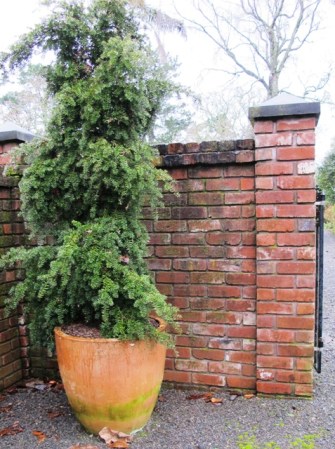
Large gardens need large pots - a weeping totara at our entranceway

Large gardens need large pots – a weeping totara at our entranceway

I am reviewing my container plants, one by one. I am a bit fed up with them and unless they have a strong case, they will be history.

Generally plants in containers become featured plants so it matters that they look in the peak of health. Unhealthy, starving specimens are a sad sight. This means regular repotting and therein lies the main disadvantage, though the bulbs are no problem. I redo those every year as a rule, using a basic composted bark mix and slow release fertiliser. It is a good wet weather occupation.

No, it is the shrubs or trees that I have in pots that are the issue. This is compounded by the fact that we have a large garden. Large gardens need large pots with large plants. Otherwise they just look out of proportion. And while I can spin most of the trees and shrubs out to a two year repotting cycle, it still has to be done. It is a heavy, dirty occupation and not one I enjoy. It is a two person job to wrestle the root bound plants out of their pots and into the wheelbarrow. I hose off all the old mix, trim the roots, shape the plant, and battle it back into the pot with enough fresh mix to sustain growth.
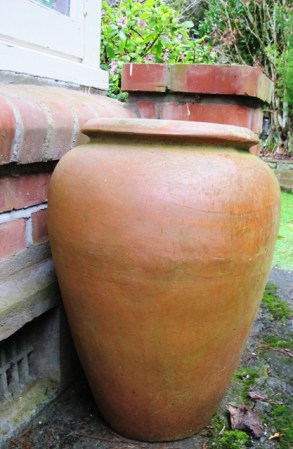
At least I will never again make the mistake of buying containers which are narrower at the top, no matter how attractive they look. You only do that once before realising that such pots are better as an ornament without the plant. It tends to be a case of destroying either the pot or the plant when it comes to getting them apart. It is all right. You do not have to put a plant into a pot. If it is an attractive pot worth displaying, it can be used on its own as a piece of garden decoration.

There was a time BC – Before Containers. They are a relatively recent garden fashion, aided and abetted by the explosion of plant pots from Asia. Believe it or not, these used to be quite expensive. Now they are cheap as chips and, as far as I am concerned, correspondingly expendable. I have long since dispensed with almost all the glazed, coloured pots I had bought as fashion items. All that remain are those in earth tones or good old fashioned terracotta. It is a matter of taste but I don’t want coloured pots, let alone ones decorated with bamboo shoots, dragons, butterflies, sunflowers or anything else for that matter. Hanging baskets are not for me, either.
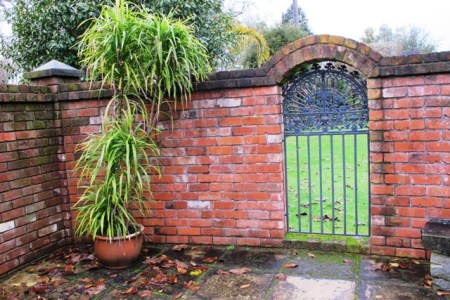
Softening the scene but Cordyline stricta has to be repotted every year

Softening the scene but Cordyline stricta has to be repotted every year

My review of the containers has led me to the conclusion that there has to be a good reason for their existence. Either they exist to soften a harsh view – in our case, the entrance way and a small paved courtyard. Or they may be a means to keep treasures or to curtail invasive plants. That accounts for plenty of smaller pots, mostly of bulbs. Or they are bonsais that we keep as feature plants. That is it. There can be no other reason for containerised plants in my garden. I just don’t think they add very much except work.

It is different in a small garden. If I ever find myself with one, I am sure I will end up with lots of containers for various reasons (though there will not be any in shiny blue). In a small garden, you can usually get the hose to most points for the constant watering required in dry spells. I might even go for growing annuals in pots – these days elevated to the term of “potted colour” in order to sell readymade but short lived flowering options to the customer.

If you are potting quick impact, low value plants, any cheap mix is going to be fine. You can even use garden soil, though this tends to compact and hold too much water. Potting mix was designed for pots and is free draining. But not all potting mixes are equal.
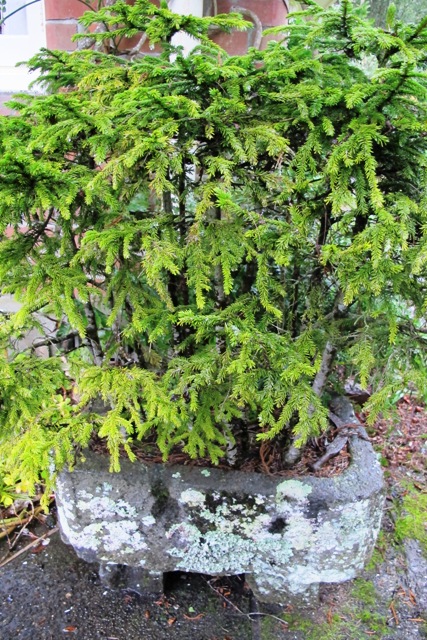
Mark calls it his Forest of Tane though these are Picea orientalis bonsai style in a small stone trough

Mark calls it his Forest of Tane though these are Picea orientalis bonsai style in a small stone trough

When it comes to longer term plants, it is worth the money to buy better quality mixes. The bagged stuff comes with everything added already so all you need to do is to fill around the plants in the pot and note how long the life of the slow release fertiliser is. The information on the bag should tell you. Slow release can be active for anything from three months to a year. Once it has been used up, there is nothing in the mix to feed the plant so you will need to start top dressing. It helps to know when because if the plant turns yellow due to starvation, it can take a while to respond.

The few bonsai type plants we keep in comparatively small containers to restrict growth and dwarf them. They need a mix with a bit more grunt and better water retention than straight granulated bark mix. In this case, we make up our own of 1/3 compost, 1/3 garden soil and 1/3 potting mix.

The other container plants are history. Either they are worth planting out to grow in the garden or they are goners. I do not have time for them any longer.

First published in the Waikato Times and reproduced here with their permission.

Grow it youself: celery

If you are harvesting celery now, you will be congratulating yourself because it is a very useful vegetable to have on hand. However, it is not a foolproof crop and if you do succeed in getting it to maturity without being stringy, slimy, disease ridden or slug infested, you often have the problem of excessive amounts of celery ready all at once. You can raise celery from seed but the need to stagger harvest means that most people will buy a few baby plants at a time from the garden centre. Seed is not such a great option when you only want 3 or 4 plants maturing at once. That said, I read one advisory that 16 to 20 plants per sowing (so we are talking successional planting) is sufficient for the average family. All I can say is that the author must have eaten vast amounts of celery.

Celery is a cool climate, very hungry crop. It needs good soil, preferably enriched with compost and rotted manure and you must keep it well watered in dry periods. Lack of water leads to stringiness and a bitter flavour. It is also a slow grower and can take up to four months to mature so you have to keep the food and water up to it for quite some time. In cold climates it is a spring crop, but in mild areas it can be sown or planted in early autumn as well. If you want to get a jump start on spring, you could sow seed soon into small pots and grow them under cover for planting out as soon as the soils start to warm up in September. Space at about 20cm apart and stay on top of the weeds which will compete with the celery’s root system and rob the nutrients.

First published in the Waikato Times and reprinted here with their permission.

THE FINAL In the garden this fortnight: Thursday 5 July, 2012

A fortnightly series first published in the Weekend Gardener and reproduced here with their permission. However, as I have now parted company from that publication, this will be the final in this particular series.

Gloriosa superba in summer

Gloriosa superba in summer

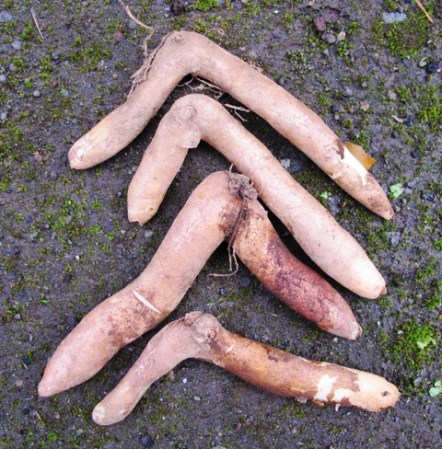
The comments about lilies in issue 339 reminded me that I needed to thin our Gloriosa superba. While these are often referred to as climbing lilies, they aren’t a lily at all, being an entirely different family. But they are a wonderful summer flower and very obliging at growing in parched, dry conditions in the front, sunny border under the eaves of the house. There are not a lot of plants that like those conditions. The tubers are very curious. As they get bigger, they grow into large V shapes and they find their own depth in the soil – sometimes very deep down. I do not understand how they do it. It is hard not to envisage them wriggling down. If they are happy, they can multiply a bit too readily and seed down as well. I dug out a bucket of spares from a short border. They are difficult to dig out without breaking them and if you lose both tips, they are no longer any good and will just rot.

Gloriosa superba tubers

Gloriosa superba tubers

These tubers come into growth in late spring. The stems need some support because they get about a metre long before they put up a succession of odd reflexed flowers in orange-red and yellow tones which look for all the world like a coronet. They lack any fragrance but they are an excellent cut flower and the season lasts months through summer. Curiously, they are the national flower of both Zimbabwe and Sri Lanka.

Top Tasks

1) Rose pruning. We like our roses to flush early here so that they are in full flower for our annual garden festival at the end of October. Being country residents, we are still allowed an incinerator and I pile up the prunings beside it so they can dry and then be burned.

2) I prefer to keep most of our roses in one area of the garden rather than spread throughout. After pruning, I rake out fallen leaves around the plants because these can harbour disease and then follow up with a mulch of fresh compost.

3) Carry my wire brush with me in my gardening basket. While the lichen growth we get here is apparently a sign of very clean air, we can end up with too much moss and lichen in our humid climate. I find it much easier to do a little often, rather than trying to clean entire areas at once. I have stonework, concrete, brickwork and plant trunks in my sights.