Tag Archives: gardening

Tikorangi Notes: Friday June 1, 2012

A true blue verbascum - Blue Lagoon (Photo: Thompson and Morgan)

A true blue verbascum – Blue Lagoon (Photo: Thompson and Morgan)

Latest posts: June 1, 2012
1) Astoundingly, a blue as blue verbascum. Currently only available in the UK, as far as I know, but we seriously covet it for our garden. Abbie’s column.
2) The last nerine for the season, N. bowdenii, standing up to late autumn with brazen pinkness.
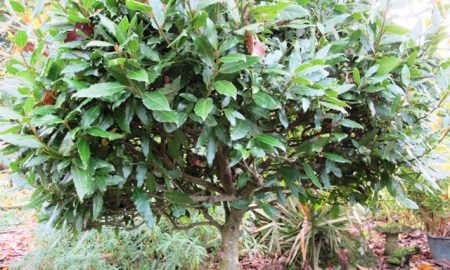
3) Grow it yourself – a bay tree. It is easy.
4) And, nothing to do with gardening, but a slew of new reviews on http://runningfurs.com – children’s books this time (mostly picture books) with three really good ones amongst them.

After last week’s column about reviewing our mixed borders, I have been having such fun reworking some of the borders. But I think my concept (and practice) of unifying the underplantings is on a somewhat different page to that of the author, Anne Wareham, who motivated me in this direction. True, in one border, I drifted the blue corydalis, yellow polyanthus and blue lobelia, but also retained the Rodgersia aesculifolia and Mark’s showy arisaemea hybrids. I cast out the dreadful mondo grass which seems to inveigling its way in everywhere (compost heaps are so useful) and figured that the interesting Manfreda maculosa would be better being interesting somewhere else. Same with the burgundy eucomis and a few other plants. But I was always bound to fall off the simplifying wagon. It being the coldest border we have in the upper gardens, I simply could not resist trying some meconopsis (blue Himalayan poppies) to see if they would like the spot. Ditto, some Higo iris, because we are looking for the right conditions for these.

The proof of the pudding is in the eating. We will see how my border looks in the spring and then for the next two or three years. There is little dross left but I realise it is just not in my nature (nor, indeed, in Mark’s) to switch to simple, unified plantings. We just have to work harder at getting the combinations better and establishing different looks so they don’t all start to meld and look the same.

A blue as blue verbascum. Apparently.

Oh wow. That is a true blue verbascum. (Photo: Thompson and Morgan)

Oh wow. That is a true blue verbascum. (Photo: Thompson and Morgan)

It is rare for us to get excited about plants we see overseas which are not available here. In fact, between us we can only recall three. There were the double hellebores in the mid nineties which Mark saw when he was taken to meet the English breeder. Similar ones are now readily available here but they represented a major breakthrough at the time in the heady world of hellebores.

Then there was the red Edgeworthia papyrifera we saw in northern Italy. We have the yellow form in this country (often called the yellow daphne though it is a different genus) but as far as we know, the red form has still not been imported.

Now there is the blue verbascum which was featured at Chelsea Flower Show last week. Not that we were there. I merely found the write-up on line and saw it – a knock-out blue verbascum. Well, verbascums plural, on the Hilliers’ Nursery stand.

Not all verbascums are equal. The family is large and some can be a bit weedy, let alone insignificant and untidy. Some can be downright difficult. We have never succeeded growing the popular English hybrid ‘Helen Johnson’, with its dusky, apricot pink colouring. We were disappointed to lose a big white flowered verbascum we bought from Peter Cave before he closed down his Cambridge nursery. It had large, felted grey leaves and would have been a lovely addition to our garden. (Has anybody got seed of it? Do tell.)

Take one good, large flowered verbascum (this one is V. creticum though Blue Lagoon is a different species))...

Take one good, large flowered verbascum (this one is V. creticum though Blue Lagoon is a different species))…

In fact our dedication to the family has much to do with the splendid Verbascum creticum. It hails from the areas of Crete and Malta and is biennial in our conditions. This means it germinates and forms a rosette of leaves in its first year and flowers, seeds and usually dies in its second year. We leave one or two strong plants in situ to go to seed and just weed out the surplus seedlings or those growing where we don’t want them. It is wonderfully easy care and in springtime we get handsome flowering spires up to a metre high which then open large, clear yellow individual blooms all the way down the stem. In the rockery, it gives us vertical accents (like exclamation marks) and the flowering lasts for many weeks.

What wouldn’t we give for blue vertical accents? Not just any old blue or lilac purple tones pretending to be blue. No, this new Verbascum Blue Lagoon is described as being the pure electric blue seen in meconopsis (Himalayan poppies). It is a rare and distinctive shade and meconopsis are notoriously difficult to keep going in our climate. In the photos, one could be forgiven for thinking one is looking at delphiniums – another plant that is not so easy to keep going without constant care and intervention.

We, of course, are visualising Blue Lagoon as a pure blue equivalent of our tried and true yellow Verbascum creticum. If it is that good, it should be a sensational addition to a garden. And the initial information says it is perennial (though possibly a shortlived perennial), not just biennial.

... but in the pure biue of the meconopsis....

… but in the pure biue of the meconopsis….

But don’t hold your breath. It won’t be here yet and it is a moot point as to whether it ever will be. We have one of the tightest border controls in the world – and rightly so. I do not dispute for one moment that we need to be very careful to mimimise the risks of introducing some of the dreadful pests and diseases which afflict other parts of the world. It is just that some of the policy got lost in translation by the bureaucratic administration process. In this day and age, you would never be able to import kiwifruit (actinidia) and it would cost a swag of money and take a long time to get approval for an apple tree if we had none here. In fact, for a country which has built its agricultural and horticultural industries on imported species, nothing new of note has come across our borders for over a decade. You can only bring in plants if the species is known to be here already. I don’t know whether the species that has thrown up the blue verbascum (from Armenia and Turkey, originally) is on the magic list. It may take a very determined individual to import it.

Nor is it as simple as importing the seed. This blue colour came as a one-off result and the plants for sale have been built up by tissue culture from that one blue seedling. Let them go to seed and they will probably revert to the common colours with only occasional exceptions. You need to raise a lot of seed to find the occasional blue ones and it will take years of selection and subsequent generations to stabilise the blue colouring – if it is possible at all. However, the original work has been done by a well established British seed company, Thompson and Morgan, so odds on they are working to stabilise the colour in a seed strain.

In the meantime, we just cast covetous eyes at the photographs.

First published in the Waikato Times and reproduced here with their permission.

Plant Collector: Nerine bowdenii

Nerine bowdenii - the last of the season to bloom

Nerine bowdenii – the last of the season to bloom

When other nerines have long since passed over, the tall, sugar pink Nerine bowdenii are looking remarkably elegant in full bloom. They flower before their foliage appears and they are happy in congested clumps, though it takes a few years to get a clump this size if you start with a single bulb. Each head has about 10 individual flowers held up on a good strong stem so it doesn’t need staking. They can bend a little in our torrential downpours but don’t flatten. N. bowdenii has particularly long stems, 80cm or even taller at times.

These South African bulbs like to have their necks out of the ground so are planted at a shallow depth only. They are best in full sun; clearly they thrive on being baked in summer when they are dormant. As with all bulbs, good drainage is critical. The strappy foliage follows soon after flowering and will hang on until late spring. This means they can look a bit tatty in the spring garden but who can complain when they cheer up an early winter day with their splendid display?

N. bowdenii only comes in shades of pink and is often grown as a cut flower. Nerines last well in a vase, though I admit we leave ours in the garden. When a bulb only puts up one flower spike, it seems mean to cut it off in its prime. You can grow them from seed (make sure the seed is fresh and sow it immediately) but you will be waiting several years for them to get to flowering size.

First published in the Waikato Times and reprinted here with their permission.

Grow it yourself: bay tree

The culinary bay has a long and noble history

The culinary bay has a long and noble history

The culinary bay is Laurus nobilis, also referred to as sweet bay. It has a long history dating right back to ancient Greece and Rome yet is still widely used today. It is easy to grow and hardy for all conditions in this country. However it needs to be kept trimmed. Left to their own devices, bay trees can reach 15 metres. Fortunately once a year is usually sufficient. We trim ours hard in early spring and the fresh growth soon appears to cover up the unsightly woodiness. At the same time, we clean up the base. Bays will sucker and shoot all over the place. If you train the plant to a standard lollipop shape, it is easy to cut away growth at the base.

One plant will yield plenty of leaves for any family. The current fashion is to use clipped bays as formal standards in potagers, but you will never need that number of leaves and there are other more interesting plants you can clip for effect. Besides, as well as suckering, bays are vulnerable to thrips – tiny insects which live on the underside of the leaf and suck the chlorophyll out, turning the leaf silver. We never spray our bay and would not want to spray insecticide on an edible leaf. Planting in a position with good air movement helps (thrips don’t like drafts) and stopping the plant from being too dense will also help reduce infestations.

Bay is not difficult to strike from cutting, though most people buy it. It grows reaonably quickly so it is not necessary to pay over the odds for a large one, unless you are impatient. If you have an abundance of leaves, they are reputed to repel pantry moths when you strew them through your food cupboard.

First published in the Waikato Times and reprinted here withe their permission.

Tikorangi notes: Friday 25 May, 2012

Latest posts:

1) Reviewing our mixed borders (and why the old fashioned activity of reading books can have quite an impact).
2) Iochroma grandiflorum (blue tubular trumpets non-stop for the past seven months or more).
3) Grow it yourself: rosemary
4) It has not been a good year for monarch butterflies in the garden – our garden diary from the Weekend Gardener.
5) Revisiting garden mulch options in Outdoor Classroom.

I can’t think I have ever written about maples (except maybe Acer griseum which is notable for its superb bark). Part of the reason could be that I have never got to grips with names of the cultivars we grow here. I recall Mark and I taking a tour of the British Hardy Plants Society around the garden one time. They were a knowledgeable crew but they also collected plant names as some collect autographs – it didn’t matter if they could never grow the plant in the UK. Every plant had to be recorded. Between us, Mark and I could name everything except… the irises and the maples.

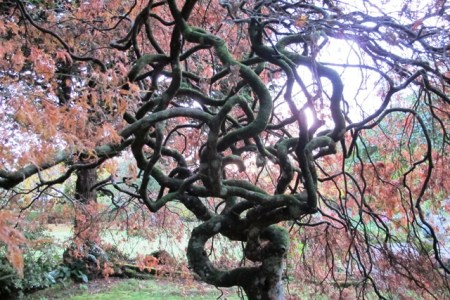
At this time of the year, the maples come into their own. Some have lovely autumn colour. Most have a lovely form which comes into sharp relief as the foliage colours and falls. They are pretty in fresh growth in spring, and fit in very well over summer (as long as they are well sheltered from wind), but it is the bare form that I like the most. They clean up very well with a little pruning and grooming to make excellent skeletons in winter.