Tag Archives: gardening

The curious arisaemas

Delighted by A. dahaiense

Delighted by A. dahaiense

Not all flowers are beautiful, but my goodness arisaemas have curious flowers and equally peculiar propensities.

Arisaema ringens has been around New Zealand gardens for a long time – sometimes called Jack-in-the-pulpit though that is more correctly used for the American species, A. triphyllum. While A. ringens has handsome, glossy foliage, the flowers hide beneath in such seclusion that you are likely to miss them entirely.

The last twenty years have seen an influx of new Asian and Japanese species to the country, many of which have piqued the interest of collectors. Even now, the choicest ones are difficult to source – often more a case of who you know rather than where you can buy them. And if you get hold of them, some are very difficult to keep going, especially in garden conditions as opposed to nursery pots.
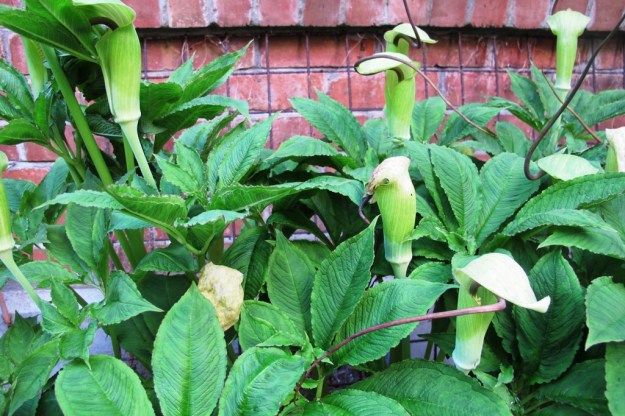
Arisaema tortuosum

Arisaema tortuosum

Not all are devilishly difficult. A. tortuosum is easy and will seed down freely, a bit too freely, we find.  It makes a big patch, maybe 75cm tall, with the green hooded flowers sitting above the foliage. We find it is perfectly happy in the border right beside the house on the eastern side where the only water it gets is run off from the adjacent path.
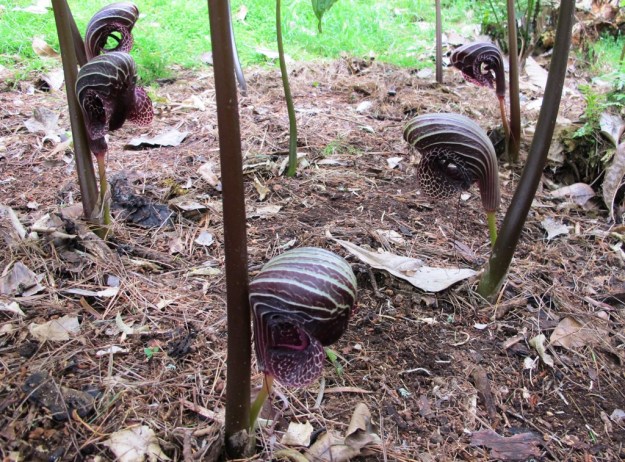
Arisaema speciosum

Arisaema speciosum

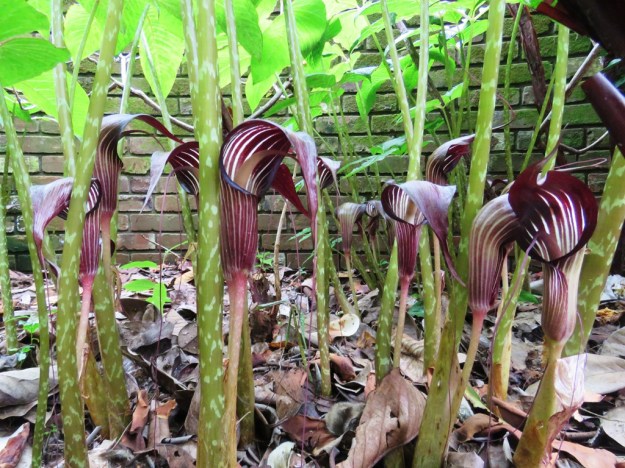
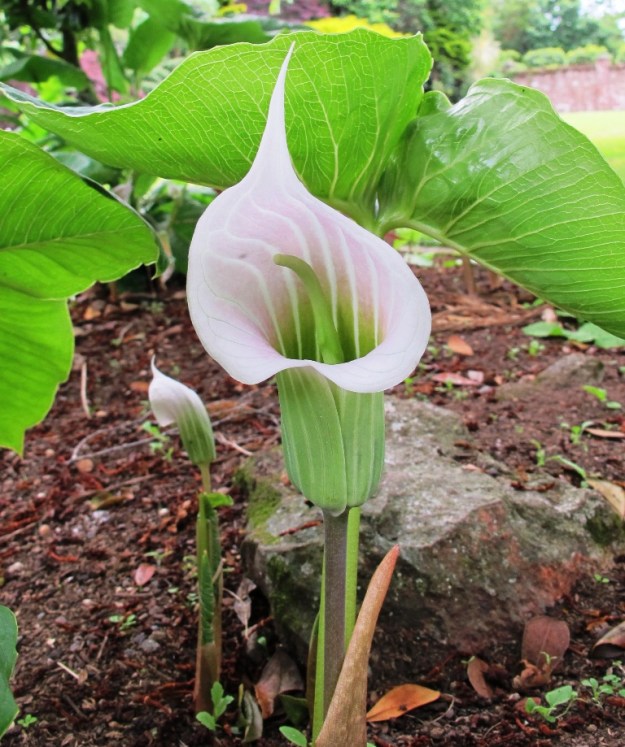
A. speciosum is another easy variety in semi shade. It has handsome foliage, lovely mottled stems and curious flowers in burgundy-brown that really do look like hooded cobras. But the issue is that the flowers are held beneath the foliage so unless they are planted on a slope or on a margin where you can see into the patch, you may miss the flowering season. The early summer blooming A. candidissimum is one of the prettiest forms and is not difficult to grow with its palest pink and white hooded blooms appearing before the foliage dominates. It also multiples well.
Mark's A. sikkokianum hybrids

Mark’s A. sikkokianum hybrids

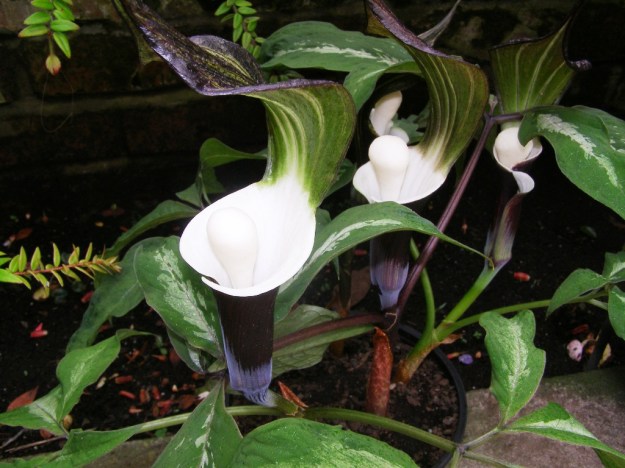
Mark's sikokianum hybrids (3) - CopyAnd then there are the tricksy ones, few more so than the Japanese A. sikokianum with its phallic spadix and hooded spathe rising prominently above the foliage. It is a show stopper in spring, though definitely curious rather than beautiful. After many years of growing it, I can tell you that it is difficult. We have never seen it increase from the corm. Growing well, it will set seed but these need to be raised in controlled conditions because it will not seed down naturally here. Even then, the patches tend to get smaller with time, rather than larger. It was for this reason that Mark experimented with hybridising it, to try and get increased vigour. This is known as hybrid vigour, in a similar way that the controlled breeding of designer dogs can make the offspring a stronger genetic strain than the highly refined parentage of pure breds. It has worked for us. The offspring carry all the best characteristics of A. sikokianum but they grow more strongly and are reliable as garden plants. Few would pick the difference to the lead species, but we know they are actually hybrids.

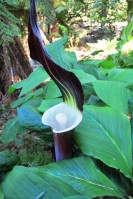
Arisaema dahaiense

Arisaema dahaiense

For sheer bizarre appearance, the more recent acquisition of A. dahaiense has to take the cake. It is very peculiar and not a carnivorous plant, though it looks as if it should be. The mottled, frilly flange is particularly striking. Because we are gardeners rather than plant collectors, the fact that this large-flowered curiosity has settled down quite happily in the leaf litter of open woodland conditions is a real bonus.

Peculiar propensities?  Arisaemas are hermaphrodites. When they are young or growing weakly, they are male. Only when conditions are right and the plant is strong, do they become female and therefore capable of reproduction. Then if they need a wee rest, maybe after a season of prolific seed set or drought, they revert to male again. Is this a metaphor for the human condition, some may wonder. I could not possibly comment.

A. taiwanense seed

A. taiwanense seed

If you notice a vague visual similarity to the mouse plant (Arisarum proboscidium), the striped Arisarum vulgare or arum lilies you are correct. Though not close relatives, they are all aroids in the Araceae plant family. Arisaemas go dormant in late summer and grow from corms – often roundish balls or larger round discs, though speciosum corms can look more like something unfortunate that the dog has left behind. Some species set copious amounts of seed which can be attractive in itself in autumn, though it helps to know your species. I remove the tortuosum seed because it can spread too freely whereas the speciosum seed, while abundant, has not created problems for us.

If you really want to know more about this plant genus, the gold standard reference is currently still a book, a proper book, not the internet – “The Genus Arisaema” by Guy and Liliane Gusman.
Arisaema candidissimum

Arisaema candidissimum

010 - CopyFirst published in the December issue of NZ Gardener and reprinted here with their permission.
Exotica in the shade

Shade gardens we have a-plenty

Shade gardens we have a-plenty

Glory be, but I do love spring.  This month subtropical bulbs and orchids shout out to be noticed.

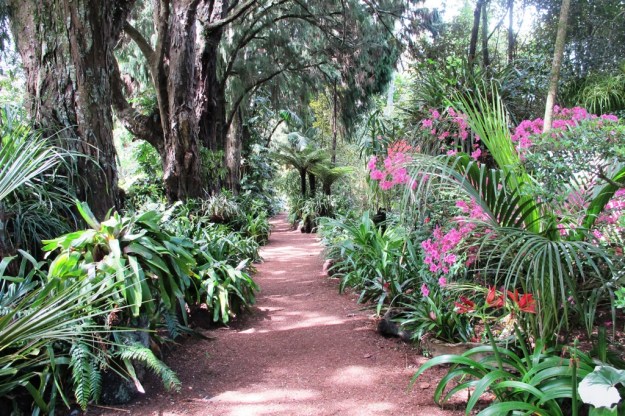
We have extensive shade gardens. It is an inevitable result of a large, mature garden with many evergreen trees dating back as far as 1870. We do a lot of what we call lifting and limbing – taking off lower branches and keeping areas open to the light, for there are not a lot of plant options when it comes to deep, dark shade. Beneath the mighty tree canopy, it is dry but frost-free with dappled light. Over the decades there has been much trial and error to find what will thrive in these conditions and the plantings have become increasingly complex.

Dendrobium Bardo Rose

Dendrobium Bardo Rose

By this time in spring, we are over peak season for cymbidium orchids but the Australian dendrobiums are a delight. These are much smaller and more mounded or clumping in appearance and they take care of themselves. We have found the Bardo Rose group to be particularly obliging and free-flowering in woodland conditions. Ours all came from the local Orchid Society, an organisation that we have found combines generosity with superior technical knowledge.

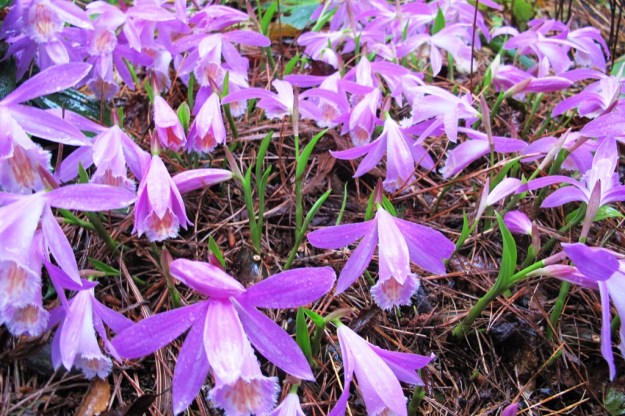
Pleione orchids in the woodland

Pleione orchids in the woodland

Pleione orchids do not last as long in bloom as many of the other orchids. Their flowers are soft rather than waxy but oh my, they make such a pretty carpet. It is easy for them to get swamped so we try and keep the area around them open but beyond lifting and dividing every few years, we just leave them alone. In our experience, the lovely yellow varieties do better in a climate where they get more winter chill. I think all our yellows have died out now but we have plenty in shades of lilac, purple and pure white. Most of our successful varieties came from the late George Fuller, orchid expert and former curator of Pukekura Park, and seem to have formosana in their parentage. If you want to build them up, a single bulb will usually set 2 offsets each season so you can double them every year.

Calanthe orchid - CopyThe calanthes are ground orchids and we have big clumps now because these obliging plants can just be left to quietly increase in size. These are fully evergreen and somewhat frost tender but they are a delightful sight through spring and they combine very well with clivias, ferns and even hostas.
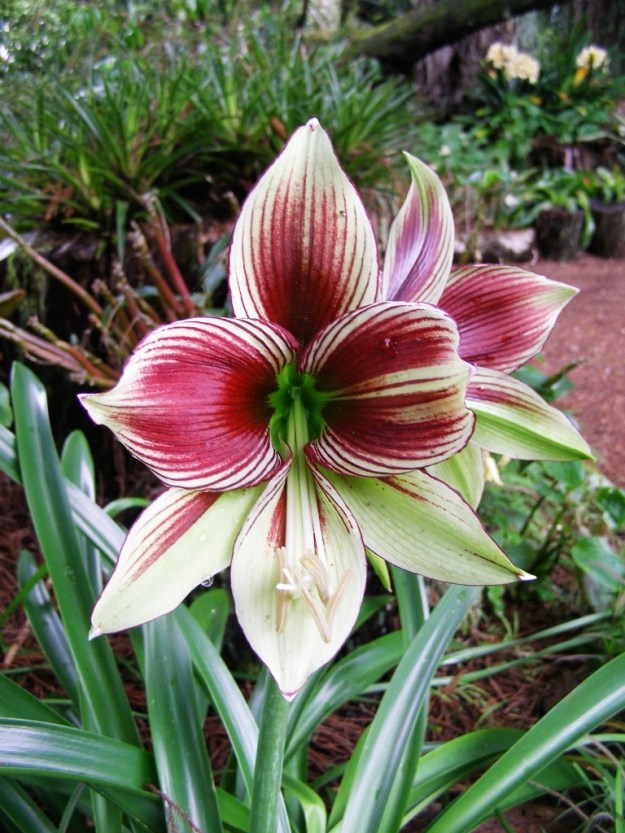
Hippeastrums are a plant family that has been much hybridised but I am not entirely convinced that has been to their advantage. It is two species that we rely on, both South American. It was by chance we found they settled happily into woodland conditions. In full sun, they were ravaged by narcissi fly but in high shade they are fine. Apparently nazi flies, as they are often called, don’t like shade. H. aulicum is one of our early to mid spring mainstays, flowering consistently year in and year out while multiplying most satisfyingly. To me, they look like beautiful Jacobean lilies in the woodland.

Hippeastrum aulicum, one of our woodland mainstays

Hippeastrum aulicum, one of our woodland mainstays

Hippeastrum papilio has been a more recent acquisition for us and it is certainly spectacular, looking more like an orchid than the butterfly for which it was named. It is offered for sale but be prepared to pay a lot for a single bulb – maybe $30 if it is flowering size – because it takes several years to get to that point. I can’t think that we would have started with more than just one or two bulbs at that price. I see with a bit of dividing and replanting we now have about sixty but not all are flowering size yet. Mark has done some hybrids of aulicum x papilio to increase numbers and get some variety, but they have yet to bloom.

Hippeastrum papilio

Hippeastrum papilio

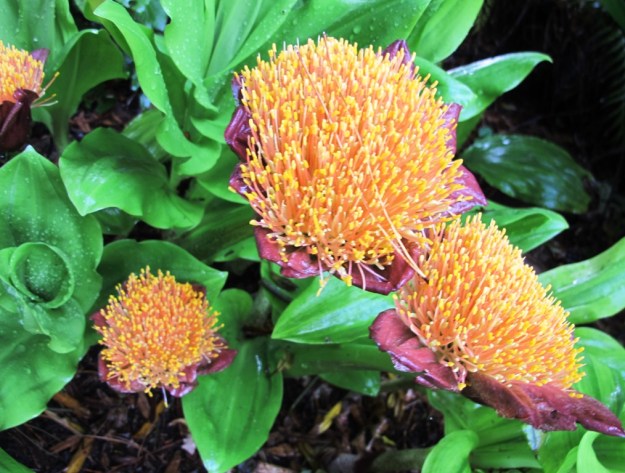
I will have to leave the arisaemas, trilliums and the Paris polyphylla for another time but will finish with Scadoxus puniceus from South Africa. Many readers will be familiar with the summer flowering red S. multiflorus ssp. katherinae, especially in the Auckland area because it was, and maybe still is, much beloved by landscapers. It is a mainstay of our summer woodland, but in spring it is the lesser known S. puniceus that is the showstopper. Growing from large bulbs which are slow to increase, the foliage is lush and the large blooms are curious rather than beautiful. S. puniceus is not widely available, but if you can find somebody with it, it is easy enough to raise from fresh seed as long as you are willing to wait quite a few years to reach flowering size.

The rewards are there for patient gardeners.

The lesser known Scadoxus puniceus

The lesser known Scadoxus puniceus

Text first published in the October issue of NZ Gardener and reprinted here with their permission 

Lachenalias part one: the early bloomers

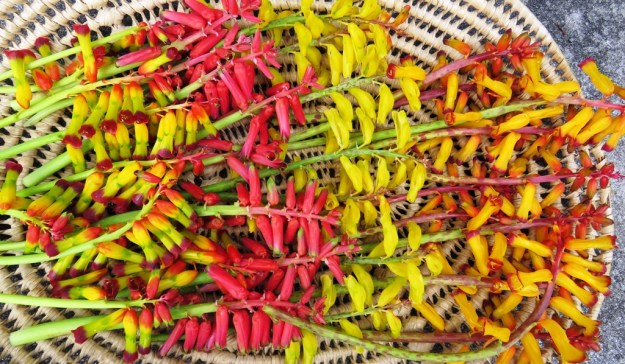
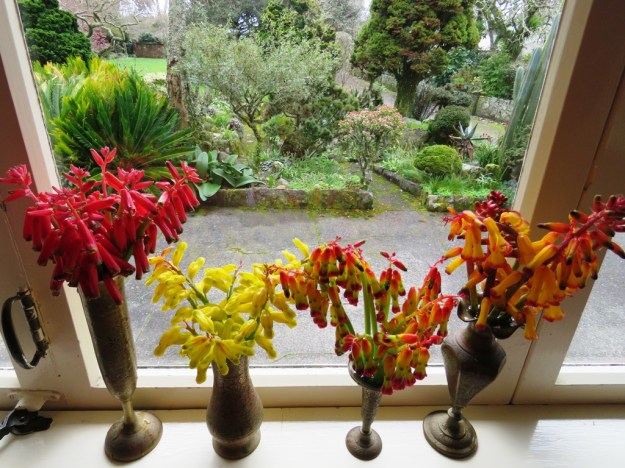
Left to right: Lachenalia aloides quadricolor, bulbifera, reflexa hybrid, aloides

Left to right: Lachenalia aloides quadricolor, bulbifera, reflexa hybrid, aloides

Pity the early-blooming lachenalias for none of them are blue. And the blues and mauves are the sought after members of this plant family. But as winter draws to a close, it is the cheerful red, orange and yellow combinations that light up a grey day. It is all in how you use them.
Nothing subtle about aloides but great in semi-wild areas

Nothing subtle about aloides but great in semi-wild areas

I had not been a fan of the most common form of Lachenalia aloides. It lacks refinement and reminds me of cheap, fake flowers. But when I relocated surplus bulbs out to an open area near our entrance, I changed my mind. They are a bright splash of colour around an old tree trunk which makes me smile. The addition of the undervalued muscari (grape hyacinths) that remind me of my childhood adds a splash of pure blue, making the colour seem even brighter, along with an early flowering scilla. We have a particularly strong growing form in New Zealand which you can still occasionally find under its completely incorrect name of Lachenalia ‘Pearsonii’. It is just a strong-growing, tall strain of aloides with its distinctive orange and red colouring.
Same species, aloides. Quadricolor to the right.

Same species, aloides. Quadricolor to the right.

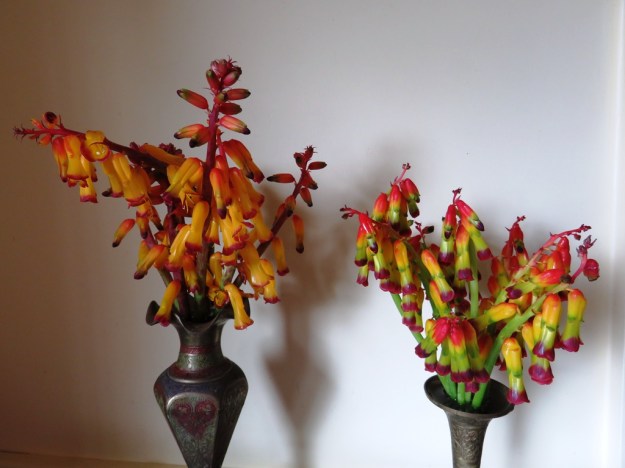
L. aloides is a variable species and one of our early bloomers is another form – L. aloides quadricolor. It has a little more subtlety than its more vibrant, stronger sibling. The individual flowers are little smaller and finer, although still on a strong stem. Quadricolour refers to the four colours – red, yellow, green and interesting maroon or burgundy tips. There is a complexity to these flowers which counters the somewhat garish effect that can be evident in the more common form.

L. aloides tricolor flowers later for us and is smaller in size and basically green with red tips. The most desirable of this set is probably L. aloides var. vanzyliae but it is the one we are struggling to get growing well. I will keep an eye out for flowers as the season progresses because it is an unusual white with pale blue at the base and bright green tips and it is just as lovely as it sounds. When I find it again – and I have it in about three places – I will lift the bulbs because I think this one will be best kept to a pot.

Lachenalia bulbifera

Lachenalia bulbifera

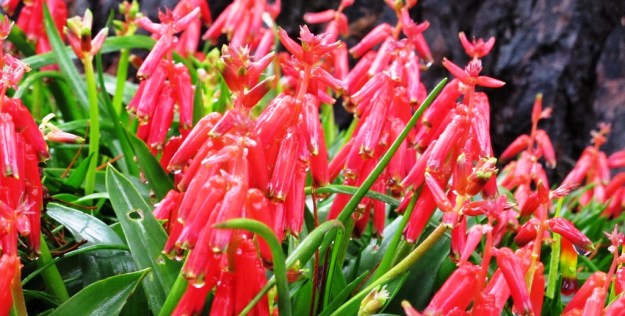
Red L. bulbifera is the first of the season to come into flower for us. It is easy to grow and sets a multitude of little bulbs, though not to the extent that we have classified it as invasive or dangerous. It is another one that I like planted around the trunk of an old tree giving a bright spot of colour in the distance and drawing one over for a closer look.
Mark's reflexa hybrid is stronger growing than the straight species

Mark’s reflexa hybrid is stronger growing than the straight species

The yellow is Mark’s L. reflexa hybrid. Because we struggle with the dreaded narcissi fly, he was casting round for alternative yellows to daffodils for naturalising. While not quite a pure yellow (the tips can have a red tinge), it is a strong and reliable grower and gives the yellow carpet effect though we have yet to get a major drift established in grass conditions.

Lachenalias are South African bulbs, mostly from the Cape Province. Some are very easy to grow, others less so. Naturally the very choice varieties are the ones that are less amenable but that is always the way. Some are desert plants and we struggle with those, but the ones that grow in areas of winter rainfall are generally easy and reliable in our conditions. A few, like L. glaucina, are particularly frost tender. Lachenalias last very well as a cut flower and will out-bloom most other late winter and spring bulbs in the garden. L. bulbifera is already in bloom by the beginning of July while the white L. contaminata flowers through November. A family of easy-care bulbs which gives us a full five months of blooming across the colour spectrum – what is not to like?
041

Garden lore: July 20, 2015 Petal blight, white camellia hedges and winter pruning

“One has a lot, an endless lot, to learn when one sets out to be a gardener.”

Vita Sackville-West, A Joy of Gardening (1958)

078

Petal blight

Petal blight

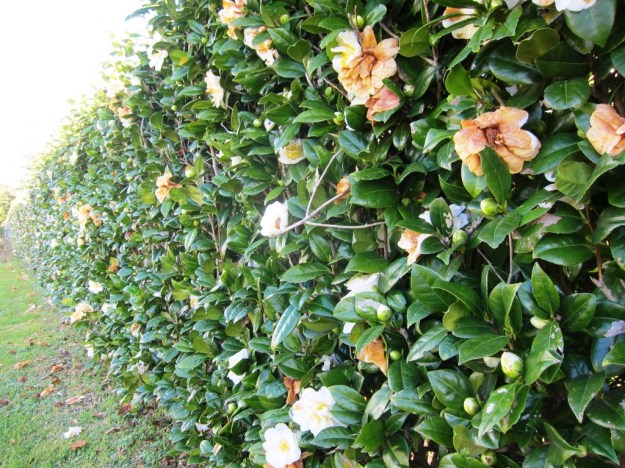
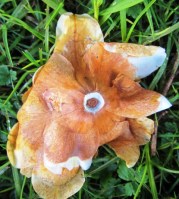
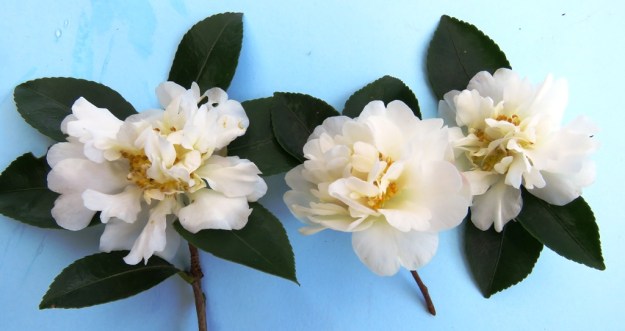
After writing about Winter Whites last week, referencing the ubiquitous white camellia hedges, of course I noticed this hedge on my way to town. My eye was drawn to the composition of brown and white flowers. It is a japonica camellia, though which one I am not sure. Closer examination revealed a bad case of petal blight, even this early in the season. There are two main giveaway signs. The first is the brown flowers hanging on to the bush. Most modern camellias are what is called self-grooming. They are bred to drop their spent blooms but those affected by petal blight hang on. The blighters. The second sign is shown by turning over a brown bloom and removing the calyx that holds the petals together. There is the tell-tale white ring of death – fungal spores. There is no remedy. You either live with it or you remove the plants.
076

I have never been a fan of japonica camellias for hedging. The foliage can go a bit yellow in full sun and both leaves and blooms are too big. Smaller leafed camellias, seen in the sasanquas, some of the species and the hybrids look much better. Miniature single flowers usually fall cleanly and disintegrate quickly, avoiding the sludgy brown effect below.

Camellia transnokoensis

Camellia transnokoensis

While our C. transnokoensis hedge needs to thicken up yet, we are charmed by its floral display. The sasanqua ‘Silver Dollar’ is also an excellent hedging choice. While the small flowers are nothing special viewed close-up, it is one of the first sasanquas to bloom for us and one of the last so it has exceptionally long season allied to compact growth and small leaves which are a good, dark green.

Camellia sasanqua Silver Dollar - an excellent hedging option

Camellia sasanqua Silver Dollar – an excellent hedging option 

While some claim that sasanquas can get petal blight, we haven’t seen it on our plants. And although the single flowered species and hybrids are not necessarily resistant, most set large numbers of flowers but each bloom only lasts a few days so they fall before blight takes hold.

On another topic, winter is pruning time. I did the wisterias on Friday. This is one plant family I recommend removing totally if you are not willing to prune them. They have dangerous proclivities. Most of the roses are done and I have started on the hydrangeas. Those in colder climates may be better to wait another month before tackling the last two because pruning encourages new growth which is vulnerable to frosts. The pruning guides I did several years ago as part of my Outdoor Classroom series give step by step instructions if you are not sure where to start – wisteria, hydrangeas, roses.

Tikorangi Notes: June 11, 2015 From Nerine bowdenii to homeopathic gins


Nerine bowdenii on May 11

Nerine bowdenii on May 11

And a month later on June 11

And a month later on June 11


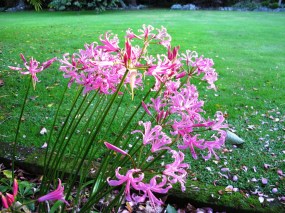
Without a camera, I may never have tracked the flowering time of Nerine bowdenii. It is a species and we have valued it for being the last of the season to flower without being too excited by it. But a MONTH at least in full bloom through autumnal storms and wind – that is an astoundingly long time for a bulb that only puts up one flower head, as opposed to successional flowering down the stem. We are now thinking we will use it more widely beneath deciduous trees where we had been relying on belladonnas. The latter flowers early in autumn when the leaves are still on the trees and the blooms don’t last anywhere near as long. Fortunately, N. bowdenii multiplies up extremely well and is probably the easiest of the nerines we grow.

The Kurume azaleas, underplanted with Cyclamen hederafolium

The Kurume azaleas, underplanted with Cyclamen hederafolium

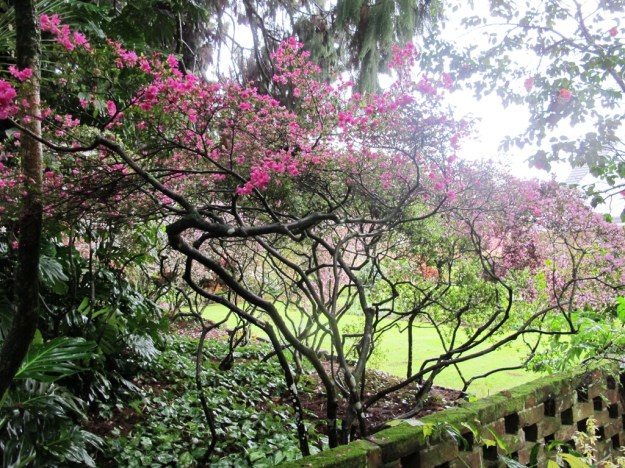
I have been cleaning out the azaleas. Oh how easily those words trip off the tongue but I tell you, doing the first of two blocks is probably 20 or 30 hours work. It must be a sign of the leisured pace of my life at the moment that I can spend that amount of time on one task. Years ago, we limbed up these tiny leaved Kurumes to make the most of their interesting form and to enable us to look through them. Sculpting them, we call it. It is more common to clip and mound them, keeping them much lower to the ground. These ones are planted on the margins of our enormous rimu trees and they catch a fair amount of litter falling from above. They also shoot from the base and we try and rub off those new shoots before they get large. But once every five or ten years, a major clean out of the dead wood and the canopy makes a major difference. It just takes time. A lot of time. I am reminded of something we once heard Christopher Lloyd say (it must have been on the telly because I can’t find it in print): “People are always looking for low maintenance and easy care gardens. Personally I am of the view that if you love what you are doing, higher maintenance is more interesting.” 

I lack a photo of passionfruit at the purple stage  of ripening

I lack a photo of passionfruit at the purple stage of ripening

But at least I have red tamarillos on file

But at least I have red tamarillos on file

On the home harvest front, we are now experimenting with homemade juices. Not using the mechanised juicing machine that we inherited from our daughter when she left to live overseas. She assured us it made good carrot juice but we have not had a surplus of carrots yet. Mostly I use it for grape juice or melon juice. It takes a prodigious quantity of fruit for a pretty small liquid yield but then so do the fresh squeezed orange juices we often make – 5 or sometimes 6 fruit per glass. No, it was the surplus of passionfruit and upcoming tamarillos that were worrying me and I didn’t want a juicing system that ground up the seeds. Mark scooped a bucket of passionfruit out. The quantity immediately reduced to medium sized basin. I added some water and brought it to the boil with a little sweetener because the fruit was rather too tart. Do not laugh. It was only because I had agave nectar in the cupboard (bought when I was test cooking a recipe book sent for review) that I used it as a sugar substitute. I simmered the fruit for a short while before straining it off. The original bucket of fruit yielded just a litre of juice. Liquid gold. We will savour it, diluting it 50% with soda water in lieu of our weekday homeopathic gins.

What, you may ask, is a homeopathic gin? Here, it is lime and soda served in a nice glass which holds the memory of gin. When we decided, in a burst of wholesome living, to manage alcohol consumption by not drinking from Monday to Thursday, we realised that it was in part the ritual of sitting down together with a drink before dinner that we enjoyed. Hence the homeopathic gins. The logical extension of wholesome living seems to be the shunning of synthetic lime juice in plastic bottles, replacing it with our own fruit juices. Virtue expires on Friday evenings, I admit.

007

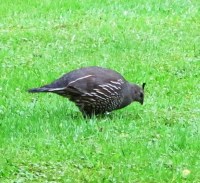
Blame the quail

Blame the quail

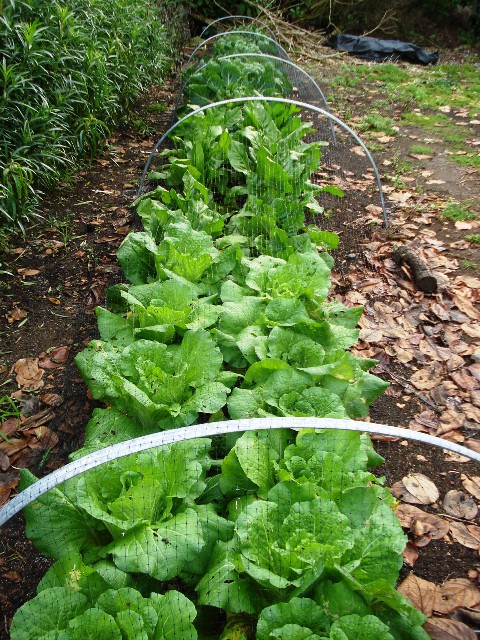
Mark has been busy in his vegetable gardens. He has now resorted to covering all the brassicas and leafy greens as well as all seedlings, in order to protect the crops from birds. He blames the cute resident quail for attacking the Brussel sprouts but there are plenty of candidates. It may just be that the quail, being predominantly ground birds, are the most visible. The strawberries are planted for spring and the garlic is already above ground.


Lovely in bloom, huge, but what is it?

Lovely in bloom, huge, but what is it?

Finally, if any reader can give us the name of this enormous perennial, we would be most appreciative. It is of similar stature to a tree dahlia – about 4m x 4m – so taking up a lot of space. Currently it is smothered in white daisies and has survived a frost but cold weather can cut it to ground. It is very late in the season for what is presumably an autumn flowering perennial. We will enjoy while we can, but we would like somebody to remind us of its name.

Postscript: That didn’t take long. A reader has identified this as Montanoa bipinnatifida which I see is commonly known as the Mexican tree daisy, a member of the asteraceae family. No wonder we were struggling to come up with a name – I don’t think either of us have ever heard it before. And it is not a perennial but a shrub. It must be that ours gets cut back so often by the winter chill that it resembles a huge perennial rather than a shrub.