Tag Archives: gardening

Learning about lobelia

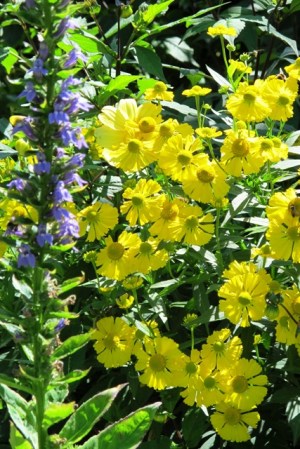
A perennial lobelia from North America - but which one?

A perennial lobelia from North America - but which one?

Lobelias, I thought. I will do lobelias this week. Now you may quite possibly have led a full and happy life without putting any thought to lobelias. My interest had been desultory at best, but as soon as I started to delve a little, I uncovered a whole lot more.

Lobelias go well beyond that little, mounding blue annual that is a summer stalwart. Yes it comes in white and purple as well but it is usually blue. That handy little plant is Lobelia erinus, hailing from southern Africa. If you garden with bedding plants, you start afresh each year with organised plantings. Or if you are more cottage garden oriented, you just let one plant go to seed and it will naturalise and reappear around the place the following spring in an obliging but gentle sort of way. It is just a handy filler – nothing too exciting about that.

It was quite exciting, in a botanical sort of way, when we were given Lobelia gibberoa. This one hailed from mountain gorilla territory in central and eastern Africa. Indeed, if you get your eye in for footage of those gorillas in the mist, you may see them browsing amongst things that look a little like palm trees or even our tree ferns. Lobelia like we had never seen it before. It rockets upwards at about two metres a year, forming rosettes of big tropical leaves on top. Apparently it stops when it gets to about 5 metres high. Ours rocketed up but we rather lost interest when we realised it was not going to impress us with a magnificent display of bright blue flowers on its huge flower spike. The flowers were negligible and inconspicuous but the plant was a magnet for white fly and red spider so we didn’t worry when it succumbed to a cold, wet winter.

Sometimes you will see Lobelia aberdarica offered for sale. It is another lobelia mega herb, a little more cold hardy, though from a similar geographical area and it too has huge leaves growing in rosettes. However, it clumps closer to the ground rather than on top of its trunk though it seems to share the same huge flower spike with underwhelming flowers.
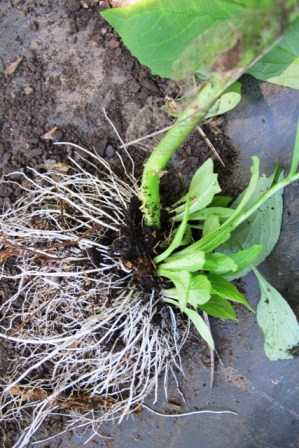
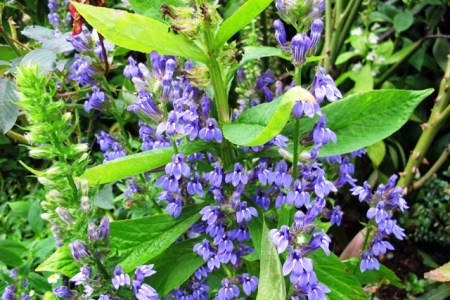
The North American perennial lobelias are very easy to lift and divide

The North American perennial lobelias are very easy to lift and divide

No, it was the unequalled display of the perennial, clumping lobelias from North America which made me sit up and take notice. We have had these for years here. They form neat little rosettes at ground level and put up metre high flower spikes which, in the past, have all then proceeded to fall over. I think what made the difference this season is that I had divided most of the plants, splitting up the crowns and spreading them around. And in these rejuvenated beds and borders, there were sufficient other plants to hold the flower spikes up. In this process, I had still managed to keep the colours separate. We have pale blue and mid blue, rich purple, cerise pink, white and even red. This year we had lots of blues and they have been a real feature.

As summer perennials, these are excellent garden plants for sun to semi shade. They’re easy. If you have a pure red one, it is likely that it will prefer damper conditions, even water’s edge. It is a different species, though still from USA.

I thought I would try and decode the species. Ha! There are somewhere up to 400 different ones. It is a huge family and many of what we have appear to be hybrids between different species. So we won’t confuse matters.

What became really interesting was the long history of lobelias in traditional herbal medicine. We come to this topic from a botanical angle which makes it really scary (identification is often wrong). But those American lobelias promise a cure for pretty much everything, though they can also be highly toxic. Lobelia inflata, also known as Indian tobacco, does not carry the alternative common name of puke weed or the equally charming vomitwort for nothing. But from snake bites to pleurisy to bronchial difficulties, it can be just the ticket. Best guess is that it is what Billy Connelly was given in the shaman’s tent on a recent Route 66 TV programme.

Be careful, should you happen to be suffering from syphilis, that it is Lobelia siphilitica that you harvest for a natural cure. I didn’t delve far into the history of syphilis in the indigenous American people around 400 years ago, but it is believed that this disease was introduced to Europe by sailors with Christopher Columbus.

The problem is that siphilitica and inflata are different species but look very similar and I have no idea whether our plants here are one, the other or a hybrid of the two. Nor am I confident that any research has been done to ascertain whether they are interchangeable in herbal medicine.

For sheer optimism, I loved the website dispensing advice on using lobelia as a herbal treatment. “Always consult your Health Professional to advise you on dosages and any possible medical interactions” it said. Yeah right. I am sure I am surrounded by health professionals who are far better than I am on botany, understand chemistry and have a deep knowledge of traditional medicines. I will just keep using these charming perennials as garden plants.

First published in the Waikato Times and reproduced here with their permission.

Grow it yourself: cabbage

Cabbages are part of the brassica family, which includes broccoli, cauli and Brussels sprout. This means they are gross feeders (gross meaning greedy or hungry in a gardening context, not revolting) growing best in heavily fertilised soils, rich in nitrogen. To hold up their large heads on a single stem requires a good root system in firm soil so get the ground right from the start. You can plant for most of the year in warmer areas, though we avoid summer for the brassica family to avoid problems with white butterfly. Cabbage can be grown from seed sown directly into the ground or from small plants. Don’t get too carried away – consider how many cabbages you want to eat. They can be difficult to give away. Every plant is also going to need about half a metre clearance all round to give it space to grow. Cabbages take two to three months to mature so planted now, will be ready in winter.

However, for those of us are who are less than enthusiastic about large heads of cabbage with lots of white stalky centre bits (there is only so much cole slaw and stir fried cabbage one can eat), there is a much larger range available now for the home gardener. There used to be a choice of large red, green or crinkly savoy. Now there are a number of mini growing varieties available with heads around 1kg instead of up to 4kg for the larger types. There are also conehead types with softer leaves, assorted quick maturing Chinese cabbages and even the Italian Cavolo nero (which is more like kale). Check out the Kings Seeds catalogue for a good range which might encourage a rethink on the role of this vegetable garden standby.

For the record, we do not for one minute think there is any truth to the current theory that white butterflies are territorial so can be discouraged by eggshells on sticks. Wishful thinking.

First published in the Waikato Times and reproduced here with their permission.
Gardening with grasses

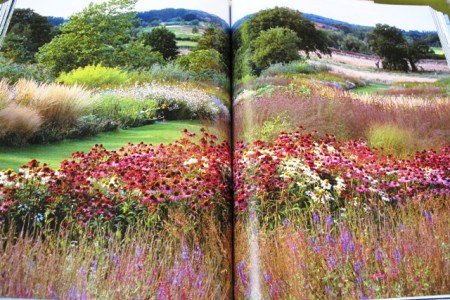
We were entranced by the Piet Oudolf borders at Wisley

We were entranced by the Piet Oudolf borders at Wisley

Years ago I was editing garden descriptions and amongst the plethora of developing gardens or tranquil havens filled with birdsong, I came across one which claimed to have “a fascinating collection of grasses.” Fascinating seemed to be overstating the case. I think I toned down the adjective. It has taken a long time to win us over to the merits of grasses here, even though we have some lovely native varieties in New Zealand.

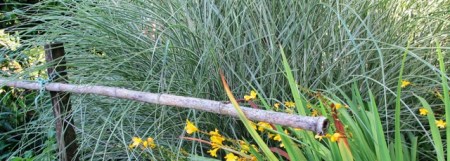
Big grasses need big space

Big grasses need big space

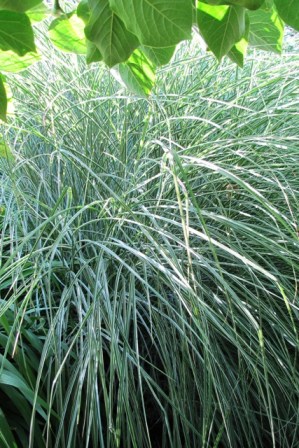
I have never actually seen grasses used in a breathtakingly beautiful way in gardens in this country though I have seen some handsome amenity planting combinations. The problem lies, I think, in how we use them. For starters we tend to limit ourselves to varieties which are knee high or lower. Even worse is the habit of forcing innocent grasses into an edging role where they are destined forever to be like an untidy fringe. And yes, mondo grass (both black and green), liriope, Carex Frosted Curls and blue fescue – I’m looking at you here. Grasses by their very form are designed to grow in the round, not to be forced into a narrow row as an edger. Nor indeed do I understand the obsession with uniform edging plants on all garden beds and borders in this country but that is another matter.

It wasn’t until we went to look at summer gardens in the UK that we were won over by grasses. We had heard slightly disparaging comments about the Piet Oudolf twin borders at Wisley (the RHS flaghip gardens) – a chevron design in grasses, I think somebody told us sniffily. It wasn’t that at all. Twin parallel borders were united by rivers of colour and texture flowing from one to the other with grasses featuring along with other plantings. Not knee high grasses, these were at least waist high and integrated with other carefully chosen perennials. It was an inspirational planting.

On the same trip, I saw the most exquisite grass I have ever seen at Beth Chatto’s garden. I don’t even know if Stipa barbata is in this country but it was light, ethereal and remarkably beautiful. Since then, we’ve seen grasses featured frequently in British TV garden programmes. One of the reasons we subscribe to Sky is to get gardening shows on the Living Channel.

Early view of the Wisley Oudolf borders before the glasshouse was built (from Penelope Hobhouse's book "In Search of Paradise" - magic

Early view of the Wisley Oudolf borders before the glasshouse was built (from Penelope Hobhouse's book "In Search of Paradise" - magic

The common threads to making these plantings work are:
1) Inspired combinations. Grasses are not planted with other grasses. They are integrated into mixed plantings which are carefully managed to look naturalistic in style. Grasses don’t generally suit formal plantings.
2) Forget grasses which are ankle high to knee high. Statement clumps are at least waist high and often considerably taller. This of course means they need quite a bit of space.
3) Big grasses plus big plantings result in a big effect. It rarely scales down effectively. Therein lies the problem – not that many of us have the space to garden on this sort of scale. Those of us who do have space (and it needs to be sunny, well drained space), have usually cluttered it up with mixed plantings including trees and shrubs. These exciting perennial plantings using grasses are usually only perennials, not mixed borders. The aforementioned Oudolf borders at Wisley are around 150 metres long by 11 metres wide – each. While that is on a grand and public scale, you really can’t expect to replicate it in miniature in a border which is only a metre wide and three metres long.
4) Many of these successful plantings have their origins in a garden interpretation of American prairies. It is a managed but not manicured style of gardening. It is some distance away from the classic herbaceous border and it is a long way away from the formal garden rooms genre we have adopted so enthusiastically in this country. It does not combine well with clipped hedges.

Set the grasses free. That is not original. I read it somewhere and it was a NZ writer though I can’t recall who. Stop trying to straitjacket them into contrived and managed combinations. If you have your grasses in a situation where they require grooming and regular combing, it is likely that you are straitjacketing them.

We were told that the Oudolf borders we so admired at Wisley required only a third of the labour input that the classic herbaceous borders needed. Partly that is because they don’t need staking or deadheading. They are cut down in late January (for us that translates to the end of July or late winter). I imagine by that stage they are quite scruffy so it is not a style that will appeal to tidy gardeners. But despite that scruffy stage, these prairie styled plantings contribute a great deal to the ecology of an area, feeding birds and wildlife. It is different to wildflower meadows in that it is managed plantings in varied combinations, often within a somewhat formal layout and with tight weed management. It is not random or self sown. This is not a style we seem to have picked up on this country. We are still mulling around as to whether we have the right position to try.

First published in the Waikato Times and reproduced here with their permission.
More bad Penguin

Stop Press
Penguin NZ have issued an immediate recall of all copies of this book.

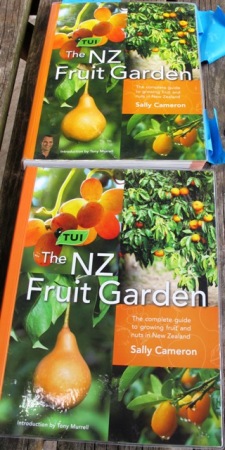
Slight sense of deja vu here - side by side

Slight sense of deja vu here - side by side

There was a bit of a problem with the first version of the Tui NZ FRUIT Garden by Sally Cameron, published by Penguin NZ. In fact it was clearly quite a large problem, given that Penguin ordered an immediate recall within a few days of its release. It’s usually called plagiarism – rather too much cut and paste from copyrighted sources without acknowledgment. It was the third such embarrassing incident in quick succession for this publisher, the highest profile being Witi Ihimaera’s work, The Trowenna Sea. No matter. Publishers closed ranks and I was on a National Radio panel where other professionals explained that it was all the author’s fault and none of this could possibly be blamed on the maligned publisher.

To my astonishment, Penguin NZ, with the backing of their sponsor Tui Garden, ploughed ahead using the same author to rewrite the book and a year later they issued a second edition which was substantially different. No better, mind, but different and minus the sections which appeared to have been plagiarised.

Would you not think that both Penguin NZ and Tui Garden would have put the first book by the same author in the same series – The Tui NZ VEGETABLE Garden – under the microscope at the same time? I reviewed it when it came out in 2009 and I was far too kind. In my defence, all I can say is that it seemed markedly better than the other book which I was reviewing alongside it. When faced with the FRUIT book a year later, I questioned whether the earlier VEG book might suffer from similar problems related to cutting and pasting other people’s work. I even cited the garlic entry and gave its source as a copyright website belonging to somebody else.

Given the obvious inexperience of the author, did nobody involved think it warranted a closer look? We are talking the same book series, same author (Sally Cameron), same sponsor (Tui), same publisher (Alison Brook for Penguin), same editor (Catherine O’Loughlin). When the author is already under scrutiny, in the dock so to speak, it is difficult to believe that others involved can dump all the blame on her a second time.

It was only ever going to be a matter of time before somebody noticed. And two weeks ago, somebody identified a primary source for the Tui NZ VEGETABLE Garden and posted the following comment on my website:
“Not only has Dr D G Hessayon ripped off Sally Cameron’s Tui NZ Vegetable Garden, chapter and verse, but, he also had the temerity to do it four years prior to Sally being published.
Is it OK to lift entire chapters of books if you include a reference to that book at the end? Hope so, ‘cos I’m just finishing my book “Great Expectations” with a small reference at the back to Mr C Dickens.”

Dr Hessayon's book may look a little old fashioned but is packed full of information and is a best seller - for British gardners

Dr Hessayon's book may look a little old fashioned but is packed full of information and is a best seller - for British gardners

My informant was working from a more recent copy of a source publication, “The New Vegetable and Herb Expert”. English horticulturist and bestselling author, Dr Hessayon actually published his book a good ten years before Sally Cameron produced hers. It took me mere minutes to track down a copy on Trade Me. I think I paid $12 for it plus P&P and it arrived in the mail this week.

Well. Oopsy. How many examples are sufficient?

1) On turnips: Hessayon: Round is not the only shape for these Early turnips – there are also flat and cylindrical ones. There is not much variation in the globular Maincrop types sown in summer, but you can choose the yellow-fleshed Golden Ball. (page 105)
Cameron: Round is not the only shape for these early turnips – there are also flat and cylindrical ones – but there is not much variation in the globular maincrop types sown in summer. (page 174 and one can do a side by side match for much of pages 174 and 175).

2) On Brussels sprouts: Hessayon: Birds are a problem – protect the seedlings from sparrows and the mature crop from pigeons. Hoe regularly and water the young plants in dry weather. The mature crop rarely needs watering if the soil has been properly prepared…. (pages 34-5)
Cameron: Birds are a problem. Protect the seedlings from sparrows and pigeons that will eat the mature crops. (Which type of pigeons, Sally?) If scarecrows don’t work, hang cutlery from a clothes hanger. (That suggestion does appear to be a Cameron original). … Hoe around the plants regularly and water the young plants in dry weather. The mature crop rarely needs watering if the soil has been properly prepared….( page 70 -71)

Even the instructions for picking are eerily identical.
Hessayon: Begin picking when the sprouts (‘buttons’) at the base of the stem have reached the size of a walnut and are still tightly closed. Snap them off with a sharp downward tug or cut them off with a sharp knife.
Cameron: Begin picking the sprouts at the base of the stem when they have reached the size of a walnut and are still closed. Snap them off with a sharp downward tug or cut them off with a sharp knife.

Similar problems exist with broccoli, celeriac, Jerusalem artichoke, the aforementioned garlic and more and I cannot claim to have done anything near a complete analysis. Given that the problems appear to be of a similar magnitude to the first version of the FRUIT book which was recalled, will we be looking at a recall of the VEG book? Maybe Tui Garden might consider whether it is a good look being affiliated to a book which claims to give good advice to New Zealand gardeners when a fair swag of it seems to have come from a book for British gardeners.

Lightning, it appears, can strike twice in the same place. It just beggars belief that editor, publisher and sponsor all appear to have failed to factor that in to their considerations.

First published in the Waikato Times and reproduced here with their permission.
Version 1 at the top, version 2 at the bottom. Just Tony Murrell's photo has disappeared from the cover though the content was substantially rewritten

Version 1 at the top, version 2 at the bottom. Just Tony Murrell's photo has disappeared from the cover though the content was substantially rewritten

The ongoing saga (and it is developing into a saga):

1) The review of the second edition of the fruit book: The Sequel – a second coming for the Tui NZ Fruit Garden

2) Does credibility and reputation count for nothing these days, or does Penguin just think we have short memories? (written upon hearing that Penguin and Tui were using the same author to rewrite the fruit book)

3) The story that started it all and that is currently the second most read article on my website, still receiving hits every day: The Tui NZ Fruit Garden – dear oh dear

4) The lead story on the Taranaki Daily News which broke the first plagiarism story. Since then I have parted company from the Daily News and moved to the Waikato Times.

5) The original review of the Tui NZ Vegetable Garden, which was far too kind and is now embarrassing to me as a reviewer. But I leave it in place because it is a good reminder – and I am considerably more thorough at reviewing garden books in NZ than many others. The Tui book did look better than the other one I was reviewing at the same time – but it, at least, was actually written by the author, based on her experience (however limited it was). Separating the genuine enthusiasts from candyfloss fashion gardening

6) The Tui NZ Flower Garden I merely add this one to complete the set. I declined to review the companion volume on kid’s gardening but I did review the flower book (same series but different author). I would not for one minute suggest that this volume suffers from plagiarism, not at all. It could only be original, for reasons which may be obvious if you read the review.

Tikorangi notes, Friday 24 February, 2012

Summer and Mark's vegetable garden is taking on its meadow garden alter ego as he grows food for the butterflies

Summer and Mark's vegetable garden is taking on its meadow garden alter ego as he grows food for the butterflies

Latest posts:

1) For us, the flowers of summer are lilies but you need to grow a range of different species to get them performing through the season.

2) Lepidozamia peroffskyana in Plant Collector this week – including how a Russian benefactor came to have an Australian plant named after him.

3) Grow your own garlic and keep vampires at bay. This piece also suggests that the conventional wisdom of planting on the shortest day and harvesting on the longest day may not always be the best advice.

4) Quite possibly the last in the short lived garden diary series done for the Weekend Gardener (unless a miracle happens and the magazine rises like a phoenix from the ashes of liquidation.

Tikorangi notes: Friday 24 February, 2012:

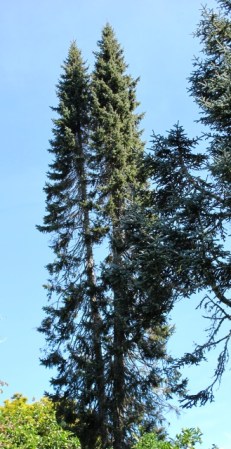
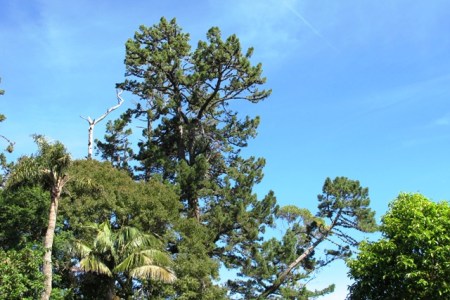
Summer came for three days this week. It was warm enough to entice me into the swimming pool where I looked up at the trees silhouetted against our blue, blue skies and reached for the camera as soon as I got out. I never tire of trees and skyscapes. The elderly pines make a pretty amazing sight even if the one leaning to the right is indeed leaning as much as it appears in the photograph below. One day it may lean beyond the point of balance.
Sadly there is no doubt that a full-on summer is simply not going to happen this year. Yesterday had the unmistakeable hint of autumn. Mark is bringing in grapes every day and muttering about how we had better eat the grapes before the melon harvest starts. Eighty something rock melons, he tells me there are ripening away out in his melon patch. He will have counted them. In the meantime we will not admit defeat and we will eat our way through the grapes. The only crop to rival them here is the green beans, which lack the romance.

The cyclamen are opening which promises an extended delight. The lilies are on their last legs – another torrential rain will spell the end of the auratums but within a few weeks, the autumn bulbs will be starting. That at least is some consolation for a truly disappointing summer.

Our old man pines, Pinus radiata, are large trees after 130 years

Our old man pines, Pinus radiata, are large trees after 130 years