Tag Archives: gardening

Garden Lore – witches’ broom

Indubitably witches' broom, not two trees

Indubitably witches’ broom, not two trees

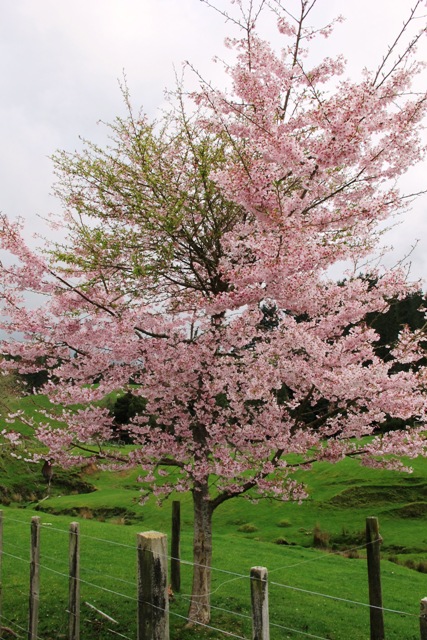
I came across this fine example of witches’ broom in a roadside tree planting of Prunus Awanui. That particular flowering cherry is known to be vulnerable to witches’ broom. It is the green section coming into dense leaf earlier than the rest of the tree and without flowers. Left to its own devices, over time the witches’ broom will take over the tree and you will no longer see much in the way of spring flowering. If you leave it for a few seasons, it also becomes harder to remove the affected sections without destroying the shape and structure of the tree.

Basically, witches’ broom is a mutation within the tree – possibly similar to an immune disorder in humans – which causes dense, twiggy growth in that section. It does not appear to heal itself and it does not grow out of it the following year. There are multiple causes but no general treatment beyond surgery – removal of all affected parts of the plant. Cherry trees are particularly prone to it, although you won’t find them in the campanulatas or Taiwanese cherries. Generally it is seen in the Japanese cherries and the hybrids. If you spot it now, mark it because it is harder to identify later in the summer when all the branches are in leaf. Spray on paint is handy for this, or a tie. Pruning cherry trees in high summer is recommended to reduce disease getting in.

On the bright side, witches’ broom mutations are what have given us many of the dwarf conifers so they are not all bad.

First published in the Waikato Times and reprinted here with their permission.

Points of interest

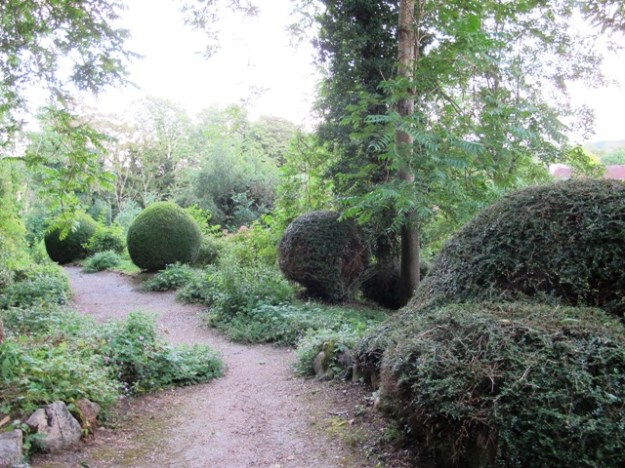
In an otherwise undistinguished garden in Giverny village, these clipped hummocks gave real impact.

In an otherwise undistinguished garden in Giverny village, these clipped hummocks gave real impact.

Punctuation points. That is what clipped shrubs can be. Very effective punctuation points, at that.

Formal gardens will often have pretty much everything clipped. If you have ever been to many Italian gardens, you may have noted the inclination to clip everything – at times to within an inch of its life. It photographs well. In fact we have often found that the photograph can be better than the real thing when you get to see it.

The modern New Zealand garden is characterised by clipped hedging, often carried out with military precision whether 30cm or 200 cm high.

But if you don’t want a formal garden or clipped hedging, there is a middle path. Punctuation marks.

Clipped accent plants give form in this garden which has predominantly loose herbaceous plantings and grassy meadows. Pettifers near Stratford on Avon.

Clipped accent plants give form in this garden which has predominantly loose herbaceous plantings and grassy meadows. Pettifers near Stratford on Avon.

It is the English gardeners who can lay claim to the mix of formality and informality. At one level, it is that act of taking hard edged design and softening it with froth as the proponents of the Arts and Crafts garden movement did.

It is a technique that you can transfer to many situations. At its simplest level, a tightly clipped shrub gives a focal point of order in a casual or chaotic environment. If your garden looks an unkempt mess, try it. You may be surprised at how a formal shape can make the disorganised areas alongside look as if they are intentional.

A sequence of clipped punctuation points gives coherence or visual order to an otherwise disorganised space. Sometimes it is a deliberate design feature, other times it may be closer to an act of trickery by a laissez faire gardener.
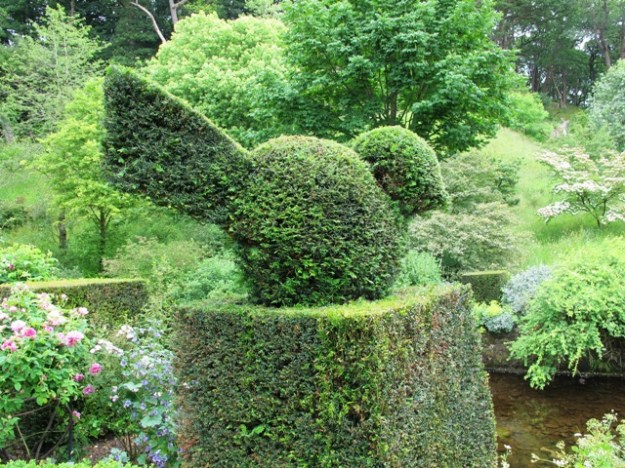
While the topiary bird At Gresgarth may be beyond the amateur, the sharp lines give contrast to the informal plantings and design.

While the topiary bird at Gresgarth may be beyond the amateur, the sharp lines give contrast to the informal plantings and design.

As you progress up the status ladder, a clipped shrub can become a deliberate focus to act as counterpoint to more informal plantings. It is then filling the role that others may choose to try and fill with manmade objects – a bird bath, a seat, maybe a sculpture – but there is a logical orderliness to a well tended shrub that those other objects may lack.
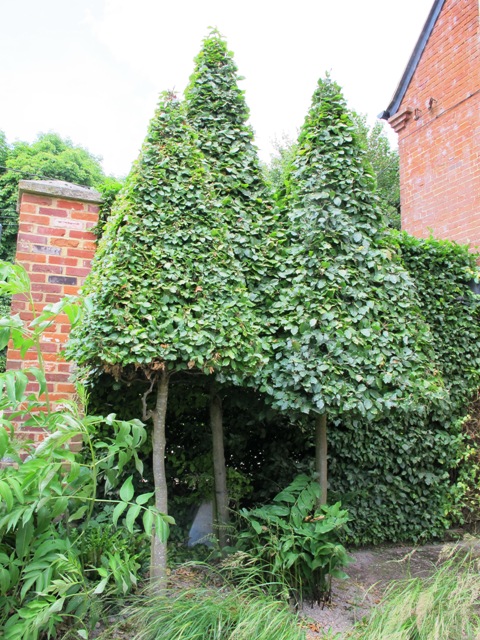
Pyramids on stilts give an accent point, a breathing space between two very different gardens at Bury Court.

Pyramids on stilts give an accent point, a breathing space between two very different gardens at Bury Court.


I have also seen small groupings of clipped shrubs used as a breathing space, a quiet linking device between two very busy but different areas of a garden.
Various shrubs can be clipped effectively. There are the tried and true hedging plants of buxus, lonicera and teucrium. Yew is a classic clipping candidate.
Often referred to as “pudding trees”, these Chamaecyparis give structure in the otherwise informal cottage garden made by Margery Fish at East Lambrook Manor

Often referred to as “pudding trees”, these Chamaecyparis give structure in the otherwise informal cottage garden made by Margery Fish at East Lambrook Manor


Camellias clip well. If you can cope with the prickles, so do hollies. Choysia ternata takes clipping. Evergreen azaleas take clipping and shaping well. So indeed do our native totara and matai. Some conifers can be clipped, some cannot. The mark of one that does not take clipping is a failure to sprout afresh from bare wood (in other words, where you have cut below the external leaf cover). It can be terribly blotchy and twiggy on conifers, if not terminal. Do some research first before you try this on your prized specimen.

The more you clip, the denser the new growth becomes so the tighter shape you get as a result. But if you are considering a first hard clip to establish a shape, do it right now. This very weekend is good. That is because at the end of the day, most plants are on the cusp of breaking into fresh spring growth (spot my political allusion). The aim is to clip before that happens, stimulating the plant to make fresh new growths at the point where you have cut it back. You will generally have to follow up with a tidy-up trim of long new growths a bit further down the season, but the first clip is the most radical shaping. Once established, you can often get away with just once a year.

Or clip on special occasions when you want your garden to look sharp, cared for or creative.

First published in the Waikato Times and reprinted here with their permission.

Plant Collector: Romneya coulteri

Romneya coulteri - the Californian tree poppy

Romneya coulteri – the Californian tree poppy

I wish I could tell you I photographed this splendid Californian poppy in our garden here. We tried, we tried hard to get it established here but failed. That is because it grows in Californian desert and coastal conditions and we can not emulate those in lush dairy farm country. It is the dry open situation that is most important, summer heat less so. Good drainage and light soils are key. Readers in coastal areas might find it viable but be warned that it needs space. It is a giant poppy and the plant will reach around that 2m mark in height and a good 1.5m in width. It grows from seed but the plant develops rhizomes and will be perennial in the right conditions, spreading ever wider.

Look at that flower. It is just a typical poppy with six petals and golden stamens, but looking like tissue paper or crinkle fabric, each flower about 10cm across. It is the sort of plant that will stop you in your tracks. You will sometimes find it offered for sale in this country but probably only from specialist nurseries.

The coulteri in the name is a tribute to an Irishman, not a Californian celebrity. Thomas Coulter was a botanist and explorer who served as a physician to the armed forces around the Californian and Mexican area in the early 1800s. Apparently he botanised in his time off which seems a constructive activity.

First published in the Waikato Times and reprinted here with their permission.
Plant Collector: Fuchsia boliviana

Rewarding but a weed here - Fuchsia boliviana

Rewarding but a weed here – Fuchsia boliviana

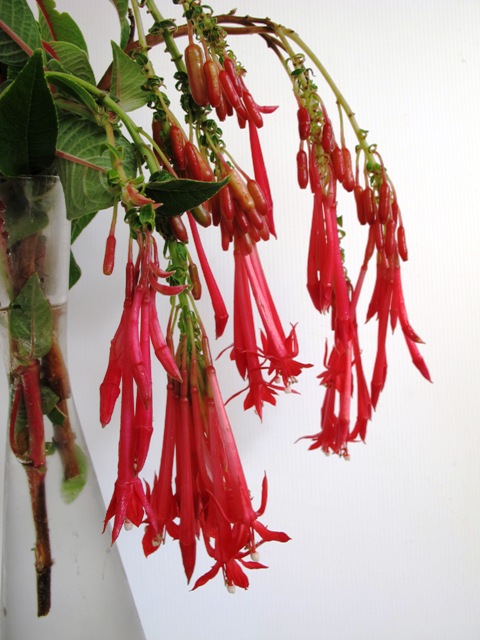
“You can’t write that up,” Mark protested when he saw me photographing this plant. “It’s a weed.” This may be the first Plant Uncollector. We have had the plant for several years but it has never made it out of the nursery, being left to its own devices in the somewhat wild area of plants waiting to be put in the garden but not urgent. There it has seeded down freely and it won’t be going out to the garden because we can see it has serious weed potential. This is a shame because it flowers pretty much all the time and the hanging clusters are showy, while the foliage is velvety to touch. Our neglected parent plant is about 3m high and a somewhat rangy shrub but it can get bigger.

This is a variable species. There are red and pink, even and pure white forms. It is South American – not just Bolivia but also southern Peru and northern Argentina so presumably parts of Chile too. It is highly prized internationally but it will be somewhat frost tender which may curb its escaping tendencies in colder climates. We have enough imported weeds in this country. Just because it is attractive and has rewarding blooming habits is not a good enough reason to knowingly unleash another weed. This plant, along with its multitude of seedlings, is destined for the mulcher and compost. The seeds are spread by birds and because the plant can establish in heavy shade, it has a wide habitat. It is on the National Pest Plant Accord so can’t be sold legally but we arrived at the conclusion of its weed pest potential all of our own accord. If there is ever a sterile version of this plant released, we would welcome it but until then, no.

First published in the Waikato Times and reprinted here with their permission.

Plant Collector: Rhododendron augustinii

Rhododendron augustinii

Rhododendron augustinii

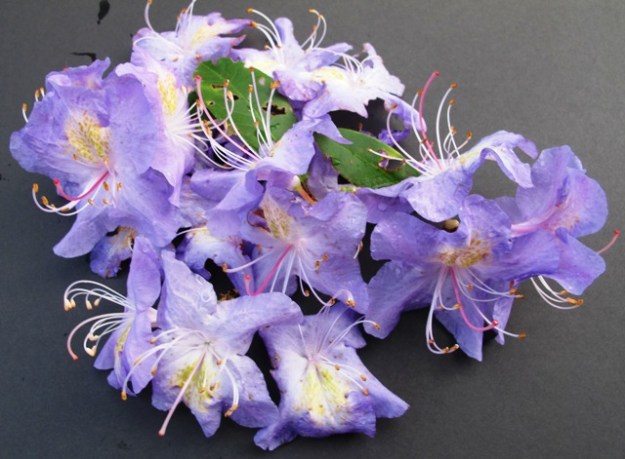
I had to pick the flowers to photograph because I was too embarrassed to show the very poor foliage in its garden setting. R. augustinii is a lovely lilac, as close to blue as rhododendrons get. I think it is delightful in bloom, which is why we continue to give it garden space even though the plant itself leaves a lot to be desired in our conditions. We used to produce two different clones commercially for rhododendron collectors because it is highly prized. I planted several out at the time but I think this is the last one. It is much assailed by the bronze beetles which are attempting to eat it to death. Every leaf – and there aren’t that many of them – is badly notched. The beetle is worse in the shade but if we had this plant in full sun, it would likely up and die on us even faster.

It originates from the Chinese areas of Szechuan and Yunnan, along with southern Tibet where the climate will be both drier and colder in winter than here. It was named for Augustine Henry (1857-1930) who was a medical officer in Chinese Customs but presumably keen on plants because he moved on to be Professor in Forestry in Dublin. The flowering is unusually early this year. It normally blooms in early October but sometimes plants can get a little out of sync with the seasons.

First published in the Waikato Times and reprinted here with their permission.