Tag Archives: gardening

Ideas to Import

Simple ideas from English gardens. First printed in the Weekend Gardener, issue 321 August 25 to September 7 and reprinted here with their permission.
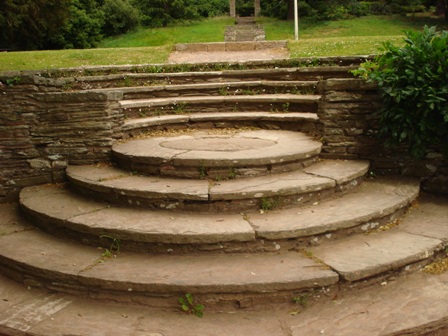
Lutyens steps at Hestercomb
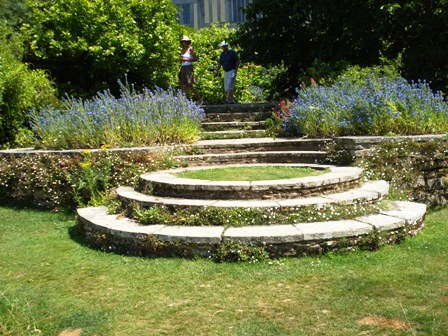
Lutyens steps at Hestercomb

Lutyens steps at Great Dixter

Lutyens steps at Great Dixter

Nobody does statement garden steps quite like the great English architect Edwin Lutyens did. Outward facing semi circles lead you into the steps from both sides with the transition of a full circle in the centre. These examples are from Hestercomb and Great Dixter.

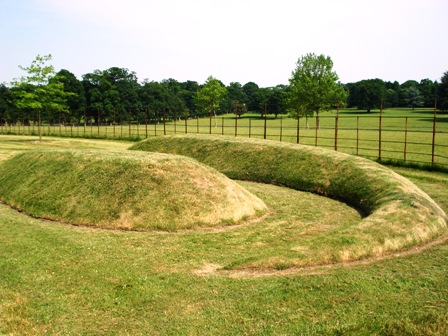
Discreet and informal seating for up to seven people in the outer reaches of the garden at Helmingham Hall. The tree trunk sections are set at the same height and backed by an informal brush barrier which frames the seating area. The view from the seating area is across a recent freeform earth feature towards the Tudor deer park.
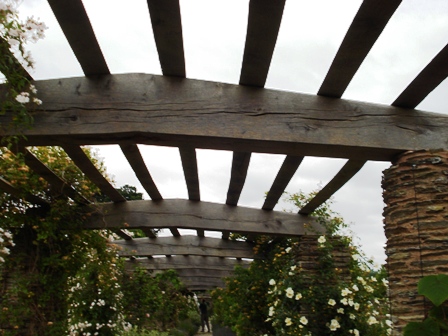
The simple device of subtly shaping the cross beams of this pergola at Hestercomb gives a lighter, more graceful effect as well as guiding the eye down the long view.
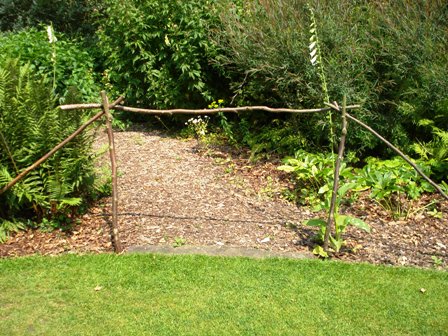
It is clear that this path is closed in Beth Chatto’s garden and the use of fresh saplings (probably hazel) forms a discreet visual barrier. Traditionally, English gardeners have used stakes and supports in their natural form, harvested from their own property, rather than the common use of imported bamboo, tantalised timber or metal stakes used in New Zealand.
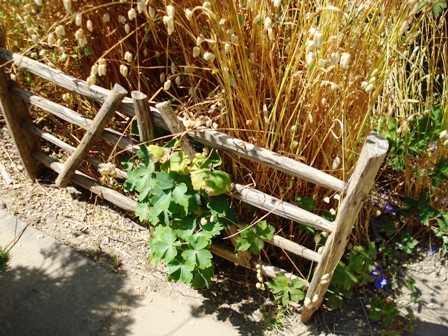
A rustic, low wooden fence built like a gate is an attractive, permanent means of holding back the floppy growth from falling over the narrow paths at Great Dixter.
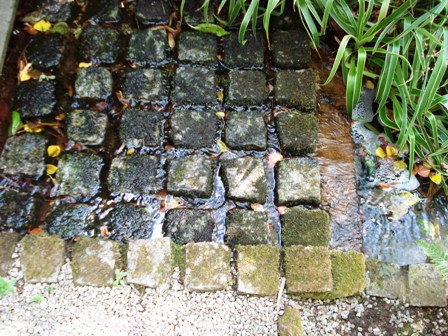
Using small, square cobbles makes the most of what is otherwise a rather insignificant small stream at Lamorran Garden in Cornwall.
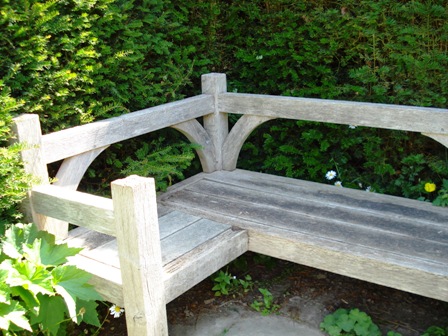
Adding a return to this seat at Great Dixter makes it a generous and attractive feature rather than just another wooden garden seat. It does not, however, increase the seating capacity.

Tikorangi Diary: Thursday August 25, 2011

If you are in New Zealand and have Sky, don’t miss Alan’s Garden Secrets on the Living Channel at 4.30pm on Sundays (rescreened at 8am on Monday). It is the inimitable Alan Titchmarsh, a doyen of British gardening. Last Sunday he was tracing the history of seventeenth century English gardening – Tudor England. Buxus hedging, knot gardens, parterres and all that. It was absolutely fascinating, at least the first half was. It fell away a bit in the last section. But it gave much food for thought and has stimulated quite a bit of conversation here since. I am wondering whether the Waikato readers will be ready for some thoughts on how we have taken buxus hedging and suburbanised it. The new look garden pages get launched at the start of September and I will be back into regular, weekly contributions.

We have a profound respect for Alan Titchmarsh who has a wealth of experience. Coming up this Sunday is his interpretation of eighteenth century gardening and we will be watching it avidly. But it should come with a warning. Titchmarsh’s style is very much of the people – he is an unpretentious Yorkshireman. Unfortunately, in this series, that translates into little DIY segments. The thyme knot garden was bad enough, but the trompe l’oeil installation plumbed hitherto unsuspected depths of naffdom. Mark and I looked at each other in utter disbelief and laughed. What else could we do? Goodness knows whose idea it was to intersperse an otherwise excellent programme with demonstrations which would be more fitting to our local Fringe Garden Festival. When the credits rolled at the end, we realised that these demonstrations were taking place in the Old Vicarage Garden in Norfolk, which we have visited. We are now wondering if they left Alan’s trompe l’oeil in place after filming….

It was this TV show which spawned three tweets. If you don’t follow Twitter, the format may confuse you (the essence of Twitter is brevity). If you do follow Twitter, I tweetie under the name of Tikorangi.

#Gardenornamentation 1: If you can’t afford the real thing, you are better off with nothing (repro classical best avoided).
#Gardenornamentation 2: Anything armless or white – best shunned I think.
#Gardenornamentation 3: Hot trend prediction: obelisks. You too can make your garden look like everybody else’s. Just need a focal obelisk.

On the gardening front, a week of fine weather is helping the magnolias but we are still nowhere near peak display yet. The snow and frost hit the early varieties badly but the mid season varieties are untouched. We are open as usual for plant sales on Fridays and Saturdays, though we are around most times on other days. The garden is now open for the season but wait another week or two if you want to see a spectacular magnolia display. However, the daffodils, Hippeastrum aulicum, reticulata camellias, Prunus campanulata (complete with masses of tui) and early azaleas are all looking lovely.

Dividing calanthe orchids

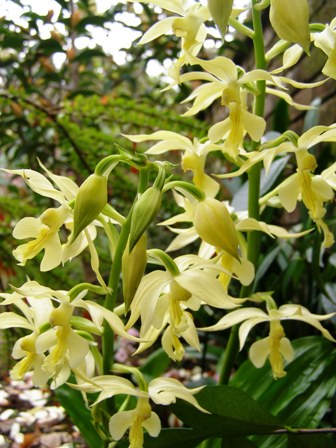
1) We are besotted with calanthes which are an obliging ground orchid suitable for humus rich woodland areas which do not get too frosty or cold. Mark is out digging and dividing them right now, though he feels he should have been onto it in June or July. He is having to take great care not to break off the flower spikes which are showing now.

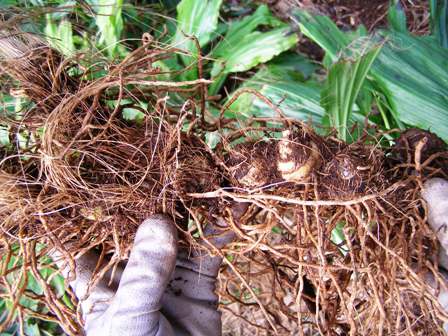
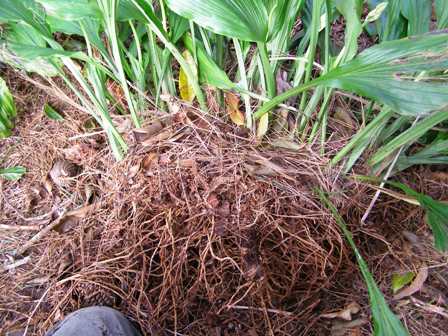
2) When the clumps are teased apart, it becomes clear that each section of foliage has a chain of rhizomes attached.

3) Break the rhizomes apart with care. Each will form a new plant. Discard any soft or mushy rhizomes. While these orchids will make a full set of new roots each year, leaving the old ones on at this time gives something to anchor the nubbly rhizome into place when you replant it.

4) The top rhizome of the chain will have the foliage attached. Leave this intact and attached to the first rhizome. Replant in well cultivated soil with plenty of compost or humus added. As the rhizomes tend to run along very close to, or on the surface, they only need to be lightly covered but they need well tilled soil below to get their roots down. The division with foliage will still flower this year. The dormant rhizomes should come into growth soon and some may flower next year, the remainder the year after.

A short lesson in hooping, no less

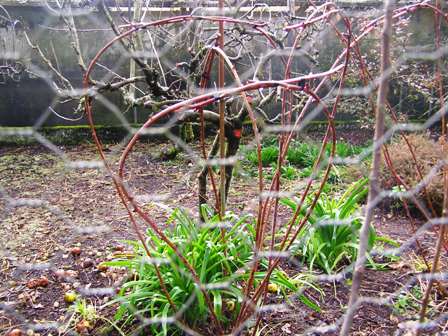
Hooping the long whips on the apple trees

Hooping the long whips on the apple trees

Many woody plants concentrate their hormones at the tips of branches. If you bend the branch closer to the horizontal, then the hormones which lead to flowering are more evenly dispersed along the length which encourages the growth buds lower down to flower and grow.

Our Friend of the Garden, Colin, braved the snow and frost this week to come and stay and he has pruned the apple trees. He has hooped over some of the long whips to encourage the plant to push out growth buds along the length, which should result in the production of stronger fruiting spurs to replace old, spent spurs.

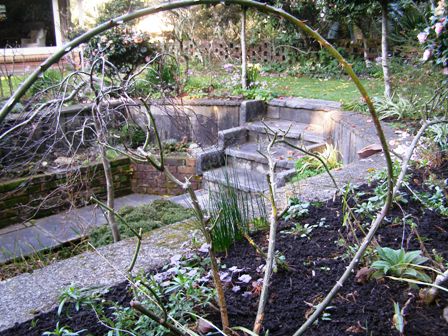
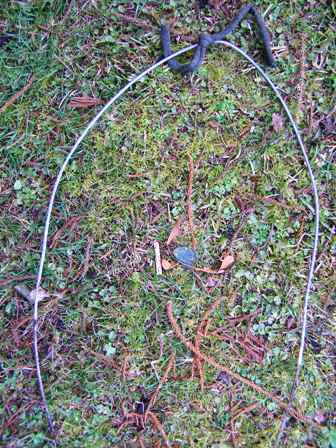
Hooping roses which put out long growths increases the flowering markedly. It is a technique I first saw done at Ayrlies Garden (back in the days when Neil Ross was head gardener there). It takes up a lot of space but is worth the effort. I tie the long whips down to wire hoops in the garden. Many of the David Austin roses put out long whips which are ideal for hooping.

Hooping the roses to maximise flowering this season

Hooping the roses to maximise flowering this season


Using a simple wire hoop to tie down the long rose whips

Using a simple wire hoop to tie down the long rose whips

It is of course the same principle as using espalier techniques to increase cropping. Espalier is not just a space saving exercise in keeping plants as close to flat as possible. It can also maximise fruit yields in a restricted space. You need to make sure that ties are flexible so they don’t cut in and damage the branches – stockinette or similar. The apple hoops were secured with a tapener or tying machine which staples a small piece of flexible plastic tape in place.

Postscript: A man on a mission, Colin is now hooping the raspberries. This is a particularly strong growing variety and this hooping is in part to keep the growth under control and to prevent them making an escape out the top of the raspberry cage. It should also make picking easier.

Any woody plants which make long, whippy growths can be hooped to maximise flowering and fruiting. Colin, a retired horticulturist of vast experience, assures me that when it comes to fruiting plants, the redistribution of the plant’s hormones achieved through hooping encourages leaf buds to form flower buds as well which increases potential fruit yield.

A man on a mission, Colin is now hooping the raspberries

A man on a mission, Colin is now hooping the raspberries

Late winter equals magnolias here

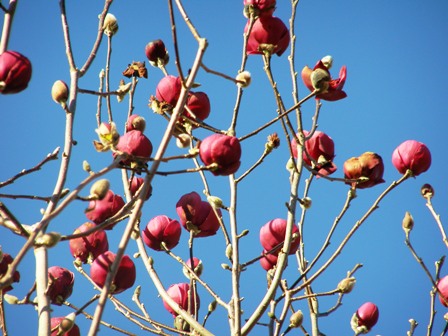
Magnolia Black Tulip is opening its flowers here now

Magnolia Black Tulip is opening its flowers here now

We were greatly amused to discover that Mark’s Magnolia Black Tulip was presented to the Queen last year. Yes, as in Queen Elizabeth of England. Apparently she likes magnolias. Sadly, we were not invited to the ceremony. It is coming into flower here now and you too can buy a magnolia fit for a queen. What is more, you get to meet Mark or me in person at the same time. Our trees on a sunny slope are coming into flower now, though it is still early in the magnolia season for us and peak display won’t be for another fortnight or so. Many of magnolia plants have flower buds so you can get the benefit of flowers immediately – the days when you had to wait a decade are long gone. Black Tulip is a splendid option for a feature tree to be viewed close up, so is ideal for smaller gardens. Because the flowers are so dark, it can meld in the bigger landscape where some of the larger, bolder flowered types will have more impact, but its perfect form certainly seems to appeal to people when they view it close up.

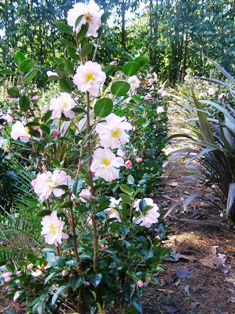
Camellia Apple Blossom Sun - one of the field grown hedging options we have available here at the moment

Camellia Apple Blossom Sun - one of the field grown hedging options we have available here at the moment

If you are after hedging, we have various options in camellias from small plants for small, low hedges to small plants for people with small budgets and patience, to instant hedges for those with larger budgets (they will still be cheaper than building a fence!). We have crops in the field (in other words we will dig to order) which are around five to six years old and ready for instant impact. Options include Mimosa Jury, Dreamboat, Apple Blossom Sun, Moon Moth, Roma Red and transnokoensis. These field grown plants are not listed under plant sales on the website – you will need to talk to us about them.

We are open for plant sales every Friday and Saturday (other days by appointment) and we have Eftpos here but we only sell to personal customers. Sorry, no mailorder. If you want to check what else we have available, check our Plant Sales