Tag Archives: gardening

Garden Diary – the first entry May 28, 2010

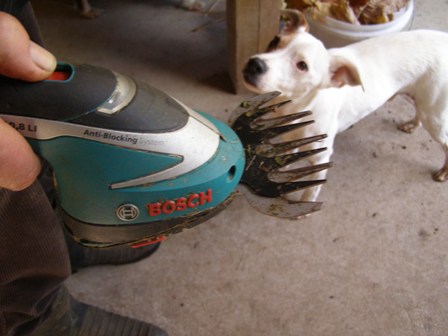
Mark covets the neighbour's wife's toy - her Bosch trimmer

Mark covets the neighbour's wife's toy - her Bosch trimmer

Ha! I knew I loved writing, but I didn’t realise quite how much until I stopped the weekly routine. So herewith the first of a new series. Instead of casting around each week to dispense advice on what readers should be doing in their garden, I thought instead I would record what we have actually done.

Mark has been playing with a new toy which belongs to Lloyd’s wife (Lloyd being our neighbour, friend and one remaining staff member). I don’t think his wife knows they are over here but despite initial scepticism, these battery powered clippers by Bosch have proven to be so useful that I can see Mark needs a set for his birthday. He has spent hours cutting back the long grass from the bulbs he has naturalised in the park (dwarf cyclamen, dwarf narcissi, snowdrops – galanthus – lachenalias and more). The clippers are much faster to use than snips and have saved a major flare-up of his RSI. He is besotted with them and loves to demonstrate how easily they cut back spent perennials and seed heads as well. To me, they resemble hairdresser’s clippers. Not that I have anything against hairdressers.

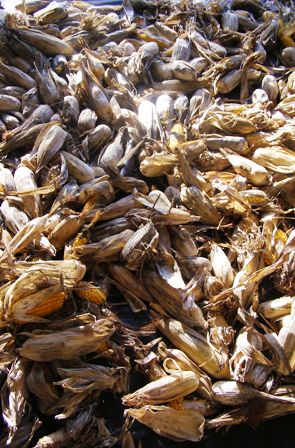
Drying the maize crop for the pigeons

Drying the maize crop for the pigeons

In the edible garden, which is entirely Mark’s domain here, he has been continuing his nightly rat and mouse bait round to combat the growing population. He gathered the maize which he grows to feed his pigeons (I call him the Jack Duckworth of Tikorangi) and has it spread out to dry. He continues to eat fresh sweet corn every day for lunch. The walnut harvest is being dried, the last of the tree-ripened apples were gathered this week but there is a major failure in the vegetable garden. He did not follow the advice we dispensed weekly a couple of months ago and there is a dearth of green vegetables. I have had to buy some – the first vegetables we have bought for close to a year.

Lloyd has spent much of the week weed-eating areas which we can not mow. If he times this autumn round well, grass growth slows so much that it does not need to be done again until we open the garden at magnolia time. An amazingly mild autumn may upset this routine. Grass growth continues unabated.

Our most reliable Friend of the Garden, Colin, has been up for the week. He likes to escape his retirement village (widely known in this country as a Home for the Bewildered) and spend an intensive four days in the garden at least once every six weeks. As a retired horticulturist, he is one of the few people we trust with areas full of treasures so he has done a major clean up of Mark’s cold border in the park – just in time as the trilliums are pushing through.

I am continuing my major revamp of the Avenue Gardens – this week a badly overgrown area of choking and choked perennials which has involved some pretty heavy digging. I have taken out the lot, divided them and discarded large quantities which are surplus to requirements before replanting in freshly dug ground. I have also been dividing and potting Soloman Seal (polygonatum multiflorum) to sell during our annual garden festival at the end of October and digging and dividing some large clumps of a particularly good variegated form of Crinum moorei. We know only too well that one of the drawcards here is our ability to offer plants for sale that can’t be found elsewhere.

For any local readers who noticed the article that replaced me in the Taranaki Daily News on Friday:
1) The unnamed vireya photographed was Golden Charm (one of ours, bred by Felix Jury).
2) The advice given to cut your luculia back to half a metre high after flowering only applies to Luculia gratissima (Early Dawn is the common sugar pink one in flower now). If you do that to Luculia pinceana types (Fragrant Cloud is the spectacular, heavily scented almond pink one most commonly available), you will kill them. We prefer to let Early Dawn grow. It forms a graceful under-storey large shrub.

Tikorangi Notes: Friday 27 May, 2011

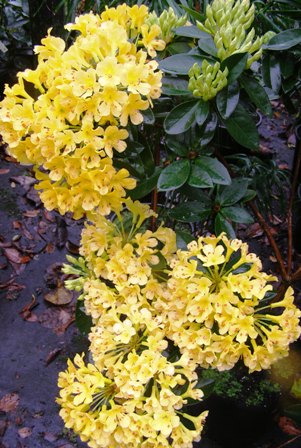
Vireya rhododendron Buttermaid, flowering with great enthusiasm

Vireya rhododendron Buttermaid, flowering with great enthusiasm

Tikorangi Notes: Friday, 27 May, 2011

As autumn closes into winter here, the days are shorter and we are getting plenty of rain but it is hardly cold yet – daytime temperatures are still in the late teens. The beauty of vireya rhododendrons is their ability to flower randomly throughout the year, even at times when there is not a great deal else in bloom. Buttermaid is one of Felix Jury’s early hybrids (aurigeranum x macgregoriae). In a world of big, fragrant, luscious blooms and heavy felted foliage, Buttermaid is destined forever to be the bridesmaid at best. However those showy big-bloomed types rarely, if ever, put on a mass display like the unpretentious Buttermaid. After decades of growing and experimenting with vireyas, we are increasingly of the view that healthy characteristics and flower power matter more than fragrance and individual flower size.

Says it all, really, though the joke of the setting will only be understood by New Zealanders

Says it all, really, though the joke of the setting will only be understood by New Zealanders

Latest Posts:

1) The end of an era.
2) Hollywood, Wellywood, Tikowood – a visual joke that will bypass those not in New Zealand this week.

The Sequel – a second coming for the Tui NZ Fruit Garden

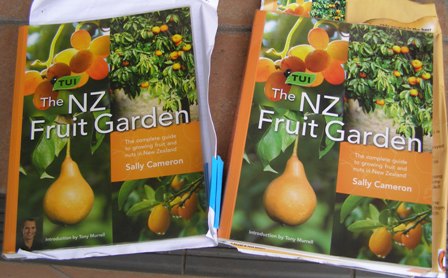
The first version to the left, the revised edition to the right.

The first version to the left, the revised edition to the right.

After due consideration, Mark's verdict was an emphatic thumbs down

After due consideration, Mark's verdict was an emphatic thumbs down

I am married to a patient and kind man but he has been looking ever more exasperated over the last two weeks. I put The Tui NZ Fruit Garden in front of him for comment because his experience with growing fruit and nuts is greater. As he dipped in and out of various chapters, he was finally moved to exclaim that he could not fathom why Tui, Tony Murrell and Rachel Vogan would put their names to this book and give it a credibility that it does not deserve.

If this seems slightly familiar to you, dear Reader, that is not a surprise. This book is the sequel – the revised edition, it tells us on the frontispiece (but not the cover). The first version was the subject of a piece I wrote this time last year, backed up by a lead story on the front page of our newspaper and picked up extensively by national media. There was a little problem with plagiarism by the author, Sally Cameron. Well, quite a big problem really – in fact an enormous one. The publishers, Penguin, pulled the book from sale immediately, mere days after it had been released. Nobody associated with the book ever commented on that withdrawal from sale so the general assumption was it had all died a natural death. No. Little did we know, they were preparing for a second coming. And here it is. It looks the same. The author is the same. The cover has been recycled. So is it the same?

I think the plagiarised sections have gone. I didn’t do an exhaustive analysis but I would guess that they have been quite thorough, given there are legal issues to be considered. But the plagiarism was only half the problem. In reviewing the original version, I was equally critical of the woeful lack of experience and knowledge by the author. And the rewrite has highlighted this even more. At least when the author was cutting and pasting information from the internet, she was generally getting it from credible sources even if they were from overseas. Now that it is in her own words, it often plumbs new depths. “A Chilean guava, pomegranate or feijoa bush can offer hedging that is just as effective as a Buxus.” Really? Shame the pomegranate is deciduous and if you clip your feijoa like you clip your buxus, you will be taking off all next year’s fruiting tips. Or, when writing about grapevines needing support: “This can be shaped or manipulated at leisure to provide a sculptured habitat for the vines to drape from.”

Even worse is the advice on protecting your grapes: “Broad pieces of netting with holes wide enough to let the sun in but keeping, bugs, diseases and birds out help let the fruit ripen nicely on the vine.” Leaving aside the description of broad pieces, since when has any netting kept out diseases and what fine grade of mesh would you need to keep out bugs? Wasps don’t even rate a mention but they are one of the biggest problems, in our experience. The sort of information that the reader needed and deserved to be told is that Albany Surprise is an excellent selection for marginal and humid conditions. Because it has a tougher skin, if you can net the birds out then the wasps can’t pierce the skin and get in to the fruit.

At least lychees, mangoes and pineapples have been consigned to a brief two page spread at the end of the book, under the title of “Fruit not commonly grown in New Zealand owing to climatic restrictions” but it is hard to understand why carambola or star fruit, which is equally marginal, remains with a four page spread of its own in the main body of the text. Maybe the author wanted to show off her recipe for pickled carambola? Proper cranberries (Vaccinium macrocarpum) should have been grouped with the lychees and mangoes too. Equally hard to understand is why tomatoes are included in a book about fruit gardens. Yes, botanically they are a fruit but every home gardener and cook regards them as a vegetable and they are grown in the veg garden, not the orchard. Doing a cut and paste of the tomato chapter from the companion volume, the Tui NZ Vegetable Garden, could be described as having a bob each way but it is unnecessary padding in a book about growing fruit. Some of the other inclusions are odd – the medlar, introduced to this country by the early settlers, is a fairly decorative tree but not worth the space in the orchard as a fruiting tree. Given that you have to wait until the small fruit are nearly rotten before you eat them, why would you bother when we can grow apples and pears so well? Peanuts are a novelty crop grown in the vegetable garden and limited to the hottest and driest parts of the country. But don’t expect too much of that sort of information in this book. In most cases, the author lacks the experience to know what is important and to sift the information accordingly.

Take kiwifruit as an example. For starters, where can you grow them? According to this book, “The kiwifruit is an appropriate crop wherever citrus fruits, peaches and almonds are successful, though the leaves and flowers are more sensitive to cold than those of orange and peach trees.” Right. So this means kiwifruit need more warmth than citrus? But refer to the entry on almonds and it says: “Almonds happily grow in areas with warm summers and cool winters.” So I guess we are talking Hawkes Bay, Marlborough and Central Otago? Refer to peaches and it says: “… a long chilling time ensures a good fruiting crop in summer.” Even we became confused about where you can grow kiwifruit successfully but at least we know that it is a warm temperate to subtropical crop.

If you are a novice and you can deduce whether your area is suitable for growing kiwifruit, what you need to know is that it is a rampant vine and if you don’t prune it thoroughly every year, it will swamp your section and choke out everything else very quickly. The book does at least tell you that kiwifruit are not self fertile so you need both male and female though it fails to mention that only the female vine produces any fruit. I will quote the section on pruning verbatim, so readers can assess for themselves whether they would understand how to prune kiwifruit from this information (including the fact that male kiwifruit vines are pruned differently to female ones). “Pruning: After fruiting has finished, the vines should be pruned in late winter, before the spring warmth. Shoots from summer pruning will not be laden with fruit until the following year after dormancy. Male plants will yield more pollen in the spring if new shoots are pinched out to leave five to seven buds during the summer. Winter pruning renews the fruiting arms, enabling plants to fruit well each year.” Got that, have you? Now you know how to prune your kiwifruit?

Another burning question about kiwifruit which most people want to know is where to buy the new yellow cultivars. The fruit is illustrated but it doesn’t tell you that you can’t buy plants. Hort Research and Zespri, who own all the research on new cultivars, keep very tight control of plants and they are not available to the home gardener. But the book does recommend Cocktail Kiwi, an unproven novelty variety – a rampant grower which is distinctly shy on setting fruit and when it does come it is about half the size of your thumb.

Ever so modest but well thumbed. I can not think that the Tui NZ Fruit Garden will still be around in 40 years time.

Ever so modest but well thumbed. I can not think that the Tui NZ Fruit Garden will still be around in 40 years time.

Kiwifruit is just one example. The book is full of chapters which are similarly inadequate. But according to Penguin, “this book contains all the essential information you need” and “it will become the reference for gardeners of all skill levels….” We wish that were true. Had this been the first release of the Tui NZ Fruit Garden, Sally Cameron and Penguin Publishers might just have got away with it, marginal though it is. To have a second shot at the same book using the same author, it needed to be very good indeed. It isn’t. We will be keeping to our old tried and true modest volume called The Home Orchard, published by the NZ Department of Agriculture in 1973. It is not glossy or trendy but at least it is by people who knew what they were writing about and it only cost us $2.25 to buy at the time.

The Tui NZ Fruit Garden, by Sally Cameron with Rachel Vogan. (Penguin; ISBN: 978 0 14 356536 9).

For the earlier story on mark one of this book, click on The Tui NZ Fruit Garden – dear oh dear.

Plant Collector: Podocarpus henkelii

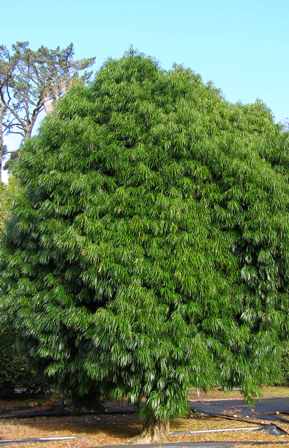
Podocarpus henkelii looks handsome all 12 months of the year

Podocarpus henkelii looks handsome all 12 months of the year

One of my favourite trees here is this African podocarpus. It must be fifty years old by now and stands some 8 metres high. About 25 years ago, we built part of our nursery around it but we made sure it remained unaffected. Now, as we turn that nursery area into garden, we are really pleased that we kept it as a feature tree for our planned Palm Walk. You can’t hurry up maturity on slow growing trees. Not that it has any connection to palms but it fits right in to that slightly exotic theme.

Henkelii comes from the Eastern Cape and Kwazulu-Natal area of South Africa. In the wild, it now has protected status but it is common as a garden plant in its homeland because it is an elegant, slow growing evergreen tree. It is commonly referred to as the Yellowwood because its timber is apparently yellow and excellent for making furniture. This may account for it needing to be protected. The narrow leaves measure over 20cm long and hang in a sickle shape. We know ours is a female because it produces plenty of seed which looks like green olives but as henkelii is dioecious, it needs both male and female plants to get fertile seed. In other words, the seed from our tree is sterile because it is a solitary specimen.

The podocarps are a big family and widespread, though mostly from milder areas south of the equator. Our native totara is a member.

In the Garden this Week: May 20, 2011

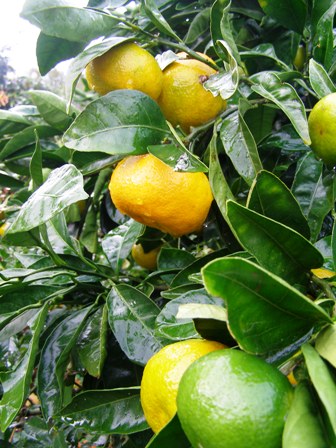
Arguably the most critical copper spray of the year on citrus now

Arguably the most critical copper spray of the year on citrus now

• Get a copper spray on to citrus trees as soon as dry weather returns. This is a particularly important spray to stop fruit rotting on the trees before it even ripens and to stop leaf drop. Mandarins are particularly susceptible.

• Sow broad beans and you can continue planting the reliable brassicas (except Brussels sprouts – it is far too late for them. Your Brussels should already be half a metre high by now if you are to get a crop in late winter).

• We are dubious of the practice of fertilising and routinely spraying your lawns because it is just all round bad environmental practice but if you insist on continuing to use hormone sprays, getting them on now rather than waiting for spring may contain some of the damage to neighbouring plants. Plants coming into fresh leaf in spring are extremely susceptible to the faintest hint of spray drift. Hormone sprays are used to take out undesirable lawn weeds. Hand weeding is kinder to the environment if you don’t want a bio-diverse lawn.

• Get the last of your autumn harvest in before you lose the lot. Any potatoes still in the ground will be getting eaten. We have finished the tomatoes here but the capsicums and peppers will hold longer in the shed whereas they rot in the garden. Gather nuts and dry them rather than leaving them to feed the local rodents.

• Polyanthus can be lifted and thinned. Replant the strong crowns to get a better display shortly.

• Keep an eye on leaf litter landing in fish ponds and water features. If you let it rot down in the water, it increases the nutrient levels leading to later problems with algae growth and it can even kill the fish by reducing oxygen levels. A kitchen sieve or butterfly net is a useful scoop for this task.

• Lily bulbs are now in stock at garden centres. These are best bought fresh so if you want to grow these wonderful summer bulbs, get in early. Pot them if you are not ready to put them straight into the garden because they don’t store well.